
Apple tree Modi: characteristics of the variety and care
| Color | Reds |
|---|---|
| Ripening season | Winter |
| Size of apples | Large |
| Taste | Sweet and sour |
| Crown type | Average tree height |
| Shelf life | High shelf life |
| Application | Universal variety |
| Winter hardiness | Average winter hardiness |
| Fruiting age | Up to 5 years |
 History of origin and regions of growth
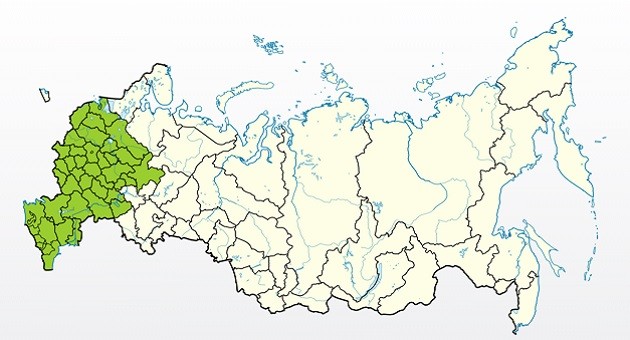
Growing regions
- Middle zone.
- North Caucasus.
- Crimea.
- Some northern regions.
Origin
This relatively new apple variety was developed not by domestic breeders, but by Italian breeders belonging to the Consorzio Italiano Vivasiti (CIV). After conducting market research, they discovered that the most popular apples were red, juicy, moderately sweet, and with a good shelf life. Transportability was also important to the grower, as was the overall sustainability of the fruit and the growing process. In 1982, the variety was developed, named MODI (CIVG198), whose parents were Liberty and Gala.
The name "Modi" was chosen deliberately. It was dedicated to the famous Italian artist Amedeo Modigliani. He was known by his family and friends, and in his paintings he often used a rich and beautiful red-scarlet hue, almost exactly the same as the predominant color of the skin of this apple tree's fruit..
The tree's journey to our country was long and difficult. It was first noticed by European farmers, then included in various fruit exhibitions. In 2014, it was introduced to the United States, after which it quickly spread throughout the world, including Russia. It has not yet been included in the State Register of Fruits in our country, and it has no official zoning, but it is often grown in our gardens and performs very well.
Description of the Modi apple variety
 Apple trees of this variety are quickly gaining popularity due to their unique qualities, attractive appearance, and excellent transportability. Because of this last point, they can be shipped anywhere in the world without fear of crop loss, which is especially valuable in the market.
The apple trees themselves are winter-hardy, regularly produce high yields, and, most importantly, have strong immunity to fungal apple infections. Given the overall compactness of the crown and, consequently, high yields per hectare, this variety is recommended for intensive commercial orchards, but it will also be a great addition to your backyard.
Apples: What they look like
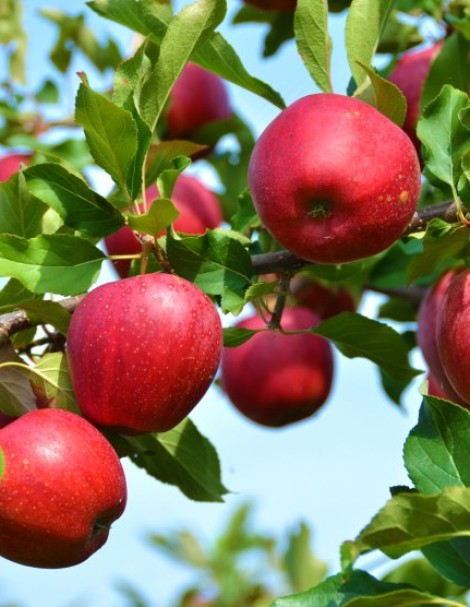
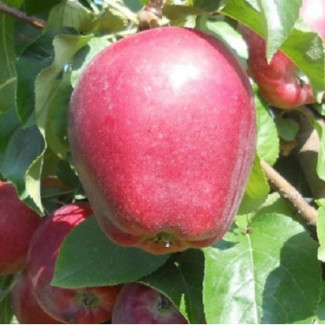
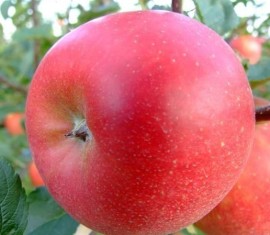
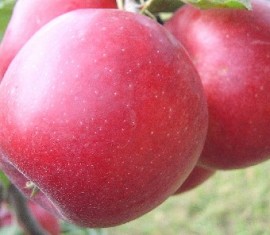
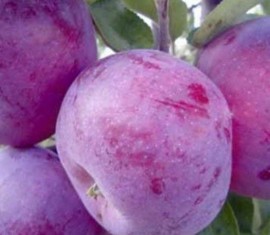
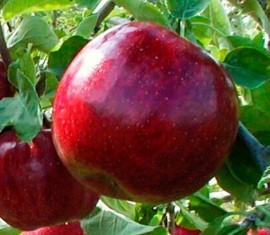
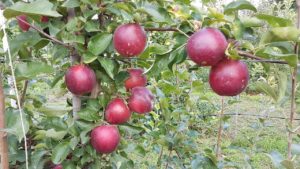 The fruits of this variety are large, or even larger than large. Their average weight ranges from 220-250 grams, but they can reach a maximum of 280-300 grams. Their shape is generally regular, round or round-conical, symmetrical, and the ribbing is subtle but sometimes noticeable. The crater is medium-sized and may be slightly rusty.
The skin is smooth, shiny, glossy, and dense, but not thick; a slight oily coating may sometimes be noticeable on the surface. Its base color is green, turning yellow as it ripens, though this is barely visible beneath the blush. This blush is very dense, uniform, and richly red or bright red, occupying more than 95-98% of the fruit's surface at the ripening stage. Subcutaneous spots are light, gray-green, small, and numerous, clearly visible against the blush. The chemical composition is most easily assessed by the following indicators:
- P-active substances (catechins) – 320 milligrams.
- Ascorbic acid (vitamin C) – 14.3 milligrams.
- Total sugars (fructose) – 12.1%.
- Pectins (fiber) – 9.6%.
- Titratable acids – 0.47%.
The flesh is dense, fine-grained, crisp, slightly prickly, yet tender, pleasantly textured, and extremely juicy. It has a strong, distinctive aroma, and the flavor is considered dessert-like, harmonious, balanced, and sweet-and-sour, leaning more toward sweetness with a hint of tartness in the aftertaste. Professional tasters give these apples 4.8 out of 5 possible points for taste and appearance.
Apple tree Modi: characteristics
Crown and root system
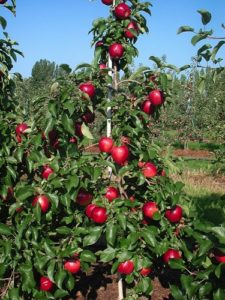 The tree is considered to be of medium height. It can grow to a maximum height of about 3.5-4 meters., but owners typically limit it to 2.5-3 meters for ease of harvesting and maintenance. It would be logical to call Modi a natural semi-dwarf. The crown has a distinct pyramidal or conical shape, which makes shaping much easier, and over the years it can become broadly oval. The stems are strong, medium-thick, and long, with fruiting concentrated on the rings.
The leaves are large, dense, slightly elongated, glossy, shiny, and delicately ribbed. They are short-pointed, finely serrated, and the margins can fold into a boat shape. They are a rich green, sometimes dark green or emerald, and have slight pubescence on the underside. The root system is superficial and branched, and may or may not have a central taproot, depending on the rootstock.
Productivity and pollination
The variety is considered high-yielding, which is unusual for such a compact-sized tree.
One tree can yield 65-80 kilograms of delicious and beautiful apples per season. Thus, with a small area, one hectare of intensive orchard will yield approximately 200-220 centners of fruit..
Modi is considered completely self-fertile, meaning it doesn't require other varieties with suitable flowering times to produce apples. However, gardeners recommend interplanting these apple trees to maximize fruit production. It's also a good idea to spray the trees with sugar or honey syrup during flowering.
Winter hardiness and disease resistance
The apple tree has quite good frost resistance, but it doesn't like sudden temperature fluctuations. Modi can tolerate temperatures of -25-27°C without any problems and continue to produce fruit as usual, as long as they last no more than 3-4 weeks at a time. In any case, it's a good idea to properly protect the trees from frost during the winter; this will definitely protect them from frost damage during the cold season.
The variety has immunity to scab, powdery mildew, and some other fungal infections. Therefore, there is no need to worry about them. The plant is not very susceptible to attack. aphids and other insects, but insecticide treatments are best done regularly and promptly. Other diseases commonly affect apple trees, so prevention is a good idea.
Rootstocks and subspecies
There are no subspecies or variants of the Modi variety. Therefore, if a seller offers you something called "Modi Early" or "Modi Red," it's best to avoid purchasing. Apple trees are grown on a wide variety of rootstocks, which can cause the compactness, shape, and spread of the crown and root system to vary.
Features of growing Modi
 Landing
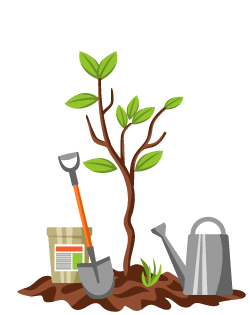 Landing
Basic conditions
- This variety doesn't require much space, but it does require sun. Therefore, choose only sites that receive good daytime sun and adequate ventilation. Stagnant air in the crown can lead to disease in any fruit crop.
- The soil for growing should be fertile, but not only black soil but also fertilized loam and sandy loam are suitable. The main thing is that the soil should not be too acidic, otherwise the trees may die.
- Leave enough space between plants to prevent them from clashing. Much depends on the rootstock. For dwarf rootstocks, for example, 2-3 meters is sufficient, while seed rootstocks require up to 5-6 meters.
- Before planting, stakes or support strips are driven into the holes to tie up the plants; these will help them cope with the winds.
- There's no need to prepare holes in advance; you can dig holes 60x80 centimeters and approximately 1 meter in diameter. Place soil mixed with a small amount of humus and mineral fertilizer at the bottom, then make a mound of soil on which to place the seedling. Cover the tree with soil, lightly compact it, water with 35-50 liters of water, and mulch the surface.
The root collar of the seedling should always be left at least 5-9 centimeters above the surface. Otherwise, the plant will root higher, completely negating all the original qualities of the chosen rootstock..
Landing dates
This variety can be planted in either spring or fall. However, it's worth remembering that in southern regions, the timing is unimportant, while in more northern regions, the apple tree may not have time to adapt before the cold weather sets in. Therefore, when planting in harsh climates, it's best to choose the spring option.
Protection from frost and rodents
Covering trees for the winter is fairly simple: wrap the trunks with burlap and pile straw or dry grass bales on the root zone. This will prevent the roots, which are located just below the surface, from freezing. Some gardeners even recommend piling 15-20 centimeters of soil onto the trunk area, which will also protect against frost. Dwarf and semi-dwarf trees can be covered using the ball method, completely wrapping them with tarpaulin.
In the fall and spring, trees are whitewashed with lime to repel insects, which readily overwinter in bark chips and cracks. Coating the trees with grease, lard, drying oil, and other pungent-smelling substances can also help repel rodents.
Tree care
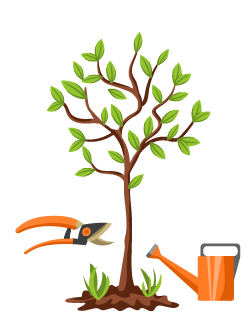 Tree care
Loosening the soil, watering: proper agricultural technology
Regular weeding of the root zone, removing weeds, other plant shoots, and root suckers will be the main task for any gardener who grows Modi. The variety doesn't like competition, so if you want a substantial harvest, it's best to take good care of the tree. Digging around the trunk area should be done no more than twice a year; this is sufficient for aeration.
Trees should only be watered when the weather is extremely hot and dry, and the surrounding plants are simply "burning." A good rule of thumb is that if it hasn't rained for two weeks, it's time to add moisture. At the same time, watering the apple trees will also help fertilize and feed them well to promote their growth and fruiting.
Pruning: simple crown shaping
The trees aren't particularly prone to becoming overgrown, and they have a distinct crown shape even without any pruning. Therefore, it's usually necessary to simply adhere to the shape specified by the nursery, trimming only the upward-growing shoots and any inward-facing shoots.
Sanitary pruning is unavoidable. Regularly remove dead, broken, or diseased branches from the tree. These can rob the tree of nutrients needed for fruit production.
Reproduction
- Rooting cuttings.
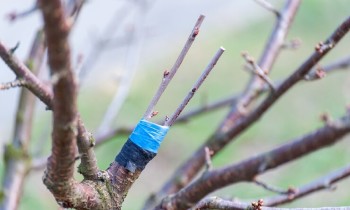
- Grafting by buds or cuttings.
- Growing from seeds.
- Clones (layering).
Diseases and pests
- Cytosporosis.
- Green aphid.
- Hawthorn.
- Codling moth.
Ripening and fruiting of Modi
The beginning of fruiting
 The beginning of fruiting
This is a very early-bearing variety, and the first buds can be seen in its first year. However, it's best to pluck them and wait until the tree is two or three years old before fruiting. Even at a young age, you'll be impressed by the harvest this apple tree produces. For a small tree, the buds may be too numerous, and the branches will need to be supported or tied to prevent them from breaking.
Flowering period
Modi begins blooming in the second half of May, around the 15th to 20th. The buds open very rapidly, turning the tree into a true wonder. The flowers are large, beautiful, and fragrant, white or white-pink, gathered in clusters of 5-8, densely covering the branches. The blooming process takes quite a long time, at least 12-14 days, so the bees have plenty of time to do their work.
Fruiting and growth
There are several different opinions regarding this indicator. For example, some say the tree will literally grow before your eyes, reaching its maximum height in just 5-6 years. However, others claim that it can grow no more than 8-10 centimeters in a single growing season. Both options are correct, as everything here will depend directly on the chosen rootstock. Therefore, it's best to inquire with the seller about this. The same applies to increasing fruiting.
You can pick apples from the branches and store them starting in late September, but you can wait until early October. They will be firmly attached to the branches and won't fall to the ground. Store them in suitable conditions (cellar, fridge) can be stored for quite a long time, no less than until May, but sometimes until the next harvest, without any loss of consumer and commercial qualities.
Top dressing
- Mineral complexes.
- Chicken manure.
- Ammonium nitrate.
- Manure.
- Compost.
What to do if it doesn't bloom or bear fruit
- Provide watering.
- Check for pests and diseases.
- Transplant to a sunnier location.
- Fertilize.
Why do apples fall?
- Natural factors.
- Pests.
- Diseases.
Please leave your feedback on the Modi variety so that other gardeners can learn about your experiences growing such trees.

Comments
Yesterday I bought a few fruits of this variety for the first time. I was tempted by the red skin—I was hoping they would be as sweet and juicy as Gala and similar varieties.
The flesh is very juicy, but a bit firm. The taste is slightly sour. I'll finish the rest and won't be buying any more.