Lobo apple tree: characteristics of the variety and care
| Color | Reds |
|---|---|
| Ripening season | Winter |
| Size of apples | Large |
| Taste | Sweet and sour |
| Crown type | Average tree height |
| Shelf life | High shelf life |
| Application | Universal variety |
| Winter hardiness | High winter hardiness |
| Fruiting age | Up to 5 years |
 History of origin and regions of growth
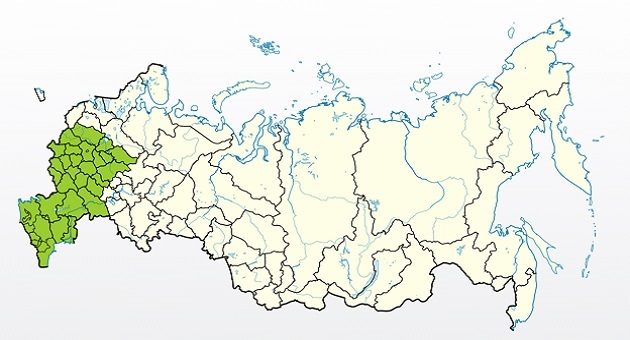
Growing regions
- Middle zone.
- North Caucasus.
- Crimea.
- Some northern regions.
Origin
The development of winter apple trees has long been underway not only in our country but also worldwide. Lobo is a Canadian variety, first developed at the Ottawa Research Center's experimental station around the middle of the last century. It was created by sowing seeds of the McIntosh variety after open (spontaneous) pollination by several different varieties.
Lobo apple trees first arrived in the Soviet Union around the mid- to late 1960s. An application was submitted in 1971, and in 1972, the variety was added to the State Register and zoned for the Central Black Earth Region. In fact, it is easily grown in the south, throughout the central part of the country, and even in the more northern regions.
Description of the Lobo apple variety
 Lobo has inherited a great deal from its parent variety. It produces fruit regularly, is undemanding to growing conditions, and requires little attention, making the gardener's work much easier. At the same time, it produces fruit of very high commercial and consumer quality—large, attractive, and delicious—and, on top of all that, produces good yields every year. It is recommended for cultivation on farms, in small garden plots, and in large, intensive commercial orchards.
Apples: What they look like
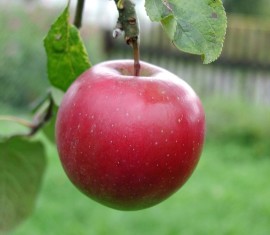
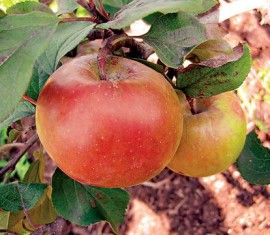
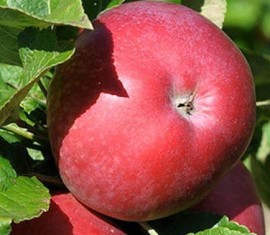
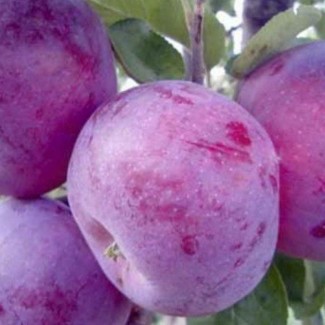
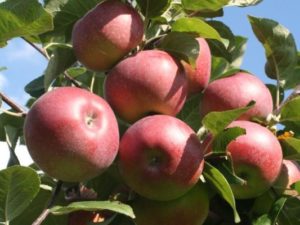 The fruits are generally considered large to very large, but can also be medium-sized. They reach a maximum weight of 180-220 grams, rarely reaching 230-250 grams under ideal weather and climate conditions, and with excellent care. They are round or round-conical, symmetrical, often irregular, and have very little ribbing.
The fruit's skin is dense but thin, smooth, glossy, and shiny, and may develop a waxy coating during ripening. It has a green or greenish-yellow hue, but this is 85-95% hidden under a raspberry, maroon, or beetroot-colored blush. Subcutaneous punctures are numerous, light-colored, and fairly small, but clearly visible on a ripe apple. The chemical composition is best assessed using the following parameters per 100 grams of product:
- P-active substances (catechins) – 324 milligrams.
- Ascorbic acid (vitamin C) – 10.7 milligrams.
- Total sugars (fructose) – 10.9%.
- Pectins (fiber) – 15.2%.
- Titratable acids – 0.49%.
The flesh is firm, medium-crisp, quite tender, fine-grained, not prickly, and quite juicy. It is light creamy, lemon-colored, and can be slightly pinkish or even white. The flavor is sweeter, with a slight apple tartness, and is considered a dessert-like, balanced, harmonious, and pleasant. The fruit's aroma is very powerful, with distinct caramel and berry notes. A professional tasting score on a 5-point scale is 4.8 points for color, flavor, and appearance.
Lobo apple tree: characteristics
Crown and root system
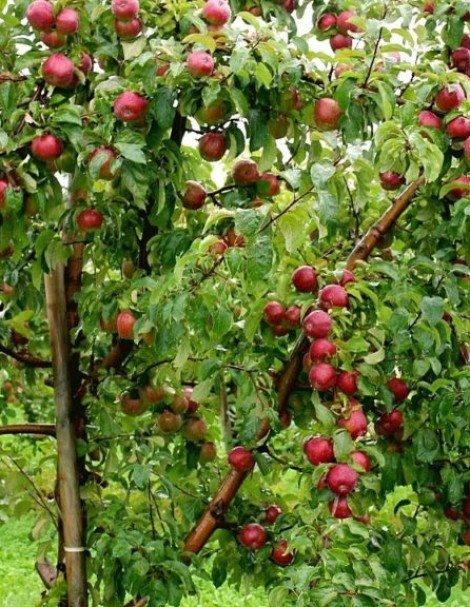
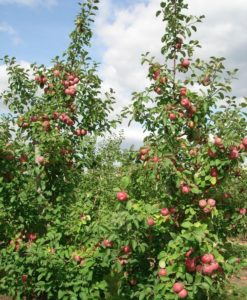 Officially, the apple tree is classified as medium-sized, although this can vary depending on the rootstock, growing conditions, pruning, and other factors. It would be more accurate to call it a natural dwarf, since It usually grows no more than 3.5-4 meters in height.The crown is pyramidal, oval, or spherical; in older apple trees, it can become spreading, weeping, or drooping. It is not prone to excessive density, so pruning is not a problem. The shoots are long, slightly angular, and covered with greenish-brown or fulvous-brown bark.
The leaves are easily recognizable by their elongated oval shape, long-pointed tip, and matte surface with coarse ribbing. They are dense, leathery, with a serrated, finely serrated, and wavy margin, often folded into a boat-like shape, and densely cover the branches. The root system is medium-deep, and depending on the rootstock, may or may not have a central taproot. It is branched but not very robust.
Productivity and pollination
High yields and early maturity are considered the main advantages of the variety.
It's entirely possible to harvest 180-220 kilograms of fragrant, delicious, and sweet fruit from a single mature Lobo tree in just one season. The official record for yield from a single tree was 267 kilograms, obtained in the Voronezh Region in 2012..
The apple tree is considered conditionally sterile, meaning that some fruit can be harvested through the wind and its own pollen. However, abundant harvests are unlikely without nearby (45-70 meters) apple trees with suitable flowering times. Therefore, experienced gardeners have long since adopted the practice of interplanting different varieties and spraying the trees with sugar syrup or diluted honey during flowering to attract more bees.
Winter hardiness and disease resistance
Lobo has high winter hardiness, which far exceeds its tolerance to low temperatures. Trees easily tolerate temperatures as low as -35-37°C and don't even require additional shelter in most temperate regions, let alone milder climates. Further north, covering is not a problem, but it won't require much effort.
They have no genetic resistance to diseases, and this is the most dangerous thing that can happen to them. After freezing, trunks take no more than a year to recover, and from scabies or powdery mildew may not recover at all and die. Therefore, it's crucial to spray them with fungicides and insecticides in a timely manner.
Rootstocks and subspecies
It's believed that Lobo can be grown on any rootstock, even rowan or pear. However, it's recommended to use winter-hardy varieties, which will provide more advantages and make the trees more resilient.
| Subspecies | Description |
| Dwarf or semi-dwarf | This variety offers an even more compact crown, making it suitable for growing in confined spaces or maximizing fruit yield per hectare. All the key characteristics of the parent variety are fully preserved, with the fruit achieving the same weight, flavor, color, and shelf life. |
| Columnar | One of the few subspecies that produces good results on this rootstock. The result is a small tree, 2-2.5 meters tall, with one or two shoots. Fruiting occurs on the trunk, where the rhizomes grow, and skeletal branches are completely absent. All other characteristics remain the same. |
| Creeping (slate) | If desired, Lobo can be trained into a creeping tree by properly shaping its crown. This allows this subspecies to be grown Urals, V Siberia and in the Far East. The fruits on the tree grow somewhat smaller, only 130-150 grams, but for northern apple trees, this is very good. |
Features of growing Lobo
 Landing
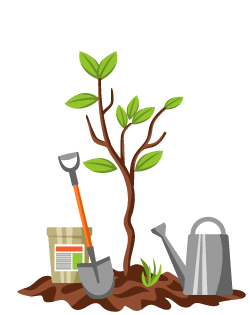 Landing
Basic conditions
- For any apple tree, it's best to choose an open location with plenty of sun for most of the day. Lobo is no exception; it's also worth finding a well-ventilated, draft-free spot. However, even in the shade and a breezy environment, the tree will definitely grow and bear fruit.
- The variety isn't particularly picky about soil, but all trees dislike overly acidic soil. Acidic soils are best mitigated with lime several seasons before planting apple trees.
- The holes are prepared in advance by digging pits 60-75 centimeters deep and the same in diameter, with steep sides. The bottom is filled with soil and organic fertilizer, a drainage layer is added, the holes are watered, and the holes are left outdoors.
- Leave approximately 4-4.5 meters between trees, and the same amount between rows. However, for columnar and dwarf varieties, even 1.5-2 meters is sufficient, as they rarely develop lateral branches.
- It's a good idea to immediately drive or dig stakes into the holes to support the tree during its first few years of life. These stakes can be removed no earlier than three to four years after planting.
- The root collar must be left 8-12 centimeters above the surface, otherwise the tree will root higher. This will completely negate all the properties and qualities of the rootstock.
- The seedling is placed vertically, with its roots spread out, on a drainage pile, covered with soil, compacted, watered with 25-40 liters of water, and the surface is mulched with humus.
Landing dates
Lobo can be planted in both spring and fall, as long as there's no sap movement in the trunks. Many choose a sunny, warm day in late March or early April, or in September or even early October. Trees with closed root systems, meaning those purchased in special pots (containers) or bags that require no additional disposal, can be planted at any time, even in the height of summer.
Protection from frost and rodents
These trees are very frost-resistant, but they must be protected for the winter, especially in northern regions. Grass or straw mats can be placed over the roots, the trunks can be wrapped in burlap, and dwarf and columnar trees can be covered with a tent-like covering. Creeping Lobo varieties benefit from simply covering them with soil or snow; then even Siberian winters will be completely unaffected.
To prevent rodents from damaging the bark and tender shoots of young apple trees, the trunks are coated with grease, various industrial products, or regular rendered animal fat. Trees are also whitewashed with lime in the spring and fall to prevent insects from nesting in the cracks in the bark.
Tree care
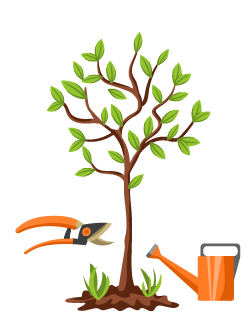 Tree care
Loosening the soil, watering: proper agricultural technology
The tree trunk area should be dug up approximately twice a year, but some believe that once is sufficient. You can hoe the soil more frequently, as weeds grow or the day after watering. This will prevent the soil from compacting into a tight ball and ensure the roots always have access to oxygen.
Young trees are typically watered approximately once a week or every ten days. This is unless there is natural precipitation. When rain falls regularly, there is no need to add water. Water is also a good way to fertilize and feed trees, as it allows nutrients to be absorbed more efficiently.
Pruning: simple crown shaping
Lobo responds well to pruning, recovers quickly, and doesn't experience much stress. This helps give the tree absolutely any shape: broom-shaped, columnar, sparsely tiered, cordon, oval, or broadly oval. Pruning should be performed starting one to two years after planting in open ground to make it easier to maintain the desired standard.
Sanitary pruning is necessary in the fall and spring. This involves removing all dead, diseased, and damaged shoots. These are simply removed, and the cut areas are always sealed with drying oil or garden pitch. After 10-12 years, you can begin pruning trees for rejuvenation, removing 2-3 mature branches and allowing new ones to develop.
Reproduction
- Rooting cuttings.
- Grafting by buds and cuttings.
- Clones (offshoots).
Diseases and pests
- Powdery mildew.
- Scab.
- Black crayfish.
- Pit bitterness.
- Cytosporosis.
- Green aphid.
- Hawthorn.
- Codling moth.
Ripening and fruiting of Lobo
The beginning of fruiting
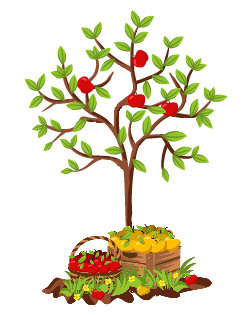 The beginning of fruiting
This variety is considered early-bearing. The first fruits can be harvested as early as 3-4 years after planting. While you shouldn't expect a large harvest, 15-20 kilograms is quite possible. The key is to pluck all flowers from the first year if they appear on the branches in the spring.
Flowering time
In temperate climates, flowering begins primarily in mid- to late May. It lasts approximately 12-16 days, allowing the bees time to complete their work. However, in poor weather or colder climates, flowering may be delayed and may even begin in early June.
The apple tree produces medium-sized, beautiful, and always abundant flowers, fragrant, white or with a slight pink tint. After 10-12 years, their number must be regulated (removing about a third), otherwise the fruit will become smaller and degenerate, and the tree will stop bearing fruit quite soon, after 30-35 years.
Fruiting and growth
Before fruiting begins, trees of this variety grow before your very eyes. They can reach more than 60-70 centimeters in a season. However, after fruiting begins, this growth slows somewhat, by approximately 25-30%. Yield growth is gradual but explosive, with more fruit being produced each year, and by the 7th or 8th year, a nearly full harvest can be achieved.
It's customary to pick apples from the branches no earlier than mid-September, or even better, late September. However, in more northern regions, they don't ripen until October. There's no need to worry about the fruit falling to the ground; they cling very firmly to the branches, and falling is a clear sign of disease. In a properly equipped cellar, apples can be stored until spring, or even until the next harvest, with virtually no loss of flavor or marketability, which is why this variety is so highly valued by commercial growers.
Top dressing
- Chicken manure.
- Mineral complexes.
- Wood ash.
- Humus.
- Compost.
- Ammonium nitrate.
- Manure.
What to do if it doesn't bloom or bear fruit
- Provide moisture.
- Check for pests and diseases.
- Transplant to a sunnier location.
- Limit watering.
Why do apples fall?
- Natural factors.
- Pests.
- Diseases.
Leave your feedback on the Lobo variety to share your experience with other gardeners.