Abundantly flowering apple tree: characteristics of the variety and care
| Color | Reds |
|---|---|
| Ripening season | Autumn |
| Size of apples | Small ones |
| Taste | Sour |
| Crown type | Tall tree |
| Shelf life | Low shelf life |
| Application | For recycling |
| Winter hardiness | High winter hardiness |
| Fruiting age | From 5 years old |
 History of origin and regions of growth
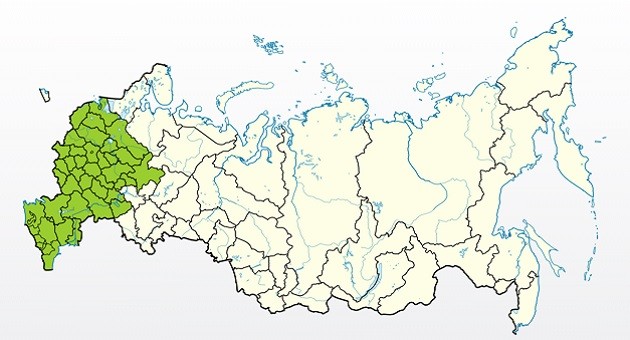
Growing regions
- Middle zone.
- South.
- Moscow region.
- Leningrad region.
- North Caucasus.
Origin
The origins of this apple tree are unknown. It is an old variety, most likely created through natural hybridization and open pollination in Japan. However, this fact also remains a mystery. The variety is not found in the wild, leading biologists to conclude that the Abundantly Flowering apple tree was artificially bred. In 1862, the tree was first imported to Britain, from where it subsequently spread throughout the world as an ornamental.
Content
Description of the Abundantly Flowering variety
 This deciduous tree is distinguished by its enviable tolerance to polluted urban air and requires little maintenance. Its crown is decorative and delicate, its height can vary greatly, and the foliage often ranges in shades from light green to burgundy. It is adaptable, and the profusely blooming tree can be grown in almost any shape. It is used in landscape design as a stand-alone element (a solitaire) or as part of a group planting, for high-quality landscaping of squares, park areas, alleys, and gardens.
Apples: What do they look like?
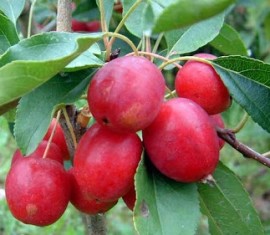
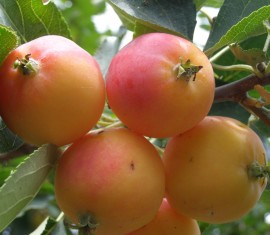
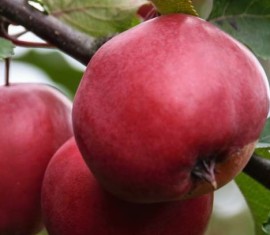
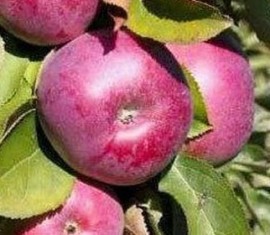
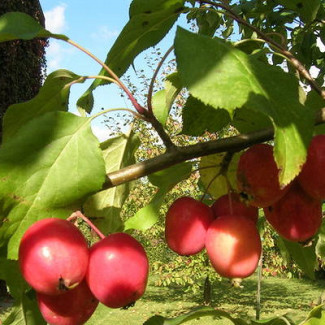
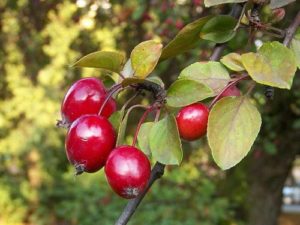 The fruits are small to very small, barely reaching 1-1.2 centimeters in diameter and weighing 5-8 grams, but can be even smaller. They are most often elongated, but can also be slightly flattened, spherical or conical, rounded, and smooth. The skin is green or light green, turning yellow and sometimes golden as it ripens. It is dense, strong, and even hard, making it difficult to bite through. The apples are 90-95% covered with a bright red, cherry, or red-orange blush.
The flesh is very dense, firm, woody, and sticky. It is white or slightly greenish. When overripe, it can become greasy and unpleasantly oily. The taste is bitter-sour and astringent, so these apples are not eaten fresh and are not rated.
Apple tree Abundant flowering: characteristics
Crown and root system
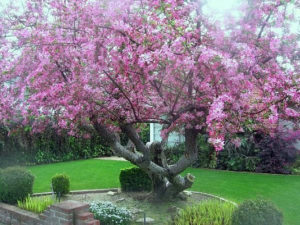 Without formative pruning, this apple tree can be classified as tall. In just a few years it reaches a height of 10-12 meters, and sometimes even higher.However, with proper pruning, it can be cultivated into more compact forms, even hedges or small shrubs 1-1.5 meters tall. The crown is spreading, sometimes weeping, with drooping branches that can often be thorny; in shrub forms, they are located at ground level.
The leaves are ovate, lanceolate, or oblong-elevated, smooth, dense, leathery, and long-pointed. They are glossy, highly shiny, and may be slightly pubescent on the underside. They are serrated and finely serrated, with delicate venation and serrated edges, sometimes wavy. The taproot system is moderately deep and branched, and can cover an area up to 1-1.5 meters in diameter, allowing for close planting.
Productivity and pollination
Because the tree is ornamental, it is not generally classified into any specific yield groups. However, gardeners say that a single mature trunk of average height (5-8 meters) can yield approximately 8-12 kilograms of very small, cherry-like fruits. These are not typically eaten, but are quite edible and can serve as a piquant addition to compotes, jams, preserves, and other dishes.
The variety is completely self-pollinating, so even in the complete absence of other apple trees nearby, its flowers will inevitably develop into ovaries and apples. Additional pollinators can be planted nearby, which may slightly increase the yield and enhance the tree's decorative appearance during fruiting.
Winter hardiness and disease resistance
The profusely flowering jay is considered frost-tolerant, even to sudden temperature fluctuations. It copes well with temperatures down to -25-28°C. However, high humidity followed by cold snaps can cause freezing of young shoots and buds. Therefore, to preserve the trees, it is important to properly and promptly cover them.
It has a high resistance to apple diseases. The profusely flowering variety is very rarely affected by powdery mildew, scab, and cytosporosis, and is practically untouched by pests such as hawthorn or leaf rollersHowever, it still wouldn't hurt to take preventative measures in a timely manner to completely eliminate the risk of developing any disease-causing illness.
Rootstocks and subspecies
Over the more than a hundred years that this variety has been well-known to gardeners around the world, many different subspecies have emerged. They differ slightly in height, crown shape, size and shape of leaves, flowers, and fruit, but not significantly. The basic characteristics of the apple tree remain unchanged.
Features of growing Abundantly flowering
 Landing
 Landing
Basic conditions
- The most important requirement when growing an apple tree is choosing a sunny, open site. Apple trees thrive in good light, but in shade they grow weak and unviable, their crown becomes bald, and the tree may die.
- It's good for the crown of the Abundantly Flowering Vera to be well ventilated, but it doesn't tolerate drafts. A drafty Vera, especially in winter, will make the tree uncomfortable and may not survive for long.
- The plant's roots don't penetrate deep into the soil, so proximity to groundwater isn't a big factor, as long as it's not very close to the surface. Avoid planting trees in swamps or floodplain meadows that are regularly flooded in the spring, but otherwise, it doesn't matter.
- The soil can be any, but the best growth is observed in well-drained, moist, slightly acidic soil.
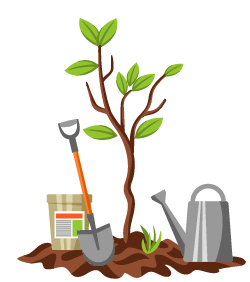
- It's not necessary to prepare the holes in advance, but they should be dug and left to stand about 2-4 weeks in advance. Make a hole 60-70 centimeters deep and 70-90 centimeters in diameter. Add fertilizer to the bottom, fill with stones, gravel, vermiculite, and nut shells, and add 25-30 liters of water.
- Leave approximately 1-1.5 meters of space between trees; this will be sufficient for them to grow comfortably. Other plants can be planted close to hedges.
- Staking stakes or planks are immediately driven into the ground. These will not only help the tree stay upright but also provide additional protection during cold weather. However, for this to be true, they should be installed on the north side. The stakes are removed no earlier than 3-4 years after planting.
- The seedling is placed on a mound of drainage material, the rhizome is carefully spread out, covered with soil, and compacted by hand. A small mound of soil, 5-12 centimeters high, is created around the perimeter, and 15-25 liters of water are poured inside. mulch, the trunk is tied to a support.
Landing dates
Both spring and fall planting times are acceptable for the Abundantly Flowering tree. The key is to ensure that the tree's trunks are free of sap movement when it's moved. This means that in the spring, try to complete all work before bud break, and in the fall, after leaf fall. In mild climates, the timing doesn't matter, but in harsher climates, it's best to choose an early planting so the tree has time to acclimate over the summer.
Tree care
 Tree care
Protection from frost and pests
Despite the trees' resistance to frost, they cannot be left to overwinter without cover, and they need to be prepared for the cold from the end of summer. watering they stop completely by the beginning of September, and in cold regions where winter comes early, then by the end AugustThe trunks are wrapped in burlap, roofing felt, or any suitable fabric. Hay mats or straw bales are thrown over the root zone, and the soil is raked. Small trees can be covered using a tent-like method.
Whiten Lime will never harm tree trunks against insects; it will prevent them from settling in bark crevices. To repel rodents, the trunks are coated with fuel oil, grease, or lard.
Loosening the soil, watering: proper agricultural technology
When the tree is young, you can dig the area around the trunk twice a year according to the standard plan, hoeing it 4-6 times per season in between. This will remove weeds and allow oxygen to reach the roots. However, as the tree matures, this is no longer necessary, and landscape design often doesn't include such elements as tilled soil. Therefore, the area around the trunk is seeded with lawn grasses, flowers, or covered with turf.
Trees may be in dire need of water during hot and dry periods. Their rhizomes aren't deep enough to take care of themselves. Therefore, it's best to apply 10-15 liters of water per mature plant once every 10-12 days. If possible, install a sprinkler or drip system to apply the moisture.
Pruning: simple crown shaping
Pruning ornamental trees usually begins in their first year. If you miss the right moment, you may never be able to correct the situation. Trees can be shaped into virtually any desired form, from simple tiered structures to complex hedges shaped like statues, objects, or animals.
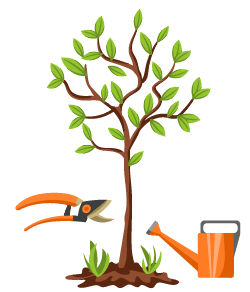
Regular sanitary pruning will be necessary. During this procedure, which is usually performed in spring and fall, a thorough inspection of the branches is carried out. Any broken, diseased, or dead branches are immediately removed. At the same time, the tree's shape is adjusted, and any shoots protruding inward or upward are removed. Apple trees generally don't require rejuvenation, although they have a fairly long lifespan, at least 55-75 years.
Pollinator varieties
- White filling.
- Delicious golden.
- Nadzvetsky.
- Manchurian.
- Royalty.
- Baya Marisa.
- Raika.
Reproduction
- Grafting by cuttings.
- Growing from seeds.
Diseases and pests
- Cytosporosis.
- Powdery mildew.
- Scab.
- Green aphid.
- Bacterial burn.
- Scale insect.
Ripening and fruiting of the Abundantly flowering
The beginning of fruiting
 The beginning of fruiting
The first flowers on an apple tree can be seen approximately 4-6 years after planting. However, they often turn out to be empty flowers. It is believed that the first fruiting does not occur until 6-8 years. There is no need to talk about the first fruits; they will be few in number, and given the size of the apples, the harvest can hardly be called abundant or even full.
Flowering time
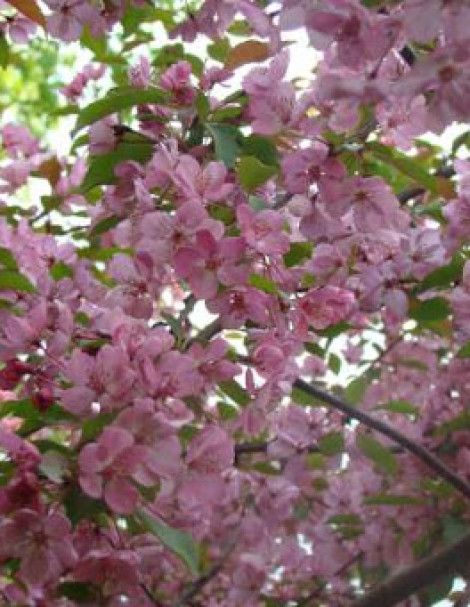
The tree's main decorative feature is its abundant, very long blooming period. It begins in early May, just as warm weather arrives, and lasts for at least 16-21 days. The apple tree's flowers are very beautiful, large, and intensely fragrant. They are gathered in clusters of 6-9, densely covering the branches. The buds are a very rich carmine-red or bright red, and after opening, the petals turn a soft pink, yet still beautiful and delicate.
Fruiting and growth
The tree is officially considered a medium-sized tree. It can grow approximately 15-35 centimeters per year, sometimes even more. Therefore, it quickly gains height and, without pruning, can easily become the largest tree in the garden. It also increases its abundant flowering yield, although this doesn't play a key role in cultivar selection. Nevertheless, the tree can begin to produce a full harvest around its fifteenth to twentieth year.
The fruits ripen at different times, depending on the growing region. In warmer climates, they can ripen as early as late August, but in the Moscow region, the average ripening time is mid-September. The fruits ripen all at once, acquiring a rich red color, giving the tree an even more attractive appearance. The fruits cannot be stored; they begin to rot immediately, but they can remain on the branches almost until spring.
Top dressing
- Peat.
- Compost.
- Manure.
- Chicken manure.
- Humus.
- Superphosphate.
- Ammonium nitrate.
- Wood ash.
What to do if it doesn't bloom or bear fruit
- Inspect for diseases or pests.
- Limit or increase watering.
- Fertilize.
- Transplant to another location.
Why do apples fall?
- Natural weather conditions (wind, rain, hurricane, hail).
- Pest damage.
- Various diseases.
Share your own experience with the Obilnotsvetushaya apple variety so everyone can experience it and get a wonderful garden decoration and a piquant addition to juices or jams.