Apple tree Tsyganka: characteristics of the variety and care
| Color | Reds |
|---|---|
| Ripening season | Autumn |
| Size of apples | Average |
| Taste | Sweet and sour |
| Crown type | Tall tree |
| Shelf life | Low shelf life |
| Application | For recycling , Fresh |
| Winter hardiness | High winter hardiness |
| Fruiting age | From 5 years old |
 History of origin and regions of growth
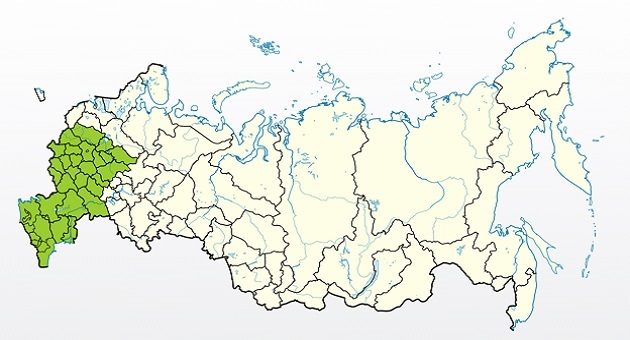
Growing regions
- Middle zone.
- North Caucasus.
- Some northern regions.
Origin
The origin of the ancient Russian apple variety known as Tsyganka is unknown. Descriptions of it can be found in seventeenth-century botanical atlases. Some believe the tree was brought there by the Ottomans a hundred years earlier. The Arabka or the Sabluk Winter variety are often mistaken for this apple tree, but they should not be confused.
Content
Description of the Tsyganka apple variety
 Many ancient apple varieties are gradually becoming a thing of the past, and most gardeners have no idea what they're even talking about. Among these undeservedly forgotten varieties is the Tsyganka, which boasts many positive qualities and attributes. Currently, the variety is considered unpromising and has been completely removed from the State Register. However, these tall apple trees can still be found in collectors' orchards.
Apples: What they look like
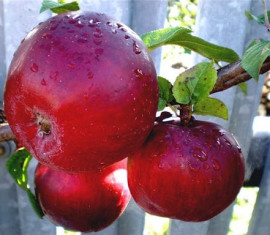
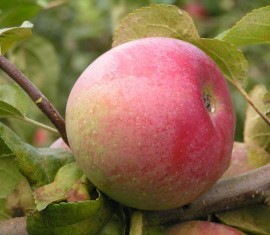
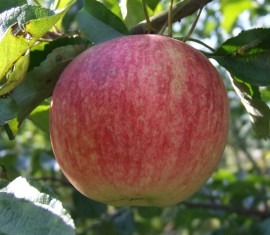
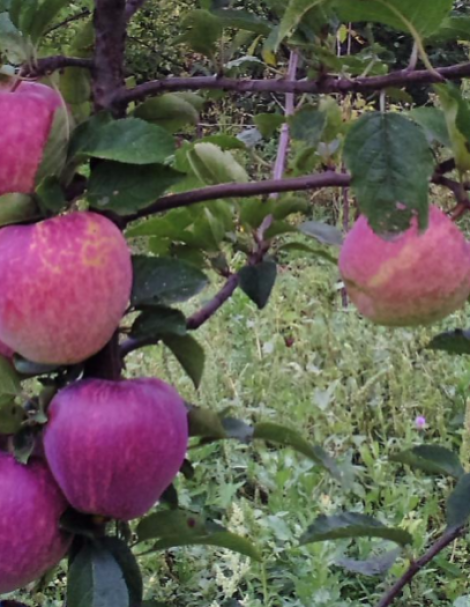
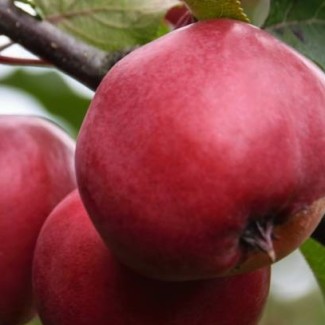
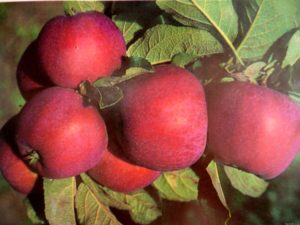 The fruits are generally medium-sized, weighing 90-130 grams. They are round or slightly round-conical. The ribbing is either not visible or only faintly pronounced.
The fruit's skin is dense, fairly firm, and thick, with a light, bluish-gray waxy-oily coating. It's green, turning yellow and sometimes even white as it ripens. However, this coating is completely unnoticeable, as it's 85-100% covered with a uniform, brownish-red blush, free of streaks or spots. Subcutaneous punctures are light green, large, and numerous, clearly visible.
The fruit's flesh is white, sometimes slightly creamy or yellowish, and may have a slight pinkish tint just under the skin. It is fairly dense, fine-grained, and of medium juiciness and aroma. The apples have a sweeter flavor, but with a pleasant apple tartness in the aftertaste, making them memorable. There is no information on the chemical composition or tasting notes; the apples are considered table apples.
Apple tree Tsyganka: characteristics
Crown and root system
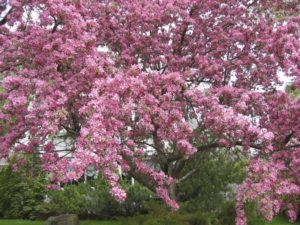 Most of the old Russian apple varieties that were previously used commercially were tall, and Tsiganka is no exception. Without pruning, a tree can reach 7-8 meters in just 10-15 years. Crown When young, it is pyramidal or broadly pyramidal, becoming more rounded, spreading, and even weeping with age. The shoots are mostly thin and drooping. The bark on young branches has a reddish tint, while on the main trunk it is brown, cracking and crumbling with age.
The leaves are medium to large, dense, wrinkled, oval-elongated, and heart-shaped at the base. They are green or dark green, leathery, slightly glossy, and lightly pubescent on the back. The root system is extensive and deep, primarily with a thick central taproot and several large skeletal roots that penetrate deep into the soil.
Productivity and pollination
The yield is considered average, even among older varieties. On average, a single apple tree can yield no more than 60-80 kilograms of beautiful fruit.
A characteristic feature of the Tsyganka is its cyclical fruiting. It's impossible to predict when the tree will decide to rest. It can produce a stable harvest for three years in a row, and then suddenly stop bearing fruit for a year or two or three.
The tree is self-fertile, meaning it will produce apples even if there are no other varieties nearby for cross-pollination. However, the yield in this case will be no more than 55-60%. To maximize this, apple trees should be interplanted with other varieties. It's a good idea to have an apiary nearby, as the aroma of apple trees during flowering is not very strong.
Winter hardiness and disease resistance
The Tsiganka variety is considered highly resistant to low temperatures. Indeed, it thrives in the harsh temperate climates of the central part of the country and easily tolerates sudden temperature fluctuations, as well as alternating severe frosts and thaws. Moreover, it requires virtually no additional shelter.
Apple trees are susceptible to powdery mildew, scab, and a whole host of other common apple tree diseases. They attack quickly and heavily, so preventative measures are essential. Pests also readily damage the fruit, leaves, and even the wood of the Tsyganka, so regular insecticide treatments are essential.
Rootstocks and subspecies
Since this variety has long been considered unpromising, no subspecies have been developed. It is grown primarily on vegetative rootstock. Dwarf or columnar varieties do not exist.
Features of growing Gypsy
 Landing
 Landing
Basic conditions
- This variety prefers open, well-lit spaces, plenty of room, and no shade. Therefore, it should be planted in such locations.
- The tree is not demanding in terms of soil; black soil, sandy loam, or loam are suitable, but like all apple trees, Tsiganka prefers slightly acidic and airy soils.
- It is not recommended to plant trees near open bodies of water, in lowlands, or in swampy areas. Groundwater levels should also be deeper than 2.5-3 meters.
- Planting holes can be prepared in advance using the standard method, but this is not necessary. You can dig them immediately before planting, but you should add a 15-20 centimeter layer of drainage between the fertilizer added to the bottom of the holes. Otherwise, the roots may become burn and the tree will die. Vermiculite, gravel, or broken brick are good drainage materials.
- It is advisable to leave a fairly large distance, at least 6-7 meters, between the Gypsy and other plantings in the garden, otherwise it will interfere with the tree's crown and roots in the future.
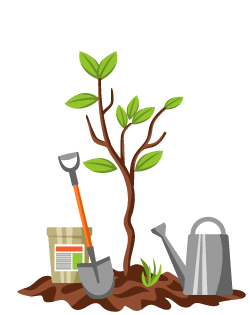
- The seedlings are planted vertically so that the root collar protrudes above the surface by 4-6 centimeters, covered with soil, compacted, watered with 30-40 liters of water, and the surface is mulched with humus, compost, or chopped grass.
To ensure the tree has time to root properly, stakes are driven into the holes immediately for support. They should not be removed until the Tsiganka begins bearing fruit, which is usually 4-6 years.
Landing dates
It's best to plant apple trees in early spring, before the sap begins to flow in the trunks, or in the fall, after it has completely finished. This can be in April, as well as September or October. According to gardeners' observations, seedlings planted in the fall take root better.
Protection from frost and rodents
Under normal conditions, this variety requires no winter protection at all. It tolerates even fairly severe frosts well, and even if it does freeze, it recovers very quickly within one growing season. However, gardeners prefer to be on the safe side with young plantings, so they cover the root zone with straw mats or spruce branches. The trunks can be wrapped with roofing felt, tar paper, agrofibre, or nylon tights.
To repel pesky insects, whitewash the trees in the fall to a height of approximately 1-1.5 meters. To prevent rodents from feasting on the juicy young bark, coat it with lard or grease. Commercially available products, available at gardening stores, can also be used.
Tree care
 Tree care
Loosening the soil, watering: proper agricultural technology
Digging the tree's trunk area once or twice a year is sufficient. You can loosen the soil more frequently with a hoe, while also removing various weeds, tree and shrub shoots, and root suckers, which the apple tree produces with enviable persistence.
Trees don't require watering. However, in particularly hot and dry years, adding moisture won't hurt. It's best to do this no more than 3-5 times per season. Watering can be timed to coincide with flowering, fruit set, and ripening. However, watering should be stopped by mid- to late September, otherwise the tree won't have time to prepare for the cold, and its winter hardiness will be significantly reduced.
Pruning: simple crown shaping
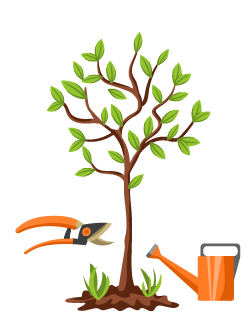
The first formative pruning is performed immediately upon planting in open ground. The central basal and skeletal branches are shortened by one-third. Subsequently, only branches that are spaced widely apart, do not grow vertically (suckers), and do not thicken the crown should be left.
Trees will also need to be regularly cleared of diseased, damaged, and dead branches. Sanitary pruning is carried out in the fall, after the harvest has been gathered and the leaves have fallen.
Reproduction
- Growing from seeds.
- Clones (offshoots).
- Grafting by cuttings or buds.
- Rooting cuttings.
Diseases and pests
- Scab.
- Powdery mildew.
- Fruit rot.
- Cytosporosis.
- Black crayfish.
- Hawthorn.
- Codling moth.
- Green aphid.
- Leaf roller.
- Flower beetle.
Ripening and fruiting of the Tsyganka apple tree
The beginning of fruiting
 The beginning of fruiting
Gypsy can be described as early-bearing, as is typical of older varieties. It blooms for the first time as early as 4-5 years after planting. A harvest of 5-10 kilograms can be harvested as early as 6-8 years.
Flowering time
Depending on the growing region, the blooming time of the buds may vary slightly, from mid-May to late May. Weather can also influence this; if the spring is cold and rainy and has late frosts, flowering is delayed. The flowers are large, gathered in small clusters, white, but more often pale pink, very delicate, and have a moderate fragrance.
Growth and fruiting
This variety grows very quickly, gaining up to a meter in height per year, which is quite noticeable. Therefore, it also reaches full fruiting quite early. Yields of over 50-60 kilograms can be harvested as early as the 9th to 11th year, and even more thereafter.
Gardeners consider the unpredictability of fruiting a particular drawback, as an apple tree may simply not produce apples for several years, only to later delight with a bountiful harvest. The older the tree, the longer the dormant periods can be.
The fruits ripen only in mid- to late September, but can linger until early October. If you miss the right moment, they may fall to the ground and then have to be processed within a few days. In any case, these apples don't last long, no more than 1-1.5 months. Their flesh becomes soft, limp, and less juicy with time.
Top dressing
- Compost.
- Peat.
- Humus.
- Manure.
- Bird droppings.
- Mineral complexes.
- Superphosphate.
What to do if it doesn't bloom or bear fruit
- Transplant.
- Apply fertilizer.
- Eliminate the shadow.
Why do apples fall?
- Overripe.
- Natural phenomena (strong wind, rain, hail, frost).
- Pests.
- Diseases.
Please share your thoughts on the Tsyganka variety in the comments, as there's very little information about it. This way, you can help other gardeners revive old varieties.