Red Catty Apple Tree: Variety Features and Care
| Color | Reds |
|---|---|
| Ripening season | Autumn |
| Size of apples | Large |
| Taste | Sweet and sour |
| Crown type | Average tree height |
| Shelf life | Average shelf life |
| Application | Fresh , For recycling |
| Winter hardiness | High winter hardiness |
| Fruiting age | Up to 5 years |
 History of origin and regions of growth
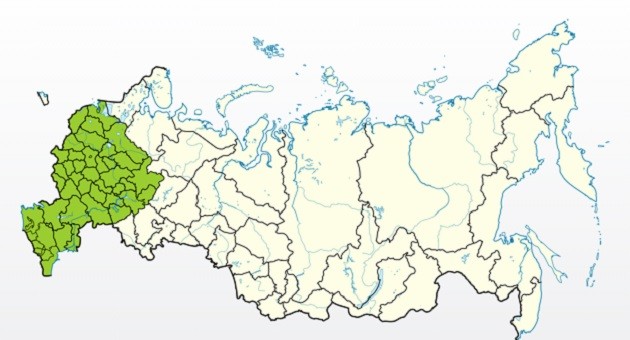
Growing regions
- Crimea.
- Middle zone.
- Leningrad region.
- North Caucasus.
- Moscow region.
Origin
In our country, and even abroad, there's very little information about the variety with the beautiful feminine name Red Katty. This apple tree was developed through open cross-pollination and natural crossing of varieties with red flesh. There are two possible countries of origin: Canada and Switzerland. It has been on the global market for approximately two decades, and during this time, it has won the hearts of gardeners in our country.
An application to register this variety in the State Register of Breeding Achievements has not yet been submitted, and the apple tree has no official zoning in Russia. It can be successfully grown not only in warm southern regions, but also throughout the central zone, and somewhat further north or east.
Content
Description of the Red Ketty variety
 This amazing variety, boldly combining extreme ornamental beauty with good productivity, immediately caught the eye of all lovers of unusual apple trees. The plant is undemanding, grows in virtually any soil, and requires little attention. These apple trees tolerate the winter cold of our country well, thrive in virtually any soil, and grace the landscape with abundant blooms in the spring, while producing unusual, beautiful fruits in the fall.
The apples are large, attractive, and most importantly, juicy and delicious. They ripen regularly on the vine without interruption, are easy to transport, and store well in a regular cellar. This variety is recommended for individual home gardens, but will also perform well in intensive planting, although the high cost of seedlings can be a significant barrier when choosing varieties for cultivation.
Apples: What do they look like?
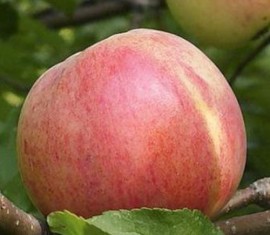
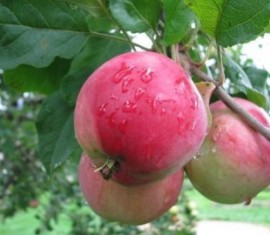
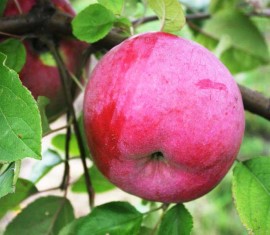
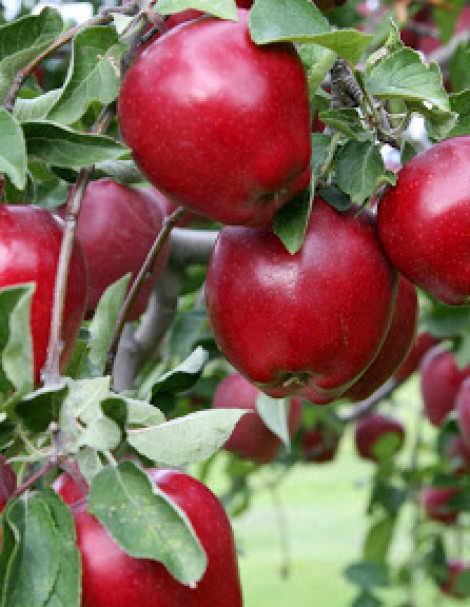
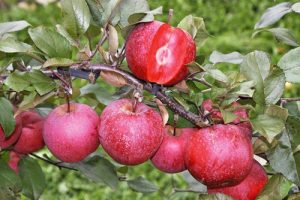 The fruits of this variety are distinguished by their characteristic shape: round, slightly flattened along the central axis, and evenly spaced. They are typically large, weighing up to 150-200 grams, sometimes even more. Ribbing may be slightly visible in the calyx area, but is indistinguishable throughout the rest of the fruit; there is no lateral suture.
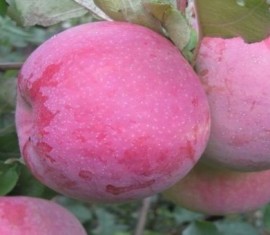
The skin is dry, highly shiny, glossy, and smooth, firm, dense, elastic, and firm, yet not thick or elastic. It has a distinct reddish-red hue, with a slight pink or crimson tint, and no underlying blush. There are numerous light-colored subcutaneous spots. They are small, often heavily rusted, and easily visible. The chemical composition can be assessed using the following data:
- P-active substances (catechins) – 424 milligrams.
- Ascorbic acid (vitamin C) – 21.6 milligrams.
- Total sugars (fructose) – 17.8%.
- Pectins (fiber) – 14.5%.
- Titratable acids – 1.18%.
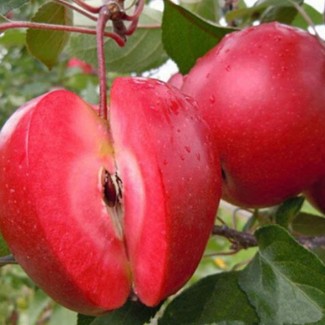
The fruit has a pleasant, easy-to-bite flesh that's crisp, tender, and juicy. It's fine-grained, quite dense, and has a wonderful aroma reminiscent of wild berries. The variety's most distinctive feature is its color—it's a deep reddish-pink, not just streaked. The juice from the apples is also red, and it remains unchanged even after any processing. Experts consider the flavor to be overly sweet, with a slight tartness, and its full flavor only develops after some storage. An official tasting evaluation has not yet been released.
Red Catty apple tree: characteristics
Crown and root system
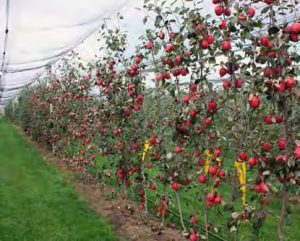 Usually, without any formation, the variety grows only up to 2.8-3.3 meters, sometimes up to 3.5, but this is rare. The crown is rounded and compact, but over the years it can become somewhat spreading, disordered, and seemingly disheveled. The branches are long, thin, and set at right angles to the main stem, usually pointing upward but can droop. They are rounded in cross-section and covered with reddish-brown or reddish-brown bark, without pubescence. Red Kitty bears fruit in a mixed manner.
The leaf blades of this variety are large, oval, dense, and leathery, with reticulated venation and a tomentose pubescence on the underside. The leaf's base color is green, but when young, it can have a reddish tint. The nerves are coarse, the tip is long and pointed, and the margins are crenate and serrated, serrated, and wavy, and can form a boat-like shape or curl upward. The root system is fibrous in most cases, well-developed, and adapted to seeking out water and various substances in the soil.
Productivity and pollination
No official variety testing has been conducted in our country, so there is little data on the actual yield of this variety; all of it comes from private individuals.
Gardeners believe that a single fully grown tree can yield at least 100-140 kilograms of aromatic, unique fruit per year. In some cases, even 150-180 kilograms have been harvested, but only with proper, timely care and favorable weather and climate conditions..
The variety is completely self-sterile, so expecting fruit without external pollinators would be futile. A wide variety of apple trees are suitable for this purpose, with no restrictions, as long as their flowering times coincide. Pollinators should be within approximately 250-300 meters, which makes the task much easier, as they can even grow in a neighbor's garden.
Winter hardiness and disease resistance
Imported varieties are typically known for their poor winter hardiness, but this is absolutely not the case with Ketty. It easily tolerates temperatures down to -30-33°C, even when they last for more than a few weeks. Caution is advised when growing trees in high-humidity conditions, as well as in areas where temperatures fluctuate constantly, from thaws to severe frosts. Winter protection should be timely and appropriate.
The variety has enviable resistance to scab and other diseases that often affect apple trees. It only becomes infected during years of extremely severe epiphytotics, and even then, not always. However, when it does become infected, it is catastrophic and severe, affecting both leaves and fruit, making them unfit for consumption.
Rootstocks and subspecies
This new foreign variety doesn't yet have any subvarieties or subspecies. However, it can be grown on various rootstocks, such as dwarf and semi-dwarf varieties. This will result in an even more compact tree and earlier fruiting.
Features of growing Red Catty
 Landing
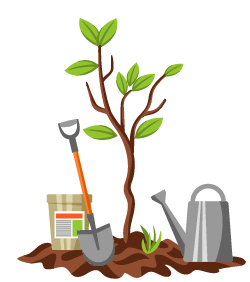 Landing
Basic conditions
- The key to successful growth of any apple tree variety, and especially for the Katya, is choosing the right planting site. It should be sunny; trees grow poorly in the shade, and may not begin bearing fruit until the fifth or sixth year, or may even refuse to bloom at all.
- Proper ventilation of the crown is a good starting point for preventing the development of various fungal infections. Therefore, the planting site should be well-ventilated, but free of drafts.
- The groundwater table should be no higher than 2.2-2 meters to prevent the tree's roots from reaching it. If this happens, they will inevitably rot and the plant will die.
- Preparing the holes the previous season is very suitable for this variety. They should be dug 55-65 centimeters deep and 80-90 centimeters in diameter—this is quite sufficient for the compact rhizomes of Red Catty. The bottom of the holes is lined with soil mixed with fertilizer, covered with stones or broken brick to a depth of 10-15 centimeters, and then filled with water (30-45 liters).
- It's common to leave approximately 2.3-2.8 meters between trees, and up to 3-4 meters between rows. This will make harvesting and maintaining the plantings much easier in the future.
- The seedlings are inspected, all dry or broken shoots are cut off, and the rhizomes are placed in water in the evening before planting.
- The tree's root collar must be raised above the ground level to prevent roots from growing higher. Otherwise, all the rootstock's properties will be completely lost.
- The drainage material inside the hole is raked into a pile in the center, the tree is placed on it, and covered with soil, compacting it gently. Care must be taken to ensure that no air pockets or voids form. The surface is watered and mulched using the standard method.
After planting, after a few days, or sometimes even weeks, depending on the soil quality, the soil may settle, forming a hole near the trunk. It's not advisable to leave the trees like this; it's better to add soil, but make sure the grafting site remains above ground..
Landing dates
This variety is no different from the common apple trees we're accustomed to. Therefore, it can be planted in either spring or fall. For spring planting, it's best to choose a warm day in late March, before the buds begin to open, while for autumn planting, it's best to choose a warm day in late September or October, after the leaves have fallen.
Tree care
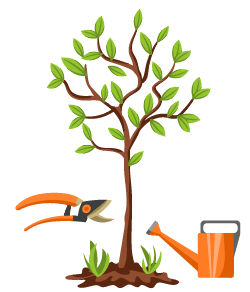 Tree care
Protection from frost and pests
Standard preparation and winter protection measures for Red Catty are sufficient. Avoid any moisture introductions in a timely manner, beginning in August before autumn. In the harshest conditions, the root zone can be covered with soil, straw, spruce branches, or hay. Trunks can be wrapped in burlap, tarpaulin, or agrofibre, while smaller trees can simply be covered with a tent-like covering.
To repel insects that happily nest in cracks and crevices in the bark, the trunks are whitewashed with a lime solution. This also gives the garden a neat and tidy appearance. To protect apple trees from rodents that feed on the bark and young branches, apply lard, fuel oil, or grease to the underside of the tree.
Loosening the soil, watering: proper agricultural technology
Gardeners typically dig around the trunk twice a year, and this is also sufficient for Ketty. You can even dig just once, removing root shoots and weeds, and simply loosen the soil with a hoe the rest of the time. Don't forget to loosen the soil the following day after watering. If the weather is dry and hot, without this, the soil may compact into a dense lump, depriving the plant of oxygen, moisture, and nutrients.
Watering is generally unnecessary for this variety; it finds its own water in the soil. However, during the driest periods, you can apply 15-25 liters of water twice a day, morning and evening, approximately 3-4 times a year. Watering can be timed to coincide with flowering, fruit set, and fruit ripening. Fertilizer can be diluted with water, but only after 3-4 years from planting.
Pruning: simple crown shaping
Training should begin in the first year if the tree wasn't pruned at the nursery. The most suitable form for it is a sparsely tiered or sparsely planted one. This way, you can fully enjoy flowering and fruiting. But the plant can also be flexibly trained in other ways, from cordons to spindles or candles.
Sanitary pruning can be done in the fall or spring as needed. Then, remove shoots that stick up, crossing and parallel branches, dry, broken, and diseased ones. Be sure to cover the cut areas with paint or garden pitch.
Reproduction
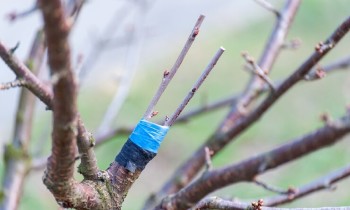
- Budding.
- Kidney grafting.
- Cloning.
- Cuttings.
Pollinator varieties
- Alva.
- Spartan.
- Auxis.
- Red Connell.
- Liberty.
- Champion.
- Ligol.
- Antey.
- Belarusian raspberry.
- Gloucester.
Diseases and pests
- Cytosporosis.
- Powdery mildew.
- Scab.
- Rust.
- Scale insect.
- Glass-box.
- Leafhopper.
- Hawthorn.
Ripening and fruiting of Red Catty
The beginning of fruiting
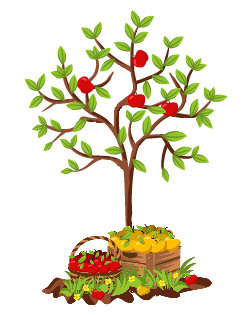 The beginning of fruiting
The trees may begin to produce flowers within the first few years after planting, but leaving them is counterproductive. Firstly, they likely won't set fruit and won't produce apples, and secondly, the plants first need to gain strength, develop rhizomes, and green mass. Therefore, Red Catty trees can be considered to begin bearing fruit in the third or fourth year.
Flowering time
Almost all autumn and winter apple trees open their buds mid-season, around mid-May, sometimes a little earlier or later. This is largely influenced by climate and weather. The flowers of this variety are very large, dark crimson or even red when closed, and turn a rich pink when open. They have delicate oval petals and long, downy peduncles.
Fruiting and growth
The tree grows 45-60 centimeters per year and matures quickly. Although the variety is considered autumn-bearing, it is recommended to harvest the fruit at the end of the season. August or early September. It won't fall to the ground, but it will store much better when not fully ripe. Technical maturity and consumer maturity don't coincide; the latter only occur after 3-4 weeks of storage in the cellar or refrigerator, when the sugars are completely caramelized.
The fruits can be transported, but careful attention must be paid to prevent mechanical damage. Otherwise, they will rot very quickly. Therefore, it's best to transport them in boxes no more than 1-3 layers deep, layered with sawdust or sand. They can be stored until February or March, provided they are kept at a temperature no higher than 5-7°C.
Top dressing
- Eggshell.
- Humus.
- Bor.
- Manure.
- Compost.
- Superphosphate.
- Copper.
- Mineral and nitrogenous complexes.
- Ammonium nitrate.
What to do if it doesn't bloom or bear fruit
- Wrap up for the winter.
- Restrict or activate watering.
- Eliminate insect infestation.
- Cure diseases.
Why do apples fall?
- Strong wind, hail, rain.
- Pests or diseases.
- Freezing.
Share your own experience with the Red Catty apple tree variety, so even novice gardeners have no questions about cultivating these trees.