Bryanskoye apple tree: characteristics of the variety and care
| Color | Reds |
|---|---|
| Ripening season | Autumn |
| Size of apples | Large |
| Taste | Sweet and sour |
| Crown type | Average tree height |
| Shelf life | Average shelf life |
| Application | For recycling , Fresh |
| Winter hardiness | High winter hardiness |
| Fruiting age | Up to 5 years |
 History of origin and regions of growth
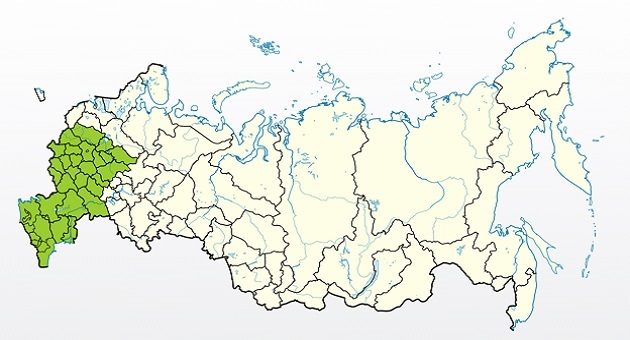
Growing regions
- Middle zone.
- Crimea.
- South of Russia.
- North Caucasus.
- Some northern regions.
- Moscow and Moscow region.
Origin
In 1987, the All-Russian Lupine Research Institute was established at the Bryansk State Regional Agricultural Experimental Station. It was in its fruit growing department, at an experimental station near Bryansk, that a new apple variety, named Bryanskoye, was developed. The selection utilized the Pobeditel variety, already well-known by then, as well as the hybrid complex form SR0523. The official author is Russian-Soviet scientist and plant breeder Alexander Ivanovich Astakhov.
The V.R. Williams Federal Scientific Center for Crops and Insemination officially applied for the variety's registration in 1993. However, it took quite some time before the application was reviewed and approved. The Bryanskoye variety was officially included in the State Register in 2001, and was then zoned for the Central and Volga-Vyatka regions.
Content
Description of the Bryanskoye variety
 The tree, grown in the vastness of Bryansk, is remarkable for its ability to adapt to a wide range of environmental conditions. It easily tolerates winter temperature fluctuations, from prolonged thaws to severe, bitter frosts, as well as summer humidity and heat. Bryanskoe bears fruit very early, requiring no pollinators, special care, frequent watering, or feeding.
The apples are truly beautiful, delicious, and juicy, with a distinctive aroma. Despite the fruit's short shelf life and poor resistance to fruit rot, the trees are recommended for both commercial orchards and small home gardens.
Apples: What do they look like?
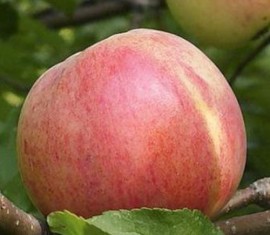
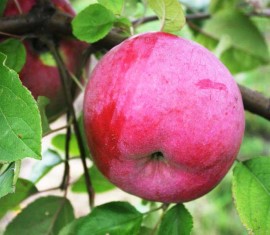
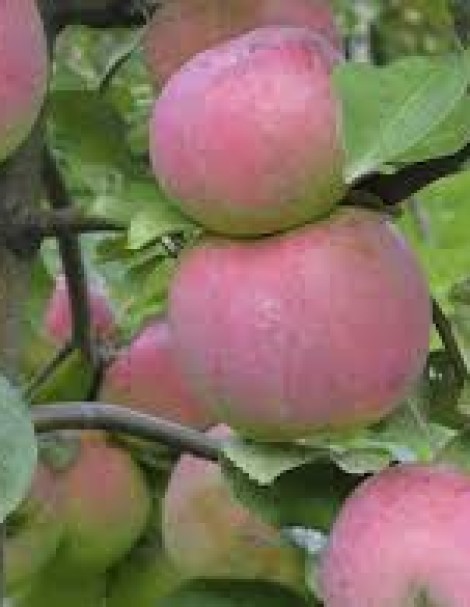
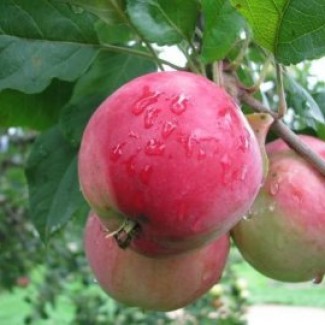
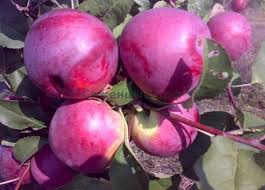 Fruit sizes range from medium to large, weighing 140-170 grams, and sometimes as much as 250-300 grams. Some gardeners report growing single specimens weighing even 400-450 grams, but this requires some effort. The fruit is either round or broadly ribbed, and may be slightly flattened along the central axis.
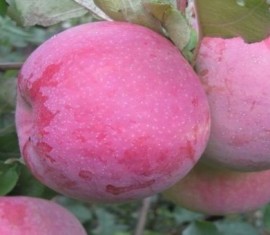
The skin is dense but rather thin and fragile, easily cracking when damaged or bitten. It is smooth and glossy. It is generally greenish or greenish-yellow in color. The blush is thick or medium-thick, blurred and mottled, reddish-pink, crimson, or even scarlet, and covers 45-90% of the surface. Subcutaneous punctures are few and far between; they are small but light, making them quite visible. The chemical composition is most easily assessed by the following indicators:
- P-active substances – 296 milligrams.
- Ascorbic acid (vitamin C) – 10.9 grams.
- Sugar (fructose) – 8.7%.
- Titratable acids – 0.44%.
- Pectins (fiber) – 11.2%.
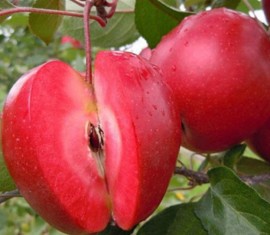
The flesh is pleasantly textured, fine-grained, juicy, medium-firm, and quite juicy. It has a distinctive dessert-like sweet-and-sour flavor, with a distinct sweetness and lemony tartness, and a powerful aroma. Professionals give these apples a tasting score of 4.8-4.9 out of 5.
Bryanskoye apple tree: characteristics
Crown and root system
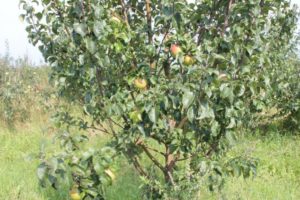 It is believed that the Bryanskoye variety medium-sized, although without pruning it can easily reach 6-8 meters in heightThe crown is oval or even pyramidal in early growth, but with age, it can become rounded, broadly oval, or even spreading. The branches are straight, fairly long and thin, directed upward, and extend from the trunk at an angle close to right angles. The shoots are covered with smooth, green or greenish-brown bark without pubescence, which turns brown and may crack, split, or crumble.
The leaves are green, deep green, sometimes emerald, large, dense, flattened, oval-elongated, rounded, leathery, glossy, and slightly wrinkled. The leaf tip is short-pointed, and the margins are serrated, crenate, and may be slightly wavy. The root system is usually fibrous, highly branched, and well-dug, adapted for the search for nutrients and moisture.
Productivity and pollination
This tree is highly valued not only for its early fruiting, but also for its good fertility, which is annual, as it does not take breaks for rest.
Experienced gardeners in Bryansk can harvest 250-300 kilograms of aromatic fruit from a single mature apple tree per season, and sometimes even more in favorable years. The record is 610 centners per hectare..
A special advantage of the apple tree is its complete and utter self-fertility. To maximize the harvest, it's not necessary to interplant different apple varieties. Even if there are no other apple trees nearby, even several kilometers away, the fruit will still be abundant. But if possible, and outside pollinators won't interfere, you can spray the trees with sugar syrup during flowering and use mobile apiaries to help with the planting.
Winter hardiness and disease resistance
Bryanskoye is highly frost-resistant, and not only that, but also sudden temperature fluctuations over a short period of time. Trees can withstand temperatures as low as -35-37°C. However, forgetting to cover the trees for the winter and properly prepare for it is also recommended. If done promptly and regularly, there will be no problems growing this variety.
The variety exhibits moderate to high disease resistance, but is completely immune to scab. Its code contains the Vm gene and polygenes that protect apple trees from scab. This is another significant advantage of the variety, attracting gardeners in our country and beyond.
Rootstocks and subspecies
Bryanskoye is grown on a variety of rootstocks, imparting slightly different qualities to the parent variety. However, there are also three main subspecies worth mentioning.
| Subspecies | Peculiarities |
| Pink | This variety is considered a high-yielding subspecies, particularly resilient to weather extremes. It produces fruits weighing 150-200 grams, with a diffuse pinkish-red blush. They ripen slightly later, in early autumn, and can be stored for 2-3 months. |
| Golden | In addition to the main subspecies mentioned above, this variety was developed using Delicious Golden and Antonovka. This makes it even more frost-resistant. The fruits are typically 180-240 grams in weight, uniform in size, and flattened. The blush is either completely absent or appears as light, translucent golden-orange spots. |
| Aloe | It differs from the previous variety by its slightly larger fruits, a rounded-elongated shape, and a bright crimson, scarlet, or bright red, continuous, blurred blush that covers 85-95% of the surface. The flesh is white and has a dense, juicy texture. It ripens in late August and keeps for 21-30 days in a special refrigerator. |
Features of growing Bryansk
 Landing
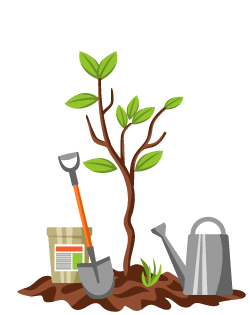 Landing
Basic conditions
- To plant this variety, choose a site that receives full sun throughout the day. In the shade, trees grow poorly, become weak, produce little fruit, or fail to bloom at all.
- It is advisable to provide apple trees with proper crown ventilation, for which the planting site should be well ventilated.
- The groundwater level should be no higher than 2.2-2.4 meters, otherwise the tree will reach the water table and begin to rot from below. Ultimately, it will likely die, as it is extremely difficult to transplant at an advanced age.
- Well-moistened loam or sandy loam, airy podzolic soil, diluted with river sand are the best options for Bryansk.
- Planting holes should be prepared 5-8 months before transplanting the trees to open ground. To do this, dig them 60-70 centimeters deep and up to 1 meter in diameter. Add soil at the bottom, diluted with humus, phosphorus-potassium fertilizers, peat, wood ash, and chicken manure. Then, add a 10-12 centimeter mound of drainage material, water the entire hole with 45-60 liters of water, and leave it outdoors.
- The trees are quite large, and their root system roughly corresponds to the size of their crown. Therefore, 5.5-6 meters should be left between holes, and 6-7 meters between rows can be convenient.
- It is impossible to deepen root collar seedling, especially if it is necessary to preserve the properties of the rootstock.
- Place the seedling vertically in the center of the hole, spreading its roots along the drainage mound. Cover with soil, compact it by hand, and water with 35-40 liters of water. To retain moisture and prevent weed growth, the surface can be mulched with grass clippings, straw, or sawdust.
Landing dates
Apple trees can be planted in either spring or fall. In the former case, it's best to wait until the soil has warmed up completely, which typically occurs around late March or early April. The key is to wait until the buds have not yet begun to grow, but also until there have been no more night frosts. In the latter case, wait until the leaves have fallen, around September or October. The first frost should be at least 3-4 weeks away.
Tree care
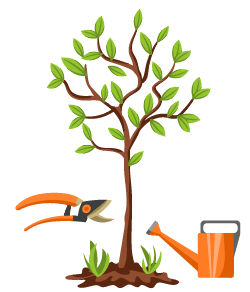 Tree care
Protection from frost and pests
Standard frost protection measures will suffice. Therefore, in very harsh climates, you can pile soil onto the roots and cover them with straw bales, hay mats, or spruce branches. Trunks can be conveniently wrapped with roofing felt, tarpaulin, burlap, or tarpaulin; young trees can be wrapped in a ball-shaped wrap.
Whitewash tree trunks twice a year, in early spring and late fall, with regular lime. This will prevent insects from nesting in the bark cracks. To repel rodent pests, you can coat the trunks with melted animal fat, fuel oil, or grease.
Loosening the soil, watering: proper agricultural technology
Initially, while the trees are young, you should dig around them twice a year and hoe 10-15 times per season. This will loosen the soil, allowing oxygen to reach the roots. However, over the years, you can do this less frequently, by about half. If you don't have the energy or time to do this, you can line the trunk with sod in the 10th to 14th year or sow aromatic, self-seeding herbs, such as dill, parsley, mint, or marjoram.
Bryansk, especially when young, needs watering during dry periods. You can apply water every two to three months, coordinating your watering according to natural precipitation. If possible, you can use drip irrigation.
Pruning: simple crown shaping
Trees typically arrive from the nursery with a well-formed crown, often sparsely layered. Optimally, it's best to simply maintain it, encouraging beneficial branching and preventing harmful branching. All branches growing inward or protruding vertically should be pruned.
Sanitary pruning can be performed throughout the growing season, immediately removing diseased, dry, or broken shoots. The cut areas (wounds) are sealed with garden pitch or at least marsh soil.
Pollinator varieties
- James Grieve.
- Idared.
- Melba.
- Mantet.
- Honey Crisp.
- Folder.
Reproduction
- Rooting.
- Kidney grafting.
- Cuttings.
- Growing from seeds.
Diseases and pests
- Bacterial burn.
- Powdery mildew.
- Cytosporosis.
- Green aphid.
- Codling moth.
- Leaf roller.
- Hawthorn.
Ripening and fruiting of Bryansk
The beginning of fruiting
 The beginning of fruiting
The variety begins bearing fruit very quickly. Already in the 3rd or 4th year after planting, it can produce several kilograms of delicious and aromatic apples. If grafted cutting to an adult tree, then you can get fruits already in the next year after grafting.
Flowering time
The Bryanskoe tree begins blooming in mid-May, but the timing can vary slightly. For example, if the weather is chilly and damp, the tree will bloom later, and if the weather is cold, it will bloom earlier. It bears large, beautiful, saucer-shaped, snow-white flowers, sometimes with a slight pinkish undertone, and possesses a powerful, spicy aroma.
Fruiting and growth
Under suitable conditions, the trees grow truly quickly, reaching 45-60 centimeters per year, or even more. Young seedlings quickly reach their full size and begin to slow down by the fourth to seventh year. They gradually increase their productivity, producing increasingly larger quantities of apples each year. A full harvest can be obtained as early as the ninth to tenth year after planting.
Apples ripen by mid- to late September, so they are considered late-autumn or pre-winter apples. They hold up very well on the branches and can easily hang until frost. However, they don't have a very long shelf life. In a special refrigerator, they will last no more than 2-3 months without losing their quality, and sometimes even less.
Top dressing
- Peat.
- Compost.
- Ammonium nitrate.
- Chicken manure.
- Superphosphate.
- Manure.
- Mineral complexes.
What to do if it doesn't bloom or bear fruit
- Check for pests or diseases.
- Transplant into the sun.
- Water.
- Fertilize.
Why do apples fall?
- Wind, hail, hurricane, rain.
- Pest damage.
- Diseases.
Please leave your feedback on the Bryanskoye variety so that other gardeners can learn from your experience and draw conclusions from it.