
Green Noise Apple Tree: Variety Features and Care
| Color | Reds |
|---|---|
| Ripening season | Autumn |
| Size of apples | Large |
| Taste | Sweet and sour |
| Crown type | Columnar tree |
| Shelf life | Average shelf life |
| Application | Fresh , For recycling |
| Winter hardiness | Low winter hardiness |
| Fruiting age | Up to 5 years |
 History of origin and regions of growth
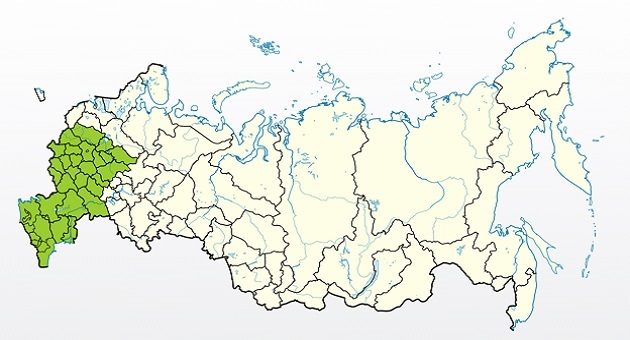
Growing regions
- Crimea.
- Caucasus.
- Some northern regions.
- Moscow region and Moscow.
- Saint Petersburg and Leningrad region.
- Middle zone.
Origin
This variety was developed at the breeding center of the All-Russian Research Institute for Fruit Crop Breeding, specifically at a station near the city of Oryol. All work was conducted under the supervision of renowned biologist Nina Glebovna Krasova, with the participation of Alexey Alekseevich Muravyov and Anna Mironovna Galashova.
Green Noise is a new hybrid that hasn't yet undergone final variety testing, but is already being actively planted by gardeners. It's not officially listed in the State Register and has no zoning, but it is recommended for cultivation in the central part of Russia, as well as slightly north and south of these regions.
Content
Description of the Green Noise variety
 Columnar apple trees attract gardeners with their compact size. They take up little space in the garden, are very decorative, and have enviable fruit production. While a single tree won't yield a lot of fruit, the yield per hectare is impressive. Green Noise doesn't require any particularly complex care; even a novice with little knowledge of agricultural techniques can grow it.
The tree's fruits are large, beautiful, and have highly desirable consumer and commercial qualities. They keep well, can be transported long distances, and are very tasty and aromatic. Despite the short fruiting period, this variety is recommended not only for small garden plots but also for commercial cultivation.
Apples: What do they look like?
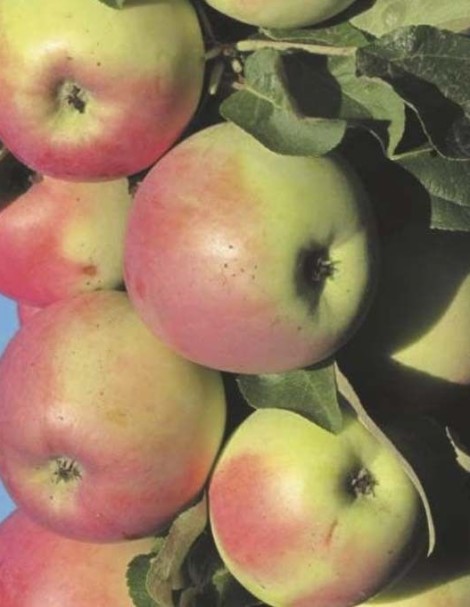
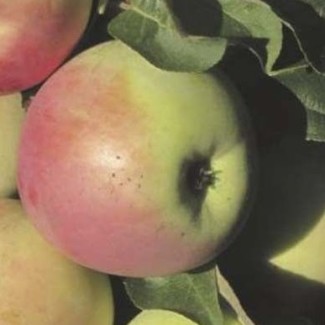
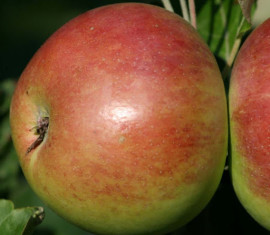
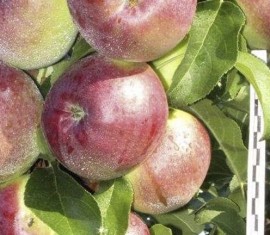
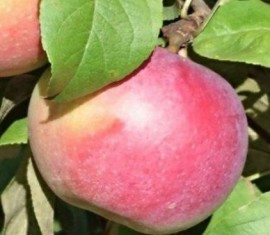
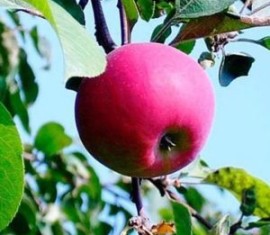
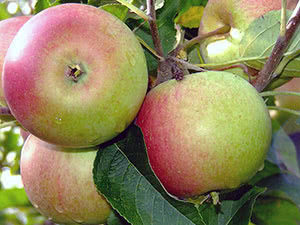 The fruits of the Green Noise apple tree are quite large, symmetrical, spherical, or slightly flattened at the stem end. They reach 190-220 grams in weight, but with proper care, timely watering and fertilizing, and favorable conditions, they can sometimes reach 230-250 grams. The apples are mostly uniform in size, but some larger or smaller specimens can be found. The ribbing is barely visible, and the side seam is completely invisible.
The fruit's skin is medium-thick but very elastic, providing excellent protection against mechanical damage. It initially has a bright green hue, but as it ripens, it acquires a yellowish and even golden tint. The sunny side of the skin has a translucent, blurred, raspberry-pink or pinkish-red, sometimes slightly orange, blush. Subcutaneous spots are almost invisible; they are light in color and small. The chemical composition is assessed according to the following parameters:
- Pectins (fiber) – 11.4%.
- P-active substances – 289 milligrams.
- Sugar (fructose) – 12.3%.
- Titratable acids – 0.67%.
- Ascorbic acid (vitamin C) – 10.2 grams.
The flesh is medium-dense, fine-grained, and has a pleasant consistency. It breaks easily when bitten, is crunchy, and is very juicy. The flavor is considered balanced and harmonious, dessert-like, sweet and sour, pleasant, and slightly refreshing. Professional tasters give Green Noise 4.4-4.6 points for appearance and flavor, respectively.
Green Noise Apple Tree: Characteristics
Crown and root system
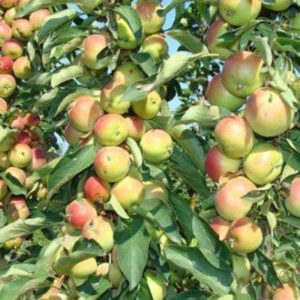 This is a medium-sized columnar plant that grows to a maximum height of approximately 3-3.5 meters, even without additional formative pruning. It grows from a single trunk, with no lateral skeletal shoots. This significantly simplifies the gardener's work, requiring virtually no pruning other than sanitary ones. The trunks are covered with smooth, shiny bark, greenish-brown or greenish-brown. Fruiting occurs on growth that is 1-2 years old.
The leaves are fairly large, dense, dark green or emerald. They are very dense and leathery, flattened, smooth, and glossy, with coarse ribbing, short-pointed tips, and slightly serrated, serrated, and sometimes slightly wavy margins. The root system, like that of almost all columnar trees, is superficial, shallow, but branched and fibrous. It is unable to hold the tree in the soil in strong winds (requiring support with a support structure), but it does a good job of finding water.
Productivity and pollination
It would be a stretch to call this variety high-yielding, but it is possible to harvest a quite reasonable amount of fruit from a given area.
Due to its small stature and fruiting directly on the trunk, a single tree can yield only 10-12, sometimes 12-15 kilograms of apples. This isn't much, but considering that a large number of compact trees can be planted in a small area, it's quite a significant yield. A hectare can yield 210-250 centners of large, high-quality apples..
The green noise is completely self-sterile, meaning it cannot serve as its own pollinator. Cross-pollination requires other trees that bloom at the same time and grow no more than 45-80 meters away. It's a good idea to bring mobile apiaries to your garden and spray the flowering crowns with sugar syrup to attract bees.
Winter hardiness and disease resistance
Shum's frost resistance is a controversial factor. Some experts say it can withstand temperatures as low as -25-27°C without special protection, while others claim it dies at -22-25°C. Ideally, it's not worth taking risks, and in harsher regions, it's better to adequately cover the trees than to worry about their survival. All standard measures, including covering them from top to bottom with tarpaulin, are also applicable to this variety.
Green Noise has a strong genetic immunity to the most common apple disease, scab, due to its Vf gene. Therefore, it doesn't require spraying with special products, but prevention is generally recommended. The trees rarely get sick, but when they do, they are severe and rapid. It's also best to protect them from insect pests.
Rootstocks and subspecies
Most columnar trees don't have any subspecies, especially new ones like this one. It can be grown on different rootstocks, imparting slightly different characteristics, such as an even more compact size or high winter hardiness.
Features of growing Green Noise
 Landing
 Landing
Basic conditions
- The variety should be grown in a sunny and well-ventilated location. Seedlings in drafts or dense shade often die within the first few days after planting.
- If the groundwater level doesn't rise above 2-2.2 meters, the trees won't be harmed. The rhizomes simply won't be able to reach the moisture. However, it's best not to plant this variety directly next to a river or pond, or in a swamp or floodplain.
- Planting holes should be prepared in the fall to allow them time to mature outdoors. To do this, dig holes 70 centimeters deep and the same or slightly larger in diameter. It's important that the roots are not bent during planting, but rather lie freely. Add 3-5 kilograms of topsoil to the bottom, mixed with 100 grams of superphosphate, potassium sulfate, and a cup of wood ash. Cover this with drainage material or another few kilograms of soil, then add 25-30 liters of water.
- Immediately dig or drive supports into the holes to support the trees. These should not be removed until at least two or three fruiting seasons, and ideally, never.
- Root collar When planting trees, the stem should not be buried deep. It should protrude above the surface by at least 4-6 centimeters.
- The seedling is positioned at a right angle to the horizon, the roots are spread out by hand, and covered with soil, compacting it well. A mound of soil, approximately 5-7 centimeters high, is built around the perimeter of the filled hole, and 15-20 liters of water are poured inside. The surface can be mulched to retain moisture longer.
Landing dates
In any climate zone, except perhaps the warmest and southernmost, it's best to plant columns in the spring. Over the summer, they'll have time to adapt to the new environment quite well, grow new roots, and grow stronger for the winter. Trees with closed root systems can be transplanted to the ground at any time; they usually take root well, as they remain in the same root ball in which they were raised.
Tree care
 Tree care
Protection from frost and pests
All such heat-loving apple trees must be carefully prepared for winter, otherwise they risk dying. The root area is covered with straw bales or mats of hay, dried leaves, and spruce branches. This will protect them from freezing. The trunks are wrapped with roofing felt, burlap, tarpaulin, and even tent-like coverings.
To reduce the risk of insect infestation, tree trunks are whitewashed with lime diluted with water. This treatment is carried out in the spring and fall. Lubricating trees with animal fat, fuel oil, or grease helps repel rodents.
Loosening the soil, watering: proper agricultural technology
Dig the tree trunk area twice a year. Ideally, this should be done in early spring and late fall, before the sap begins to flow. Hoeing the soil more frequently, as needed. Regularly remove weeds, shoots, and root suckers, as these can rob the seedling of nutrients.
Watering Trees need regular watering, as their roots can't penetrate very deeply. The ten-day rule can be used as a guideline. This states that watering should be done once every ten days if there is no rain. If natural precipitation does occur, then the ten-day period is counted from there. During extremely dry and hot periods, watering can be increased to once or twice a week.
Pruning: simple crown shaping
The tree doesn't produce skeletal branches, but if you notice any, the shoots should be cut off immediately before they become woody. All cut areas should be carefully sealed with water-based paint or garden varnish to minimize stress. The tree's height is pruned once or twice, once a year, after which it's left alone, and the top is cut off only when the frost reaches a living bud. Dried fruiting shoots are cut off at the base.
Pollinator varieties
- Antonovka.
- Mantet.
- Ostankino.
- Korobovka.
- Raditsa.
- Currency.
- Chervonets.
- Poetry.
- Titovka.
- Melba.
Reproduction
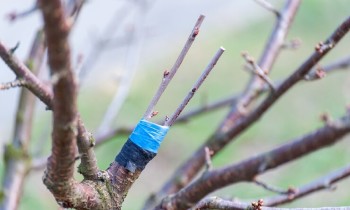
- Kidney grafting.
- Rooting cuttings.
- Grafting by cuttings.
- Growing from seeds.
Diseases and pests
- Powdery mildew.
- Cytosporosis.
- Pit bitterness.
- Green aphid.
- Codling moth.
- Scale insect.
- Leaf roller.
- Hawthorn.
Ripening and fruiting of Green Noise
The beginning of fruiting
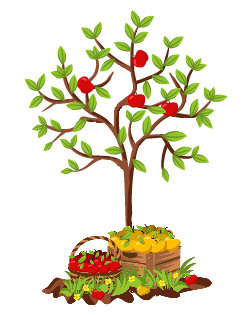 The beginning of fruiting
Almost all columnar apple trees begin bearing fruit very early, and this variety is no exception. It begins to bloom in its very first year, even in the nursery, and is quite capable of producing and ripening apples. However, advanced gardeners usually pick all the first-year blossoms and allow them to develop only in the second or third year. At that point, you might only harvest a few apples, but they'll be large and beautiful.
Flowering time
The 'Green Noise' tree typically blooms at a medium time, beginning in the second ten days of May. Around the 12th-15th, the flowers begin to open and bloom until the 20th-25th, a fairly long time. The tree's flowers are beautiful, very large, with delicate, pleated petals that densely cover almost the entire trunk. They make the plant very decorative, a true highlight of the garden.
Fruiting and growth
The Shuma can easily reach 55-70 centimeters in just one year, making it considered a fast-growing tree. Therefore, in just a couple of years, it becomes a full-fledged tree, simultaneously increasing its fruitfulness to its maximum. A significant drawback is its short lifespan. It can bear fruit for no more than 10-15 years, after which it grows, but the fruiting pods gradually die off, and the yield declines. Experienced commercial gardeners prefer to replace the trunks every 10-12 years to always stay on top of the crop.
Apples ripen late, in late September, and sometimes even early October. They can be picked a little earlier, before they reach consumer maturity. They hold up well and won't fall, but they keep better if they don't sit on the tree too long. In a special refrigerator with the right humidity, they retain their properties and quality until January, and in a cellar, they'll last until mid-December. By then, they should be fully processed or eaten.
Top dressing
- Ammonium nitrate.
- Mineral complexes.
- Chicken manure.
- Peat.
- Superphosphate.
- Compost.
- Manure.
- Humus.
- Humus.
What to do if it doesn't bloom or bear fruit
- Inspect for diseases or pests.
- Organize timely regular watering.
- Fertilize.
- Transplant to a more suitable location.
Why do apples fall?
- Natural weather disturbances.
- Pest damage.
- Various diseases (except scabies).
Please share your own experience with the Green Noise apple variety so that everyone can learn about it and avoid potential mistakes when growing their own garden.

Comments
Dear colleagues! The "Green Shum" apple variety was developed by a team of scientists led by Academician E.N. Sedov, N.G. Krasova and A.M. Galasheva are employees of the institute's variety testing laboratory, and A.A. Muravyov is a specialist in fruit tree pruning and training. Sincerely, former chief researcher of the All-Russian Research Institute of Fruit Crops, Doctor of Agricultural Sciences E.A. Dolmatov.