Senator apple tree: characteristics of the variety and care
| Color | Reds |
|---|---|
| Ripening season | Autumn |
| Size of apples | Large |
| Taste | Sweet and sour |
| Crown type | Columnar tree |
| Shelf life | Average shelf life |
| Application | Fresh , For recycling |
| Winter hardiness | High winter hardiness |
| Fruiting age | Up to 5 years |
 History of origin and regions of growth
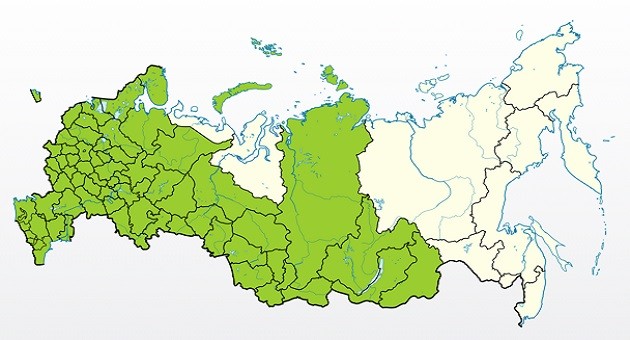
Growing regions
- North Caucasus.
- Crimea.
- Northern regions (partially).
- Moscow region.
- Middle zone.
- Ural.
- Leningrad region.
- Siberia.
Origin
The breeding of columnar apple trees in our country is primarily concentrated at the All-Russian Institute of Horticulture and Nursery in the Moscow region. Under the guidance of renowned breeder Viktor Valerianovich Kichina, many new varieties were developed, including Senator. This new variety was first recognized as an elite variety only after 2010.
The parent varieties used were presumably Brusnichnoe, a source of winter hardiness, and the Vf KV-102 gene, a donor of the columnar growth habit. Complex hybrids, which impart resistance to scab and other infectious fungal diseases, were also used in the hybridization. The variety has not yet been entered into the State Register and has not yet been officially zoned.
Description of the Senator apple variety
This is precisely the apple tree whose merits are truly difficult to overstate. Senator is early-bearing, frost-tolerant, and disease-resistant. It's undemanding of soils and requires little maintenance, yet boasts an outstanding yield per hectare. Despite its short lifespan, average fruiting period, and poor shelf life, it's recommended for both large, intensive commercial farms and small home gardens.
Content
Description of the Senator apple variety
 This is precisely the apple tree whose merits are truly difficult to overstate. Senator is early-bearing, frost-tolerant, and disease-resistant. It's undemanding of soils and requires little maintenance, yet boasts an outstanding yield per hectare. Despite its short lifespan, average fruiting period, and poor shelf life, it's recommended for both large, intensive commercial farms and small home gardens.
Apples: What they look like
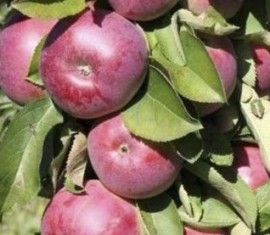
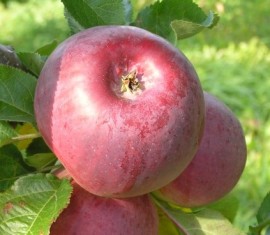
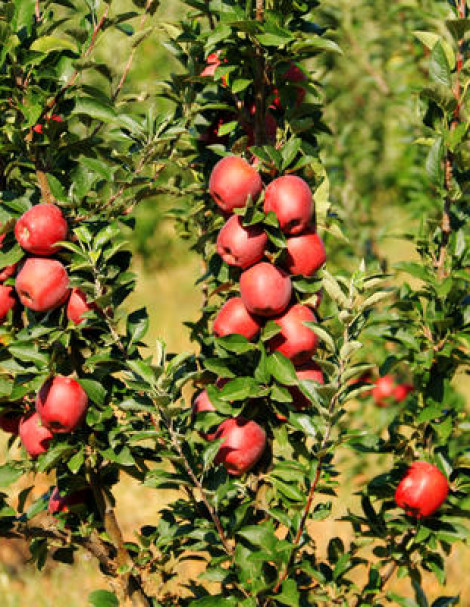
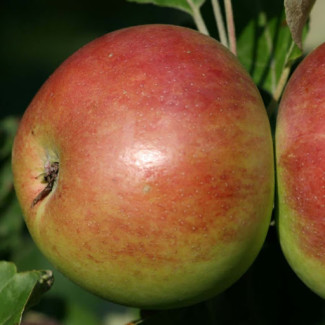
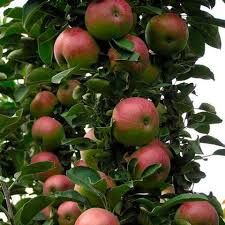 The fruits are symmetrical but can be uneven, weighing from 130-150 grams to 270-300 grams. Size largely depends on flowering regulation (bud thinning). The fruits are round or flattened, and may be slightly turnip-shaped.
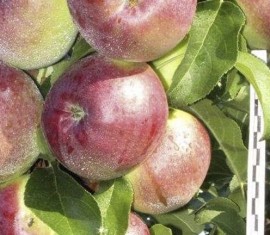
The skin is dense, elastic, strong, but quite thin, with a greenish or greenish-yellow hue. It is 55-75% covered with a fuzzy, sometimes slightly mottled, blush of red-burgundy, carmine-red, or raspberry color. During ripening, it becomes covered with a dense waxy-oily coating. Subcutaneous dots are small but numerous and clearly visible. The chemical composition is most easily assessed by the following factors:
- P-active substances – 412 milligrams.
- Ascorbic acid (vitamin C) – 12.6 grams.
- Sugar (fructose) – 10.1%.
- Titratable acids – 0.42%.
- Pectins (fiber) – 6.5%.
The flesh is medium-dense, but rather soft, slightly crunchy, not at all prickly, fine-grained, and very juicy. It's creamy or slightly greenish in color, sweet and sour, and considered a dessert fruit, harmonious and balanced. Experts give the Senator 4.5-4.7 out of 5 stars for taste and appearance.
Apple tree Senator: characteristics
Crown and root system
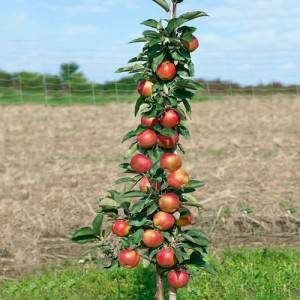 Despite its columnar shape, the tree is considered tall, because It can easily stretch to 4-6 meters without any formative pruning.This allows for high yields from standard trees. The tree's crown is compact, no more than 0.5 meters in diameter, allowing for a standard planting of 20,000 trees per hectare. It grows as a single trunk, covered in reddish-brown or dark brown bark, sometimes with a greenish tint. Fruiting occurs on one- and two-year-old fruiting canes, spurs, and spears.
The leaves are large, green or dark green, dense, leathery, predominantly shiny, glossy, and coarsely ribbed. They are elongated, oval, and short-pointed, with tips that can curl downwards like propellers. The edges are serrated, serrate, and wavy. The root system is fibrous, branched, and lacks a central taproot. It is moderately deep and well adapted to the search for water and nutrients.
Productivity and pollination
This variety is considered high-yielding, not only among columnar trees. It looks very attractive compared to many dwarf and semi-dwarf varieties.
A single mature, tall, mature Senator tree can yield 15-17 kilograms of large, attractive fruit with proper care and favorable weather and climate conditions. This equates to approximately 160-200 tons per hectare at standard planting density..
Senator is conditionally self-fertile, which is considered a special advantage. Even without any other apple trees within 50-100 meters, you can still get a harvest. It will be more meager, no more than 35-55% of the maximum, but at least you'll get something. Experienced gardeners recommend interspersing the trees to maximize yields. It's a good idea to use mobile apiaries during flowering, as well as spraying the branches with a honey or sugar solution.
Winter hardiness and disease resistance
The Senator is quite cold-tolerant, so it can be planted even in the Urals or Siberia. It can withstand temperatures down to -27-32°C for quite a long time, even with minimal cover. However, it's important not to forget about winterization. The tree dislikes sudden temperature fluctuations, large swings from severe frost to thaw, blustery cold winds, and icing. It needs to be properly prepared for the cold season.
The variety has a strong, inherent immunity to scab in the form of the Vf gene, acquired from its parents. It is never affected by any of the races. scabies, which makes life much easier for gardeners. Other diseases and insect pests can easily damage trees, so neglecting regular preventative maintenance would be a bad idea.
Rootstocks and subspecies
The variety is completely new and hasn't yet been thoroughly tested by gardeners, so it's too early to talk about subvarieties. It's unclear whether they will appear in the future, as no breeding work is currently underway. Apple trees can be grown on a wide variety of rootstocks, from vegetative seedlings to dwarfs, semi-dwarfs, and even wild varieties. All of these have little effect on the fruit itself, although they may slightly affect their size, but they have a significant impact on the tree's height.
Features of growing Senator
 Landing
 Landing
Basic conditions
- A sunny, open, but well-protected location from drafts is best for planting this variety. The space should allow the crowns to breathe, but piercing winter winds can easily kill the plants.
- Soil acidity plays a key role when choosing a garden site. If it's significantly elevated, it's best to immediately neutralize it. This is usually accomplished with regular lime. Otherwise, Senator has no specific soil requirements: it grows well in sandy loam, clay loam, rocky slopes, and black soil.
- The tree's roots are quite deep and can easily find groundwater, even at a depth of 2-2.3 meters. Therefore, planting apple trees near water close to the surface is not recommended, as this can cause rot. It is not recommended to plant apple trees near rivers, streams, springs, ponds, or lakes, or near shallow wells.
- Preparing the holes in advance is a good idea, as this will allow the soil and fertilizer to mature, ensuring the tree thrives from day one. To do this, dig holes 80x90 centimeters (32x36 inches), fill the bottom with fertile soil mixed with organic matter and minerals, and then add rocks or vermiculite for drainage if needed. Fill the entire hole with water and leave it uncovered. At a minimum, the hole should sit for 3-4 weeks, but it's best to dig it a season before planting.
- Plants in a row are typically spaced 60-90 centimeters apart, depending on the rootstock the apple trees are grafted onto. Rows are spaced 1-1.2 meters apart. This is sufficient for comfortable growth.
- Planks, stakes, or any other supports for tying the tree up are dug or driven directly into the holes. It's best to position them on the north side of the trunk.
- Root collar It's customary to leave at least 9-12 centimeters above the soil surface to prevent roots from growing higher. If this happens, the rootstock's properties will be completely lost.
- Place the seedling in the hole, adding drainage or soil in a pile in the center, spreading the roots, and holding it vertically. Fill the hole in layers, compacting the soil by hand, ensuring there are no air pockets. Water the top (35-50 liters), and mulch the surface with sawdust, manure, or chopped grass.
Landing dates
In warm and temperate regions, Senator is best planted in the fall, around late September or October, after the leaves have finished falling. Make sure frost doesn't arrive for at least 3-4 weeks, otherwise the tree may freeze. In more northern regions, where the climate is less favorable and more severe, it's best to postpone planting until spring. Even if you purchased seedlings in the fall, you can bury them at a 45° angle, cover them properly, and leave them until the weather warms up.
Tree care
 Tree care
Protection from frost and pests
Senator trees can be protected for the winter using all the standard methods used for other apple trees. They require covering the root zone if winters in the region are frosty. The root zone is covered with soil, dry leaves, grass, straw, spruce branches, and even polystyrene foam. The trunks are wrapped in fabric, such as burlap or agrofibre. A tarp or film can be used to create a ball-shaped shelter. The main thing is to remove all this in early spring, as soon as the last frost has passed.
To repel insects that tend to overwinter in bark crevices near the roots, whitewash the trunks with lime in the spring and fall. Rodents also cause inconvenience and damage, chewing the bark and even tender young shoots during cold weather. They can be repellent by smearing the trunk with lard, drying oil, old, poor-quality sunflower oil (unrefined or rancid), or grease.
Loosening the soil, watering: proper agricultural technology
Regularly cultivating the soil under a tree is essential, but digging around the tree trunk is sufficient only once or twice a year. This is usually done in the fall and spring, with the soil simply hoeed in between. Root suckers, weeds, and other plant shoots are also removed. Some people seed the area under fruit trees with lawn grass, but it's much more beneficial to sow lemon balm, parsley, mint, celery, dill, and calendula, which help maintain natural aeration.
The tree can find its own water, but regular watering, especially during hot and dry periods, is essential. If there's been no rain for 10-14 days, apply approximately 25-40 liters of water per mature apple tree, divided into two portions: morning and evening. Before wintering, around mid-September, all watering should be stopped completely; otherwise, the tree won't have time to prepare for the frost and will die.
Pruning: simple crown shaping
Forming columns isn't as easy as it might seem. They periodically tend to send out side shoots, which must be ruthlessly cut back. Only two main trunks are left, growing at a very sharp upward angle. Then, in the fall, the weaker one is cut back, and in the spring, another one is allowed to develop again, and this continues constantly, choosing the top that bears the most fruit.
Senator doesn't require any rejuvenation, as its lifespan is already short. However, dry shoots and fruiting twigs will need to be trimmed regularly. You should also keep an eye out for broken branches and frozen tops. If a bud near the top freezes, it will need to be cut off and a new one grown. Otherwise, fruiting may cease.
Pollinator varieties
- Jonathan.
- Vazhak.
- Chervonets.
- Triumph.
- Borovinka.
- Gin.
- Yesenia.
- Dialogue.
Reproduction
- Rooting.
- Kidney grafting.
- Growing from seeds.
- Cuttings.
Diseases and pests
- Black crayfish.
- Bacterial burn.
- Green aphid.
- Codling moth.
- Leaf roller.
- Hawthorn.
Ripening and fruiting of Senator
The beginning of fruiting
 The beginning of fruiting
The first fruits can be picked quite early, as this variety is considered not only fast-growing but also early-bearing. By the second to fourth year, the tree will bear up to 5-7 kilograms of fragrant, juicy, and delicious fruit. Flowers may appear earlier, but it's best to pick them off immediately.
Flowering time
Senator buds open in May, but the exact timing depends directly on the climate and weather. This could be early, mid, or even late in the month. It's important to deadhead the blossoms completely in the first few years so the tree doesn't waste energy on them and instead builds up foliage and roots. Blooming is abundant, with large, beautiful flowers, snow-white or with a slight pinkish tint, very fragrant, gathered in clusters of 6-8. This process can last 10-18 days, also depending on the weather.
Fruiting and growth
The tree can easily grow 55-70 centimeters in the first few years, reaching its maximum height very quickly. However, after fruiting begins, this extreme growth slows down. Fruiting begins fully around the sixth to eighth year. To maximize yield, experienced gardeners recommend regulating the flowering process by removing 35-50% of the flowers.
Autumn apples ripen in the second half of September, but in poor weather they can be delayed until early October. They ripen evenly, almost all at once, allowing them to be picked in one go. There's no need to rush harvesting; they cling tightly to the branches. The harvest can be stored until early spring, but in some cases, with a good cellar, they can be kept until the end of May.
Top dressing
- Peat.
- Compost.
- Ammonium nitrate.
- Humus.
- Superphosphate.
- Manure.
- Mineral complexes.
What to do if it doesn't bloom or bear fruit
- Check for pests or diseases.
- Transplant into the sun.
- Water.
- Fertilize.
Why do apples fall?
- Wind, hail, hurricane, rain.
- Pest damage.
- Diseases.
Please leave your feedback on the Senator variety, as many gardeners would like to grow similar varieties in their gardens.