Yellow Sugar Apple Tree: Variety and Care Features
| Color | Yellow |
|---|---|
| Ripening season | Summer |
| Size of apples | Average |
| Taste | Sweet |
| Crown type | Tall tree |
| Shelf life | Low shelf life |
| Application | Fresh , For recycling |
| Winter hardiness | High winter hardiness |
| Fruiting age | Up to 5 years |
 History of origin and regions of growth
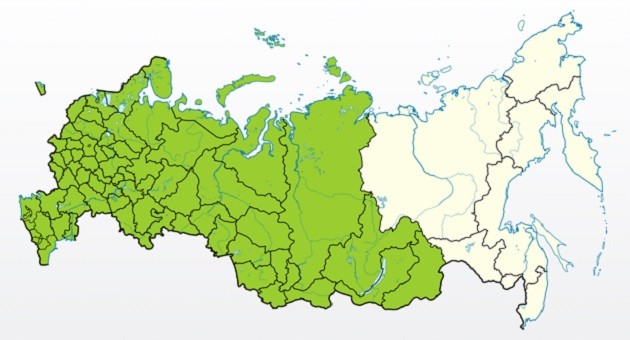
Growing regions
- Crimea.
- Middle zone.
- Leningrad region.
- Ural.
- North Caucasus.
- Siberia.
- Moscow region.
- Far East.
Origin
The development of the new variety in the post-war period was undertaken by the renowned Soviet pomologist G. A. Belov. He worked on the Kirov collective farm in the Kubeno-Ozersky district of the Northern Territory (now the village of Zhutovo in the Vologda Oblast).
The State Register of Breeding Achievements contains absolutely no information about this variety, and it currently lacks official zoning. Therefore, it is impossible to determine the exact origin of this apple tree. It is easily cultivated in virtually all regions of Russia, from the southern regions to the Far North, and in the western, central, and eastern regions.
Content
Description of the Yellow Sugar variety
 A very large tree with a dense, heavily foliated crown, it is characterized by rapid growth and regular annual fruiting. It is undemanding of soil, easily adapts to various climates, is winter-hardy, and requires little in the way of soil, watering, or fertilizer. It blooms profusely, becoming a truly decorative landscape element, and produces a significant amount of fruit.
The fruits themselves are attractive to look at, very tasty, and have a very pleasant, powerful, distinctive aroma that's hard to confuse with anything else. These summer apples are rich in various nutrients and so sweet that they can be cooked without adding sweeteners, which is especially valuable for those suffering from endocrine problems (like diabetes). The fruits are easy to transport, but they don't keep well for long. This variety is recommended for home gardening and for commercial intensive orchards specifically designed for processing.
Apples: What do they look like?
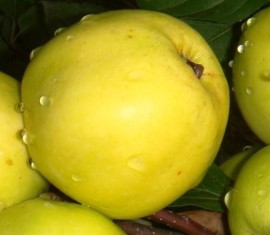
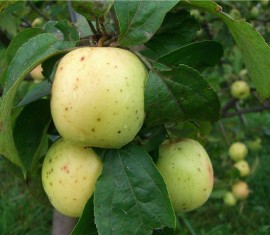
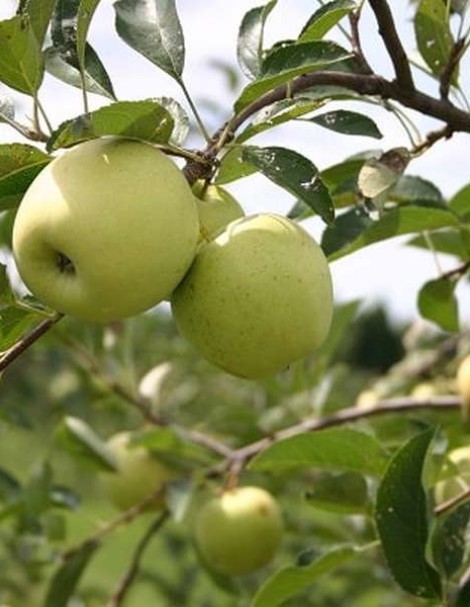
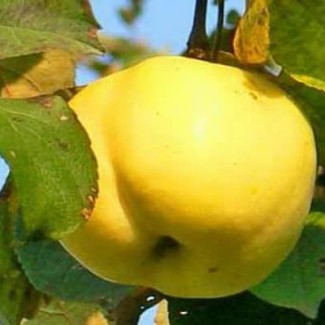
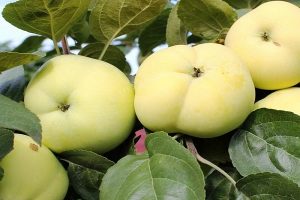 The fruits are medium to medium-large in size, weighing approximately 120-150 grams. They are round, uniform, symmetrical, and uniform in shape, spherical in shape, sometimes slightly flattened along the central axis horizontally or slightly elongated. Ribbing is visible near the calyx, smoothed out on the rest of the fruit, and the lateral suture is not visible.
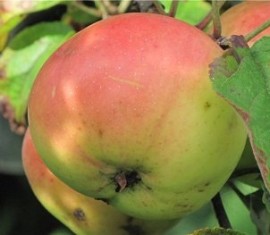
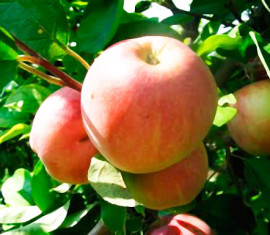
The fruit's skin is dense, smooth, shiny, and dry, but may develop a bluish-silver waxy coating when fully ripe. It is thin, yet strong and elastic, offering good protection against mechanical damage. Apples have a light green or deep yellow base color, with virtually no blush, though faint red-orange or brick-red streaks may appear on the sunny side. Subcutaneous punctures are numerous; they are small, inconspicuous, and light in color. Experts recommend assessing the chemical composition based on the following data:
- P-active substances (catechins) – 124 milligrams.
- Ascorbic acid (vitamin C) – 7.4 milligrams.
- Total sugars (fructose) – 13.7%.
- Pectins (fiber) – 11.1%.
- Titratable acids – 0.37%.
The Yellow Sugar Apple has a distinctive, coarse-grained texture, yet it's juicy and very tender, not prickly but slightly crunchy. It has a powerful apple aroma. The flavor is considered harmonious, balanced, and dessert-like. It's sweet and sour, with a strong sweetness and a slight tartness that lingers in the aftertaste. The fruit's tasting score is 4.7 out of 5 for both taste and appearance.
Yellow Sugar Apple Tree: Characteristics
Crown and root system
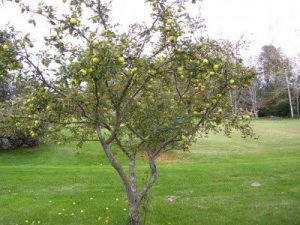 Trees of this variety are tall and fast growing, They can easily reach 7-9 meters in height without formative pruning.The crown is broadly oval, spreading with age, moderately dense, and can become weeping or drooping. The shoots are medium thick, extending at right angles to the trunk, straight, long, and directed upward, covered with greenish-yellow or brown bark. Yellow bears fruit on ringlets and fruiting shoots for 2-3 years.
The leaves are elongated, not lanceolate, but rather ovate, dense, leathery, and long-pointed. They have a slight matte sheen and a felty pubescence on the underside. They are light green or slightly yellowish in color, with serrated, slightly wavy, and crenate-serrate edges. The root system is very robust and branched, fibrous on most rootstocks, with numerous small branches. It covers an area roughly equal to the crown diameter.
Productivity and pollination
There is no official data on this issue, but it is optimal to classify the tree as having an average productivity type.
From one adult Yellow Sugar tree, you can collect approximately 100-120 kilograms of aromatic sugar fruits per season..
The variety is self-sterile, which is generally considered a drawback. To produce fruit and ovaries, it requires external pollinators, which should grow no more than 25-50 meters away for a successful process. It is advisable to spray the trees with sugar syrup during flowering in the spring and use mobile apiaries.
Winter hardiness and disease resistance
The variety has enviable resistance to low temperatures. Even in severe and prolonged frosts, the trees are virtually unaffected by freezing, and if buds are slightly damaged, they recover very quickly. Standard shelter is sufficient even in the coldest regions. They tolerate drought a little less well, but with timely watering, they do not suffer from lack of moisture or sunlight. burns even in extreme heat.
Sakharny trumpet has an average resistance to diseases, meaning it only becomes susceptible to disease during years of severe epidemics, and even then, only in the absence of timely preventative treatments. High humidity and drafts, as well as uncleaned tree trunks full of rotting fruit and leaves, can trigger fungal growth. Therefore, it is recommended to maintain hygiene and humidity, as well as regularly treat with fungicides and insecticides.
Rootstocks and subspecies
No subspecies of the Yellow Sugar variety are officially registered. However, it can be grown on various rootstocks, which slightly alters the tree's properties but does not affect the quality of the fruit. There are no columnar or creeping varieties of this variety, so be careful and cautious when purchasing.
Features of growing Yellow Sugarcane
 Landing
 Landing
Basic conditions
- Almost any soil is suitable for apple trees, as long as it is loosened, moistened, and fertilized regularly. Loams, sandy loams, and podzolic soils are the best options. Apple trees don't like heavy black soil, which will require diluting with river sand, or highly acidic and saline soils.
- The trees tolerate drafts well, but they can become slightly ill, so it is better to plant the variety in protected areas, but without stagnant air.
- Trees don't tolerate stagnant water, so they shouldn't be planted where groundwater is close to the surface. Floodplain meadows, swamps, or directly next to a pond, river, lake, or stream are unsuitable locations. Even near shallow wells, apple trees can reach the water with their roots and die.
- A sunny, open space suits Yellow best; in the shade it grows poorly and may not bloom or bear fruit for many years or even die altogether.
- Experienced gardeners always dig holes for apple trees well in advance, the season before. However, this isn't necessary for this variety. It's enough to dig the holes 3-4 weeks before planting. They should be approximately 60-80 centimeters deep and up to 1 meter in diameter. Fertilizer is placed at the bottom, followed by stones or vermiculite for drainage, then the entire thing is filled with water and left uncovered.
- Leave sufficient space between trees in a row—at least 4-5 meters, and between rows up to 5-6 meters, depending on the rootstock used. This will prevent trees from interfering with each other in the future, either with their crowns or rootstocks.
- Trellis, planks, or stakes are immediately driven into the holes for support. If they are positioned on the north side of the tree trunk, they will provide additional protection from cold winter winds.
- The root collar is left 4-8 centimeters above the surface to prevent roots from appearing higher, otherwise the properties and qualities of the rootstock will be completely lost.
- The seedling is inspected for broken or dry shoots and suckers, and these are removed. You can soak the rhizomes in warm water for 5-8 hours before planting.
- Place the young tree on drainage, straighten the roots, sprinkle with soil, tamp, water and mulch with sawdust, chopped grass, compost, manure.
Landing dates
The usual planting dates for fruit trees in the region are also suitable for the Yellow Sugar Tree. In spring, it should be transplanted into the soil before the sap begins to flow in the trunks, around late March or early April. In the northernmost regions, it can be moved to mid-month, although even young seedlings are not particularly susceptible to recurrent frosts.
In autumn, it's best to choose a time when the leaves have already fallen. However, it's important to leave 5-6 weeks, or at least a month, before the onset of severe, persistent frosts. The optimal time is late September or early October. In southern regions, trees can be planted even as late as late October if the cold weather typically arrives late and isn't characterized by severe frosts.
Tree care
 Tree care
Protection from frost and pests
In temperate climates, trees don't require much shelter; wrapping the trunks in burlap is sufficient. However, in colder, northern climates, it's better to cover young saplings with a tent-like covering, and older trees should be wrapped with roofing felt or tar paper, with soil piled up around the roots and covered with spruce branches, straw, or hay.
To prevent rodents from eating young shoots and tender bark, tree trunks are coated with fuel oil, lard, grease, or other commercially available products. Whitewashing with lime effectively repels insects, while also giving the garden a neat and attractive appearance. Regular treatments with insecticides and fungicides are necessary to minimize the risk of disease.
Loosening the soil, watering: proper agricultural technology
Gardeners dig around the trunk twice a year, or even just once if the soil is well-aerated. They dig halfway with a spade to avoid damaging the roots. Hoeing can be done throughout the growing season. At the same time, remember to remove weeds, rotting leaves and fruit, and any debris that could promote disease.
Trees should be watered only during dry periods and when young. Young trees can be watered once every 10-14 days, while older trees will benefit from 5-6 waterings per season. On the second day after watering, loosen the soil to prevent it from compacting. As the trees get older, you can stop digging and sow the root zone with herbs or grasses.
Pruning: simple crown shaping
Sugar lily has a clear tendency to become overly dense, so pruning is sufficient. It's best to begin in the first year, creating a sparse or sparsely layered crown so that shoots are spaced widely apart at different heights. Pruning should be done annually in the fall, removing any inward-growing or vertically protruding branches to prevent excessive overgrowth.
Tree pruning can also be done in the fall or spring. At that time, it's customary to prune away broken, diseased, dead, or damaged branches. All cut areas should be sealed immediately or the next day. garden pitch, paint or just primer.
Pollinator varieties
- Anniversary boy.
- Ranetki.
- Glory to the victors.
- Summer striped.
- Pepinka.
- White filling.
- Candy.
- Melba.
- Kovalenkovskoye.
Diseases and pests
- Cytosporosis.
- Pit rot.
- Powdery mildew.
- Scab.
- Scale insect.
- Green aphid.
- Hawthorn.
Ripening and fruiting of Yellow Sugar
The beginning of fruiting
 The beginning of fruiting
This variety is generally considered early-bearing, although the first fruits can only be harvested in the fourth or fifth year after planting in open ground. Flowers may appear earlier, as early as the third or fourth year, but they are unlikely to produce fruit; they are sterile. Therefore, it is recommended to pluck all buds so the tree can develop roots and branches without wasting its energy on useless blooms.
Flowering time
Buds open on the tree around early May, but as you move further from the temperate zone, the timing can shift significantly toward summer. In some regions of Siberia and the Urals, Sakharnoe can bloom as late as early June. It usually has plenty of pollinators, and the blooming period lasts at least 14-17 days. The flowers themselves are large, fragrant, beautiful, and snow-white, densely covering the branches. However, the ovaries are prone to shedding, so it's best to stunt the blooming process by 15-35%.
Fruiting and growth
Trees not only begin bearing fruit quite early but also grow rapidly, reaching at least 45-60 centimeters per season. They also rapidly increase their productivity. By 8-10 years, yields are almost fully realized, and this level is maintained throughout the tree's active life.
The fruits are among the first to ripen in the garden, allowing you to enjoy the fragrant fruit around August 15th-20th. In the northernmost regions, technical maturity, which coincides with consumer maturity, can be delayed until the end of August, but not later. They ripen very uniformly and should be picked immediately to prevent them from falling to the ground. They are easy to transport and are excellent for processing (juices, dried fruits, jams, jellies). But they practically can't lie down. The maximum period of injury in a special refrigerator is 30-45 days, sometimes up to 60, but not more.
Top dressing
- Peat.
- Superphosphate.
- Humus.
- Bor.
- Calcium.
- Manure.
- Compost.
- Ammonium nitrate.
What to do if it doesn't bloom or bear fruit
- Limit or increase watering.
- Eliminate insects.
- Cure diseases.
- Feed.
- Transplant to a sunny place.
Why do apples fall?
- Wind, frost, rain, hail.
- Overripe.
- Pests or diseases.
Leave a review of the Yellow Sugar apple tree variety so that even a novice gardener can receive useful information firsthand.