Geneva apple tree: characteristics of the variety and care
| Color | Reds |
|---|---|
| Ripening season | Summer |
| Size of apples | Average |
| Taste | Sweet and sour |
| Crown type | Average tree height |
| Shelf life | Low shelf life |
| Application | For recycling , Fresh |
| Winter hardiness | Low winter hardiness |
| Fruiting age | Up to 5 years |
 History of origin and regions of growth
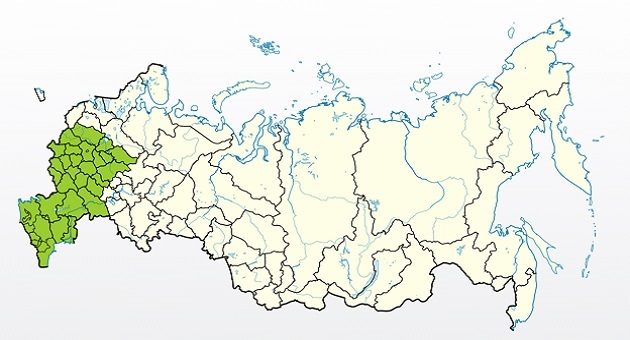
Growing regions
- Middle zone.
- Crimea.
- South of Russia.
- North Caucasus.
Origin
The variety was developed at a breeding station in Geneva, New York, United States. Experiments began in the early 1960s, and the first seedlings were obtained in 1964. The complex Canadian hybrid Quinti (Red Melba + Crimson Beauty) and the Julired variety were used. In 1973, the most outstanding specimens were selected, one of which received the unique identification number NY 444.
The variety was originally named Geneva Early, and registered with this name. It's possible that later subvarieties were intended for future development, but these were never created. In Russia and throughout Europe, the apple tree is commonly referred to simply as Geneva.
By 1982-1983, the apple tree had already become widespread in the United States, and by the mid-1990s, it had "moved" across the ocean to Europe. From there, the Geneva apple tree successfully made its way to Russia. The variety was officially added to the State Register only in 2017, although Sady Belogorya LLC had submitted an application a year earlier. The apple tree is zoned for the Central Black Earth, Lower Volga, and North Caucasus regions.
Content
Description of the Geneva variety
 Apple trees immediately caught the attention of Russian gardeners. They truly possess numerous advantages. The harvest ripens quite early, and the trees never take a break to rest, bearing fruit with enviable consistency throughout their life.
Geneva apples are beautiful, large, and extremely juicy. They are delicious and aromatic, suitable for fresh consumption and for use in various culinary delights. Despite their poor transportability and shelf life, these apple trees are recommended for cultivation in intensive orchards for commercial juice processing or in small garden plots.
Apples: What do they look like?
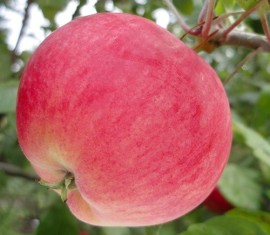
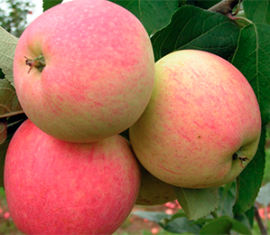
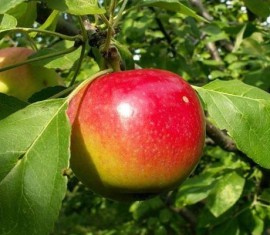
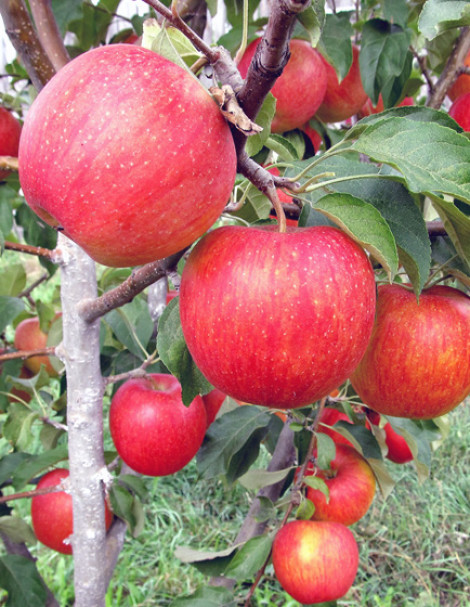
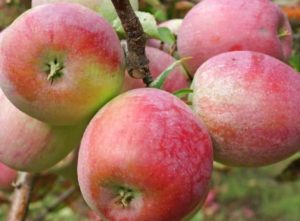 The fruits are generally medium-sized or slightly larger than average. They grow to 90-140 grams, but some gardeners claim that with good care, regular, timely fertilizing and watering, and regulation of flowering, and in favorable years, they can easily reach 140-200 grams, which is considered large. They are round, perfectly spherical in shape, but can also be slightly conical or flattened. They are symmetrical, uniform, without a lateral seam or pronounced ribbing.
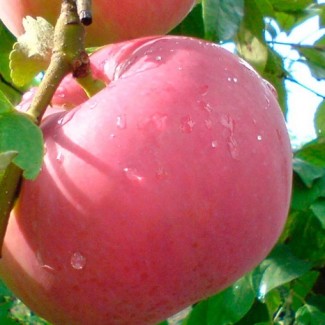
The skin is glossy, shiny, and dense, but very thin, brittle, and easily cracked. It is lemon-green or yellow in color and, when ripe, may develop a light waxy or waxy-oily coating, giving the apples a bluish-silver color. The blush is crimson, red-pink, or crimson-pink, mottled and diffuse, and may have slight speckles and streaks, covering 75-95% of the surface. Subcutaneous punctures are numerous, light and small, making them virtually invisible against the bright surface. The chemical composition should be assessed based on the following factors:
- P-active substances – 289 milligrams.
- Ascorbic acid (vitamin C) – 14.2 grams.
- Sugar (fructose) – 9.9%.
- Titratable acids – 1.15%.
- Pectins (fiber) – 12.6%.
The flesh is medium-dense, but fine-grained and very juicy, with a slightly oily consistency. The flavor leans more toward the sour, but is officially considered sweet and sour. It is considered a table and amateur variety, scoring 4.1-4.3 on a 5-point professional scale.
Geneva apple tree: characteristics
Crown and root system
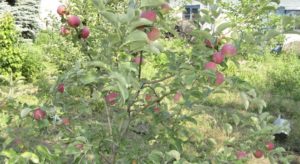 Trees of this variety are classified as medium-sized, as they They grow to a maximum of 2.5-3, sometimes 3.5 metersThe crown is moderately dense. Initially oval or even pyramidal, it eventually becomes broadly oval and even spreading, weeping. Branches point upward, extending at right angles from the trunk. They are of medium thickness and length, straight, and may be pubescent. The bark is brown, brownish-green, or brownish-brown. Fruiting occurs on simple and compound rhizomes, or fruiting twigs, for 2-3 years.
The leaves are large, leathery, dense, and matte, with a distinct pubescence on the back. The shape is oval and elongated, with a short, pointed tip. The edges are wavy, serrated, jagged, and crenate, with coarse nervation. The root system is superficial, shallow, but highly branched and fibrous.
Productivity and pollination
The variety is considered to be medium-yielding, but some gardeners say they can achieve high yields without much difficulty.
On average, one mature Geneva tree can yield 80-120 kilograms of aromatic, delicious, and beautiful apples per year. In exceptional cases, yields of over 140 kilograms have been achieved, but this requires careful and timely care, regular fertilization and watering, and favorable weather conditions..
The variety is completely self-sterile, meaning it won't produce any fruit unless pollinators are nearby. Savvy gardeners plant varieties that bloom at appropriate times, interspersed, within 50-90 meters of each other. During flowering, the trees can be sprayed with sugar or honey syrup, and mobile apiaries can be brought into the garden.
Winter hardiness and disease resistance
Geneva is considered to have average tolerance to low temperatures. However, in reality, this figure can be considered quite low. It can withstand frosts down to -20-22°C with proper shelter and winterization, but stronger frosts will likely destroy it. Careful attention to preparation and insulation will be required if you want to grow this variety in a cold climate.
Apple trees are generally immune to almost all fungal diseases, but parasha is truly terrifying. They become infected very quickly, and the damage is rapid and severe. Therefore, regular preventative spraying with fungicides is essential, and don't forget about insecticides, as these pesky insects can be a real nuisance for any gardener.
Rootstocks and subspecies
There is no information about any subspecies or subcultivars of Geneva. Trees are grown exclusively on standard rootstocks; the variety does not grow on dwarf or semi-dwarf rootstocks, and it is impossible to cultivate it into a trailing tree. Columnar Geneva does not exist.
Peculiarities of growing Geneva
 Landing
 Landing
Basic conditions
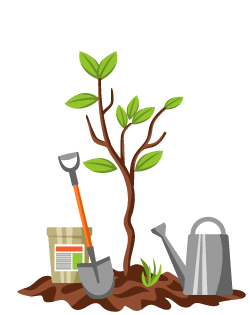
- The future harvest depends on the correct planting location. It must be spacious and well-lit, as Geneva plants almost never grow in the shade, becoming weak, spindly, and eventually dying.
- Without pruning, the tree can grow up to 4.5-5 meters in good conditions, and its root system is even wider, so the holes need to be spaced approximately this distance apart.
- Choose slightly acidic, well-drained, fertile soils, otherwise the apple tree will lack nutrients and minerals. Lime, dolomite flour, and wood ash added to the planting holes can help address acidity issues. Fertilizers and other fertilizers will help address any lack of fertility.
- The holes can be prepared in advance, 6-10 months before planting, but even 4-5 weeks will be enough for them to stand.
- Dig holes 60-70 centimeters deep and the same diameter. Add soil to the bottom, mixed with humus, mineral fertilizers, urea, wood ash, or other fertilizers of your choice. Next, lay a drainage layer, then fill with 45-50 liters of water. Leave the holes to stand outdoors.
- Planks or stakes are immediately inserted or driven into the holes to tie the young seedlings in place. If they are placed on the north side, they will not only provide reliable support support for the fragile tree, but also as additional protection from the frosty, cold winter wind.
- Root collar All apple trees remain outside when planted, approximately 5-8 centimeters above the soil surface.
- Place the tree vertically, spread the roots on a mound of drainage material, cover with soil, compacting it gently with your hands, and water with 40-50 liters of water. If desired and necessary (in arid regions), the surface can be watered to retain moisture. mulch grass, sawdust, manure, compost.
Landing dates
For Geneva, either spring or fall planting dates are perfectly acceptable. The harsher the region's conditions, the preferable is the former. In the South, Crimea, or the North Caucasus, you can choose the timing as convenient, and in the central zone, and even more so, Moscow region In the Leningrad region, with its changeable and rather unstable weather, it's best to plant the variety in late March or early April. The soil should be completely warm by then, and the risk of frost should have passed. In the fall, you can choose a warm, dry day in late September or early October, while there's still plenty of time before frost.
Tree care
 Tree care
Protection from frost and pests
Apple trees need to be specially prepared for winter by stopping watering in mid-August or early September. Sap flow in the trunks must be stopped, otherwise they may freeze. Trunks are usually wrapped with various insulating materials: burlap, roofing felt, tar paper, agrofibre, tarpaulin, or old nylon tights. Young, low-growing trees can be covered using the tent method.
To repel hungry rodents, tree trunks are coated with a thick layer of melted animal fat, fuel oil, or grease. Regular (twice a year) application will help eliminate insects that have settled in the bark crevices. whitewash lime, thickly diluted with water.
Loosening the soil, watering: proper agricultural technology
Dig around the trunk twice a year, in autumn and spring, but you can hoe more often, simultaneously adding moisture and feeding the trees. Watering well once every 10-14 days, depending on natural precipitation.
- The first feeding is done in the spring during bud break. Then minerals, urea, and humus.
- A second good time to fertilize apple trees is during bud break, around mid-May. You can use dry mineral fertilizers and other fertilizers, but it's best to dilute them with water for better absorption.
- In summer, preference can be given to potassium and nitrogen mixtures, they have a positive effect on the growth and development of fruits.
- When it rains, it is customary to add urea diluted with water, and not only pour it into the soil, but also treat the trunks at the same time.
- When the rosy, fragrant fruits begin to ripen on the branches, apply the third fertilizer application. At this time, organic matter, ranging from chicken manure to chopped grass infusion, should predominate.
Autumn fertilizing is timed to coincide with the last waterings. A potassium complex, generously diluted with water, is the optimal option. This fertilizer is applied to the area around the tree trunks, after which the trees are not watered again until spring.
Pruning: simple crown shaping
The first pruning of a tree usually occurs in its second year. It's best to create a sparse, tiered form, with shoots spaced far apart and at different heights. The first time, the central conductor is cut back by a third, and all branches are shortened a few centimeters, from the highest to the lowest.
Shoots protruding into the crown or vertically upwards are regularly removed. They won't produce fruit, but they can easily thicken the crown. Cuts should be sealed with garden pitch or at least with marsh oil. Inspect the tree in the fall and spring and remove all dead, diseased, or broken branches.
Pollinator varieties
- James Grieve.
- Idared.
- Delicacy.
- Melba.
- Mantet.
- Honey Crisp.
- Discovery.
- Folder.
- Ottawa.
Reproduction
- Rooting.
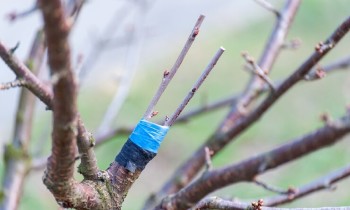
- Kidney grafting.
- Cuttings.
- Growing from seeds.
Diseases and pests
- Scab.
- Bacterial burn.
- Powdery mildew.
- Cytosporosis.
- Green aphid.
- Codling moth.
- Leaf roller.
- Hawthorn.
Ripening and fruiting of Geneva
The beginning of fruiting
 The beginning of fruiting
This variety is very early-bearing, and flowers and ovaries can be found on it in its first year in the nursery. However, it's best to pick them immediately, without allowing them to develop, as the tree needs to develop green mass and rhizomes. The first harvests of 4-7 kilograms are usually collected in the third or fourth year after planting.
Flowering time
Like all early summer apple varieties, Geneva blooms early. By early May, pink buds can be seen, which soon open into beautiful, large, fragrant inflorescences. These have a delicate texture, a saucer-shaped form, and slightly ruffled petals. Flowering lasts 12-15 days.
Fruiting and growth
Before fruiting begins, the tree grows rapidly, gaining at least 35-50 centimeters in a single season. Afterward, the growth rate slows slightly, but not significantly. Fruitfulness also increases at a remarkable rate. By the 10th to 12th year, the harvest is full-fledged and remains so thereafter. The apple tree does not take rest breaks; the average lifespan of active and fruit-bearing trees is 50-75 years.
The fruit ripens around early August, which is when the harvest begins. They ripen unevenly, allowing you to enjoy the fresh fruit straight from the branches for longer. Apples have a short shelf life; they can be stored in a special refrigerator for no more than 2-3 weeks, after which they become limp, soft, crumbly, unpleasant-tasting, and begin to rot.
Top dressing
- Peat.
- Compost.
- Ammonium nitrate.
- Humus.
- Chicken manure.
- Superphosphate.
- Manure.
- Mineral complexes.
What to do if it doesn't bloom or bear fruit
- Check for pests or diseases.
- Transplant into the sun.
- Water.
- Fertilize.
Why do apples fall?
- Wind, hail, hurricane, rain.
- Overripe.
- Pest damage.
- Diseases.
Please leave your feedback on the Geneva variety so that other gardeners can learn from your experience and draw conclusions from it.