Bryanskoye Zolotistoe apple tree: characteristics of the variety and care
| Color | Yellow |
|---|---|
| Ripening season | Autumn |
| Size of apples | Large |
| Taste | Sweet and sour |
| Crown type | Average tree height |
| Shelf life | Average shelf life |
| Application | For recycling , Fresh |
| Winter hardiness | High winter hardiness |
| Fruiting age | Up to 5 years |
 History of origin and regions of growth
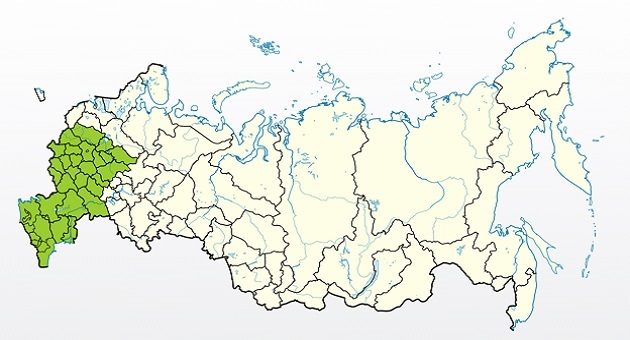
Growing regions
- Crimea.
- Middle zone.
- Leningrad region.
- North Caucasus.
- Moscow region.
Origin
This variety was developed by renowned pomologist Alexander Ivanovich Astakhov. It was obtained by hybridizing the Antonovka variety with the American variety Delicious Golden. This work was conducted relatively recently, so some of the subvariety's properties are still unknown to many gardeners.
In 2005, the first application was submitted by the V.R. Williams Federal Scientific Center for Forage Production and Agroecology, located in the town of Lobnya, Mytishchi District, Moscow Region. That same year, it was accepted, and Bryanskoye Zolotistoe received official zoning for the Central Region. In reality, it can be grown in much larger areas, from Crimea to the Leningrad Region.
Content
Description of the Bryansk Golden variety
 This high-yielding, weather-resistant, and easy-to-grow winter variety is favored by many gardeners in our country, as well as apple lovers far beyond its borders. It inherits the best qualities from its parents. It is hardy, resistant to harsh Russian winters, and tolerant of a variety of soils, humidity, and growing conditions, as well as severe air pollution and environmental contamination.
The fruit ripens regularly on the tree, without resting. They are large, beautiful, and golden-hued when ripe, giving the variety its name. The apples are delicious, have a strong, distinctive aroma, are easy to transport, and keep well. This variety is recommended for cultivation in private gardens and in commercial, industrial, and intensive plantings.
Apples: What do they look like?
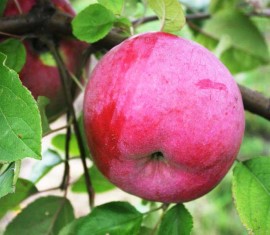
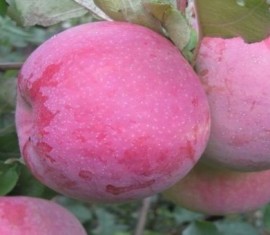
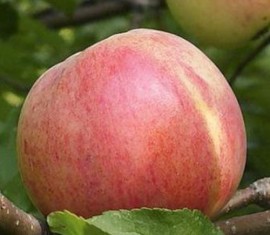
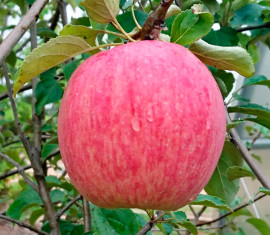
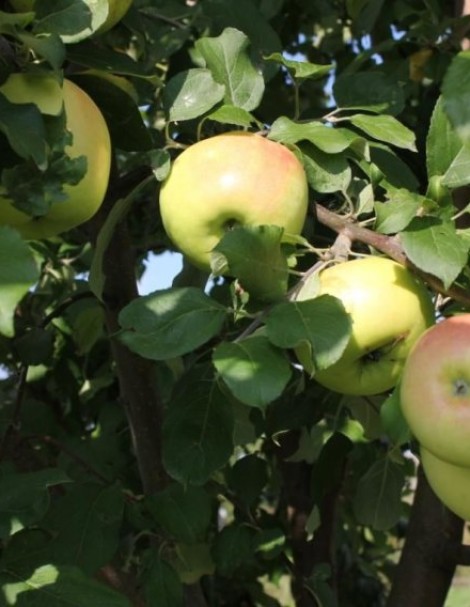
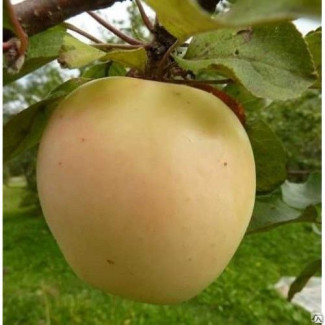
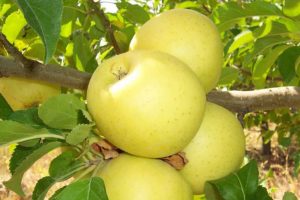 Bryanskoye Zolotistoe apples are quite large, reaching 180-220 grams in weight, with some specimens even weighing 220-250 grams or more. They are round, smooth, and slightly flattened along the central axis. The ribbing on the fruit's surface is barely noticeable, but is clearly visible near the calyx.
The skin is dense, strong, and elastic, capable of protecting the delicate flesh even from severe mechanical damage. It is slightly shiny but predominantly matte, and may have a waxy coating on the surface, imparting a bluish tint. The skin's primary color is yellow, greenish-yellow, and golden. The fruits lack a blush, but light pinkish or coral-colored, translucent, blurred spots may appear on the sunny side. Subcutaneous punctures are moderate in number and highly visible, ranging in color from dark gray, rusty, to light green. The fruit is of average uniformity, as is its symmetry. It is recommended to evaluate the chemical composition based on the following data:
- P-active substances (catechins) – 226 milligrams.
- Ascorbic acid (vitamin C) – 14.1 milligrams.
- Total sugars (fructose) – 10.9%.
- Pectins (fiber) – 11.2%.
- Titratable acids – 0.87%.
Bryansky apples have dense, fine-grained flesh that's very juicy, aromatic, and crispy, yet not prickle-yet rather tender. It's snow-white or slightly creamy, with a creamy-lemon hue. The flavor is considered dessert-like, balanced, sweet and sour, with a distinctive spicy aftertaste, and harmonious. Professionals give the apples a 4.3 on the official 5-point tasting scale.
Bryanskoye Zolotistoe apple tree: characteristics
Crown and root system
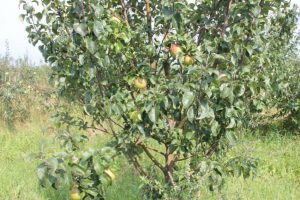 Trees of this variety are considered to be of medium growth and medium height. Without shaping they can easily reach 4.5-5 meters., but they usually don't grow any further. The crown is rounded, broadly oval, or spreading in old age, moderately dense, with abundant foliage. The branches are long, straight or curved, extending from the main stem at an angle close to right angles, but directed sideways or downwards, giving the trunk a weeping appearance. They are covered with brown or brownish-brown bark. Fruiting is mixed.
The leaves are medium to large, slightly elongated, oval, or oblong. The margins are finely serrated, palmate, or crenate, and may have some undulation. The leaf blade may fold like a boat or curve downwards. The color is rich green, green, or sometimes emerald. The root system is medium to deep, fibrous on most rootstocks, with numerous tiny offshoots, well adapted to the search for moisture and nutrients.
Productivity and pollination
This variety is truly capable of achieving record yields, making it a favorite among many gardeners, from small private growers to owners of large industrial plantings.
In one year, a mature Bryansk Golden tree can yield approximately 190-220 kilograms of beautiful fruit, putting it on par with the parent Antonovka variety. At standard planting density, commercial orchards can yield 300-350 centners per hectare. The absolute record is currently considered to be 600 centners..
This variety can be used as a monoculture, as it is self-fertile and does not require additional pollinators. It will produce a harvest even if there is no other apple tree within 200 meters of a suitable flowering time. However, experienced gardeners prefer to interplant apple trees, believing that this results in higher yields, and this makes sense.
Winter hardiness and disease resistance
This variety was specifically bred for the harsh conditions of the central and northern regions. Therefore, it has a high tolerance for low temperatures. It can easily withstand temperatures as low as -32-35°C, but proper winter preparation and adequate shelter are essential. Trunks with rhizomes extending to groundwater and growing in drafty areas are susceptible to freezing.
The variety is highly resistant to various apple tree diseases. It is rarely affected. scab, powdery mildew, cytosporosis, but bacterial burn It can be fed regularly. Parasites and fruit rot are also dangerous for the Goldenrod. Therefore, regular preventative treatments should be kept in mind.
Rootstocks and subspecies
The main variety, Bryansky, has numerous subspecies, but this variety has none yet. Zolotistoe can be grown on a wide variety of rootstocks, slightly altering the tree's properties, which has virtually no effect on the quality of the fruit.
Features of growing Bryansk golden
 Landing
 Landing
Basic conditions
- A sunny planting site is essential for good growth and subsequent abundant fruiting. In the shade, apple trees will survive, but they may become weak and refuse to bloom.
- The groundwater table plays a huge role, because if it's high, apple trees can not only start to rot, but also freeze in the winter.
- Drafts can kill any young tree, including a Bryansk goldenrod sapling. However, it thrives on good crown ventilation, so you'll need to carefully select a planting site.
- The best soil is sandy loam or loamy soil, rich in moisture and well-aerated. However, trees will also grow well in black soil, sand, or clay, provided the root ball and surface of the soil are properly maintained, with regular watering, fertilizer application, fertilizer application, and hoeing.
- It's best to dig the holes in advance, at least 1-2 months before planting, or even better, the previous season. They should be at least 60-80 centimeters deep and up to 1 meter in diameter. Add soil and fertilizer (ash, chicken manure, phosphorus-potassium complexes, peat, manure, or humus) to the bottom, followed by a drainage layer if needed. Add plenty of water and let the holes sit until planting time.
- Always leave at least 3-4 meters between trees, and 5-7 meters between rows. This will make harvesting and garden maintenance easier in the future.
- The root collar of a seedling should never be buried deep in the soil, but rather protruding above it. Otherwise, the tree will root higher, rendering the rootstock useless.
- Place the tree on a mound of drainage material in the center of the hole, cover with soil, supporting it by the trunk and controlling the depth of the root collar. Gently compact the soil, water with 25-30 liters of water, and mulch with available materials.
Landing dates
The Bryanskoye Zolotistoe variety doesn't offer anything new at standard planting times. It can be transplanted into open ground in the spring, until mid- or late April, or in the fall, after the leaves have fallen. In warmer climates, either variety is suitable, but for harsher regions, spring planting is best.
Tree care
 Tree care
Protection from frost and pests
To maximize winter hardiness, trees need to be properly prepared for cold weather and properly covered. Watering and any moisture additions should be stopped no later than early September. This will allow the apple trees to stop sap flow in their trunks in time. The trees themselves are wrapped in various materials: burlap, roofing felt, tarpaulin, and so on. In exceptional cases, young trunks can be wrapped from the crown to the rootstock using a tent-like method. Straw, hay, spruce branches, and even a 15-25 centimeter layer of soil are commonly scattered over the root zone.
Whitewashing the trunks will help get rid of annoying insects. Apply a thick lime solution to a shallow height (1-1.4 meters). Coating the apple tree trunks with various strong-smelling substances is also effective against rodents. Fuel oil, solid oil, rancid drying oil, or butter can be used.
Loosening the soil, watering: proper agricultural technology
Standard care for the Bryansk tree is sufficient. Twice or once a year, dig around the trunk, not going too deep with a spade, just one-third or one-half. The rest of the time, you can lightly loosen the soil with a hoe or hoe, removing weeds and debris from under the trunk. It's best to do this the day after applying water to prevent the soil from drying out into a dense lump.
It's good to water young trees once every ten days, unless there's been natural precipitation. If it rains, count the days until watering from there. Mature trees no longer need such frequent watering; 5-8 times per season is sufficient. Various fertilizers and fertilizers are usually added along with the water.
Pruning: simple crown shaping
Bryanskoe Zolotistoe is easy to shape. It can be shaped into almost any classic form:
- Tiered.
- Sparsely tiered.
- Whorled.
- Palmette.
- Cordon.
- Spindle.
- Cup-shaped.
To maintain the tree's proper shape, a sanitary pruning is also performed every autumn. This includes removing broken or damaged shoots, dry branches, branches that stick out vertically upward or inward, and branches that run parallel or cross.
Reproduction
- Cuttings.
- Budding.
- Cloning.
- Kidney grafting.
Pollinator varieties
- Idared.
- Antonovka ordinary.
- Elstar.
- Delicious golden.
- Gala.
- Gloucester.
- Golden Vladimir.
Diseases and pests
- Bacterial burn.
- Scab.
- Cytosporosis.
- Powdery mildew.
- Rust.
- Apple moth.
- Scale insect.
- Glass-box.
- Hawthorn.
Ripening and fruiting of Bryansk golden
The beginning of fruiting
 The beginning of fruiting
The onset of fruiting usually depends on the rootstock used, but there is one general rule. On vegetative varieties, fruit ripening begins approximately 4-5 years after transplanting to open ground, and on dwarf varieties, it occurs in 2-3 years. However, the fruit should not be allowed to ripen before the third year, to allow the tree time to develop rhizomes and foliage. Therefore, it is best to completely remove all inflorescences before this time, preventing them from developing into ovaries.
Flowering time
Bryansk apple trees typically bloom simultaneously with late-ripening apple trees. It begins in the second half of May and lasts until the end of the month. In some particularly harsh years, the process can even be delayed until early June, especially if there are few sunny days. The apple tree blooms profusely, with large, snow-white, and strongly scented flowers densely covering the branches, making the tree look very attractive.
Fruiting and growth
Apple trees grow very quickly, reaching 55-70 centimeters per year. Therefore, they reach their full height quite quickly. Fruiting is also similar: by the sixth to eighth year, it reaches full fruiting, and by the eighth to ninth year, it can reach over 200 kilograms per trunk. Therefore, you won't have to wait long for record-breaking fruit; this variety is perfect for those who want the maximum harvest in the shortest possible time.
The fruit ripens in late September, and sometimes as early as early October, depending on weather and climate conditions. There's no need to rush the harvest, as they cling very firmly to the branches and don't fall off even after the first frost. While the apples can be transported long distances, they can be stored in a regular cellar for a maximum of 2-3 months. After that, they'll become soft, slightly tart, less juicy, and have a cottony texture.
Top dressing
- Eggshell.
- Humus.
- Bor.
- Manure.
- Compost.
- Superphosphate.
- Copper.
- Mineral and nitrogenous complexes.
- Ammonium nitrate.
What to do if it doesn't bloom or bear fruit
- Wrap up for the winter.
- Limit or activate watering.
- Eliminate insect infestation.
- Cure diseases.
Why do apples fall?
- Strong wind, hail, rain.
- Pests or diseases.
Share your own experience with the Bryanskoye Zolotistoe apple tree variety so that even novice gardeners have no questions about cultivating these trees.