Arkad apple tree: characteristics of the variety and care
| Color | Greens |
|---|---|
| Ripening season | Summer |
| Size of apples | Average |
| Taste | Sweet |
| Crown type | Average tree height |
| Shelf life | Low shelf life |
| Application | Fresh , For recycling |
| Winter hardiness | High winter hardiness |
| Fruiting age | From 5 years old |
 History of origin and regions of growth
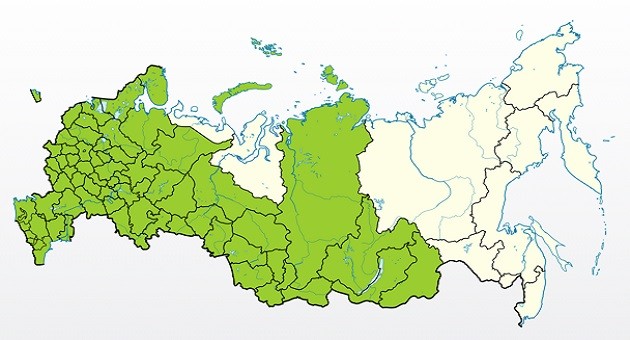
Growing regions
- Middle zone.
- Moscow region.
- Ural.
- Siberia.
- North Caucasus.
- Leningrad region.
- Crimea.
- Urals and Trans-Urals.
- Some northern regions.
Origin
This variety can be considered ancient, as it has been known in our country and its immediate neighbors for quite some time. Originally, it was a summer apple tree, producing abundant sweet fruit. Over its more than a century-long history, many Arkada subvarieties have been developed, the most famous of which are Tenkovsky, Volzhsky, Sakharny, and Biryukovsky, all of which have been included in the State Register. Currently, only the first two varieties are officially listed.
Description of the Arkad variety
 Gardeners typically choose this variety for its early fruiting period, allowing them to enjoy fresh apples as early as late summer. The trees themselves don't take up much space, are compact and beautiful, and, most importantly, are resilient even to the harshest growing conditions. They don't require extensive care, don't require special attention, and are undemanding of soil, moisture, fertilizer, or supplements.
The beautiful and fairly large fruits come in a variety of colors, depending on the subspecies. The apples are aromatic, juicy, and delicious, mostly sweet. Today, only a few Arkada subspecies are grown commercially, but they are being rapidly supplanted by newer, more advanced subspecies. It is quite common in private gardens due to its unusually sweet flavor.
Apples: What do they look like?
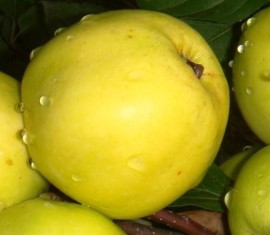
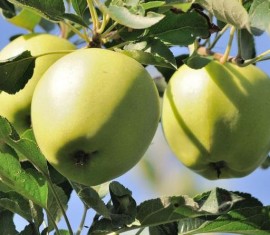
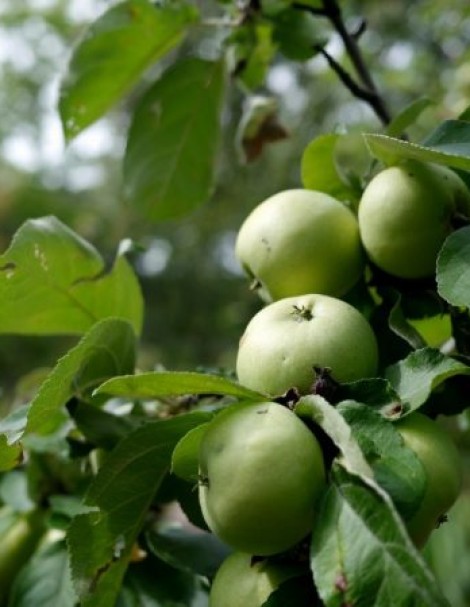
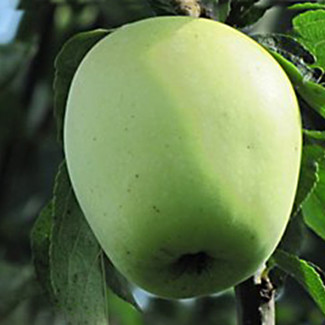
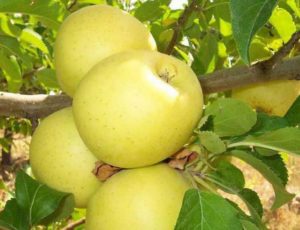 The fruits are medium or slightly larger than average in size. They barely reach a weight of 95-130 grams, and even then, with good, timely care and fertilizing, they can reach this. They can be round or spherical, but are more often flattened or conical-oval, elongated, or turnip-shaped. The fruits are symmetrical and uniform; the ribbing may be visible or smooth, and the side seam is usually invisible.
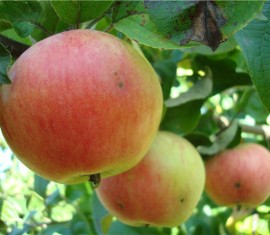
The skin is dense, smooth, highly glossy, shiny, thin, and free of any oily or waxy coating, even when fully ripe. The base color is light green, green, or greenish-whitish, and can turn yellow, lemon, or light green-white as it ripens. The blush varies significantly in shade and density across subspecies, and can be spotted and diffuse, translucent, or mottled and striped, bright. It can be orange, carmine, pink, crimson, red, and bright red, or completely absent. Subcutaneous dots are dark, very small, and barely visible. It is easier to assess the chemical composition using average composition indicators:
- P-active substances (catechins) – 324 milligrams.
- Ascorbic acid (vitamin C) – 4.7 milligrams.
- Fructose (total sugars) – 16.5%.
- Pectins – 1.2%.
- Titratable acids – 0.23%.
- Dry matter – 11.9%.
The flesh is medium-dense, fine-grained, and very juicy. It has a subtle, pleasant, slightly spicy-lemonade aroma and flavor. The flavor is generally considered sweet and dessert-like, scoring 4.1-4.2 on a professional 5-point tasting scale.
Apple tree Arkad: characteristics
Crown and root system
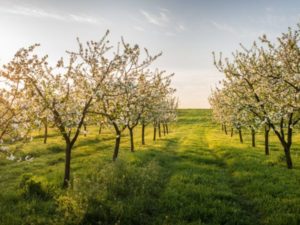 Some people call this variety tall, but this is incorrect. Any subspecies of Arkada extremely rarely grows taller than 4-4.5 meters.Therefore, it can safely be classified as a medium-sized, and sometimes even a natural semi-dwarf. The crown is predominantly rounded; when young, it may appear pyramidal, but with age, it becomes more spreading. It is quite dense, with shoots extending from the trunk at right angles and directed upward, covered with green-brown or brown bark without pubescence.
The leaves are fairly large, leathery, very dense, smooth, highly glossy, glossy, long-pointed, lanceolate, and elongated. The leaf margins are serrate-crenate, serrated, and can fold into a boat shape, with delicate ribbing. The root system depends on the rootstock used, but is generally fibrous, branched, and well-dug.
Productivity and pollination
Considering their small height, the trees can be safely classified as high-yielding varieties.
A single mature Arkad apple tree, and any variety, can yield at least 75-110 kilograms of delicious, sweet fruit. With proper and timely care, as well as favorable weather and climate conditions, these figures can increase by 15-25%.
The variety is relatively self-sterile, so it's best to plant it interspersed with other early apple trees. If there are no other trees within 55-90 meters, only 15-35% of the flowers will produce fruit. Spraying the trees with a honey and sugar syrup and placing beehives in the garden in the spring can positively impact the yield.
Winter hardiness and disease resistance
Most Arcada subspecies are very tolerant of low temperatures, including sudden changes and fluctuations. They are unfazed by either severe frost or the subsequent thaw, especially if properly prepared for winter. This makes Arcadas suitable for growing not only in warmer regions, but also in the Urals and Siberia.
The variety has no immunity to fungal, viral, or parasitic diseases. During years of severe epiphytotics, it is susceptible to severe and severe infections. Not only the leaves but also the fruits are affected. Seasonal preventative spraying with fungicides, insecticides, and other products is recommended.
Rootstocks and subspecies
There are many different subspecies and subcultivars of Arkada, and it can be grown on a wide variety of rootstocks. It's worth mentioning at least a few of them.
| Subspecies | Peculiarities |
| Sugar | The most frost-hardy subspecies, producing robust, five-meter-tall trees with a dense crown. It can withstand temperatures as low as -38-42°C without affecting yield. It regularly produces large, sweet apples weighing up to 140-170 grams. These are easy to transport, have no blush, and ripen in July. |
| Pink | The tree's crown is oval and compact, and it grows to no more than 3-3.5 meters. The apples are small, weighing 75-100 grams, and are covered with a speckled, striped pink or pink-raspberry blush. The fruit is flattened, the skin is thick, the texture is pleasant, the flavor is slightly sweet and sour, the aroma is powerful, and they ripen in early August, can be stored for 15-20 days. |
| Yellow | This Arkada subspecies ripens in mid-July, or even earlier in hot climates. Its skin is distinctly yellow, firm but thin, matte, and easily split. The trees are medium-sized, well-adapted to frost, and have a more spreading crown, less dense than other subspecies. |
| Biryukova | This apple tree is exceptionally winter-hardy, making it suitable for cultivation even in Siberia and the Far East. The trees are medium-sized, approximately 3.5-4 meters tall, round, spreading, and bear fruit annually. The apples lack a blush, are green or light green, intensely sweet yet slightly spicy, aromatic, and juicy. The name is derived from the surname of pomologist Arkady Pavlovich Biryukov. |
| Volzhsky | This variety ripens later, around early or even mid-September. The rather large (135-150 grams) fruits have a slightly longer shelf life, up to 45-60 days in a cellar or special refrigerator. They are slightly elongated, greenish, with a light and delicate, barely visible blush on the sunny side. Developed by breeders Lyubov Georgievna Demina and Anatoly Aleksandrovich Kuzmin. |
| Tenkovsky | A fast-growing and early-ripening Arkada subvariety, it produces fairly good yields annually without interruption. The apples are large, sweet and tart, and have a unique, pleasant aroma and texture. They ripen by the end of September and can be stored in the cellar until mid-January, and sometimes even longer. It is included in the State Register of Breeding Achievements. |
Features of growing Arkada
 Landing
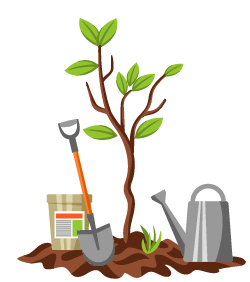 Landing
Basic conditions
- All apple trees are best planted in open, sunny locations. Arkad is no exception; it thrives in full light and air, where it grows better and produces fruit faster. It can grow in the shade and will even produce fruit, but in much smaller quantities.
- It's undesirable for groundwater to be closer than 2-2.4 meters to the surface. Otherwise, the tree's roots will begin to grow there and eventually rot.
- Preparing the holes in advance isn't necessary. You can dig holes 50-60 centimeters deep and 60-80 centimeters in diameter a week in advance, add fertilizer and drainage to the bottom, fill with water, and leave them outdoors.
- Root collar Trees are left above the soil surface if it is necessary to preserve the properties of the rootstock.
- You can immediately insert planks or stakes into the holes for tying, preferably on the north side. Then they will not only become reliable support, but also additional protection from frost.
- There should be approximately 3-4 meters of space between apple trees and the same between rows. This should be sufficient for easy harvesting and maintenance, and will prevent the trees from clashing with each other.
- Place the seedling upright, cover with soil, compact it, and water with 20-30 liters of water. If necessary, the surface can be mulched to retain moisture.
Landing dates
Arkad can be planted both in early spring, before bud break, and in autumn, after leaf fall. With a closed root system, trees can be planted at any time during the growing season.
Tree care
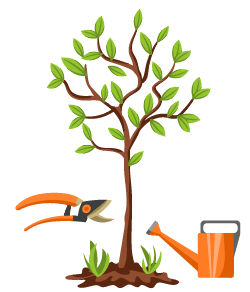 Tree care
Protection from frost and pests
Saving trees doesn't require any special equipment or tricks. Standard measures, such as wrapping the trunks and piling straw, spruce branches, or hay onto the root zone, will suffice.
To prevent insects from nesting in the bark, the trunk is whitewashed with lime twice a year to a height of approximately 1-1.3 meters. To repel various hungry rodents that might gnaw at the bark and young branches, the trees are coated with fuel oil, grease, or lard.
Loosening the soil, watering: proper agricultural technology
The most responsible gardeners dig around their apple trees twice a year, removing weeds, root suckers, and other plant shoots. But this isn't necessary; after 5-6 years, you can simply sow lawn or herbaceous grasses under the tree to provide natural soil aeration.
Arkad is watered during the hottest and driest years. It is usually able to find moisture, nutrients, and minerals on its own. However, with timely fertilizing, it shows much better yields.
Pruning: simple crown shaping
Trees are pruned twice a year. Crown pruning and shaping are done in the spring, and sanitary pruning is done in the fall. It's a good idea to start shaping the tree from the first year to ensure the desired dimensions are achieved right away. The best option is a sparse, tiered system, where shoots are spaced widely apart and at different heights.
In the fall, carefully inspect the crown, trimming any branches that protrude inward, as well as any that grow vertically upward. Remove any dead, diseased, or damaged branches, as these will interfere with the apple tree's normal development.
Pollinator varieties
- Mantet.
- Folder.
- Melba.
- Pepinka.
- Korobovka.
- White filling.
- Daria.
- Nastenka.
- Cheburashka.
Reproduction
- Grafting by cuttings.
- Growing from seeds.
- Layers.
Diseases and pests
- Cytosporosis.
- Rust.
- Powdery mildew.
- Fuzziness.
- Pit bitterness.
- Green aphid.
- Copperhead.
- Flower beetle.
- Codling moth.
- Scale insect.
Ripening and fruiting of Arkada
The beginning of fruiting
 The beginning of fruiting
Depending on the subspecies, the variety may begin bearing fruit at different times. However, all but the dwarf variety begin to bloom and bear fruit no earlier than the fifth or sixth year, and sometimes even as late as the seventh or ninth. However, the tree bears fruit for 55-75 years, and sometimes even for a century. The low-growing (dwarf) hybrid produces its first fruit as early as the second or third year, after which it bears fruit regularly for 12-15 years, after which its active life ends.
Flowering time
This figure depends entirely on the region where the trees are grown. Arkada trees are most often chosen in areas where the harsh climate offers few options. There, March and April are still cold, sometimes even frosty. Therefore, the buds only open in mid-May, and sometimes at the end of the month or early June.
However, in warmer regions, they can open as early as late April or early May. The flowers themselves are large, beautiful, and abundant. They are pure white or slightly pinkish, intensely fragrant, and densely cover the branches, making the tree look elegant and beautiful.
Fruiting and growth
Arkad grows at a moderate rate, gaining only 25-40 centimeters per year after fruiting begins. When young, the tree can reach 50-60 centimeters, but as soon as it needs to expend energy on fruiting, the rate slows. Fruiting also increases gradually, reaching almost full production by the sixth to eighth year, and peaking at the ninth to 12th year (excluding dwarf varieties, which produce their maximum fruit in the sixth year).
The fruits usually ripen uniformly, depending on the subspecies, between late July and early September. Timing will require experimentation, but taste can be a guide. Once the fruits are overripe, they may begin to fall off, at which point they must be processed immediately, otherwise they will spoil very quickly. Arkad apples can be stored in a cellar or refrigerator for a very short time, no more than 15-25 days in most cases. Therefore, it's best to make dried fruit, compotes, and eat the apples fresh immediately.
Top dressing
- Peat.
- Compost.
- Manure.
- Chicken manure.
- Humus.
- Superphosphate.
- Ammonium nitrate.
- Wood ash.
What to do if it doesn't bloom or bear fruit
- Inspect for diseases or pests.
- Limit or activate watering.
- Fertilize.
- Transplant to another location.
Why do apples fall?
- Natural weather conditions (wind, rain, hurricane, hail).
- Pest damage.
- Various diseases.
Share your own experience with the Arkad apple variety so every gardener can learn more about it before planting and achieve maximum results.