When to pick apples from the tree for winter storage
The shelf life of an apple orchard's harvest depends directly on the conditions created, whether the grower picked the apples from the trees correctly, the ripeness of the fruit, its quality, and the shelf life of the particular variety.
Content
When to harvest apples for winter storage
If you want the apples you pick from the tree to last as long as possible, while remaining fragrant and juicy, you need to choose the right time to pick them.
Unripe fruits do not have a distinct taste or smell, while overripe fruits cannot boast of a long shelf life.
Signs that it's time to pick fruit from the tree:
- Among the fallen fruits there are now fruits that have characteristic signs of full ripeness.
- The apple flesh has acquired a creamy or white tint.
- When pressing on the peel, no dents are formed, but it bursts at the point of pressure.
- Seeds darkened and turned brown.
- The fruit is easily removed from the branch along with the stalk.
Summer apples
 Summer varieties begin to be picked from the trees in August. By this time, the juicy fruits have accumulated the maximum amount of sugar and vitamins. Summer varieties are recommended to be put into storage immediately. processing, since they do not last long.
Winter apple varieties
Late-season (winter) pome fruits have an incredibly persistent aroma and harmonious flavor. The harvest ripens in late September – early October, after all other fruit has been harvested. They should be harvested before temperatures consistently drop below freezing. They have a long shelf life.
Winter apple varieties are excellent for long-term storage and transportation.
Autumn apples
The harvest of autumn apple varieties usually lasts from August Until September. They should be stored for no more than 4 months; otherwise, the fruit loses its firmness and its flesh becomes excessively loose.
How to tell when apples are ready to be picked
The ideal time to pick apples from the tree to ensure their long shelf life is called harvest maturity. At this stage, the fruit is plump but not yet overripe. You can determine when the right time has arrived in the following ways:
- If you press on the apple and a dent remains, it's time to remove it from the branch.
- Dissolve 1 g of potassium iodide solution in 1 liter of water and immerse half an apple in the resulting mixture. After a couple of minutes, check the condition of the fruit. If the center has turned yellow and the flesh closer to the edges has taken on a blue tint, it's time to harvest, as the fruit has reached harvestable ripeness. If the apple remains yellow, the harvest is overripe and won't last long.
Winter apple varieties in the Volga region
Given the region's weather conditions, winter apple varieties are best harvested in early autumn, in the first half of September. Some varieties are picked from the branches from late July to early September as they ripen.
Winter apple varieties in the Urals
Winter apple varieties Urals The fruits are picked slightly unripe. The main characteristic of these trees is the ability of the fruit to ripen even during a short growing season. Fruit harvesting begins in the last weeks of August and early September.
When to harvest apples in the Moscow region
IN Moscow region Late-ripening pome fruits begin to be picked from the branches in October. It's important to complete the harvest before the first steady frost sets in. Therefore, the end of September is the best time.
How to pluck
To ensure apples keep well throughout the winter, proper harvesting practices are essential. Here's how:
- Collect only in dry weather.
- Try not to squeeze the fruit to avoid causing dents.
- Do not wash off the waxy (pruinate) coating from the fruit, as it is essentially a protective barrier of beneficial bacteria that helps the harvest to last longer.
- You shouldn't pierce apples with your fingernails; to be on the safe side, it's best to wear gloves.
- It is necessary to remove the apple carefully, gently turning it around its axis so as not to separate the stalk.
- Try to avoid fruits falling to the ground, use collection devices.
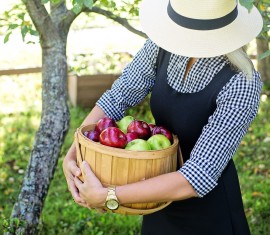
Harvesting should begin in the morning, after the dew has cleared. Apples are picked starting from the lower branches, gradually working their way up to the top of the tree.
How to treat before storage
 Before storing, the entire harvest is sorted and sorted by size and type. Larger apples are best kept close and used first, as they rot and spoil faster than others. Smaller apples can be stored significantly longer.
Treating sweet fruits with special compounds will help protect them from all kinds of rot and fungi:
- It is recommended to wipe the fruits with a soft cloth soaked in glycerin;
- The collected fruits can be dipped in a 4% solution of calcium chloride for 1 minute and then thoroughly dried;
- Each apple can be sprayed with a slightly pink solution of potassium permanganate.
Fruits processed using any of these methods will have a much longer shelf life, preventing infection and spoilage. Just remember to wash them with soap before eating.
Proper storage of apples
Long-term storage of the harvest is only possible if the temperature regime of 2–5°C is maintained. Humidity in the room is also crucial; it should be between 85–90%. In an excessively dry microclimate, the fruit will quickly shrivel and wilt. To maintain the required humidity level, it is recommended to place containers filled with damp sand in the room.
Before planting the crop, the room should be cleaned and the walls treated with lime or copper sulfateThis type of disinfection will prevent the growth of bacteria and fungi that can negatively affect the condition of apples.
There are several ways to store apples:
- Wrap each fruit in a sheet of paper and place it stem-side up. Multiple layers are acceptable.
- The fruits are placed in dry sawdust or clean sand so that they do not touch each other. The fruit can be placed in layers up to four deep.
- 5 kg of apples are placed in plastic bags, sealed tightly, and stored, covered with soil.
A variety of spaces can be used for storing the harvest, including basements, balconies, and pantries. However, apples should never be stored near other fruits or vegetables, as they emit harmful ethylene gas.
Another interesting place where the fruit will thrive throughout its entire storage life is a hole in the ground. It should be located below the frost line. Spruce branches are placed at the bottom of the hole, the apples are placed in bags, and the empty space is filled with soil mixed with dry leaves.
How to store apples depending on the variety
Varietal characteristics determine the shelf life of apples. Different fruits remain edible for a specific amount of time, which must be taken into account before harvesting. The shelf life of different apple varieties also directly depends on their shelf life.
Idared
Idared As they ripen, their color changes from green to yellow and red. Their flesh is usually juicy and firm. These apples are eaten fresh and processed. They can also be used in purees, compotes, juices, and dried fruit.
Harvest – end of September, storage – 150–180 days.
Antaeus
A late-ripening variety that's frost-resistant, these sweet winter apples retain their natural flavor and exceptional juiciness for a long time. Ripeness is indicated by a bright red or burgundy color. They are eaten fresh or processed.
Harvest: September-October, storage: 200-240 days.
Antonovka
The most delicious, but unfortunately not the most shelf-stable variety. The fruits are white, slightly yellowish. The flavor is sweet and tart. It is recommended to harvest it in small quantities, as it rarely lasts until mid-January.
Harvest – end of September, storage – 90–100 days.
Bogatyr
The fruits of this late-winter variety are typically firm, with a sweet-tart flavor. They remain green until harvest, turning yellow afterward. They retain their original marketable appearance for a long time.
Harvest – end of September, storage – 150–180 days.
Jonathan
Apples have varieties Jonathan good taste, when ripe they acquire a bright red hue.
Harvest: mid-September, storage: 150–180 days.
Lobo
Bred from a variety Mac, from which it inherited its flavor and rich color. It bears fruit vigorously, producing a harvest every year.
Harvest: from late September to early October, storage: 150–180 days.
Mac
This Canadian variety produces fruit with a yellowish tint or a dense green color. It ripens 2–3 weeks after picking. The apples are very sweet and have a long shelf life.
Harvest: September-October, storage: 150-180 days.
Red Delicious
Ripe Red Delicious fruits have a rich red color and incredibly sweet, juicy flesh. These apples store well and transport well, but are susceptible to bitter spot.
Harvest is at the end of September, storage is 180–220 days.
Renet Simirenko
Reinette fruits Simirenko Typically large or medium-sized, they are green in color. The flesh is rich white, juicy, and has a pleasant wine-like flavor.
Harvest: September-October, storage: 230-250 days.
Sinap Orlovsky
This is a late-winter variety with large fruits. The fruit is primarily green, sometimes with a red "blush." The flesh has a sweet and sour taste.
Harvest is at the end of September, storage is 200–240 days.