Apple tree Aphrodite: characteristics of the variety and care
| Color | Reds |
|---|---|
| Ripening season | Winter |
| Size of apples | Average |
| Taste | Sweet and sour |
| Crown type | Tall tree |
| Shelf life | Average shelf life |
| Application | For recycling , Fresh |
| Winter hardiness | High winter hardiness |
| Fruiting age | Up to 5 years |
 History of origin and regions of growth
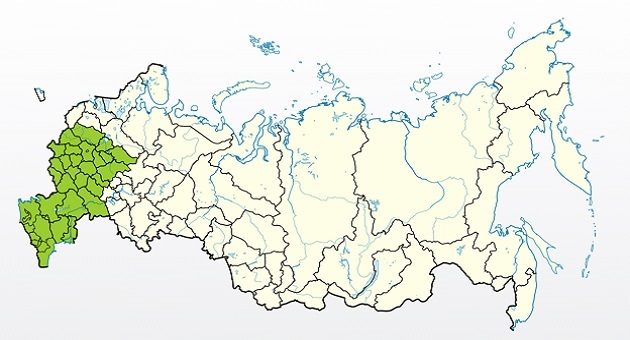
Growing regions
- Middle zone.
- Southern regions.
- North Caucasus.
- Some northern regions.
Origin
In our country, apple breeding only reached widespread proportions in the mid-twentieth century, although work had already begun in the early 1920s and 1930s. Scientists' primary goal was to develop varieties resistant to common apple fungal infections and their undoubted "queen"—scab.
In the mid-1970s, the All-Russian Research Institute of Fruit Crop Breeding bred seedling 814, which carried the Vf gene (immunity to scab). In 1981, a new variety was developed from this seedling through open pollination, given the beautiful and poetic name "Aphrodite." The authors are generally considered to be Z. M. Serova, V. V. Zhdanova, E. A. Dolmatova, and E. N. Sedov. It has not yet been zoned and is still undergoing testing for inclusion in the State Register.
Content
Description of the Aphrodite apple tree variety
 This early-winter, fairly cold-hardy variety is considered relatively new. A decision on its inclusion in the State Register has not yet been made, but many gardeners have already chosen these tall trees over others for a variety of reasons.
Aphrodite apple trees quickly reach fruiting age, rapidly increasing yields and producing delicious and attractive fruit that retain their marketable and nutritional qualities for a long time. They are recommended for both small home gardens and commercial intensive orchards.
Apples: What they look like
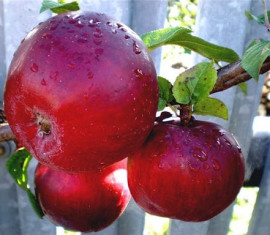
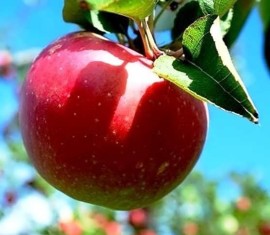
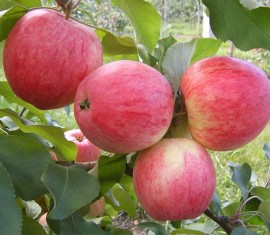
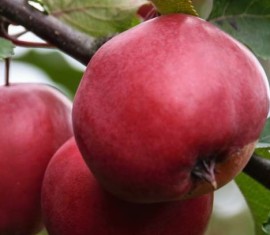
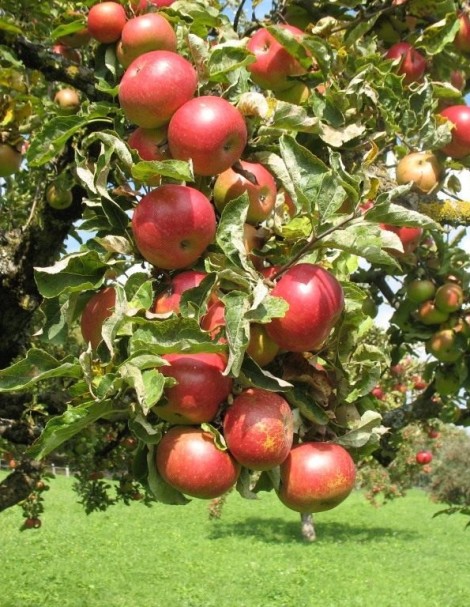
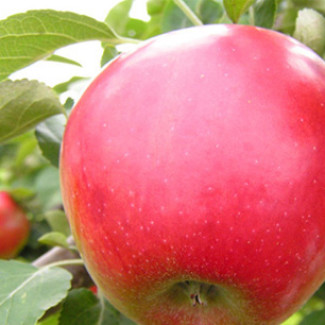
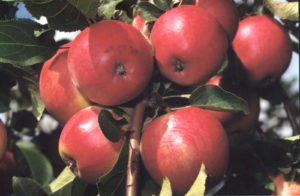 The fruits of this variety are generally medium-sized, barely reaching 150-160 grams. Small apples are rare on the tree, with the majority weighing between 115-130 grams. They are round, slightly flattened, with wide, barely noticeable ribs, and may be slightly slanted to one side.
The apple skin is dense, yet tender and not hard, and cracks easily. It is smooth and glossy, with a light oily coating that is difficult to wipe off. It is green in color, turning light green-yellow as it ripens. However, the underlying color is difficult to see due to the blush, which covers approximately 85-90% of the surface. It is reddish-crimson, sometimes ruby, or bright scarlet, with a blurred, streaky appearance. Subcutaneous punctures are numerous, clearly visible, and have a light gray tint. The chemical composition is best characterized by the following parameters:
- P-active substances (catechins) – 368 milligrams.
- Ascorbic acid (vitamin C) – 6 milligrams.
- Total sugars (fructose) – 12.5%.
- Pectins (fiber) – 9.2%.
- Titratable acids – 0.43%.
The fruit's flesh is white, crisp, fine-grained, very juicy, and fairly firm yet crisp. It may have pinkish veins when ripe. It has a sweet and sour, balanced, and harmonious dessert flavor. A professional taste tester gave it a 4.4 out of 5 possible points for taste and appearance.
Apple tree Aphrodite: characteristics
Crown and root system
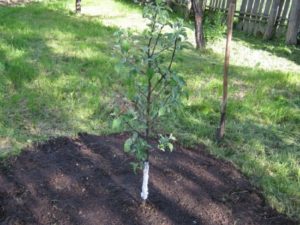 The tree is considered tall, as it can easily reach a height of 8-10 meters.However, to facilitate harvesting and maintenance, gardeners limit the height to 4-5 meters by pruning. The crown is moderately dense, rounded or broadly oval. The shoots are typically long and thin, arching, and extend from the trunk at right angles. They are covered with smooth, green bark, or, when mature, greenish-brown, glossy bark, slightly pubescent in places. Over the years, the bark may turn brownish, crack, and crumble. The fruits ripen on simple and compound rings.
The leaves are medium-sized, slightly elongated, oval or ovate, dark green, sometimes with a slight yellowish tint. They are matte yet leathery, dense, corrugated, wrinkled, and slightly pubescent above and more heavily beneath, but not excessively so. The ribbing is coarse. The foliage has a serrated, serrated edge and an elongated, spirally curled tip. The root system is highly branched, most often with a central taproot, deepened, and firmly anchors the tree, making it resistant even to strong winds.
Productivity and pollination
Aphrodite is considered a high-yielding tree, although its performance cannot compare to Antonovka. Moreover, its ability to quickly increase yields has not gone unnoticed by gardeners.
On average, a single tree can easily yield around 150-160 kilograms of fragrant, juicy fruit by the age of 8-10 years. The record harvest is 225 kilograms, collected in the Voronezh Region..
The variety is considered self-sterile, meaning it cannot pollinate itself. To ensure a good harvest, the trees must be interspersed with other varieties, or at least planted within 50-150 meters of other apple varieties with suitable flowering times. Experienced gardeners also recommend using mobile apiaries during this time or even establishing orchards near honey farms.
Winter hardiness and disease resistance
This tree shows very good frost resistance. However, it cannot withstand temperatures below 37-43°C for longer than 2-3 weeks at a time. It also dislikes sudden changes from severe frosts to thaws and back again. However, with proper care, it tolerates the conditions of the central part of the country and even some more northern regions well.
It's essential to clear the garden of fallen leaves, and especially of rotting fruit under the tree. Carelessness and negligence will inevitably lead to a host of problems. If the root zone isn't kept sanitary and clean at all times, fruit rot will be unavoidable.
Aphrodite has a genetic immunity to scab, as we've already discussed. However, other diseases can certainly affect the apple tree. However, the tree is quite resilient, and it would take some effort to prevent fungal infections from affecting it. Furthermore, a comprehensive treatment regimen of antifungal and anti-disease sprays would certainly be beneficial.
Rootstocks and subspecies
Aphrodite is primarily grown on vegetative rootstock, but dwarf and semi-dwarf varieties are also used. These trees grow slightly shorter, reaching only 4-6 meters, but their winter hardiness and fungal resistance are reduced. There is no columnar variety, and if you're offered something similar, it's a sign of deception.
Features of growing Aphrodite
 Landing
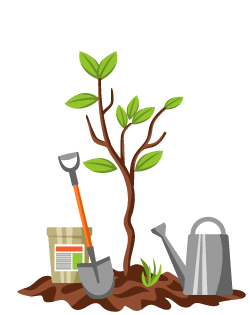 Landing
Basic conditions
- Apple trees prefer open spaces where they receive full sun for most of the day. However, the location should be draft-free to protect the trunk until it becomes established and develops foliage.
- Aphrodite shouldn't be planted in areas with high groundwater levels. If the water table is no deeper than 2-2.5 meters, it's best to relocate the garden. The trees also don't like open water, near wells, marshy areas, lowlands where meltwater accumulates in the spring, hollows, or floodplains.
- It's best to prepare the holes in advance, approximately 3-4 weeks in advance, or even better, in the fall or spring, depending on the chosen planting time. To do this, dig steep-sided holes 80-90 centimeters deep and the same in diameter. Place a top layer of soil mixed with fertilizer at the bottom, followed by drainage material such as broken brick, gravel, vermiculite, or nut shells. Fill the entire hole with 3-40 liters of water and leave it outdoors.
- It's optimal to leave approximately 6-7 meters between trees in a row, as they are indeed large and tall, and 5-6 meters between rows. This will prevent their root systems and crowns from clashing.
- You can immediately dig in the stakes for tying the trees. If there are two, it doesn't matter which side, but if there is only one, the north side is best. They can be removed only after the third or fourth year of fruiting.
- The apple tree should be positioned so that the root collar is approximately 5-8 centimeters above the soil surface; otherwise, it will inevitably root higher. This will completely negate all the properties and qualities of the rootstock.
- Before planting, inspect the roots; trim away any dry or damaged ones, straighten them, and place them on a drainage mound. Cover with soil, compacting the root ball firmly, but only by hand. Avoid over-packing the soil. Water the surface (40-50 liters) and mulch with humus, chopped grass, manure, or any other suitable fertilizer.
Experienced gardeners believe that the best material for planting are 2-year-old seedlings from nurseries, which already have pre-formed skeletal branches and a correct crown in general.
Landing dates
Aphrodite can be planted in either fall or spring. In the former case, the optimal time is after the leaves have fallen, around late September or early October. In spring, time it so the risk of frost has completely passed, but the buds have not yet begun to open and the sap has not yet begun to flow in the trunks. This period occurs around late March, early April, or even mid-April.
Protection from frost and rodents
Trunks are indeed resilient to low temperatures and harsh weather conditions, but only when the cold weather lasts for short periods. Therefore, it's a good idea to protect the trees for the winter, especially in northern regions or more eastern temperate zones. To do this, simply cover the root zone with mats of dry grass or straw, and wrap the trunks in burlap, agrofibre, or old tights.
To prevent trees from being damaged by hungry rodents that move closer to human dwellings during the winter, coat the trunks with 1-1.2 drops of grease or lard. Garden store products are also suitable. To protect against insects, trees should be whitewashed to the same depth in the fall and early spring.
Tree care
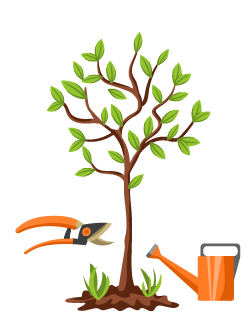 Tree care
Loosening the soil, watering: proper agricultural technology
To achieve truly good harvests, you'll need to put in the effort, dedication, and proper care. This primarily involves timely weeding and loosening the soil around the tree trunk. Twice a year, you should dig around this area, removing weeds, root suckers, and shoots from other shrubs and trees.
Trees don't require much watering, but if there has been no rain for more than 10 days, it's worth applying water twice (morning and evening) at a rate of 30-50 liters per trunk. Young seedlings should be watered approximately once every two weeks throughout the first year, until the fruit ripens, after which watering should be stopped completely.
Pruning: simple crown shaping
Despite their relatively tall growth, the trees aren't particularly prone to dense crowns, so they won't require much effort. When growing from seed, the key is to form tiered skeletal branches in the first year, spacing them widely apart. Subsequently, you'll need to maintain the shape and trim the shoots and central trunk.
Rejuvenation pruning is also recommended, starting around 15-18 years of age. At this point, you'll need to remove 2-3 older branches, allowing younger ones to develop. You should also clear the crown of dry, diseased, and damaged shoots twice a year.
Pollinator varieties
- Spartan.
- Welsey.
- Antey.
- Gloucester.
- Ligol.
- Champion.
Reproduction
- Clones (layering).
- Rooting cuttings.
- Grafting by buds and cuttings.
- Growing from seeds.
Diseases and pests
- Fruit rot.
- Tinder fungus.
- Moniliosis.
- Hawthorn.
- Scale insect.
Ripening and fruiting of Aphrodite
The beginning of fruiting
 The beginning of fruiting
This variety is considered early-bearing. The first apples can be seen as early as 3-4 years after planting in open ground. However, it's customary to remove all blossoms until the fifth year to allow the apple tree to establish itself and develop a root system and foliage. Then, in the first few years, in the fifth or sixth year, you can expect to yield around 10-15 kilograms of juicy, delicious fruit.
Flowering time
Like most other apple trees, this one blooms around mid-May. However, in some cases, for example, due to regional weather conditions, the blooming time may shift. The flowers are large, saucer-shaped, and snow-white with a pink tint at the base, with fleshy petals. They emit a powerful, pleasant aroma, making them easy for pollinating insects to find. Blooming lasts 10-14 days.
Fruiting and growth
The main feature of this apple tree is its ability to increase its yield very quickly. By the tenth year, you can get up to 150 kilograms of delicious fruit. The tree's growth seems insignificant, approximately 12-20 centimeters per year, which significantly facilitates pruning, which requires no particular rush.
Aphrodite grapes are typically harvested starting in the second half of September. The first fruits begin to ripen around the 20th or 25th. They ripen rapidly, but remain firmly attached to the branches, making harvesting easy. When properly stored at the right humidity and temperatures below 15-18°C, the fruits can last for 2-3 months without losing their nutritional value. They transport well. However, after some time, they become soft and tasteless, so it's best to eat them before mid- to late December.
Top dressing
- Superphosphate.
- Mineral complexes.
- Peat.
- Compost.
- Manure.
- Humus.
What to do if it doesn't bloom or bear fruit
- Check for pests and diseases.
- Transplant.
- Limit watering.
Why do apples fall?
- Overripe.
- Natural factors.
- Pests.
- Diseases.
- Excess moisture.
Leave your feedback on the winter-hardy Aphrodite variety to share your experience and knowledge with others.