Antonovka dessert apple tree: characteristics of the variety and care
| Color | Greens , Striped |
|---|---|
| Ripening season | Autumn |
| Size of apples | Large |
| Taste | Sweet and sour |
| Crown type | Tall tree |
| Shelf life | Average shelf life |
| Application | Fresh , For recycling , Storage |
| Winter hardiness | High winter hardiness |
| Fruiting age | Up to 5 years |
 History of origin and regions of growth
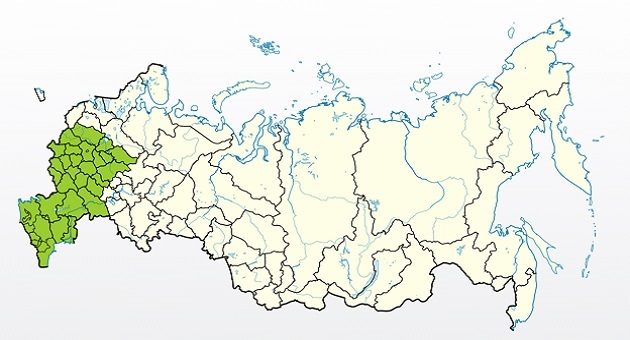
Growing regions
- Crimea.
- Middle zone.
- Leningrad region.
- North Caucasus.
- Moscow region.
Origin
The renowned Soviet pomologist Sergei Ivanovich Isaev made a significant contribution to the quantity and quality of apple tree diversity. One of his developments is the Antonovka Dessertnaya variety. It was developed using the Antonovka Ordinnaya variety, which was successfully crossed with the Pepin variety. This work was conducted around the late 1960s or early 1970s.
The variety was originally included in the State Register of Breeding Achievements. However, over the years, it has been supplanted by newer and more promising apple trees. It also has no official regionalization. It is more common on small private farms, not intended for industrial use, throughout the European part of Russia, and in the southern and northern regions.
Content
Description of the Antonovka dessert variety
 This variety is loved and respected not only for its beautiful and delicious apples, but also for its regular and abundant fruiting. The tree itself is undemanding in terms of growing conditions, although inferior in all respects to its parent variety. It grows well in virtually any soil, doesn't require frequent fertilizing or watering, is low-maintenance, and tolerates improper or aggressive farming practices. The tree itself is neat and compact, and winter-hardy.
The fruits are large, quite attractive, aromatic, with a nearly harmonious flavor and sweetness. They produce quite a lot, although their productivity isn't exactly record-breaking. They ripen in mid-autumn, are easy to transport, and keep well in the cellar. This variety is recommended for individual cultivation in home gardens.
Apples: What do they look like?
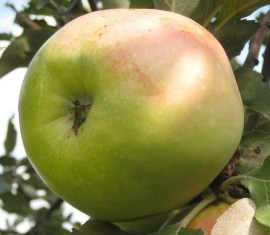
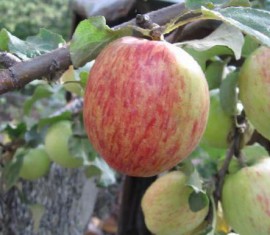
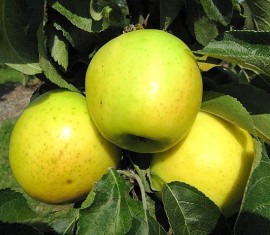
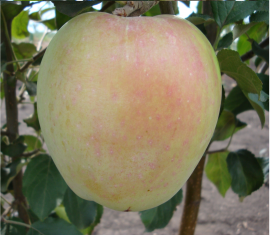
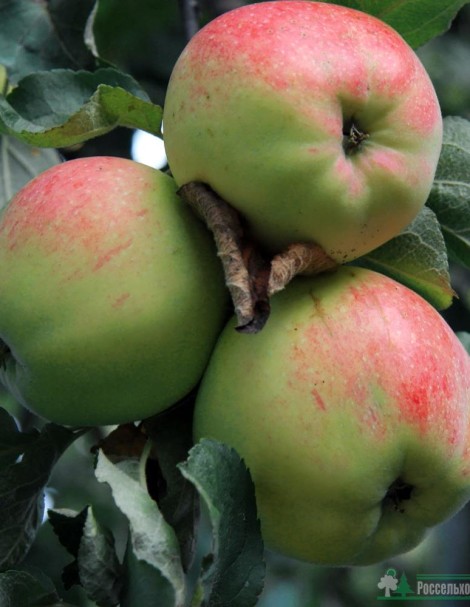
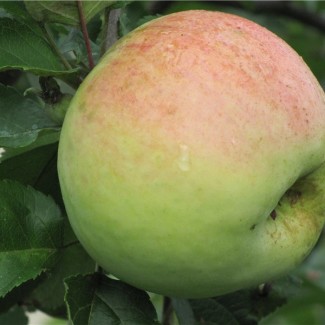
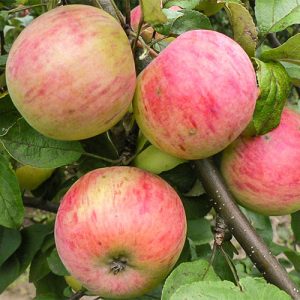 The fruits are quite large, reaching 190-220 grams, and some are even much larger. They are often asymmetrical, of medium uniformity, rounded or spherical, with pronounced ribbing; they may be slightly elongated, but not cylindrical. The side seam is sometimes visible.
The fruit's skin is dense, strong, and elastic, protecting the flesh well from mechanical damage. Its base color is light green or light green, sometimes slightly creamy. The blush appears as fuzzy, translucent, somewhat striped spots on the sunny side, ranging in color from pink, pink-crimson, coral, or even brick pink. Subcutaneous punctures are numerous, but they are small in size and light green or greenish-gray in color, making them difficult to see. The chemical composition is best determined by the following information:
- P-active substances (catechins) – 328 milligrams.
- Ascorbic acid (vitamin C) – 17.6 milligrams.
- Total sugars (fructose) – 9.3%.
- Pectins (fiber) – 14.1%.
- Titratable acids – 1.1%.
The Antonovka dessert variety has dense, fine-grained, and fairly firm flesh. It is crisp, prickly, refreshing, and pleasantly textured, easily chipped. It most often has a distinct yellowish-cream or even yellow hue, is very juicy, and has an aroma characteristic of the parent variety. The flavor is considered harmonious, balanced, and dessert-like. It is much softer than the Antonovka ordinary variety, sweeter, with only a slight tartness in the aftertaste. According to professional tasting reviews, this subvariety scores no more than 4.2 out of 5.
Antonovka dessert apple tree: characteristics
Crown and root system
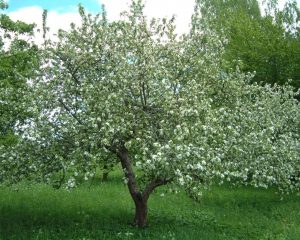 The tree is of medium height, much smaller than the parent tree.It can grow no more than 4.5-5 meters maximumThe crown is oval, round, or spherical, neat and regular in shape. In old age, it can become spreading, but not excessively so, sometimes even moderately weeping. The branches are strong, fairly robust, rounded in cross-section, covered with brownish-green bark, long and straight. They extend from the central conductor at an angle close to right angles.
The foliage is dense, covering the branches well. The leaf blade is smooth, flattened, slightly wrinkled, dense, smooth, and leathery. It is matte but has a distinctive sheen, green or light green. The tip is long and pointed, and the edges are strongly serrated, serrated, and crenate, and may be slightly wavy. The root system is highly branched, moderately deep, but well adapted to the search for water and nutrients. On most rootstocks, it is fibrous, but taproot is also common, occupying an area corresponding to the crown perimeter.
Productivity and pollination
In official documentation, the variety is considered high-yielding, although it cannot in any way “reach” the parent variety.
A single mature and fully formed Antonovka Dessertnaya tree can yield up to 100-120 kilograms of unusual fruit per season. With excellent care and favorable weather conditions, these figures can be increased by 10-15%, but no more. Some claim that in certain years, productivity can drop to 40-55 kilograms, although the yield is not considered periodic..
The dessert apple is considered relatively self-sterile, meaning a few apples will set on the tree even without pollinators within 50-90 meters. However, it's much better to have them present. This will maximize the harvest. The most experienced gardeners spray the trees with syrup during flowering in the spring and also bring mobile apiaries to their plantings.
Winter hardiness and disease resistance
In terms of low-temperature tolerance, the apple tree is somewhat inferior to its parent variety. It tolerates frosts down to -25-32°C quite well, even without special shelter. However, it's still best to carry out all necessary treatments promptly. Buds can freeze in severe cold, but the trees recover fairly quickly, within just one season.
Dessertnaya has no immunity to disease; it is susceptible to them just like the common variety. The variety has average resistance, meaning that the trunks are only susceptible to infection in years of severe epiphytotics. They suffer from scabies And powdery mildew Not only the leaves, but also the fruit. Pests are also very prone to damage apple trees. Therefore, it's essential to pay close attention to preventative treatments with insecticides and fungicides, which are available in gardening stores.
Rootstocks and subspecies
Of the two hundred Antonovka subspecies, this one is considered the most similar, although slightly inferior in all respects. It has the most similar flavor, albeit sweeter, and the aroma is virtually identical. The variety has no distinct subspecies, and does not come in columnar or creeping varieties. It is grown on various rootstocks, which have little effect on the quality and properties of the tree, but not the fruit.
Features of growing Antonovka dessert
 Landing
 Landing
Basic conditions
- Trees prefer open, sunny locations. Therefore, they are preferably planted in well-lit areas.
- It's important to ensure adequate ventilation and prevent stagnant air in the tree crowns. Otherwise, excess moisture will encourage fungal growth.
- It's best to choose soil that is both breathable and permeable. Loams, sandy loams, and black soil are all suitable. If there's too much clay, you can dilute the soil with river sand. Poor soils are suitable if fertilized properly and in a timely manner.
- Don't forget about the groundwater depth. It should be no higher than 2-2.2 meters to prevent root rot.
- Digging the holes in advance isn't necessary, but they should be left to settle for at least 2-3 weeks. Dig holes 80-90 centimeters in diameter and 70-80 centimeters deep, then add a small amount of topsoil mixed with organic and mineral fertilizers to the bottom. Then, place a drainage layer on top, water, and leave uncovered.
- For normal growth, you need to leave about 5 meters of distance between the trunks, and 3-3.5 meters between rows is enough, so that in the future the trees will not conflict with either crowns or rhizomes.
- It's a good idea to immediately drive trellises, planks, or stakes into the holes for support. If placed on the north side, they will also provide additional protection from cold weather.
- The trees are lowered into the hole, with their roots resting on the drainage surface, spreading them evenly to prevent them from bending. They are then covered with soil, compacting it layer by layer by hand, and watered with 35-40 liters of water. The surface is mulched with grass, sawdust, manure.
Landing dates
Trees are planted in the spring, in mid- to late April, when the threat of frost has passed and the soil has warmed up well. However, the variety also thrives in the fall if planted in late September or early October, when the first serious frosts are at least 3-4 weeks away. However, planting too early is not recommended, as the apple tree may begin to bud and freeze.
Tree care
 Tree care
Protection from frost and pests
For young saplings, both one- and two-year-olds, a tent-like shelter can be considered. However, with taller trees, this is no longer possible. Therefore, the trunks are wrapped in roofing felt, burlap, roofing felt, or any other material. Mats of straw or straw bales, spruce branches, and dried leaves are thrown onto the root zone.
To protect against insects, apple trees are whitewashed with lime, approximately 1-1.3 meters high. This gives the garden a neat and tidy appearance. To prevent rodents from damaging the delicate bark and young shoots, the trees are coated with fuel oil, lard, or grease.
Loosening the soil, watering: proper agricultural technology
All apple trees are traditionally dug once or twice a year, and in between, the soil is hoeed and loosened. At the same time, all debris, weeds, root suckers, and shoots from other plants should be removed from under the trunk. This should be done the day after watering, especially during dry and hot weather.
Water the Antonovka dessert tree as needed to prevent the root ball from drying out completely. Mature trees may not require watering at all, only in extreme cases, but young trees require moisture for development. The key is not to overdo it. A good rule of thumb is to water only if there's been no rainfall for ten days.
Pruning: simple crown shaping
Trees typically arrive from the nursery with a fully formed crown, consisting of a main stem and 2-4 scaffold shoots. These are planted at different heights, spaced far apart. As they grow, further shaping will be necessary, maintaining natural branching. Branches that will not bear fruit, such as upward-protruding suckers, crisscrossing shoots, and branches growing inward, should be removed.
In the fall, it's customary to perform sanitary clearing. This involves removing all broken, dry, or diseased shoots that interfere with the tree's growth. Cut areas must be sealed with paint. garden pitch Or at least cover it with clay or soil. This will significantly reduce stress on the tree.
Pollinator varieties
- Saffron pepin.
- Autumn striped.
- Anise.
- Borovinka.
- Korobovka.
- Champion.
- Welsey.
- Antonovka.
Diseases and pests
- Cytosporosis.
- Rust.
- Pit rot.
- Powdery mildew.
- Black crayfish.
- Scab.
- Rust.
- Scale insect.
- Leafhopper.
- Green aphid.
- Hawthorn.
Ripening and fruiting of Antonovka dessert
The beginning of fruiting
 The beginning of fruiting
This is an early-bearing apple variety, beginning to bear fruit as early as 3-4 years after planting. Of course, don't expect a huge harvest in the first few years; you might still see a few dozen apples. If flowers appear earlier, it's best to pick them off immediately, while they're still in bud, to prevent them from wasting the tree's energy.
Flowering time
Most autumn apples bloom at the same time, and the Antonovka dessert apple blossoms around mid-May. Therefore, finding pollinators is a sure thing. The tree produces large, fleshy, milky-white blossoms. They are very beautiful, abundant, and have a pleasant, distinctive scent. The process lasts about two weeks.
Fruiting and growth
Dessertnaya trees grow quickly, gaining approximately 45-60 centimeters per year before fruiting begins. Afterward, the growth rate may slow slightly, but not significantly. The apple tree increases its productivity quickly. By the 8th or 9th year, it's possible to harvest a full harvest of over 100 kilograms.
Apples ripen by the end of September or the beginning of October, sometimes slightly delayed, depending on the weather. They hold well on the branches, don't fall off, and will only take a couple of days to pick, although they ripen evenly. Leaving them on the tree for too long is not recommended, as the consistency and flavor may deteriorate slightly, becoming soft and slightly tart. The fruits transport well, and can be stored in the cellar until almost spring.
Top dressing
- Peat.
- Superphosphate.
- Humus.
- Bor.
- Calcium.
- Manure.
- Compost.
- Ammonium nitrate.
What to do if it doesn't bloom or bear fruit
- Limit or increase watering.
- Eliminate insects.
- Cure diseases.
- Feed.
- Transplant to a sunny place.
Why do apples fall?
- Wind, frost, rain, hail.
- Overripe.
- Pests or diseases.
Leave a review of the Antonovka Dessert apple tree variety so that even a novice gardener can receive useful information first-hand.