Arbat apple tree: characteristics of the variety and care
| Color | Reds |
|---|---|
| Ripening season | Summer |
| Size of apples | Average |
| Taste | Sweet and sour |
| Crown type | Columnar tree |
| Shelf life | Low shelf life |
| Application | For recycling , Fresh |
| Winter hardiness | Average winter hardiness |
| Fruiting age | Up to 5 years |
 History of origin and regions of growth
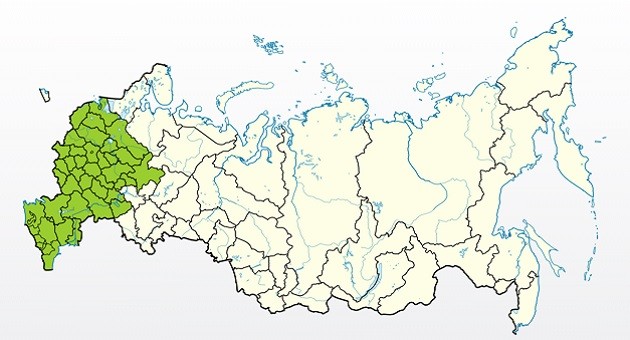
Growing regions
- North Caucasus.
- Crimea.
- European part of Russia.
- Moscow region.
- Leningrad region.
Origin
The development of columnar apple trees began in the USSR quite early, back in the early 1960s. In 1984, renowned breeder Viktor Valerianovich Kichina developed a completely new variety, later named Arbat, at the experimental station of the All-Russian Selection and Technological Institute of Horticulture and Nursery.
Two hybrids were used as parent varieties for the new apple tree: the scab immunity donor TSR12T77 and the columnar growth donor SA 54-108. The following year, the RD43 seedling was selected from among many others, eventually named Arbat, designated as an elite variety, and accepted for unofficial testing by various farms. Despite the obvious merits of this cultivar, it has not yet been included in the State Register of Breeding Achievements or zoned, although it is actively grown in the south, the European part of our country, and even in some more northern regions.
Content
Description of the Arbat apple tree variety
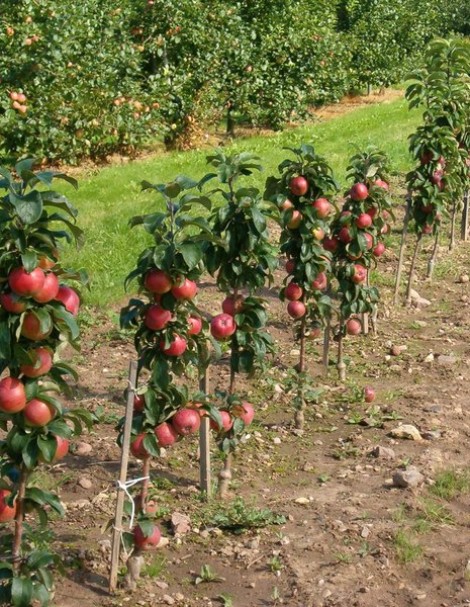
 Columnar apple trees attract gardeners with their particularly compact crown. The Arbat requires only half a square meter of space for comfortable growth and abundant fruiting. The tree has immune protection against various fungal infections, is resistant to pests, bears fruit annually without interruption, and is also frost-hardy and easy to maintain.
Despite some drawbacks, such as a short active lifespan, poor fruit shelf life, and a tendency for fruit to become crushed if not properly cared for, it is recommended for use in large-scale commercial intensive plantings for industrial purposes and in small private farms.
Apples: What they look like
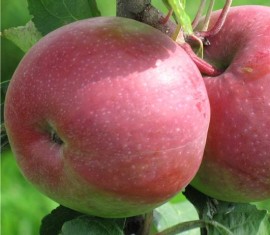
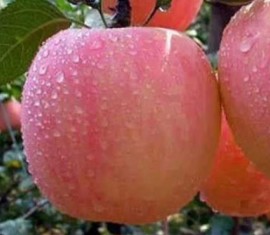
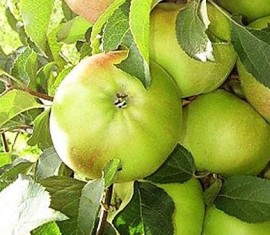
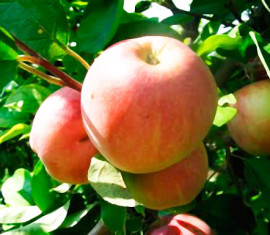
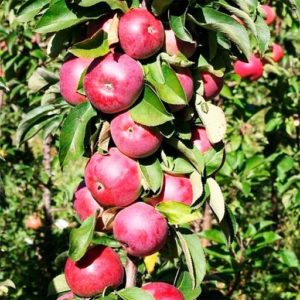 The fruits are usually medium or slightly larger than average in size. They are uneven, reaching a maximum weight of 95-135 grams, but can reach 150-180 grams with proper care. If the buds are not thinned in the spring, they inevitably become smaller over time. The apples are round, flattened, sometimes turnip-shaped, slightly conical, and smooth. The apex often has a smooth ribbing and a side seam.
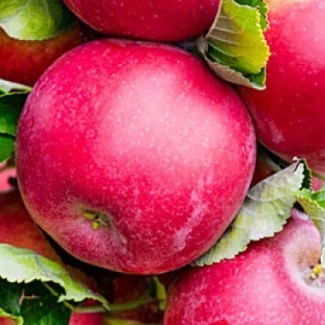
The skin is dense but very thin and fragile, making transportation difficult. It is glossy and smooth, elastic, and light green, light green, or greenish-yellow. During ripening, a slight waxy-oily coating develops on the surface, giving the apples a bluish tint, as if covered with frost. The blush is dense, blurred, striped, and rich pink, red, or crimson. Subcutaneous punctures are large, light-colored, few in number, and moderately visible. The chemical composition of the fruit is usually characterized by the following parameters:
- Pectins (fiber) – 12.2%.
- Titratable acids – 0.49%.
- Sugars (fructose) – 8.3%.
- Ascorbic acid (vitamin C) – 7.8 milligrams.
- P-active substances (catechins) – 182 milligrams.
The flesh is medium-dense, slightly crunchy, pleasantly textured, fine-grained, and juicy. The color is predominantly light yellow or slightly creamy. The flavor is sweet or slightly sweet and sour, considered more of a dessert than a table fruit. It is harmonious but unbalanced due to its excessive sweetness. Official tasting reviews from professionals are not yet available.
Arbat apple tree: characteristics
Crown and root system
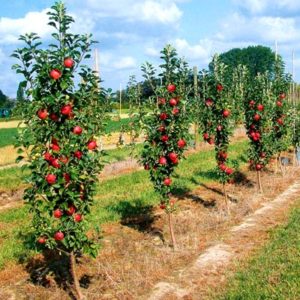 The tree is considered a natural columnar semi-dwarfIt can stretch up to 1.6-2.3 meters maximum., which truly simplifies maintenance and harvesting. The crown barely reaches 25-40 centimeters in height, consisting of a single trunk covered with greenish-brown or light-brown bark that is slightly dry, with delicate ribbing. Rings, spears, and small fruiting twigs, which are where the fruiting occurs, grow directly on the trunk.
The leaves are small, dense, slightly elongated, leathery, dark green or emerald, shiny, glossy, and may have slight pubescence on the back. They are arched and have a short, pointed tip, with wavy, finely serrated, and serrated edges. The root system is superficial, branched, and shallow, poorly adapted to water-seeking.
Productivity and pollination
Arbat is recognized as a high-yielding and early-bearing variety, because its productivity can truly impress even a seasoned gardener, especially when it comes to columnar apple trees.
One mature tree can produce up to 20-22 kilograms of tasty, though not particularly large, fruit per season. Considering that the tree barely reaches two meters in height, these figures are truly remarkable..
The variety is considered conditionally self-fertile, and its pollen has a viability index of 40%. This means that in the absence of other pollinators nearby (50-100 meters), the autumn harvest will yield no more than the aforementioned percentage. Therefore, gardeners typically interplant these apple trees to maximize fruit yield.
Winter hardiness and disease resistance
Arbat has quite good frost resistance. It tolerates temperatures down to -25-27°C quite well, but only when such periods last no more than 1.5-2 weeks. Therefore, preparation for wintering and covering during the cold period always require considerable attention. The standard procedures described in more detail below are quite suitable for this variety.
An apple variety with genetic immune memory against was used as a parent for Arbat. scabiesThis disease is considered a major problem in Russian gardeners' plantings, but it's completely harmless to this columnar plant. The variety is resistant to cytosporosis, powdery mildew, and other diseases. However, it requires regular treatment against pests, such as scale insects, hawthorn, and green rhizomes. aphid, leaf rollers and other insect pests can cause a lot of trouble.
Rootstocks and subspecies
Arbat is a completely new columnar apple tree, so no subspecies have been developed yet, and no work is being done on it, at least not at the official development level. Apple trees are grown on seed, standard, dwarf, and semi-dwarf rootstocks, the MM-106 hybrid being considered the best. The tree's overall characteristics do not change significantly.
Features of Arbat cultivation
 Landing
 Landing
Basic conditions
- Almost all fruit crops thrive in open spaces and good light, and this variety is no exception. In the shade, it will look unhealthy and weak, and may refuse to flower or bear fruit.
- Apple trees don't have any special soil requirements, but they certainly don't like overly acidic soil. They thrive in loam, black soil, or sandy loam. If the pH exceeds the norm (5.5-6 pH), it's best to neutralize it with lime before planting.
- Arbat doesn't require much space, so holes are dug approximately 85-95 centimeters apart, which is sufficient for comfortable growth and fruiting.
- It's preferable to prepare the holes in advance, at least 12-16 days before planting. Dig holes 60x80 centimeters in size, fill the bottom with fertile soil from the top layer, then add drainage, fill with water, leave uncovered, and let sit.
- It's a good idea to dig or drive stakes (planks, rods) into the holes immediately for support. Removing them is not necessary; the tree is tied to them for winter shelter, but this can be done approximately 5-6 years after planting.
- Each seedling is inspected before planting; if any dried or damaged roots are found, they are trimmed. To hydrate the rhizomes, you can soak the trees in water for 6-10 hours before planting them in the ground.
- Root collar When planting, it should always remain 4-8 centimeters above the surface, otherwise all the qualities of the rootstock will be leveled out.
- Place the apple trees in the hole so that the roots can lie freely. Cover with soil and compact it firmly by hand to avoid air pockets, which often lead to root rot. Water the trees with 15-20 liters of water, and mulch the soil surface with sawdust, chopped grass, and manure.
Landing dates
Arbat apple trees can be planted in either spring or fall, after all the other trees have shed their leaves. However, experienced gardeners note that the trees have a much better survival rate in the former case. As soon as the snow melts, the soil warms, and the threat of frost has passed, choose a warm day to plant. In fall, however, you need to seize the moment when frost is still a long way off, but the sap flow in the trunks has stopped. If the apple tree begins to develop buds during this period, it will inevitably die in the winter frosts.
Care and agricultural technology
 Care and agricultural technology
Protection from frost and rodents
According to the standard, watering should be stopped no later than mid-September before the cold weather sets in, allowing the tree time to prepare for winter. Mats of dry grass, leaves, straw, or spruce branches are placed on the root zone. If winters are severe in the region, soil can be piled 10-15 centimeters onto the roots, which, like the mats, should be removed in the spring. Trunks are wrapped in burlap, any fabric, agrofibre, roofing felt, or roofing felt. If severe frosts threaten, trees are also covered with a tent-like covering.
To repel insect pests hiding in cracks and crevices in the bark or near the rhizomes, tree trunks are whitewashed with lime in the spring and fall to a height of at least 40-60 centimeters. Coating the trees with melted animal fat, drying oil, grease, or any other pungent-smelling substances will help repel rodents.
Pruning: simple crown shaping
Pruning is crucial for this columnar tree, as it is crucial to forming a proper crown. In the first year, two lateral shoots (skeletal branches) are left and pruned back to two buds. The following year, the stronger, main, and fruiting branch is completely removed, allowing the second branch to develop. This process is repeated year after year. If the upper buds are frozen, it's best to cut them off; this will allow the tree to recover more quickly. All damaged shoots, rhizomes, and fruiting twigs are trimmed with pruning shears in the spring or fall.
Pollinator varieties
Reproduction
- Rooting of cuttings or buds.
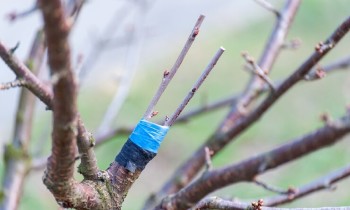
- Kidney grafting.
- Grafting by cuttings.
- Cloning (layering).
Diseases and pests
- Powdery mildew.
- Black crayfish.
- Green aphid.
- Codling moth.
- Scale insect.
- Hawthorn.
Ripening and fruiting of Arbat
The beginning of fruiting
 The beginning of fruiting
The first flowers bloom in the first year, even if the seedlings are still growing in the nursery. Experts recommend plucking them to allow the tree to establish itself. Therefore, it is believed that the variety only begins to bear fruit in the second or third year after planting in open ground, as all buds must be completely removed before then. In the first few years, you'll only be able to harvest 2-5 kilograms of apples, but that's plenty for a taste.
Flowering time
Flowering occurs mid-season, around mid-May. The exact timing will largely depend on the climate and weather conditions of the particular year. In warm, sunny conditions, the buds will open earlier, while in cool and rainy conditions, they will open later. Blooming is very profuse, but the flowers themselves are small, white or slightly pinkish, with curly, ruffled petals. The flowers are fragrant and beautiful, and the trees look very beautiful and elegant during the flowering period, which lasts approximately 9-14 days.
Fruiting and growth
Arbat grows quite quickly, reaching 12-18 centimeters per season. Because the tree doesn't grow very tall, it reaches its full height very quickly. Fruiting also increases gradually, but quite rapidly. The first year's harvest may be quite limited, but by the 4th-6th year, a full harvest of up to 10 kilograms will be achieved. The main drawback of this variety is its short lifespan—only 10-15 years—after which it will need to be replaced.
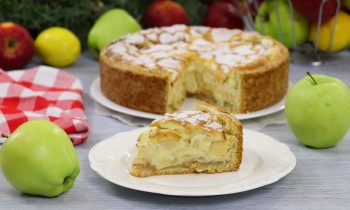
The fruits ripen around the second half of August, and it's crucial to catch the moment. You can tell when they're ripe by the presence of a bluish, waxy coating, which signals that it's time to pick them, otherwise they'll fall to the ground. They can't be stored for more than two to three months; they become soft and fluffy, lose their flavor, and become sour. However, they transport well, and they make excellent compotes, preserves, juices, and jams.
Top dressing
- Mineral complexes.
- Peat.
- Compost.
- Manure.
- Ammonium nitrate.
- Humus.
- Superphosphate.
What to do if it doesn't bloom or bear fruit
- Provide feeding and fertilizers.
- Check for pests and diseases.
- Water.
- Transplant.
Why do apples fall?
- Wind, hail, hurricane, rain.
- Pest damage.
- They are very overripe.
- Diseases.
Please leave your feedback on the Arbat variety, giving other gardeners the opportunity to gain insights on how to improve the cultivation of these apple trees and maximize their yields.