Apple tree Medok: characteristics of the variety and care
| Color | Whites |
|---|---|
| Ripening season | Summer |
| Size of apples | Average , Large |
| Taste | Sweet |
| Crown type | Columnar tree |
| Shelf life | Low shelf life |
| Application | For recycling , Fresh |
| Winter hardiness | High winter hardiness |
| Fruiting age | Up to 5 years |


 History of origin and regions of growth
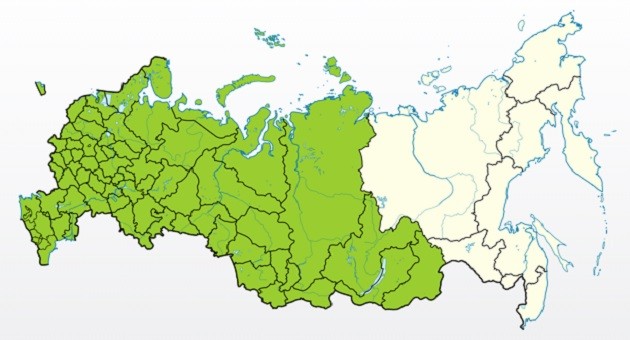
Growing regions
- Some northern regions.
- North Caucasus.
- Crimea.
- Volga region.
- Black Earth Region.
- Western Siberia.
- European part of Russia.
- Ural.
Origin
Viktor Valeryanovich Kichina was the main developer of columnar apple trees in our country. This variety also belongs to the scientist and his creative team with Nadezhda Gennadyevna Morozova. It was first developed relatively recently, at the All-Russian Institute of Plant Breeding and Selection (VTISP) in Moscow in 1987. At that time, seeds were sown that were collected after open pollination of the columnar donor, KV 103.
First, in 1993, a seedling was selected and assigned the special number 385/342, under which it was tested. In 1996, for its qualities, it was given the name Medok and sent to experimental farms for propagation and evaluation. While the variety has not yet been regionalized or included in the State Register, it is successfully grown in the aforementioned regions.
Content
Description of the Medok apple variety
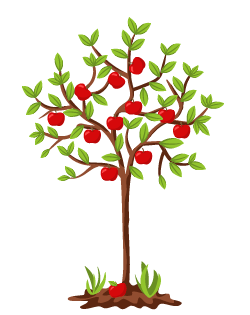 This columnar apple variety, whose name directly alludes to the taste and color of its fruit, despite not yet being included in the State Register or zoned, has already found its place in the gardens and hearts of numerous domestic and international gardeners. It's fast-growing, reaching its maximum height in just a couple of years, unpretentious, with a compact crown suitable for harvesting without lateral shoots, is not particularly susceptible to various weather conditions, and is winter-hardy enough for cultivation outdoors. Urals.
The fruits are large and numerous, possessing exceptionally high commercial and consumer qualities. They begin to ripen on the trunk soon after planting, and the compact crown makes care and harvesting extremely easy. Medok is recommended for both small garden plots and large commercial orchards with intensive production.
Apples: What they look like
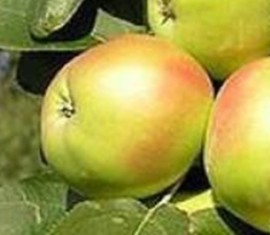
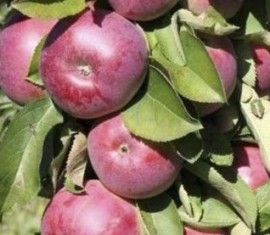
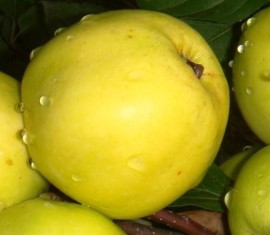
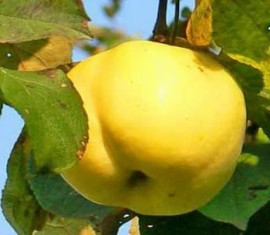
 The variety's fruits are generally medium-sized, although this will largely depend on care, regional climate, and, most importantly, the weather conditions of a given year. They reach a maximum weight of 180-210 grams, but most often range from 120-150 grams. They are round, uneven, and can be slightly elongated. The ribs are flattened and smooth, often revealing a clearly visible side seam.
The skin is dense and elastic, preventing most mechanical damage. When unripe, it has a green or light green hue, but as it ripens, it acquires a slight yellowish or golden tint. It is smooth, but not glossy, more of a matte finish; at full maturity, it becomes covered with a delicate waxy, oily coating. The blush is virtually absent, but in sunny years, it may appear as pinkish or orange, blurred, translucent spots on the side with more light. Subcutaneous spots are grayish, with a dark green tint, large, evenly spaced, numerous, and clearly visible to the naked eye. The chemical composition of the fruit is as follows:
- Titratable acids – 0.57%.
- Sugars (fructose) – 16.2%.
- Pectins (fiber) – 11.9%.
- Ascorbic acid (vitamin C) – 13.8 milligrams.
- P-active substances (catechins) – 312 milligrams.
The flesh is coarse-grained but not crumbly, but dense, prickly, and very juicy. It is white or slightly lemon-colored, sometimes creamy, and has a strong, distinctive, and easily recognizable aroma. The flavor is considered dessert-like, balanced, and harmonious, leaning heavily toward sweetness but with a slight tartness in the aftertaste, with distinct honey notes. Professional tasters give the fruit 4.6 out of 5 possible points for appearance and 4.7 for taste.
Apple tree Medok: characteristics
Crown and root system
 Standards are considered natural semi-dwarfs because they do not grow more than 2-2.5 meters. Considering this is a columnar tree, it's immediately clear that it's very compact and can be planted in large numbers in a small area. This allows for good yields even in small spaces. The tree doesn't produce lateral skeletal branches, but if any do form, they should be removed during spring pruning. The bark is brown, brownish, or reddish-brown, glossy and shiny, and may have slight pubescence in some areas. Fruiting is concentrated on the ringed branches.
The leaves are large, oval-elongated, curved, leathery, glossy, and a rich, dark green. They are distinguished by a short, pointed tip, curved downward, and a crenate-serrate margin. The root system is fibrous, robust, highly branched, shallowly buried, and well adapted to water-seeking.
Medok is one of the few columnar vines that can be grown in pots or containers. This means they don't need to be planted outdoors at all, and will still produce fruit as usual.
Productivity and pollination
It is difficult to call this variety a high-yielding variety, since due to its compact size, it is unlikely that a significant number of fruits will be obtained from one tree.
A mature Medok tree typically yields approximately 15-25 kilograms of beautiful honey-colored fruits during the growing season. However, the total yield per hectare is at least 100-120 centners, which is quite high, comparable to Simirenko or Antonovka..
One of the advantages of this variety is its complete and utter self-fertility. Even if there is absolutely no other apple tree within reach, it will still produce fruit. However, experienced gardeners say that the presence of such trees will significantly (by 20-35%) increase the Medok's yield. Therefore, interplanting different varieties still makes sense. Attracting honey-producing insects by spraying flowering trees with sugar syrup is also encouraged.
Winter hardiness and disease resistance
A unique feature of this variety is that the tree can withstand temperatures as low as -37-42°C without significant damage. If all the required standard measures, described below, are taken, even more severe frosts will not affect the trunks, and they will bear fruit normally the following year.
Medok is highly resistant to scab, powdery mildew, and other apple diseases, no less so than its taller counterparts. Even during years of severe epiphytotics, trees can remain unaffected. When the disease strikes, the leaves are most often affected, while the fruit remains edible. Preventive measures should still be taken correctly and promptly: clear the area around the trunk of rotting leaves and fruit, remove weeds, and spray with fungicides against fungi and insecticides against insects.
Rootstocks and subspecies
The variety has no subspecies; it exists only once, and its uniqueness is its special appeal. However, it can be grown on various rootstocks, which can sometimes affect the basic characteristics of the trees and fruit. The most popular are the dwarf rootstock Mark and hybrid No. 62-396. These trees grow no more than 2 meters tall and produce large, beautiful fruit in the second year after planting.
Features of growing Medok
 Landing
 Landing
Basic conditions
- The first condition for a good future harvest is a high-quality, well-lit, and well-ventilated growing site. If the trees are shaded by taller plants, the fruit will be smaller and the overall yield will be reduced.
- The depth of the groundwater table isn't critical, but it's best if it doesn't rise above 2-2.2 meters. Trees are generally not planted near rivers, ponds, or streams, as are lowlands or floodplain meadows, which are flooded by spring runoff.
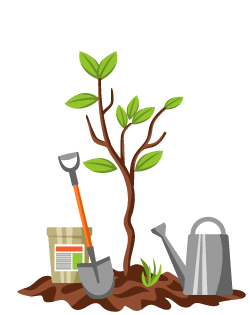
- Apple tree holes are usually prepared in advance of the planting season, but this isn't necessary for Medok. You can simply dig holes 60 centimeters deep and 80 centimeters in diameter, fill the bottom with fertile soil (topsoil) mixed with humus, peat, or compost, then add a drainage layer (gravel, broken brick, nutshells), and plant the trees on top. For larger plantings, you can cut furrows with a tractor and place the trees in them.
- It is customary to leave the root collar of the seedling above the surface, 5-9 centimeters, so as not to lose the properties of the rootstock.
- The distance between the trunks should be left within a row at 60-70 centimeters, and between rows at 1-1.2 meters.
- Place the seedling on a drainage hole, ensuring the roots don't bend. If the holes are too small, it's best to trim off the shoots with pruning shears. Fill with soil, compact it lightly, and mulch the surface.
Landing dates
Following the standard planting dates (spring and fall) is quite sufficient for this variety. You can choose a sunny day in late March or September to do the job. It is important that the threat of frost has passed or the leaves have completely fallen. Trees with closed root system You can move it to open soil at any time during the growing season.
Protection from frost and rodents
Despite the enviable resistance of standard trees to low temperatures, it's a good idea to monitor their condition, especially if winters in the growing region are quite cold and variable. By mid-September, all watering should be stopped completely. The root area can be covered with dry leaves, straw bundles, or even soil. All this should be removed in the spring, after the soil warms up. Trunks can be wrapped in burlap, roofing felt, or agrofibre, and the trees can even be covered with a tent-like covering.
To prevent insects from settling in the intertwined rhizomes or bark crevices, the trunk's underside is whitewashed with lime twice a year, in early spring and late fall. To repel rodents, it's a good idea to coat the trunks with pungent-smelling substances, such as grease or rendered animal fat.
Tree care
 Tree care
Loosening the soil, watering: proper agricultural technology
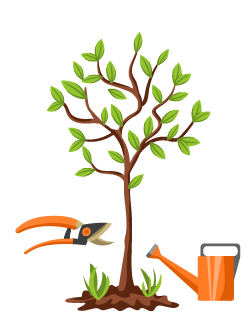
Dig the area around the tree trunk once or twice a year. Care should be taken to avoid cutting the roots, although this likely won't cause significant harm to the tree. It's a good idea to remove weeds and root suckers, along with other plant shoots, more frequently—4-6 times per season—and hoe the soil around the trunk. Don't allow fallen fruit to rot under the tree. Regular mulching is a good idea to retain moisture and nutrients.
Trees need watering, especially in the first few years after planting, until they become established. It's best to follow the 10-day rule, which states that water should be applied if there has been no natural precipitation for exactly ten days. If rain does fall, then the ten days are counted from that point onward. For one mature tree trunk, 15-25 liters of water is sufficient. Also, add necessary fertilizers and fertilizers.
Pruning: simple crown shaping
Columnar trees, including the Medoc, require virtually no pruning, as lateral shoots are not allowed. Their growth is impeded by the growth of runners that spread along the entire trunk. However, if the top bud freezes in winter, it's best to cut the runner down to the next runner, which will allow the tree to recover more quickly.
Pollinator varieties
- Melba.
- A gift to Count.
- Mantet.
- Antonovka.
- Kate.
- Folder.
- White filling.
- Currency.
Reproduction
- Growing from seeds.
- Rooting.
- Grafting.
Diseases and pests
- Rust.
- Scab.
- Powdery mildew.
- Black crayfish.
- Green aphid.
- Codling moth.
- Scale insect.
- Hawthorn.
Ripening and fruiting of Medok
The beginning of fruiting
 The beginning of fruiting
This variety begins bearing fruit unusually early. In its first year, it may produce buds and several tasty, sweet apples. However, don't expect this; pick the blossoms immediately to allow the tree to develop a root system and height. Experienced gardeners say that the optimal time to begin harvesting is between the second and third years, and the fruit will be quite abundant, weighing approximately 4-6 kilograms.
Flowering time
The Medok apple tree begins to bloom in the second half of April, but most often towards the end of the month or even early May. The flowering period lasts for more than 14-15 days, allowing bees and wind to usually complete the pollination process. The flowers themselves are large, fleshy, white or with a light green tint, densely covering the entire trunk, giving the tree a very unique, decorative appearance.
Fruiting and growth
Considering the dwarf and columnar nature of the tree, its growth rate can be considered average. In a year, the tree can grow 10-13 centimeters, sometimes a little more. Fruiting increases very quickly, and the full 12-15 kilograms can be achieved approximately 6-8 years after planting. However, the active lifespan of a columnar tree is short, only 25-30 years at most, after which it is recommended to uproot the trees and plant new ones.
The fruits begin to ripen in late August, when they can be immediately picked and processed. However, they only acquire their most pleasant flavor by early September, when they reach consumer maturity. The main drawback of this variety is the poor shelf life of the apples, which lasts only 25-35 days, after which they lose their firmness and flavor.
Top dressing
- Mineral complexes.
- Manure.
- Peat.
- Humus.
- Superphosphate.
- Chicken manure.
- Compost.
- Ammonium nitrate.
What to do if it doesn't bloom or bear fruit
- Provide watering and fertilizing.
- Check for pests or diseases.
- Transplant into the sun.
- Fertilize.
Why do apples fall?
- Wind, hail, hurricane, rain.
- Pest damage.
- Diseases.
Please leave your feedback on the Medok variety so that other gardeners can learn something similar from it to enhance their experience.