Arkad Biryukov apple tree: characteristics of the variety and care
| Color | Greens |
|---|---|
| Ripening season | Summer |
| Size of apples | Average |
| Taste | Sweet |
| Crown type | Average tree height |
| Shelf life | Low shelf life |
| Application | Fresh , For recycling |
| Winter hardiness | High winter hardiness |
| Fruiting age | From 5 years old |
 History of origin and regions of growth
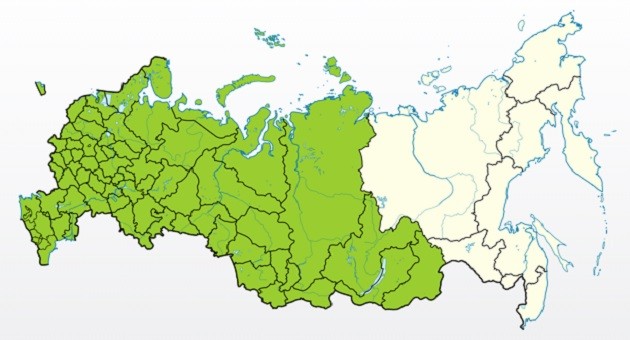
Growing regions
- Ural.
- Crimea.
- Middle zone.
- Leningrad region.
- North Caucasus.
- Bashkortostan.
- Moscow region.
- Siberia.
Origin
This apple tree was cultivated at the very beginning of the twentieth century by a renowned Soviet pediatrician named Arkady Pavlovich Biryukov. In the 1920s, he established an orchard on his property, where he successfully conducted pomological experiments. Open pollination of the Arkad winter apple with pollen from seedling No. 21 resulted in a completely new variety, which has become popular among many gardeners in our country and far beyond. The goal was to produce a late-ripening, yet tasty and highly aromatic variety, which they successfully achieved.
The apple tree turned out to be of high quality, but its listing in the State Register of Breeding Achievements was short-lived—it was easily supplanted by more promising and fresher new varieties. There is currently no information about it there. The tree also lacks official zoning, but it is successfully cultivated throughout the central part of the Russian Federation, and slightly further south and north.
Content
Description of the Arkad Biryukova variety
 The apple tree's main advantage is its frost resistance, as it easily withstands the harsh climate even in the challenging Leningrad region and thrives in the harsh Siberian and Ural regions. The variety is hardy, doesn't require any special growing conditions, doesn't require frequent feeding or fertilizing, and is undemanding of soil and watering. However, it can easily be affected by frost. scab or another fungal disease - it does not have sufficient resistance to diseases.
The yield is regular and average, with the fruits ripening quite early. They are medium-sized, very attractive in appearance, rounded, with a light blush on the barrels, and intensely aromatic and delicious. They store well in a standard cellar and can be transported over long distances. The Arkad Biryukova variety is recommended for cultivation in private gardens.
Apples: What do they look like?
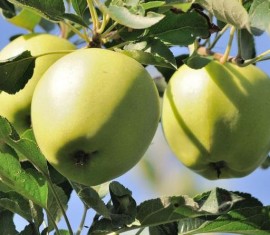
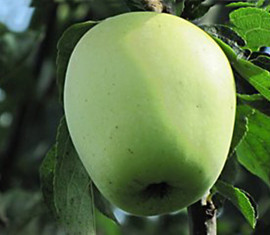
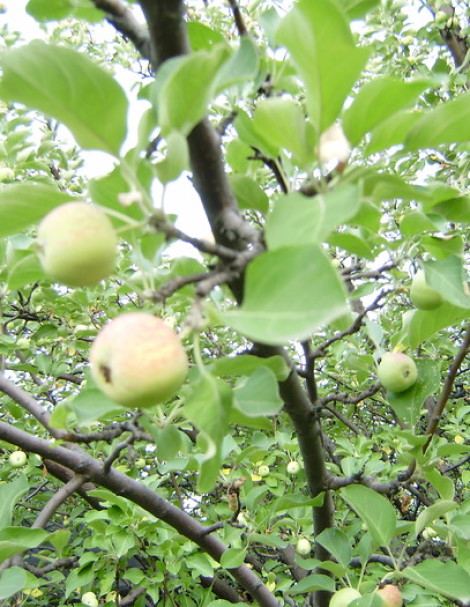
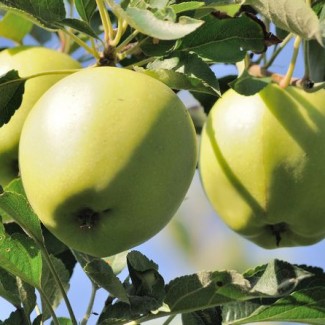
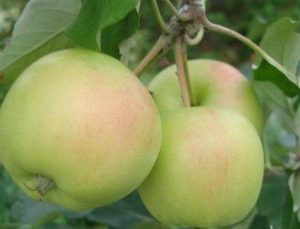 The fruits are medium to medium-large in size, weighing approximately 110-140 grams. Their shape is round or slightly rounded-elongated, reminiscent of a turnip, but not cylindrical. Ribbing may be slightly visible near the calyx, and the lateral suture is often clearly visible.
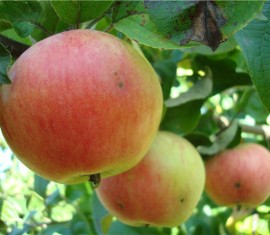
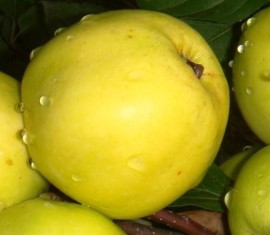
The fruit skin is dense, elastic, and quite strong. It is green or yellow-green when ripe, uniform, and smooth. A light, striped, dotted, or stippled blush of pale coral, crimson, or pinkish color may appear over the entire surface. Subcutaneous punctures are numerous, large, light, light green, or grayish, and clearly visible. The chemical composition is not significantly different from the parent fruit:
- P-active substances (catechins) – 220 milligrams.
- Ascorbic acid (vitamin C) – 8.9 milligrams.
- Total sugars (fructose) – 13.9%.
- Pectins (fiber) – 11.2%.
- Titratable acids – 0.49%.
The Arkada Biryukova pulp is dense, fine-grained, very juicy, and very aromatic. It has a pleasantly sweet flavor with a characteristic slight acidity and a spicy aftertaste, which can feel slightly winey. According to a professional taste test, it scores only 4.4 out of 5 for appearance and flavor.
Arkad Biryukov apple tree: characteristics
Crown and root system
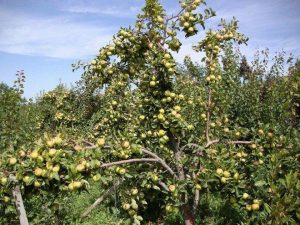 It is considered that the variety is of medium height, because its maximum height is no more than 4-4.5 metersThe crown is predominantly rounded, but can be pyramidal or oval when young. It is highly dense, but over time, the crown can become particularly spreading, becoming untidy and overgrown. Branches extend at right angles to the main stem; they are long, geniculate or straight, of medium thickness, and covered with greenish-brown or brown bark.
The leaves are quite dense, small, dense, highly glossy, and leathery. They can sometimes feel slightly sticky to the touch. The blade is rounded and slightly elongated, with a short- or long-pointed tip. The edges are serrated, crenate-serrate, and can be wavy or flat. The underside of the blade has a felty pubescence. The tree's root system is fairly deep, highly branched, and occupies a large area. This extensive branching and numerous small branches suggest that the tree is adapted to seeking nutrients and moisture in the soil.
Productivity and pollination
Average level is the best description of the yield of the Arkad Biryukov variety.
A single mature tree of this variety yields approximately 75-90 kilograms of very aromatic, sweet fruit per season for experienced growers. However, such results can only be expected if the apple trees receive proper, regular, and timely care, and the weather and climate are favorable. Otherwise, you can expect no more than 60-70 kilograms of apples.
The variety is considered self-fertile, but only conditionally. This means that up to 35-50% of the fruit can be produced even when there are no trees nearby, which is appropriate for the flowering period. To maximize the harvest, you'll need to ensure that pollinators are present nearby. Ideally, the distance should not exceed 150-200 meters.
Winter hardiness and disease resistance
The Biryukov's Arkad's resistance to low temperatures is the envy of many gardeners. It can easily tolerate temperatures down to -25-32°C, even without any cover. Therefore, it can be grown in virtually any region of our country, with the exception of the Far North and the Far East. If properly protected, the trees will withstand even lower temperatures lasting more than 2-3 weeks at a time, as well as sudden temperature fluctuations.
The variety's main drawback is its low resistance to various fungal infections that plague apple trees. They are very susceptible to various diseases, and the illnesses are severe and severe, making treatment difficult and practically ineffective. Therefore, it's best to carry out preventative treatments and sprays with commercially available products in a timely manner. Good pest control products are also available in gardening stores; you won't be able to avoid them.
Rootstocks and subspecies
Arkad Biryukova is a subspecies of the ancient Arkad variety, but it has no subvarieties of its own, and likely never will. No breeding efforts are being conducted on this variety. It can be grown on various rootstocks, from dwarfs to standard vegetative rootstocks. These determine the width and height of the crown, its spread, and winter hardiness, but have no effect on the quality of the fruit.
Growing Arkada Biryukova
 Landing
 Landing
Basic conditions
- The site for planting apple trees of this variety should be carefully chosen, allowing sufficient space for the crown to grow, which can be quite extensive. At least 4-5 meters should be left between trees, and the same amount between rows or other plants.
- Arkad Biryukova grows best in well-lit areas where there is no shade from buildings or other trees.
- It is important that the groundwater level is no higher than 2 meters from the surface, otherwise the apple tree's roots may begin to rot, which will lead to its death.
- Proper ventilation of the tree crown plays a key role in preventing fungal diseases. However, apple trees should not be allowed to grow in drafty conditions, as this will likely kill them. A careful balance must be maintained.
- Trees thrive in any type of soil, from rich, fertile black soil to sandy or rocky mountain slopes. If fertilized and loosened regularly, the trees will produce bountiful harvests anywhere.
- It's best to dig the holes in advance, at least 3-4 weeks before planting, or even better, the previous season. Fill the bottom with fertile soil, then add drainage, then fill with water and leave uncovered.
- The root collars of seedlings should always remain above the soil surface to prevent the trees from taking root higher. This would completely negate the properties and qualities of the chosen rootstock. 5-8 centimeters will be sufficient, even if the soil around the trunk settles over time.
- Lower the seedling into the hole, holding it by the guide. Cover with soil, compacting it with your hands or feet, but not too vigorously. Water the trees with 15-25 liters of water, and carefully mulch the surface with sawdust, chopped grass, manure, or any other available material.
Landing dates
This easy-to-grow variety responds well to planting in both spring and fall. In spring, the optimal time is mid-April, and in fall, around the end of September. The further north and cooler the growing region, the more preferable the first planting option.
Tree care
 Tree care
Protection from frost and pests
In warm regions with mild climates, Biryukov's arborvitae requires no winter protection at all. It tolerates even fairly severe frosts well, as long as they don't last long. In harsher climates, it's best to wrap the trunks with burlap, roofing felt, or tar paper, and toss spruce branches, straw, or hay over the roots. Small trees can be wrapped in burlap, tarpaulin, or agrofiber like a tent, but this approach isn't suitable for larger mature specimens.
Insects nest in bark crevices for the winter. To repel them, tree trunks are whitewashed to a height of about one meter with a thick lime solution. Greasing trees with lard, tallow, grease, and fuel oil is effective against rodents. Commercially produced products are effective, but many gardeners believe it's better to choose more environmentally friendly options.
Loosening the soil, watering: proper agricultural technology
Savvy people dig around the trunk once or twice a year. This ensures oxygen and nutrients reach the apple tree's rhizomes. At the same time, weeds, root suckers, and other debris are removed from under the trunk. It's recommended to hoe the soil the day after watering. Otherwise, it compacts into a tight ball, making the trees uncomfortable.
Arkada tree trunks can be watered throughout the growing season. However, frequent watering is only recommended during periods of extreme heat and drought. Otherwise, approximately 3-5 times per summer is sufficient. Time watering to coincide with bud break, fruit set, and apple ripening. Water volumes should be generous, up to 4-5 buckets per trunk.
Pruning: simple crown shaping
Proper pruning of apple trees of this variety is crucial. Crown shaping begins in the spring or fall of the first year, immediately after planting. The central trunk is shortened by about a third, and two to three skeletal shoots are left, as these will form the entire crown. Branches should be at different heights and spaced far apart.
Sanitary pruning is most often done in the fall, but in some cases, when snow has damaged shoots, it can be done in the spring. Remove any shoots that will not bear fruit in the future—old, broken, dry, shoots growing vertically upward (suckers), crisscrossing shoots, shoots protruding inward, and parallel shoots. Cuts should not be left uncovered. Paint or drying oil can be used. garden var and even the earth.
Pollinator varieties
- Idared.
- Spartacus.
- Gala.
- Liberty.
- Champion.
- Borovinka.
- Antey.
- Ligol.
- Belarusian sweet.
- Gloucester.
- Silver hoof.
Diseases and pests
- Cytosporosis.
- Rust.
- Pit rot.
- Powdery mildew.
- Black crayfish.
- Scab.
- Rust.
- Scale insect.
- Leafhopper.
- Green aphid.
- Hawthorn.
Ripening and fruiting of Arkada Biryukova
The beginning of fruiting
 The beginning of fruiting
The tree isn't considered an early fruiting tree, although you won't have to wait too long for the first harvest. As early as the fifth or sixth year, buds begin to appear, followed by apples. Yields increase very gradually, so in the first few years, you're unlikely to harvest more than a few kilograms of fragrant apples.
Flowering time
The Biryukova Arkad begins to open its numerous buds around mid-May. In some cases, the timing may shift slightly. The process lasts approximately 14-28 days, so you'll definitely have time to enjoy the spectacle. The flowers are small, snow-white, with the lightest, airiest petals. There are so many of them, they densely cover the branches, turning the tree into a veritable bouquet of flowers.
Fruiting and growth
The apple tree grows at a moderate pace, not very quickly. In a single growing season, it can grow approximately 25-40 centimeters before fruiting begins, and slightly less once the apples begin to ripen on the tree. The variety also increases fruitfulness slowly, so a full harvest will have to wait until about 10-13 years. Fortunately, the tree's active lifespan exceeds 55-60 years.
In late summer or early autumn, the fruits begin to ripen—fragrant and beautiful. By early September, they should be fully harvested and stored in a cellar or special fridgeThen they'll last until the New Year. If you pick them from the tree too early or too late, their shelf life is significantly reduced. The fruits are easy to transport, but keeping them until spring is unlikely; their flesh becomes sour, crumbly, and less juicy.
Top dressing
- Humus.
- Peat.
- Bor.
- Calcium.
- Manure.
- Compost.
- Superphosphate.
- Ammonium nitrate.
What to do if it doesn't bloom or bear fruit
- Limit or increase watering.
- Eliminate insects.
- Cure diseases.
Why do apples fall?
- Strong hurricane, wind, rain, hail.
- Overripe.
- Pests or diseases.
- Freezing.
Leave a review of the Arkad Biryukov apple tree variety so that even a novice gardener can receive useful information firsthand.