Apple tree "Good News": characteristics of the variety and care
| Color | Reds |
|---|---|
| Ripening season | Winter |
| Size of apples | Large |
| Taste | Sweet and sour |
| Crown type | Average tree height |
| Shelf life | Average shelf life |
| Application | For recycling , Fresh |
| Winter hardiness | High winter hardiness |
| Fruiting age | Up to 5 years |
 History of origin and regions of growth
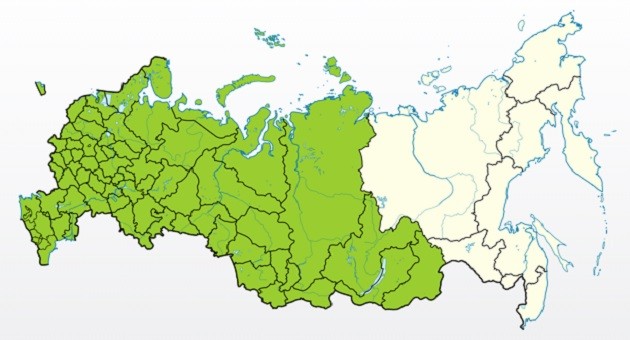
Growing regions
- Middle zone.
- Kirov region.
- Chuvashia.
- Moscow region.
- Mari El.
- Leningrad region.
- Udmurtia.
- Ural.
- Nizhny Novgorod region.
- Perm Krai.
- Siberia.
- Sverdlovsk region.
Origin
The apple tree was developed through the development of trees with high natural disease immunity and good winter hardiness. It was bred by crossing the immune form X-2034 and the already popular Krasa Sverdlovsk variety by the renowned pomologist and breeder Leonid Andrianovich Kotov in the early twenty-first century.
In 2004, an application was submitted to classify the new variety, beautifully and poetically named "Blagaya Vest," as an elite variety. By that time, the new subspecies had already undergone all field testing, so it was immediately approved, entered into the State Register of Breeding Achievements, and officially zoned for the Volga-Vyatka region. In fact, it can be grown in both southern and slightly more northern regions, due to its high adaptability.
Content
Description of the Good News variety
 This scab-resistant variety immediately spread to neighboring farms, as everyone was eager to get their hands on a new apple tree. The trees are remarkably resilient to low temperatures and sudden temperature fluctuations, are undemanding in terms of soil, care, and watering, and can grow even in heavily polluted areas. They are compact, take up little space, and bear fruit regularly, without a break for dormancy.
The fruits are quite large compared to other Ural apple trees. They are very attractive, tasty, aromatic, have a good shelf life, and easily withstand the rigors of transportation. The "Good News" variety is recommended for intensive plantings for industrial purposes, but it will also be a real find for small home gardens.
Apples: What do they look like?
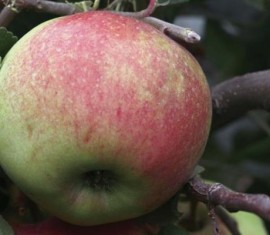
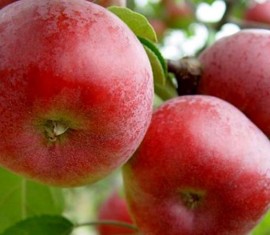
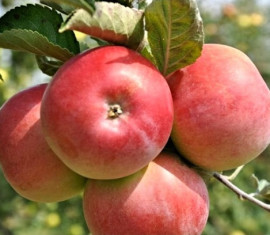
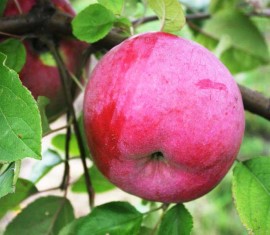
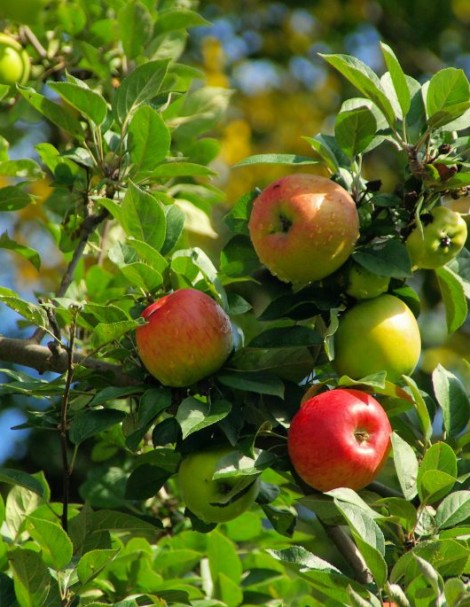
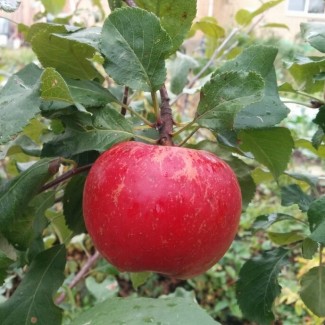
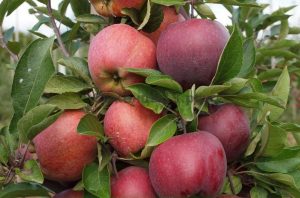 This variety produces beautiful, perfectly rounded, cylindrical, chiseled, and very attractive apples. They are generally symmetrical and uniform in size. Apples range in size from 80 to 120 grams, but can be larger in some years. The ribbing on the calyx is quite visible, while on the rest of the fruit it is smoothed and unnoticeable, with no visible lateral seam.
The skin of the Good News fruit is dense, very elastic, some say even somewhat hard, strong, and thick, but not excessively so. It is smooth, glossy, and highly shiny, without pubescence, and may have a light waxy-oily coating. Its base color is green or yellowish-green, but this is mostly hidden under a purple-red blush covering at least 65-70% of the surface. The apples have few small, gray-green, pale subcutaneous spots that are barely noticeable. The chemical composition is rich and rich:
- P-active substances (catechins) – 206 milligrams.
- Ascorbic acid (vitamin C) – 11.7 milligrams.
- Fructose (total sugars) – 10.5%.
- Pectins – 13.1%.
- Titratable acids – 0.47%.
Blagovesti has fine-grained, juicy flesh of medium density. It's crisp, prickly, and sometimes even a bit sharp. The flavor is considered table-like, more tart but with a distinct sweetness. Professional tasters rate the fruit 4.3-4.5 points for taste and appearance.
Apple tree "Good News": characteristics
Crown and root system
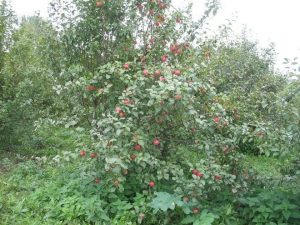 These trees are very compact and are considered to be of medium height, although it would be more logical to classify them as natural semi-dwarfs. On vegetative rootstock they barely reach 3-3.5 meters, and on low-growing varieties, they don't grow more than 2-2.5 meters. The crown is well-filled, but not excessively dense, oval-pyramidal or high-oval in shape. The branches are thin, medium-length or short, geniculate, covered with brownish-brown or brownish bark, and are pubescent.
This cultivar has numerous, small, round-oval, slightly ovate leaves curved along the central axis. They are leathery and dense, short-pointed, and smooth, with a rough nervation and a tomentose underside. The leaf blades are emerald or dark green, with serrated, finely serrated, and crenate edges. The root system is deep, fibrous, and branched, easily finding moisture in the soil.
Productivity and pollination
Experts classify apple trees' fertility as average, but this is more than compensated for by the regularity of their fruiting.
A single tree can yield at least 40-55 kilograms of beautiful, long-lasting fruit per year. However, young trees yield only half that amount, so patience is required..
The variety is self-fertile, but nearby apple trees blooming at the appropriate time will only increase the yield. It's best to plant them no further than 50-90 meters away. It's a good idea to have an apiary near the garden, and the most advanced ones even bring mobile apiaries to their orchards. Spraying with syrup (honey or sugar) will further attract bees for cross-pollination.
Winter hardiness and disease resistance
The new variety's resistance to low temperatures is even greater than that of its parent. It easily tolerates frosts down to -29-32°C without any cover. However, this only applies if the frosts last no more than 1-1.5 weeks at a time. Therefore, despite its enviable frost resistance, it is necessary to cover the trees in a timely manner.
To the five existing races scabies The Good News is completely impervious. Resilience is built into its genes. However, other diseases, as well as parasites, can attack apple trees. Therefore, it's essential to carry out preventative treatments, protect the trees from stagnant air and excess moisture, and regularly remove debris from under the trunks.
Rootstocks and subspecies
New varieties rarely develop subspecies in less than 20 years, and Blagoveshchenie is no exception. However, it can be grown on a wide variety of rootstocks, from large vegetative ones to low-growing dwarfs. Low-growing apple trees are less adapted to harsh conditions, but they are compact and begin bearing fruit in just one or two years, producing slightly larger fruits.
Peculiarities of Growing the Good News
 Landing
 Landing
Basic conditions
- Apple trees prefer moist, fertile soil that is well-drained and well-ventilated. However, they will grow in any soil, provided they are provided with the proper conditions and care.
- Sunny areas are the best place to plant Vesti. It prefers its crown to be exposed to ultraviolet light for most of the day. Only sunny areas should be avoided. burnswhen the weather is too hot.
- It's best to choose a groundwater level of 2-2.2 meters to avoid the risk of roots becoming submerged. If the apple tree reaches the water's surface, it will rot and die, seemingly for no apparent reason.
- The crowns of the trees need to be well-ventilated to prevent stagnant air. At the same time, it's important to avoid drafts, which increase the risk of disease in the garden.
- When purchasing seedlings from a nursery or private farm, be sure to check that they have the appropriate documentation (certificates). Pay attention to the crown and rhizome; they should look healthy, with no broken or dry shoots, and the grafting site should be clearly visible.
- It's best to prepare a site and dig holes for the garden in advance, at least a month before planting in the fall or the previous spring. A depth of 50-70 centimeters and a diameter of up to 90-100 centimeters is sufficient. Add a small amount of fertile soil mixed with fertilizer to the bottom, cover with drainage, water, and leave the hole uncovered.
- It's a good idea to immediately dig trellises or single stakes into the holes for support. Vesti's rhizomes are weak, so strong winds can knock them over. Furthermore, the support will provide additional protection during cold weather if positioned north of the trunk.
- If you decide to preserve the properties of the rootstock, the grafting site should be left 5-8 centimeters above the surface, taking into account possible soil subsidence after the initial watering.
- Place the seedling on a mound of drainage material, spread out the roots, cover with soil, and lightly tamp down. Water from above with 3-5 buckets of water, and mulch the surface.
Landing dates
Trees can be planted in either spring or fall. The key is to ensure the soil is well-warmed and no frost is expected for the next 21-30 days. Trees are most often planted in March-April or September-October, after the leaves have fallen.
Tree care
 Tree care
Protection from frost and pests
It is very important to stop adding moisture under the tree trunks no later than AugustIf this isn't done, the apple trees won't have time to prepare for winter and stop the flow of sap in their trunks in time. Smaller trees can be covered with a tent, while taller trees can be wrapped with burlap, roofing felt, tights, or any other materials. Straw, hay, or spruce branches can be thrown onto the root zone (the crown projection), but in the harshest areas, 10-20 centimeters of soil can be piled up. All this should be removed in early spring.
Industrial insect repellents are effective, but many gardeners limit themselves to whitewashing the trunks with a thick lime solution. Whitewashing them twice a year adds an extra touch of neatness to the garden. Rodents can be repelled with grease, fuel oil, or lard. Apply a thick coating to the lower part of the trunk.
Loosening the soil, watering: proper agricultural technology
The soil around the tree trunk should be dug twice a year, once in spring and once in fall. Don't dig too deep to avoid damaging the shallow roots. A depth of half to two-thirds of a spade's width is ideal. After each watering, be sure to lightly hoe the soil to prevent it from compacting too much and to allow oxygen to reach the rhizome. At the same time, you can remove any unwanted debris, such as rotting fruit and fallen leaves, from under the tree.
Don't allow the soil beneath the tree to dry out completely, so watering will be necessary quite frequently. This is especially important in dry, hot years. Fertilizers and fertilizers are mixed with the water, and it's recommended to apply them no earlier than every 2-4 years.
Pruning: simple crown shaping
A tree forms itself as it grows, and forcing it to grow any other way is very difficult. Therefore, if you have no experience with rooting, it's best to limit yourself to maintaining natural branching. Typically, seedlings from nurseries come with 2-4 skeletal branches and a central conductor, so you'll need to start from there.
Every fall, and sometimes even spring, trees need to be trimmed, removing all unnecessary growth. Shoots protruding upward or inward from the crown, parallel branches, and dry or broken ones are discarded. The cut areas are carefully sealed with paint or varnish.
Reproduction
- Cuttings.
- Budding.
- Cloning.
- Kidney grafting.
Pollinator varieties
- Idared.
- Blagovest.
- Reinette.
- Beauty of Sverdlovsk.
- Chinese Kandil.
- Sinap northern.
- Ural beauty.
- Beauty of Bashkiria.
Diseases and pests
- Bacterial burn.
- Black crayfish.
- Cytosporosis.
- Powdery mildew.
- Rust.
- Apple moth.
- Glass-box.
- Leafhopper.
- Scale insect.
- Hawthorn.
The Ripening and Fruitfulness of the Good News
The beginning of fruiting
 The beginning of fruiting
This variety is considered early-bearing. It can produce some fruit as early as 4-5 years after planting. Dwarf varieties begin bearing fruit much earlier, blooming in the first year and producing apples in 2-3 years. There won't be many, just a few dozen, but it'll be enough to determine whether you like the variety.
Flowering time
This apple tree blooms late. It doesn't begin blooming until the second ten days of May. Fortunately, there are many similar varieties, so finding pollinators won't be a problem. The flowers of the Good News are gathered in clusters, each with five petals of a soft pink or white hue, and have a moderate fragrance. The blooming process lasts approximately 8-10 days, so you might not have time to admire them enough.
Fruiting and growth
The tree begins to grow immediately, gaining 35-50 centimeters during the growing season. Therefore, by the 6th to 9th year, it has fully achieved its final appearance. Fertility also increases, increasing year by year, without any periodicity. Full harvests can be obtained as early as the 8th to 10th year.
Apples ripen in late September, sometimes in early October. They ripen evenly, so the harvest can be completed in a day. However, there's no need to worry about them falling; they hold tightly to the branches even after the first frost. Consumer ripeness occurs approximately 3-4 weeks after storage. Good News can be transported anywhere in crates, sprinkled with sawdust. It can be stored in a regular cellar until spring.
Top dressing
- Eggshell.
- Humus.
- Bor.
- Manure.
- Compost.
- Superphosphate.
- Copper.
- Mineral and nitrogenous complexes.
- Ammonium nitrate.
What to do if it doesn't bloom or bear fruit
- Wrap up for the winter.
- Limit watering.
- Eliminate insect infestation.
- Cure diseases.
Why do apples fall?
- Wind.
- Pests or diseases.
- Frosts.
Share your own experience with the "Good News" apple tree variety so that even novice gardeners have no questions about cultivating these trees.