Golden Vladimir apple tree: characteristics of the variety and care
| Color | Greens , Yellow |
|---|---|
| Ripening season | Winter |
| Size of apples | Large |
| Taste | Sweet and sour |
| Crown type | Average tree height |
| Shelf life | Average tree height |
| Application | For recycling , Fresh |
| Winter hardiness | High winter hardiness |
| Fruiting age | Up to 5 years |


 History of origin and regions of growth
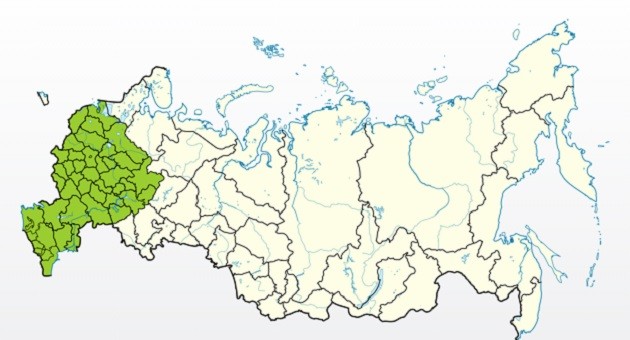
Growing regions
- Middle zone.
- Crimea.
- Central and Central Black Earth regions.
- Moscow region.
- North Caucasus.
- Yaroslavl region.
- Leningrad region.
Origin
Many people mistakenly believe that the Vladimir Golden is a direct descendant of the Delicious Golden, but this is not entirely true. The development was carried out by the renowned Soviet pomologist and breeder Viktor Valeryanovich Kichina. In 1984, by pollinating the well-known Antonovka apple with an "American" apple, immune to scab, a new apple tree was bred, named after its "father" variety.
The work was carried out on a farm near the town of Suzdal in the Vladimir region. Several applications were submitted for inclusion of the new variety in the State Register of Breeding Achievements, but none were confirmed. The apple tree has also not been officially zoned. It is grown throughout the central and southern regions, and, with proper care, thrives in the Moscow region and the Leningrad region.
Content
Description of the Golden Vladimir variety
 This autumn apple tree is quite rare, although it possesses many positive qualities and properties. It is quite resistant to low temperatures, withstands fluctuations from thaws to severe frosts, and has a strong genetic immunity to all five races. scabies, the main "enemy" of apple plantings. The trees are undemanding, tolerate dry periods well, begin bearing fruit early, and produce a regular harvest.
The fruits are attractive, large, and have a pleasant aroma and flavor. They are easily transported over long distances and keep fresh for a long time. The Golden Vladimir apple variety is recommended for intensive commercial plantings and small private farms.
Apples: What do they look like?
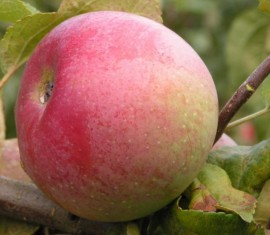
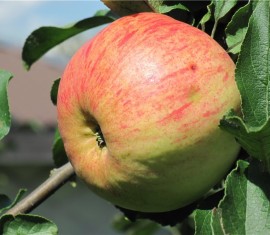
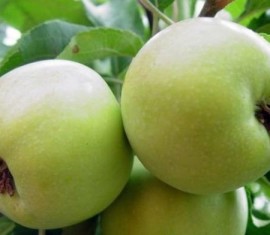
 The fruits are predominantly large to very large. In good years, they can reach 200-240 grams, with some specimens even larger. They are round, slightly oblong, cylindrical-conical, smooth, and can be slightly flattened at the stem.
The Vladimir Golden has a firm, elastic skin, like its parent variety. It is greenish-yellow, green, or sometimes light green-yellow. On the sunny side, it may develop a light, translucent reddish blush. The surface is smooth, slightly matte, and has a subtle sheen. Rusty, gray-green subcutaneous spots are few in number, large, and clearly visible. Chemical composition is assessed based on the following criteria:
- P-active substances (catechins) – 232 milligrams.
- Ascorbic acid (vitamin C) – 12.1 milligrams.
- Fructose (total sugars) – 13.9%.
- Pectins – 9.1%.
- Titratable acids – 0.48%.
The fruits have a fairly firm, dense, fine-grained flesh, white or slightly lemon-green in color. It's juicy, crisp, prickly, and easily peels off, with a powerful, pleasant, distinctive aroma. The flavor can be described as dessert-like and harmonious; the apples are sweet and sour, with a hint of sweetness, and balanced. According to an unofficial tasting by professionals, the fruits score 4.5 out of 5 for appearance and flavor.
Golden Vladimir apple tree: characteristics
Crown and root system
 A medium-vigorous cultivar, it typically reaches a height of 4.5-5 meters without pruning. It has a moderately spreading, not very dense, broadly rounded crown, which can even become drooping and weeping over the years. The shoots are set at a nearly right angle from the central trunk. They are rounded in cross-section, long, and can be slightly curved, but are more often straight, covered with brown or fulvous-brown bark, smooth, and pubescent.
The branches are densely packed with numerous large, ovate, slightly elongated, and fairly wide leaves. They are matte, coarsely ribbed, with long, pointed, and elongated tips. The margins are finely serrated, crenate, and wavy, and may curl upward. The leaf blades are green or rich green. The root system is well-deepened, with numerous small rootlets, branched, and occupies a large underground space, adapted to seeking moisture and nutrients.
Productivity and pollination
Trees reach fruiting quickly, as does their yield. A key advantage is their regularity, without rest periods.
In favorable climate and weather conditions, a single tree can yield over 180-220 kilograms of delicious, aromatic fruit per season. Some gardeners say they can achieve even more, almost as much as the Antonovka, with proper care and proper farming techniques..
Golden apples require pollinators to increase their yield. If suitable apple trees are not available within 60-100 meters, you can expect no more than 45-50% of the maximum yield. It's a good idea to have an apiary near the orchard, and treat the trees with sugar or honey syrup during flowering.
Winter hardiness and disease resistance
The variety has high tolerance to low temperatures. Trees can survive temperatures down to -29-32°C without shelter. However, if such weather persists for more than 2-3 weeks, buds and even wood freeze. Trees recover quickly if damage does not exceed a severity level of 2. During drought, it's best to water the trunks promptly, preventing the soil around the trunk from drying out completely, although they tolerate hot days and even weeks well. Otherwise, this may negatively impact yield.
The five scab strains known to pomologists do not affect the Vladimir Goldenrod; it has a genetic immunity. However, other diseases can be dangerous. Therefore, it's best to take preventative measures early, especially in warm, humid climates. Parasitic diseases are uncommon, but spraying the trees with fungicides is also important.
Rootstocks and subspecies
The variety itself is a subspecies; no development is currently underway to develop its varieties. It can be grown on various rootstocks, slightly altering the tree's characteristics, which has virtually no effect on the appearance or taste of the fruit.
Features of growing Golden Vladimir
 Landing
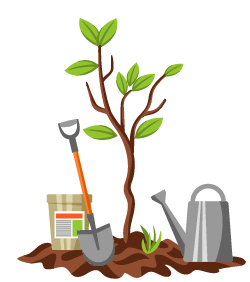 Landing
Basic conditions
- The tree thrives in any soil, from rich, rich black soil to rocky and sandy soils. If you feed and fertilize the tree regularly, there won't be any problems.
- It's best to plant trees in open, sunny areas. In the shade, they can become weak, grow tall, and refuse to bloom or bear fruit.
- The area should be well ventilated to prevent air stagnation in the crowns. This will reduce the risk of tree diseases. However, drafts should be strictly monitored; they are unacceptable. In winter, strong northerly winds can be fatal to young seedlings.
- The groundwater level in the area should be at a depth of 2-2.2 meters; this is just right for the variety. If the water level is higher, the rhizome may rot, which will kill the apple tree.
- The most experienced farmers prepare the holes for planting apple trees the season beforehand. They dig them approximately 50-70 centimeters deep and up to 1 meter in diameter. They add soil mixed with fertilizer to the bottom, fill with the chosen drainage material, and water. If you haven't prepared the holes in advance, it's best to wait at least 2-3 weeks, otherwise the fertilizer can burn the roots.
- It's common to dig supports—stakes or trellises—into the holes, especially in commercial plantings. Young seedlings are tied to these supports not only to provide support but also to provide additional trunk protection during cold weather.
- Saplings are inspected upon purchase, selecting the strongest ones with a strong, thick trunk and a clearly visible graft. Broken or dried shoots are trimmed off, if necessary, before purchase.
- The root collar of the tree must always remain above the horizon, otherwise the tree will root higher and the properties of the rootstock will be lost.
- Place the apple tree on a drainage platform, loosely arranging the rootstock. If necessary, the hole can be gently widened. Cover with soil and tamp down gently, but not too hard. It's best to water with 3-4 buckets of water, and mulch the surface to retain moisture.
Landing dates
It's preferable to plant this variety in spring. A warm, dry day in late March or early April is a good time. However, in warmer regions with predictable and mild weather, planting in September or October is also possible.
Tree care
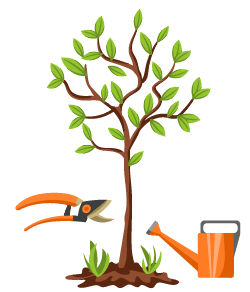 Tree care
Protection from frost and pests
Harsh conditions require careful sheltering of trees, especially young ones, and proper preparation for winter. Watering is stopped before the onset of autumn, in mid- to late autumn. August, do not apply any fertilizers or supplements after this. Young seedlings can be wrapped like a tent, and taller ones can be wrapped around the lower part of the trunk with any suitable materials (burlap, spongebond, roofing felt, roofing felt, old tights). Spruce branches, bundles of straw, and bundles of hay are thrown over the root zone, and the soil is raked up. All this should be removed in early spring.
Tree trunks are whitewashed with lime not only for aesthetic reasons, although aesthetics are important. It also protects against insects that like to nest in the crevices of the bark. Rendered lard, fuel oil, grease, or industrial products can help repel rodents.
Loosening the soil, watering: proper agricultural technology
In the trunk area, it's common to dig half a shovel deep in the spring and fall, when the sap is still flowing. Over the years, digging may be limited to the fall, after the trees have been pruned. In the summer, it's good to loosen the soil the next day after each watering. This is especially important during hot and dry periods.
Young trees should be watered frequently, every 10-12 days, to ensure the soil never dries out completely. Starting from 2-4 years, you can dilute fertilizer and fertilizer with water and apply it around the perimeter of the crown, where the rhizome tips are located.
Pruning: simple crown shaping
The most suitable crown shape for the Vladimir Golden is a sparse or sparsely tiered form. It consists of a central conductor and 2-4 scaffold shoots, left at different heights and widely spaced. As the tree grows, it will be necessary to prune away any excess shoots, including those protruding inward or vertically, maintaining the natural branching.
Sanitary pruning is most often carried out in the fall, when the sap flow in the trunks has stopped. Then, dried, broken, or diseased branches should be removed. All wounds are sealed. garden pitch or paint, or, as a last resort, rub it with clay or earth.
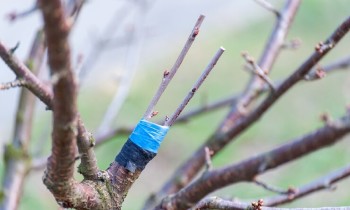
Reproduction
- Cuttings.
- Budding.
- Cloning.
- Kidney grafting.
Pollinator varieties
- Idared.
- Blagovest.
- Reinette.
- Beauty of Sverdlovsk.
- Chinese Kandil.
- Sinap northern.
- Ural beauty.
- Beauty of Bashkiria.
Diseases and pests
- Bacterial burn.
- Black crayfish.
- Cytosporosis.
- Powdery mildew.
- Rust.
- Apple moth.
- Glass-box.
- Leafhopper.
- Scale insect.
- Hawthorn.
Ripening and fruiting of Vladimir's Golden
The beginning of fruiting
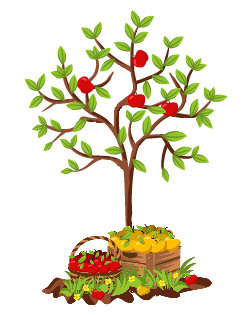 The beginning of fruiting
The tree's first flowers may bloom early, 2-3 years after planting, but it's best to pluck them completely, as most of them are barren. Harvesting will begin in the 4-5th year. Don't expect abundant fruiting in the first few years, but you should be able to get a few dozen apples.
Flowering time
The apple tree is a late-bearing tree, so it usually blooms a little later than its earlier-blooming counterparts. Around the second half of May, or even towards the end of the month, you can expect pinkish buds to open into large, white flowers. They are delicate, five-petaled, and very fragrant. This process lasts 10-14 days.
Fruiting and growth
The Antonovka descendant grows quickly, reaching 30-45 centimeters in a season, sometimes even more. Therefore, the trees quickly reach full maturity, and the harvest is abundant. By the 8th to 10th year, you can harvest over a hundred kilograms of delicious apples.
The fruits are considered winter fruits because they ripen in the first half or mid-October. They hold tightly to the eyelids and do not fall off even after the first frost. They ripen uniformly, simultaneously, so harvesting can be timed to one or several consecutive days. Consumer ripeness coincides with technical ripeness. The fruits keep well in the cellar for up to 5-6 months and are suitable for processing and transportation.
Top dressing
- Eggshell.
- Humus.
- Bor.
- Manure.
- Compost.
- Superphosphate.
- Copper.
- Mineral and nitrogenous complexes.
- Ammonium nitrate.
What to do if it doesn't bloom or bear fruit
- Wrap up for the winter.
- Limit watering.
- Eliminate insect infestation.
- Cure diseases.
Why do apples fall?
- Wind.
- Pests or diseases.
- Frosts.
Share your own experience with the Golden Vladimir apple tree variety, so even novice gardeners have no questions about cultivating these trees.