Fuji Kiku Apple Tree: Variety Features and Care
| Color | Reds |
|---|---|
| Ripening season | Autumn |
| Size of apples | Large |
| Taste | Sweet |
| Crown type | Tall tree |
| Shelf life | High shelf life |
| Application | Universal variety |
| Winter hardiness | High winter hardiness |
| Fruiting age | Up to 5 years |
 History of origin and regions of growth
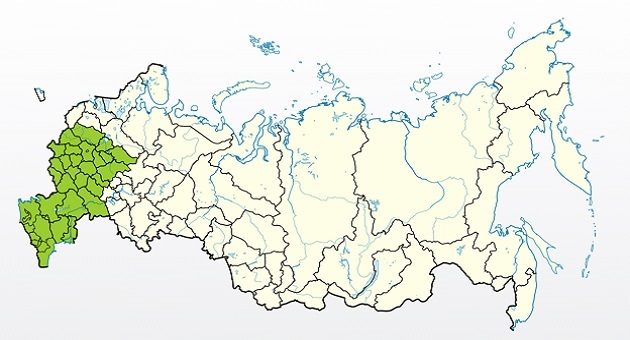
Growing regions
- Middle zone.
- Leningrad region.
- Central Black Earth District.
- Middle Volga region.
- North Caucasus.
- Crimea.
- Some northern regions.
- Moscow region.
Origin
This winter apple tree descends from the famous Japanese Fuji variety, developed in the first half of the twentieth century at the Nakahara Experimental Station, located in the village of the same name. A clone of this apple tree, created through hybridization and named Fuji Kiku, became the descendant of the American varieties Rolls Janet and Delicious Red.
This apple tree has only recently appeared in Russian orchards, although it is tipped for a bright future. It is not yet listed in the State Register of Breeding Achievements, and it has not received official zoning, unlike some other Fuji clones.
Description of the Fuji Kiku variety
 A relatively cold-hardy Fuji apple variety, the Kiku subvariety, may soon become a global favorite, according to renowned pomologist and breeder Evgeny Nikolaevich Sedov. It's undemanding regarding soil, moisture, and care, and tolerates the relatively harsh conditions of temperate climates, unlike its "brothers." It doesn't require special care or careful shelter, is rarely affected by apple tree diseases, and doesn't require frequent watering or fertilizing.
Kiku bears fruit regularly, producing large, delicious, beautiful, and aromatic fruits. They store well and are easy to transport. This variety is recommended not only for individual cultivation in home gardens but also for large, intensive commercial and industrial orchards.
Apples: What do they look like?
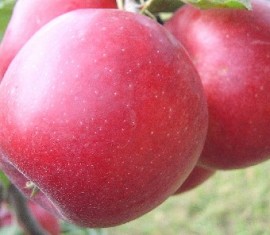
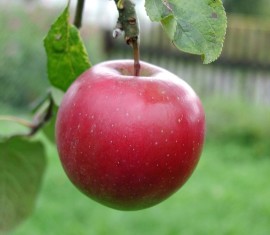
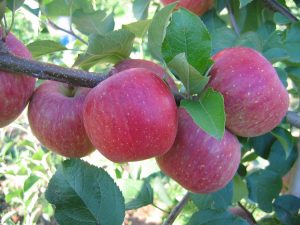 The fruits are medium, larger than medium, and large in size. They can easily reach 220-280 grams, and sometimes even 290-320. The shape of the fruit is round and smooth, and can be slightly elongated, oblong, flattened, or perfectly spherical. The ribbing is virtually invisible even at the calyx. The fruits are generally uniform and symmetrical, as they say, "one to one."
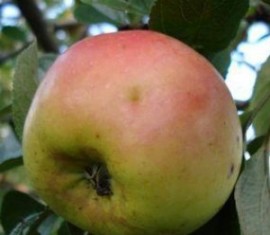
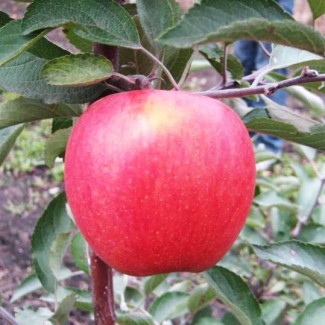
The skin is dense but thin, brittle, smooth, elastic, and highly shiny. When fully ripe, it can become covered with a dense, oily, waxy, and transparent coating. The base color is greenish-yellow, later turning pinkish-yellow. The blush is dense, spotted, streaked, bright red, amber-red, or carmine-red, intense, and covers at least 65-85% of the apple's surface. Subcutaneous punctures are numerous; they are light green, barely noticeable, and small. Experts recommend evaluating the apple's composition based on the following factors:
- P-active substances (catechins) – 201.2 milligrams.
- Ascorbic acid (vitamin C) – 10.8 milligrams.
- Fructose (total sugars) – 17.3%.
- Pectins – 11.8%.
- Titratable acids – 0.47%.
Kiku fruits have dense, fine-grained flesh that's crisp and easily broken apart. It's creamy or slightly yellowish in color, can be lemony, and is intensely aromatic, juicy, and has a pleasant texture. The flavor is considered dessert-like, harmonious, sweet and sour with a strong sweetness. It has a very pleasant honey-like flavor, can be slightly spicy, and has a slightly tart aftertaste. An unofficial tasting score is 4.6-4.8 out of 5.
Fuji Kiku Apple Tree: Characteristics
Crown and root system
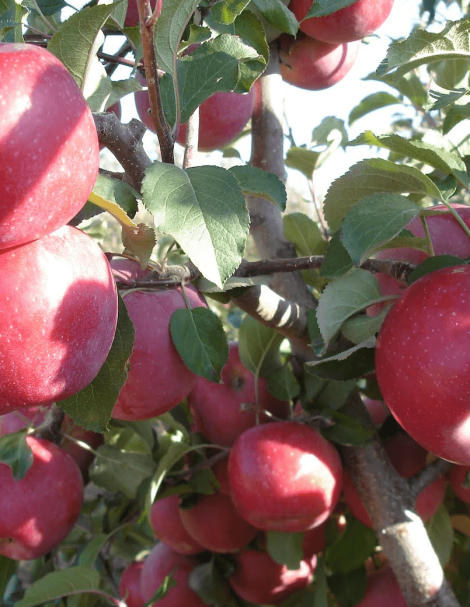
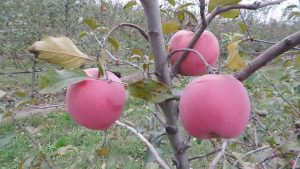 Trees of medium or tall growth. They can reach 5-8 meters, sometimes even more, in the absence of formative pruning.The crown is predominantly rounded or oval, but can become broadly oval and spreading over the years, sometimes weeping or drooping. Branches are of medium thickness and length, extending from the trunk at right angles and directed upward, but may begin to droop over the years. They are covered with gray-brown or greenish-gray bark without pubescence. Fruiting is mixed, meaning it occurs on fruiting shoots, rings, and spurs.
The leaves are medium-sized or small, elongated, oval, rounded, and short-pointed. They are leathery, dense, smooth, and glossy, with a dark green, green, or emerald hue. The undersides may have a felt-like pubescence. The root system is highly branched and penetrates deep into the soil, well adapted to the search for water and nutrients, with numerous small, thin branches, and covers a large area.
Productivity and pollination
The tree is considered a high-yielding tree with medium vigor and a tendency to bear fruit intermittently. This can be easily prevented by regulating flowering, making this variety increasingly popular.
One fully mature tree can produce approximately 180-220 kilograms of delicious, sweet, and aromatic fruit per year. In some years, yield may decrease or increase slightly, depending on environmental conditions, but this is not critical.
The variety is relatively self-sterile, meaning it can produce a certain number of apples (no more than 10-15%) even without any other apple trees within 150-200 meters. However, experienced gardeners prefer to interplant Kika with other varieties, fortunately, there are plenty of varieties with overlapping flowering times.
Winter hardiness and disease resistance
The variety's resistance to low temperatures, unlike its parent variety, is much higher; it can be considered average. Apple trees tolerate frosts down to -27-29°C quite well, and sometimes even lower, with proper preparation and winter protection. Therefore, they can be grown not only in mild regions like Crimea or the North Caucasus, but also in much colder ones.
Kiku is moderately resistant to apple tree diseases, but preventative treatments and spraying should be carried out regularly and promptly. It is resistant to scab, powdery mildew, cytosporosisIt will then be very tolerant of other diseases. Even if it does become ill, it may be a minor injury, and the tree will fully recover within just a year.
Rootstocks and subspecies
The Fuji variety has a huge number of subspecies, which can't be said for the Kiku variety. This relatively new variety can be grown on a variety of rootstocks. On standard vegetative rootstocks, it will grow tall and winter-hardy, but on dwarf or semi-dwarf rootstocks, it will be much more compact, but also less cold-resistant.
Growing Fuji Kiku
 Landing
 Landing
Basic conditions
- Medium loams, moist sandy loam, moist chernozem, podzolic soil - all of these are well suited for planting Kiku.
- A sunny location where ultraviolet light illuminates the tree for most of the day during the initial stages, until it reaches a good height, is the key to high-quality and rapid growth and abundant fruiting in the future.
- It's best to plant this variety at elevated sites where groundwater doesn't reach the surface. Avoid planting apple trees in swampy areas, near natural or artificial reservoirs, in floodplain meadows, in lowlands, or near wells.
- Proper crown ventilation is essential to prevent common apple tree diseases, which are much more likely to develop in stagnant air. However, Kika should also be avoided in drafty areas.
- You can prepare the holes in advance, but it's not necessary. You can dig them not the previous season, but just 3-5 weeks before planting the seedlings in open ground. Dig the holes to a diameter of approximately 60-80 centimeters and a similar depth, depending on the seedling's rootstock. Fertilize the bottom, cover with soil or drainage material, then fill with water and leave uncovered.
- It is customary to leave no more than 2.5-3 meters between holes, but between rows you can leave up to 4-5, this will significantly simplify maintenance, and will also prevent the trees from interfering with each other.
- The root collar of the seedlings must always remain above the surface (5-8 centimeters), otherwise all the properties of the rootstock will be completely leveled out when the apple tree takes root higher.
- The seedlings are inspected, dry and damaged roots are cut off with garden shears, and they are placed in water for 4-7 hours.
- Place the tree in the hole, directly on the drainage, spreading the roots so they don't interfere with each other or become bent. The hole can be widened or deepened slightly if needed. Cover with soil, compacting it layer by layer by hand to eliminate air pockets. Water with 20-30 liters of water, and mulch the surface to retain moisture.
Landing dates
The tree thrives in both fall and spring plantings, but only in warm or temperate climates. If winters in the planting region are harsh and the weather unpredictable, it's best to choose the latter option, choosing a dry, warm day in late March or early April, when all frosts have passed and the soil has warmed sufficiently. The closed root system (saplings in pots, bags, or containers) allows Kika to be transplanted into open ground at any time during the growing season.
Tree care
 Tree care
Protection from frost and pests
In the southern regions of the country, where the weather is mild and moderate, you don't need to worry too much about covering the trees; the main thing is to stop watering before the beginning of September. However, if the weather is much harsher, it's better to cover young seedlings while they're still small, using a tent-like method. Larger trees are covered at the base of the trunk with burlap, old tights, roofing felt, or roofing felt. Straw mats, spruce branches, hay bales, or branches can be placed on the roots.
Coating trees with lard, fuel oil, grease, or other pungent and unpleasant-smelling substances is effective against rodents. To prevent insect infestations, trunks are cleaned with a stiff brush in the fall, removing bark cracks, debris, pieces, and crevices. Then, they are whitewashed with a thick lime solution. Treatment with industrial products and timely spraying are also helpful.
Loosening the soil, watering: proper agricultural technology
You can dig around the trunk once or twice a year, in early spring or late fall, after all the leaves have fallen. This will also be a good time to remove weeds, root suckers, overgrown shrubs, and other trees. Fallen leaves and rotting fruit should not be left under the tree, as these can lead to diseases that will need to be treated, which will reduce the yield. During this process, you can hoe the soil in the summer, for example, after watering the next day, to prevent the soil from compacting into a dense lump.
Watering Trees need watering every 2-3 weeks, but only when young (1-3 years old). Subsequently, the frequency of watering can be reduced to 4-6 times per season, depending on the weather conditions of the year and the general climate of the region. Fertilizers and other fertilizers are added along with the water, pouring them around the perimeter of the tree's crown.
Pruning: simple crown shaping
Fuji Kiku has a medium-density crown, but can sometimes become quite overgrown if left unpruned for extended periods. Therefore, it's best to begin shaping the tree in its first year if it's arrived from the nursery as is. A sparsely layered version is most commonly used, but cordon, broom, and other shaping options are also possible.
Sanitary pruning is timed for late autumn, after the leaves have fallen, or early spring, before the buds begin to open. Then, broken, dry, and diseased shoots are cut off, and the cut areas are lubricated. garden pitchAt the same time, you can remove any branches that stick up or grow inward from the crown; they will only get in the way if there is no fruiting at all.
Diseases and pests
- Powdery mildew.
- Scab.
- Moniliosis.
- Black crayfish.
- Hawthorn.
- Aphid.
- Leaf roller.
- Scale insect.
Pollinator varieties
- Antonovka.
- Pepinka.
- Saffron pepin.
- Welsey.
- Autumn striped.
- Idared.
- Sinap northern.
- Borovinka.
- Gala.
Ripening and fruiting of Fuji Kiku
The beginning of fruiting
 The beginning of fruiting
The apple tree is an early fruiting tree, with buds appearing and apples ripening as early as 2-3 years after planting. You'll have to wait a bit longer for a full harvest, but you can still get a few kilos to try. It's advisable to pluck the blossoms completely in the first or second year, as this will increase the initial harvest by 30-40%.
Flowering time
Kiku apple blossoms may bloom at different times in different regions, so it's impossible to pinpoint the exact date. In warmer southern regions, they bloom from around mid-May until the end of the month, and sometimes even a little earlier. In harsh northern climates, apple trees may bloom towards the end of May or early June. The blooming process lasts approximately 10-14 days. The flowers are large, gathered in clusters, with massive, delicate, slightly pinkish petals. They densely cover the branches and are intensely fragrant.
Fruiting and growth
Fuji Kiku grows rapidly, especially before it begins to bear fruit. It grows approximately 35-50 centimeters in height per year, reaching its full size quite quickly. The apple tree also produces fruit quite rapidly. Harvests will be full-fledged by the 8th to 10th year. Its active fruiting period exceeds 50-65 years, making it a wise choice for many gardeners.
Apples ripen in mid-October, sometimes lasting until the end of the month. This is why the apple tree is called a winter or even late-winter apple tree. The fruits are firmly attached to the branches and do not fall until the first frost, so there's plenty of time to pick them. They are well suited for long-distance transport. They can be stored in a cellar until spring, and in a special refrigerator until the next harvest, without losing their original flavor and aroma. They are well suited for processing and fresh consumption.
Why do apples fall?
- Weather.
- Frosts.
- Pests or diseases.
What to do if it doesn't bloom or bear fruit
- Protect from the cold.
- Limit or activate watering.
- Eliminate insects.
- Cure diseases.
Top dressing
- Manure.
- Compost.
- Humus.
- Superphosphate.
- Chicken manure.
- Mineral and nitrogenous complexes.
- Ammonium nitrate.
Share your own experience with the Fuji Kiku apple tree variety, so even novice gardeners have no questions about cultivating these trees.