Fuji Apple Tree: Variety and Care Features
| Color | Reds |
|---|---|
| Ripening season | Winter |
| Size of apples | Large |
| Taste | Sweet |
| Crown type | Tall tree |
| Shelf life | High shelf life |
| Application | Universal variety |
| Winter hardiness | High winter hardiness |
| Fruiting age | Up to 5 years |
 History of origin and regions of growth
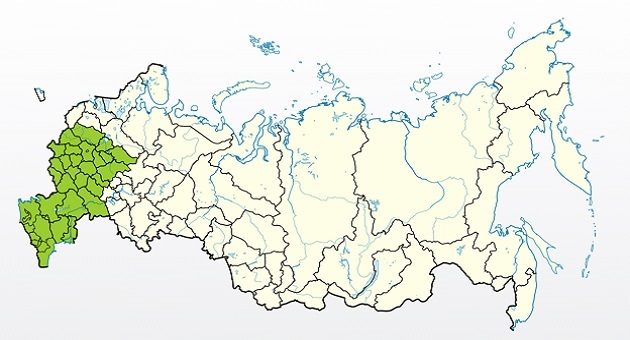
Growing regions
- Middle zone.
- Leningrad region.
- Central Black Earth District.
- Middle Volga region.
- North Caucasus.
- Crimea.
- Some northern regions.
- Moscow region.
Origin
The Fuji apple variety was first developed in the second half of the 1930s at the Tohoku Experimental Station. It remains located today near the village of Fujisaki, in Minamitsugaru County, Aomori Prefecture. The apple was created by crossing two "native American" apples: the Virginian Ralle Janet, sometimes called Revles Janet, and the well-known Delicious Red.
The Fuji apple variety was officially recognized as one of the best Japanese apple trees in 1962, and a few years later, it became widely popular worldwide. It was named among the 15 most popular apples in the United States in the twentieth century. The State Register of Breeding Achievements of our country currently contains no information about this apple tree, but there is information about three of its most famous clones: Fujik, Fujina, and Fujion.
Description of the Fuji variety
 This apple tree is truly popular worldwide, and for good reason. For example, in China, a country with millions of people, it accounts for more than three-quarters of the entire apple industry. It's easy to grow and maintain, tolerant of moisture and soil quality, and tolerates not only dry summers but also relatively cold, prolonged winters.
The large, attractive fruits possess high marketability and consumer qualities. They are aromatic and delicious, have a long shelf life in a standard cellar, and are suitable for transportation and processing. This variety is suitable for industrial cultivation in intensive commercial gardens, as well as for individual cultivation in small garden plots.
Apples: What do they look like?
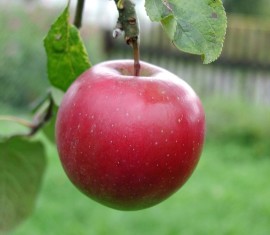
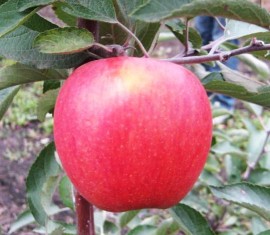
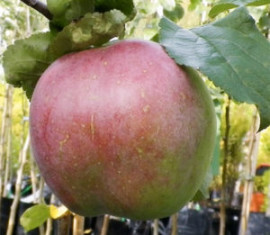
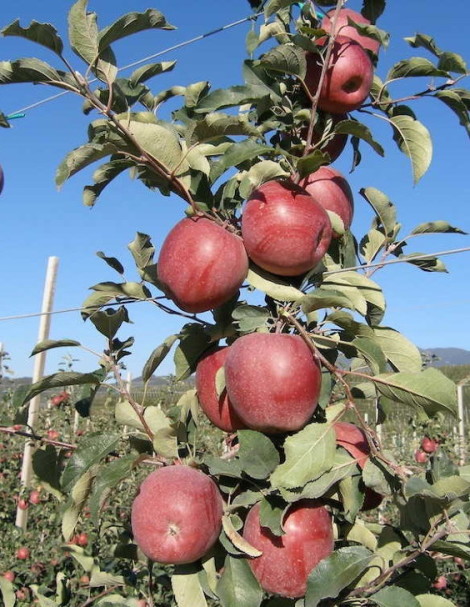
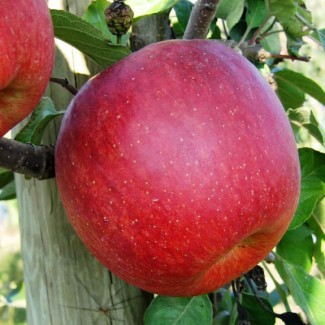
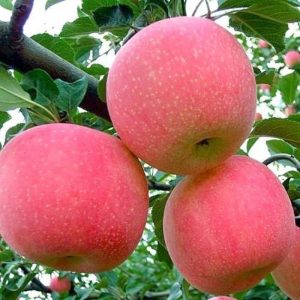 The fruits are large, attractive, and round, easily reaching 180-260 grams, with some specimens reaching 270-300 grams in good years. Their shape is spherical or slightly elongated, the surface is smooth, with no noticeable ribbing even at the calyx. The peduncle is long, thin, and reddish-brown.
The apple skin is firm and even slightly thick, elastic but not hard, cracks easily when bitten, and smooth. It is dry to the touch, has no oily or waxy coating, is slightly glossy but not overly shiny, and has a characteristic matte sheen. Its base color is greenish-yellow or whitish-yellow, but can be rich, honey-colored, or yellow-orange. The blush is dense, rich, carmine-red, bright red, crimson-red, or pinkish, spotted and diffuse, speckled, sometimes somewhat streaky, and covers 75-90% of the surface. Subcutaneous punctures are numerous; they are gray-green, rusty, large, and clearly visible. The chemical composition can be determined by determining the following factors:
- P-active substances (catechins) – 204.2 milligrams.
- Ascorbic acid (vitamin C) – 12.8 milligrams.
- Fructose (total sugars) – 16.9%.
- Pectins – 10.7%.
- Titratable acids – 0.67%.
Fuji has dense, fine-grained flesh, snow-white or slightly creamy white, very tender and juicy. It can be crisp and prickly, but has a very pleasant texture, easily breaking off when bitten. The flavor is considered sweet and sour, but the sweetness predominates, with a slightly tart and spicy aftertaste. It has a dessert-like, harmonious, and balanced flavor. On the official tasting scale, it scores at least 4.7-4.8 points out of 5.
Fuji apple tree: characteristics
Crown and root system
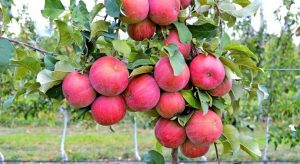 The tree is very tall and can easily reach 7-9 meters, but gardeners usually prefer to limit it by pruning to 5-6 meters.The crown is irregular, almost "shaggy" without pruning, moderately to heavily dense. With timely and proper pruning, it becomes neat and compact, rounded or oval. The branches are spaced widely apart, at right angles to the trunk, and covered with brown or gray-brown bark.
The leaves are round rather than elongated, sometimes lanceolate or oval-lanceolate, leathery, and dense. They are slightly glossy but mostly matte, with rough ribbing, a short-pointed tip, and serrated, serrate-crenate margins, sometimes slightly wavy, and rarely folded into a boat. The root system is well-branched, often fibrous, and deeply rooted, adapted to the search for water and nutrients.
Productivity and pollination
This variety is considered a high-yielding cultivar, but it has intermittent fruiting, which is its main drawback. This is mild, and even in lean years, the tree still produces apples, albeit in slightly reduced quantities. Fruiting can be achieved uniformly by regularly regulating flowering, preventing the tree from becoming overloaded with fruit. This will ensure normal fruiting the following year.
One mature tree can produce approximately 180-220 kilograms of apples per season, under favorable growing conditions and suitable weather..
The variety is not considered self-fertile; it requires other apple trees blooming at the same time to produce fruit. If no such trees are available, the blossoms will simply fall off, leaving no more than a few apples on the tree, randomly pollinated by trees growing far away. Therefore, experienced gardeners prefer to plant Fuji near suitable pollinators and also bring mobile apiaries to the plantings.
Winter hardiness and disease resistance
Apple trees aren't particularly tolerant of low temperatures. There are subspecies that are much more winter-hardy than the parent variety. However, they can easily tolerate temperatures as low as -22-25°C. They need to be properly protected for the winter and prepared for winter in a timely manner. This will ensure the trees thrive, even in the challenging conditions of the Moscow and Leningrad regions.
Fuji has a moderate resistance to scab; it rarely gets sick, but it is severely and severely affected during years of severe epiphytotics. It is more susceptible to powdery mildew, moniliosis And Cytosporosis. These diseases are difficult to control, and their consequences require long-term treatment. Therefore, it's best to carry out preventative treatments promptly, preventing foliar or fruit rot near the trunk, and avoiding excessive humidity.
Rootstocks and subspecies
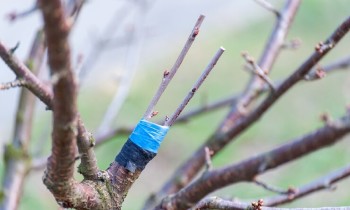
There are a large number of diverse Fuji subspecies bred around the world. They possess slightly different characteristics from the parent variety, but are still highly sought after.
| Subspecies | Description |
| Aztec | Despite its American name, which derives from a Native American tribe, the variety was developed in New Zealand around the second half of the 1990s. The trees are large, the fruits are juicy and dark red, ripening in late September and weighing 250-270 grams. |
| Yataka | The Japanese "native" Fuji subspecies, like all its varieties, is prone to fungal infections. It grows well in dry regions with timely pruning, although it is particularly prone to overloading with fruit. The apples ripen 2-3 weeks before the parent variety; they are red, juicy, sweet, and large (280-300 grams). |
| Kiku | This subspecies produces beautiful, round fruits that are very juicy and aromatic, reaching 250-270 grams, sometimes even more. It is winter-hardy, can withstand temperatures down to -29°C without significant damage, and requires no special watering or fertilizing. |
| Toshiro | A late-winter Fuji variety with good cold tolerance, it's a Japanese selection. It produces larger fruits, over 300 grams, with a characteristic pinkish-red blush. It's equally hardy and shelf-stable as its parent variety. |
| Nagafu (Ed) | This is a medium-sized tree, barely reaching 4-5 meters. Of all the existing subspecies, it has the earliest ripening fruit. As early as September, you can harvest bright red, very attractive, juicy, and delicious apples. |
Features of growing Fuji
 Landing
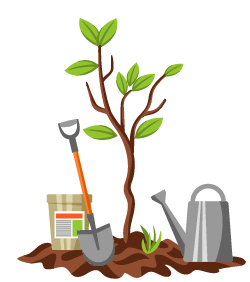 Landing
Basic conditions
- It's best to choose a location for this variety that receives full sunlight most of the time. Apple trees don't thrive in the shade and may refuse to bloom or bear fruit, or even die in the first few years after planting.
- Drafts aren't ideal for growing Fuji, but they also dislike stagnant air. Therefore, it's best to choose an open, elevated location, but sheltered from strong northerly winds.
- The soil must be nutritious and rich, but this can be achieved by adding fertilizers and fertilizers. Otherwise, it can be sand and sandy loam, clay and loam, black soil, or even rocky mountain slopes, as long as they are not highly acidic or saline.
- The groundwater table shouldn't be too high, as the tree's root system is quite deep. If the apple tree's roots reach the water, it will rot and die.
- It's best to prepare the holes well in advance of the season, but you can dig them 2-4 weeks in advance if you don't have time. Dig holes 70-80 centimeters deep and the same diameter, add fertilizer and soil to the bottom, then add drainage, and then fill with 25-40 liters of water.
- Leave at least 4-5 meters of space between trees, and between rows as well. Otherwise, they will interfere with each other in the future, and harvesting and maintenance will be seriously hampered.
- The root collar should protrude above the soil surface by 5-8 centimeters if the properties of the rootstock need to be preserved.
- Place the seedling on a drainage trench after spreading the roots, inspecting them, and trimming off any dry or broken ones. Cover with soil, compact it with your feet, but not too much. Water with 45-50 liters of water, and mulch the surface to slow moisture evaporation.
Landing dates
Trees should be planted when the soil is completely warm, either in spring after the risk of frost has passed, or in autumn after the leaves have fallen. Choose a clear day, with no precipitation the day before. The first half of the day, when the dew has dried, is preferable; midday is ideal. Container-rooted trees, those sold in bags or containers, can be planted at any time; they root easily because they have their own root ball.
Tree care
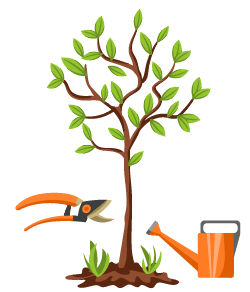 Tree care
Protection from frost and pests
All standard methods of covering trees for the winter will not interfere with Fuji trees. Young seedlings in the first and second years can be easily covered using a tent-like method, wrapping them from the top to the ground. However, with larger trees, this is no longer possible, so it's best to simply wrap the trunks with burlap, roofing felt, old tights, roofing felt, or tarpaulin. Spruce branches, straw, hay, and well-dried leaves are placed on the roots.
Regularly brushing the bark with a stiff brush, followed by whitewashing with a thick lime solution, helps get rid of insects. Spraying with industrial products is also necessary. Trees also need disease prevention. Rendered lard or fuel oil applied to the lower part of the trunk works well against rodents. The unpleasant, pungent odor repels animals, preventing them from gnawing at the bark and tender shoots.
Loosening the soil, watering: proper agricultural technology
Hoing the trunk can be done all summer long, if done carefully. However, it's not necessary; three to four times a season, after watering or fertilizing, is sufficient. It's generally advisable to dig no more than twice a year, in late fall and early spring. Over the years, you can fill the root zone with stones, sod, or seed it with herbs or grass, eliminating the need for loosening.
Watering Fuji trees can be watered, but it's not necessary. Only during the driest periods might the tree need some help. Young seedlings should be watered every 2-3 weeks (10-15 liters). Fertilizer and fertilizer should be added along with the water, but remember that in dry weather, the soil may become compacted the next day and will need to be stirred up a bit.
Pruning: simple crown shaping
The tree can become overgrown, and without pruning, it can develop a strange, shaggy shape, unlike anything else. Therefore, pruning begins in the first year, creating a sparse, tiered crown. Subsequently, it's advisable to actively prune excess foliage annually or every other year, but avoid removing more than one-third of the canopy at any one time, as this can stress the tree and cause disease.
Sanitary pruning involves removing all dry, broken, or diseased shoots. This is done in late autumn or early spring, when the trunks are dry. The cuts (wounds) must be sealed. garden pitch or other available means (oil paint, water-based paint, swamp).
Diseases and pests
- Powdery mildew.
- Scab.
- Moniliosis.
- Black crayfish.
- Hawthorn.
- Aphid.
- Leaf roller.
- Scale insect.
Pollinator varieties
- Antonovka.
- Ligol.
- Saffron pepin.
- Granny Smith.
- Delicious Golden..
- Idared.
- Sinap northern.
- Everest.
- Gala.
Ripening and fruiting of Fuji
The beginning of fruiting
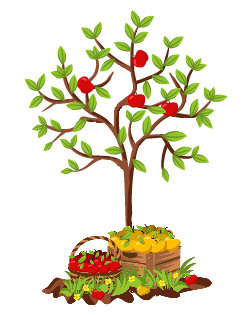 The beginning of fruiting
The first apples can be picked from the tree as early as the third or fourth year, which is why it's considered an early-fruiting tree. The harvest is unlikely to be a full one, but you'll definitely get to enjoy several kilograms of beautiful, tasty, and sweet fruit.
Flowering time
The buds open in May, around the second half of the month, sometimes a little later or earlier. The flowers are usually large, beautiful, fragrant, pure white or with a slight pink tint. The process lasts 10-14 days, during which time the bees have time to pollinate the trees.
Fruiting and growth
Fuji apples grow very quickly, especially before they begin to produce fruit. They can reach at least 35-60 centimeters in a year. As they grow, the rate slows slightly, but not significantly. Therefore, the variety can reach its peak as early as 10-12 years. By then, the yield is almost at its full potential, and over a hundred kilograms of apples can be harvested. The apple tree's active lifespan exceeds 50-60 years, and regular fruiting can be achieved throughout this period by regulating flowering.
The fruits begin to ripen in early to mid-October. They cling tightly and firmly to the branches, so there's no need to worry about them falling. They aren't particularly tasty right away, even a bit sour, so they're stored and ready to eat after about 30-45 days. By then, the sugars in the fruit have fully caramelized, giving them a sweet and pleasant texture. The apples store well until spring and are suitable for processing and transportation.
Why do apples fall?
- Weather.
- Frosts.
- Pests or diseases.
What to do if it doesn't bloom or bear fruit
- Protect from the cold.
- Limit or activate watering.
- Eliminate insects.
- Cure diseases.
Top dressing
- Manure.
- Compost.
- Humus.
- Superphosphate.
- Chicken manure.
- Mineral and nitrogenous complexes.
- Ammonium nitrate.
Share your own experience with the Fuji apple tree variety so that even novice gardeners have no questions about cultivating these trees.