
Granny Smith apple tree: characteristics of the variety and care
| Color | Greens |
|---|---|
| Ripening season | Autumn |
| Size of apples | Large |
| Taste | Sweet and sour |
| Crown type | Average tree height |
| Shelf life | High shelf life |
| Application | Storage , Fresh |
| Winter hardiness | Low winter hardiness |
| Fruiting age | Up to 5 years |
 History of origin and regions of growth
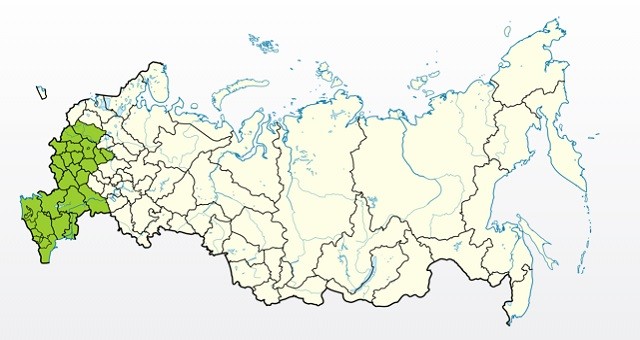
Growing regions
- Middle zone.
- Southern regions.
Origin
This unusual apple tree with the mysterious name Granny Smith has a long and complex history, filled with many unsolved mysteries and riddles.
The name Granny Smith is associated with Anna Maria Smith, known as "Granny Smith." She is credited with developing this variety..
It is believed that in the late nineteenth century, Granny Smith, née Sherwood, who lived in the vast Australian steppes, developed a passion for breeding. She became interested in her garden and developing new varieties of fruit crops. Around the 1850s, she received wild apple trees from France, which she crossed with a local wild apple tree, achieving a remarkable result.
According to another theory, the cross-pollination occurred purely by chance, and Miss Smith only discovered the result. Moreover, no one has ever been able to replicate the mutation, as the variety requires exclusively vegetative propagation.
By the early twentieth century, the variety, so beloved in Australia, had also won many fans in New Zealand and, in the 1930s, successfully migrated to Europe and then the New World. Granny soon became one of the most widely grown varieties in America, and remains so to this day. It arrived in Russia in the mid-twentieth century, but due to the abundance of local varieties more resilient to harsh weather and climate conditions, it never gained widespread popularity.
Content
Description of the Granny Smith apple variety
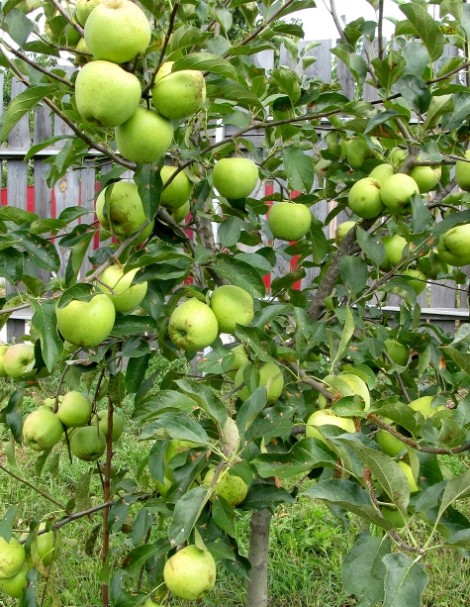
 Apples of this variety are very easy to distinguish – they have such a beautiful, distinctive emerald color that it's difficult to confuse them. The medium-sized trees adapt well to a variety of weather conditions, but are not very resistant to frost. This disadvantage is more than compensated for by the excellent transport qualities of the fruit, its long shelf life, and its excellent taste and quality, coupled with its enviable early maturity.
Recommended for warm and temperate climates with fairly mild winters, both for commercial intensive gardens and small home gardens.
Apples: What they look like
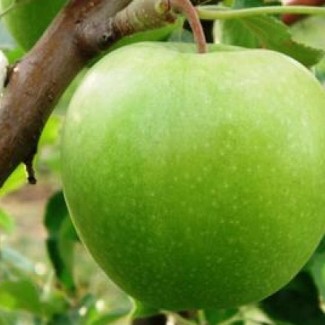
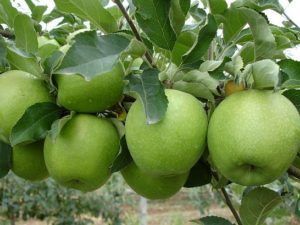 The fruits of this apple tree are typically large to very large. They can easily reach 250-300 grams in favorable conditions. In unfavorable weather or climate, at lower temperatures, they can be slightly lighter (180-220 grams). They are usually round or round-conical, and can be slightly flattened, uniform in size, with little or no ribbing.
The apple skin is dense, firm, and glossy, without a visible waxy or oily coating. When unripe, it has a bright green, even slightly emerald hue, which becomes lighter as it ripens. It is covered with a waxy coating, sometimes with a faint, diffuse blush resembling a light reddish "tan" on the sunny side. Subcutaneous spots are lighter, grayish or yellowish in color, numerous, and clearly visible. The chemical composition of the fruit is characterized by the following factors per 100 grams:
- P-active substances (catechins) – 206 milligrams.
- Ascorbic acid (vitamin C) – 18.7 milligrams.
- Total sugars (fructose) – 9.2%.
- Pectins (fiber) – 14%.
- Titratable acids – 0.85%.
The apple flesh is dense and fine-grained, very juicy, yet quite firm, prickly, and crisp. When unripe, it is green, becoming light green or greenish-white as it ripens. It has virtually no aroma, possessing a scent that borders on the olfactory. The flesh tastes sweet and sour during technical ripeness, becoming sweeter after a month of storage due to the caramelization of sugars, which are rare in apples. According to professional tasting reviews, the fruits score 4.6 points for appearance and 4.6 points for taste out of a possible 5.
Granny Smith apple tree: characteristics
Crown and root system
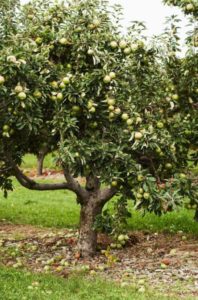 Trees of this variety are considered medium-sized because without pruning they can grow no more than 3-4 meters. However, most gardeners prefer to limit their growth to a maximum of 2.5-3 meters, which simplifies maintenance and harvesting. The trees have an oval, spherical, or broadly oval crown, prone to becoming dense and requiring regular pruning. Branches extend from the trunk mostly at an acute angle, increasing the risk of splitting during heavy fruiting, so staking may be necessary. The bark is usually greenish-brown or green, glossy, and pubescent.
The leaves are large, emerald green, leathery, glossy, very dense, and thick. They are often folded into a boat shape, have serrated edges, and a long, pointed tip. The root system is highly branched, superficial, and in most cases lacks a central rootstock.
Productivity and pollination
The tree is classified as moderately productive, but it would be more accurate to classify it as low-yielding. It produces only 20-30 kilograms of fruit per mature stem.
True, its crown can be considered compact, so it simply cannot bear more fruit. However, the apple tree is distinguished by its consistent annual harvests for at least 20-25 years, making it a desirable choice for every farm. In commercial orchards, apple trees are replaced after 8-10 years of fruiting.
Granny Smith apple trees are conditionally sterile. This means that even if there are no other varieties within reach (50-150 meters) with suitable flowering times, a small harvest will still be possible. This yield will be approximately 15-20% of the potential yield, so gardeners prefer to ensure cross-pollination with other varieties. Granny Smith apple trees themselves are excellent pollinators for many other trees. Another common practice is to place the orchard around apiaries, or use portable apiaries.
Winter hardiness and disease resistance
Trees of this variety do not exhibit any particular frost resistance. Furthermore, they do not tolerate sudden temperature fluctuations or frosts alternating with thaws, making them difficult to grow. This apple tree is best suited for regions with mild and short winters followed by long warm spells. The maximum temperature this variety will tolerate, even with proper shelter, is approximately -18-20°C. Harsher winters will result in death or a delayed recovery.
The variety has no particular resistance to various apple diseases; it is equally susceptible to infection. scab, powdery mildew, fruit rot. However, the greatest danger to trees is rust, moniliosis, and powdery mildew. Therefore, all precautions, from timely root zone cleaning to spraying with commercial fungicides, must be taken regularly.
Rootstocks and subspecies
Granny is grown on various rootstocks, but dwarf and semi-dwarf rootstocks are considered the most popular. These trees grow more compact, taking up less space in the garden while producing virtually the same yield. This does not affect the consumer or commercial quality of the fruit.
Features of growing Granny Smith
 Landing
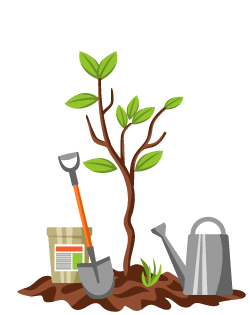 Landing
Basic conditions
- Apple trees prefer open spaces, good lighting, but no drafts. Therefore, it's best to choose locations where the sun illuminates the crown for most of the day, but within the protection of taller trees, building walls, hedges, or fences.
- Do not plant this variety in places where groundwater rises above 2.5 meters, in close proximity to open water bodies, near wells, in swampy hollows and lowlands where meltwater accumulates in the spring.
- It is better to prepare the holes for planting in advance, at least 3-4 weeks before planting, but preferably in the fall or spring.
- The holes are dug approximately 80 centimeters deep and the same in diameter. Topsoil, previously mixed with fertilizer, is added to the bottom, followed by 10-15 centimeters of drainage material, watered with 20-30 liters of water, and left outdoors.
- Stake stakes are immediately driven in, preferably on the north side. They can be either metal or wooden. The stakes should not be removed until two or three years have passed, to prevent the trunk from becoming deformed or the fragile seedlings from being uprooted by strong gusts of wind.
- Root collar should always remain at least 7-10 centimeters above the soil surface.
- Trees are placed on drainage (gravel, broken brick, vermiculite), with the root system spread out and any damaged or dead shoots trimmed off. The soil is then covered, compacted by hand. It is not advisable to pack the root ball too tightly, as apple trees prefer oxygen-rich soil. Water with 20-30 liters of water, and mulch the surface with compost, humus, or chopped grass to retain moisture.
Landing dates
Granny Smith responds well to spring or fall planting. One-year-old seedlings are best planted outdoors in late April or early April, when the threat of frost has passed but the buds have not yet begun to open. Older trees are best planted in the fall, around late September or early October, after the leaves have fallen.
Protection from frost and rodents
This variety is quite sensitive to low temperatures, so it needs to be carefully prepared for winter every year. If the region experiences prolonged frosts, 15-20 centimeters of soil should be raked onto the root zone, then covered with straw bundles or dry grass mats. The trunk is protected with agrofiber, burlap, roofing felt, or roofing felt. Many experienced gardeners use a tent-like covering, which even protects the branches.
To prevent rodents from feasting on the juicy bark in winter, the trunks are coated with melted lard, grease, or special commercially available solutions. To prevent the proliferation of insects, which often settle near the roots during the winter, the trunks need to be whiten lime, and as a preventative measure against fungal infections, spray with copper sulfate and other preparations.
Tree care
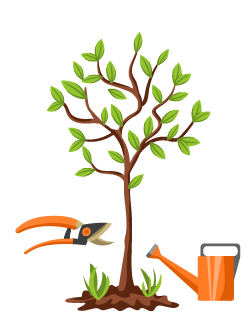 Tree care
Loosening the soil, watering: proper agricultural technology
This delicate apple tree requires constant soil loosening to ensure unimpeded oxygen access to the root system. At the same time, you can remove shoots from other plants, root suckers, and weeds that rob the tree of nutrients.
Proper watering of Granny is crucial, especially in the first few years after planting and during dry periods. Young trees should be watered approximately 3-5 times per season if rainfall is regular, or 5-7 times if the weather is dry and hot. All necessary fertilizers can be applied at this time; moisture helps them absorb better.
Avoid watering apple trees during the ripening period. This can cause the apples to crack from excess moisture. They will then have to be picked and processed immediately; storing such fruit will be impossible.
Pruning: simple crown shaping
Trees of this variety grow foliage very vigorously, especially in the first few years of life. Therefore, regular pruning is necessary to ensure adequate light exposure. This should begin around the second year after planting, when all branches should be removed, leaving only skeletal branches, spaced at least 30-45 centimeters apart. Many people feel as if the tree is left "bald," but it quickly regenerates.
In the future, it will be necessary to regularly remove all branches growing vertically upward (suckers), as well as those growing inward. Sanitary pruning involves removing all dry, damaged, or diseased shoots. Starting around the fifth or sixth year, rejuvenation pruning is performed, removing older branches and allowing younger ones to develop. This significantly extends the active life of apple trees.
Pollinator varieties
- Pink lady.
- Ligol.
- Delicious.
- Aidaret.
- Elise.
Reproduction
- Rooting cuttings.
- Grafting by buds and cuttings.
Diseases and pests
- Powdery mildew.
- Moniliosis.
- Scab.
- Rust.
- Powdery mildew.
- Fruit rot.
- Tinder fungus.
- Moniliosis.
- Hawthorn.
- Scale insect.
- Leaf roller.
- Codling moth.
Ripening and fruiting Granny Smith
The beginning of fruiting
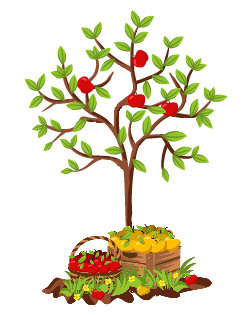 The beginning of fruiting
The first flowers bloom on apple trees very early, already in the first or second year after planting. However, it is recommended to completely remove these blossoms so the trees have time to strengthen before devoting their energy to fruiting. The first harvests can only be harvested in the fourth or fifth year. However, it's still too early to expect a full crop; at most, you'll get a few dozen apples.
Flowering time
Considered a winter tree, it blooms quite late, not until late May or early June. Therefore, it requires appropriate pollinators. Granny blooms uniformly, quite abundantly, and lasts for a medium duration (8-10 days). The flowers are very large, saucer-shaped, gathered in small inflorescences, snow-white or slightly light green.
Fruiting and growth
The fruit reaches technical maturity around late September or early October, depending on the growing region and weather conditions. At that point, the apples should be harvested and stored in wooden crates, sprinkled with sawdust, in a suitable cellar with good ventilation and stable temperature.
The main feature of these apples is their rich vitamin and mineral content. They are packed with antioxidants, macro- and microelements, so it is recommended to consume them fresh.
Consumer maturity for these apples occurs somewhat later, after the fruit has been sitting for a while, allowing the sugars to crystallize. The optimal time for consumption is approximately 20-30 days after harvest. Properly harvested fruits are very easy to transport and can be stored without any change in quality until the next harvest.
Top dressing
- Superphosphate.
- Mineral complexes.
- Peat.
- Compost.
- Manure.
- Humus.
What to do if it doesn't bloom or bear fruit
- Check for pests and diseases.
- Transplant.
- Provide watering.
Why do apples fall?
- Natural factors.
- Pests.
- Diseases.
Leave your feedback on the Granny Smith apple variety to share your experience and knowledge with others.






Comments
Thank you.