Apple tree Imanta: characteristics of the variety and care
| Color | Reds |
|---|---|
| Ripening season | Winter |
| Size of apples | Large |
| Taste | Sweet and sour |
| Crown type | Average tree height |
| Shelf life | Average shelf life |
| Application | For recycling |
| Winter hardiness | Average winter hardiness |
| Fruiting age | Up to 5 years |
 History of origin and regions of growth
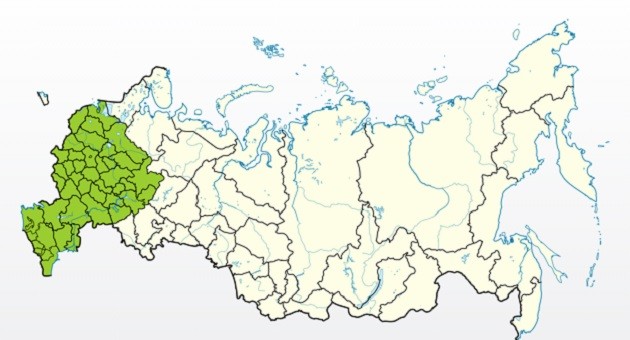
Growing regions
- Kaluga region.
- Middle zone.
- Moscow region.
- Vladimir region.
- Tula region.
- Leningrad region.
- Crimea.
- North Caucasus.
Origin
One of the new varieties developed in the village of Samokhvalovichi in the Minsk region by Belarusian breeders from the Republican Scientific and Practical Development Unitary Enterprise "Institute of Fruit Growing." The breeding was carried out by pollinating the Antey apple tree with Liberty pollen. The authors of this variety are Galina Mikhailovna Marudo, Grigory Kondratyevich Kovalenko, Dmitry Vikentyevich Grakovich, and Viktor Mikhailovich Evdokimenko.
Imant is believed to have been bred in 1999, but the first application for its elite classification was received only in 2003. The variety successfully passed field trials and was officially included in the State Register of Breeding Achievements in 2009. It was also then zoned for the Central Region. It is easily cultivated over much larger areas.
Description of the Imant variety
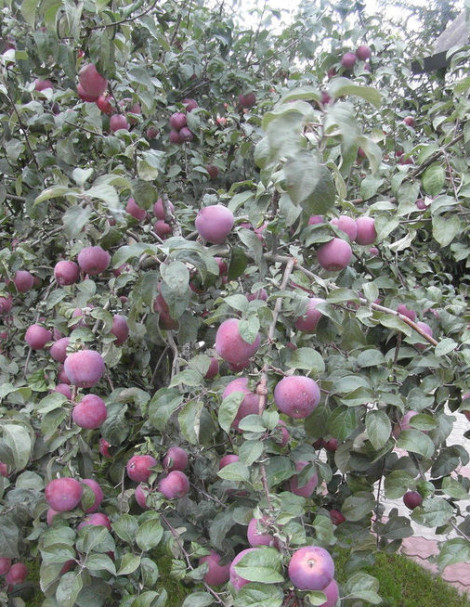
 This compact, neat apple tree, which doesn't take up much space and ripens late, immediately caught the attention of gardeners in the central part of the country. The trees begin bearing fruit quickly, are not overly regular, and produce good harvests every year. They are tolerant of virtually any growing conditions, are undemanding of soil, and easily tolerate air pollution and environmental contaminants. A particular advantage is their immune defense against scabies (Vf gene), the most common apple disease.
Imanta produces large, attractive fruits with a rich, deep color. They are juicy, tasty, and aromatic. They are easy to transport, even over very long distances, and can be stored for a long time in a refrigerator or regular cellar, as well as processed. This variety is recommended for cultivation in any farm, from a small home garden to intensive commercial fruit planting.
Apples: What do they look like?
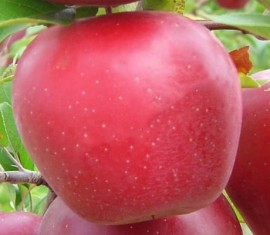
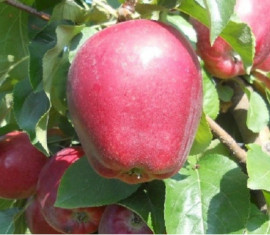
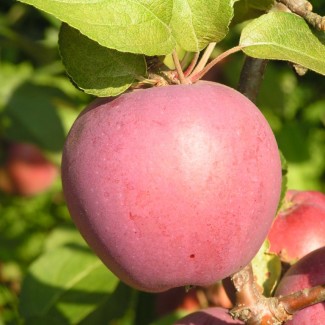
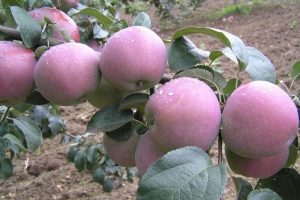 The fruits are medium-large to large, growing to 180-250 grams. In good years, with proper care, they can reach 280-300 grams. They are smooth, conical-round, generally regular in shape, symmetrical, but can be beveled. The fruit is moderately uniform in size, with slight ribbing.
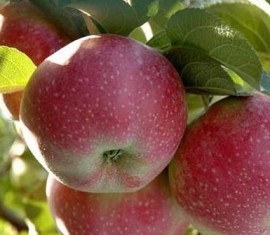
The imant has a dense, fairly elastic skin. It is green, even deep green, with a silvery-blue waxy coating. The blush is very dense, reddish-burgundy, tinged with purple or violet. It covers more than 85-95% of the surface, so the underlying color is not always visible on ripe fruits. Subcutaneous spots are grayish-green, medium in size and density, and clearly visible against the dark surface. Professionals assess the chemical composition based on the following data:
- P-active substances (catechins) – 117 milligrams.
- Ascorbic acid (vitamin C) – 8.8 milligrams.
- Fructose (total sugars) – 11.2%.
- Pectins – 7.3%.
- Titratable acids – 0.67%.
The apples are medium-dense, with very juicy, tender, crisp, and fine-grained flesh. It's creamy-green, slightly lemon-colored, and intensely aromatic. The flavor is pleasant, dessert-like, harmonious, and sweet-and-sour, considered well-balanced. According to professional tasters, Imants scores 4.2 points on a 5-point scale.
Apple tree Imanta: characteristics
Crown and root system
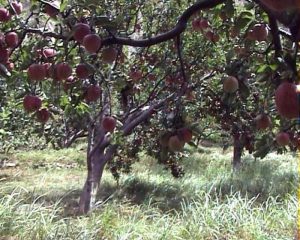 The trees grow quickly, are medium-sized, and have a neat, rounded or rounded-conical crown. They are not prone to excessive thickening, so pruning is minimal. Branches are straight, medium in length and thickness, and are compactly arranged, extending at right angles to the main stem. Rounded in cross-section, they are covered with pubescent bark of a tan or brown hue.
The foliage density is average to above average. The leaves are oblong, elongated, ovate, large, and pubescent on the back. They are dense, dark or rich green, leathery, with a long, pointed tip that curls into a helical shape, and a serrated, finely serrated, and wavy margin. The surface has a subdued matte sheen, and the ribbing is coarse. The root system is medium-deep, branched, fibrous, and has numerous small branches.
Productivity and pollination
Imanta is considered not only a regularly fruiting and early-bearing variety, but also a high-yielding one.
The variety's yield increases as the tree matures. A single tree can yield a maximum of 100-135 kilograms of beautiful and delicious apples. According to official data, the average yield at standard planting density is at least 170 centners per hectare.
The variety is partially self-fertile, but its fertility increases with the presence of nearby pollinators with similar flowering times. Therefore, it is recommended to interplant the trees.
Winter hardiness and disease resistance
The variety's cold tolerance is a positive trait. It tolerates temperatures down to -25-27°C quite well. With proper winter preparation and timely covering, it will not be damaged even by sudden temperature fluctuations. However, prolonged frosts may damage the buds. Trees recover fairly quickly, within one to two years.
Imants is completely resistant to scab, as it has a genetic immunity. Other diseases rarely affect it, but bacterial scab is especially a concern. burnParasites are not dangerous if preventative treatments are carried out.
Rootstocks and subspecies
There are currently no subspecies of this variety, although they may be developed in the future. Breeders are working on creating a columnar version of Imanta. It can be grown on standard and dwarf rootstocks. The low-growing trees barely reach 1.8-2 meters, begin bearing fruit in the second year, but are more sensitive to frost.
Features of growing Imanta
 Landing
 Landing
Basic conditions
- Choose a sunny, open site for apple trees. In the shade, the variety may not only grow stunted but may even die.
- Imanta thrives in airy, permeable soils that are fertile and well-drained. It can also grow in poor soil, but it will require regular, proper fertilization and feeding.
- The tree's rhizome is of medium depth, so it can be planted in areas where groundwater rises to 2-1.8 meters.
- It's best to prepare planting holes in advance, during the previous season, or at least 2-4 weeks in advance. Dig them 65-75 centimeters deep and 1 meter in diameter. Add fertilizer mixed with the topsoil to the bottom, then cover with 10-15 centimeters of crushed brick or vermiculite for drainage. Fill the hole with water and leave it uncovered.
- It's a good idea to insert stakes into the holes for staking, and for larger plantings, trellises are better. They will provide support and additional protection during cold weather.
- When purchasing, carefully inspect the seedlings. They should be fresh, healthy-looking, and free of dry or broken shoots. One- or two-year-old trees are the best choice.
- If the roots become over-dried, it is better to soak them in water for 5-7 hours to rehydrate them.
- The root collar should always be left above the surface. After planting and the first watering, the soil may settle slightly, so the grafting point should protrude 6-8 centimeters.
- A mound of drainage material is raked into the center of the hole. The tree is placed on it, carefully spreading the roots so they don't interfere with each other. Cover with soil, tamp it down with your feet, but not too vigorously, and water with 20-35 liters of water. To prevent water evaporation, the surface is usually mulched with compost. manure or sawdust.
Landing dates
When planting apple trees, it's important to consider the region's climate and weather conditions. It's important that they aren't damaged by either recurrent frosts or early frosts. In southern latitudes, it's best to plant Imanta approximately 25-30 days before the first frost, in late September or early October, after the leaves have fallen. In more northern latitudes, a warm, dry day in late March or early April is ideal. The key is for the soil to be thoroughly warmed.
Tree care
 Tree care
Protection from frost and pests
In the North Caucasus or Crimea, even young trees don't particularly need winter protection. However, in harsher climates, it's best to plan for wintering well in advance. Watering should be stopped completely by the second half of August, or at the latest by early September. Shorter trees can be wrapped in burlap or even tarpaulin from the rootstock to the crown. Larger trees can be wrapped at the base of the trunk with agrofibre, roofing felt, spongebond, or old tights. Hay mats, straw bales, or spruce branches can be placed over the roots.
To combat insects, tree trunks are whitewashed with ordinary lime; this not only protects them but also makes the garden more aesthetically pleasing. To repel rodents, trunks are coated with old lard, fuel oil, grease, or drying oil. The most effective pest control products are available in gardening stores and industrially produced ones, but not all gardeners consider them completely safe.
Loosening the soil, watering: proper agricultural technology
Trees prefer airy and well-drained soil, so it's best to dig around the trunk twice a year, in the fall and spring. In the summer, you can hoe the soil, removing weeds, root suckers, and other plants. Don't forget to clean the root area; make sure there are no rotting fruits or fallen leaves left there. This significantly reduces the risk of apple tree diseases.
In the first few years, Imanta is watered quite generously, especially in the spring and fall before the fruit ripens. Apply 25-40 liters per trunk every 10-12 days, or every 6-8 days during drought and heat. Mature trees require 5-7 waterings during the growing season. It's a good idea to add fertilizers and fertilizers along with the water, but not before the third year of growth.
Pruning: simple crown shaping
Trees can be formed into almost any shape:
- Cordon.
- Sparsely tiered.
- Sparse.
- Palmette.
- Spindle.
- Bowl.
- Broom-shaped.
- Bush.
Pruning is done every spring, before the sap begins to flow, starting in the first year. From the fifth year onward, shoots protruding inward and vertically upward, as well as duplicate and crossing shoots, are removed. Cut sites are immediately treated with oil or water-based paint. garden pitchIn the fall, after the leaves have fallen, dry, diseased, and broken branches are removed.
Reproduction
- Cuttings.
- Budding.
- Cloning.
- Kidney grafting.
Pollinator varieties
- White rosemary.
- Kandil white.
- Reinette d'Orléans.
- Kandil Orlovsky.
- Chinese Kandil.
- Sar-sinap.
Diseases and pests
- Bacterial burn.
- Black crayfish.
- Cytosporosis.
- Powdery mildew.
- Rust.
- Apple moth.
- Glass-box.
- Leafhopper.
- Scale insect.
- Hawthorn.
Ripening and fruiting of Imanta
The beginning of fruiting
 The beginning of fruiting
An apple tree begins bearing fruit as early as the second year if grown on a dwarf rootstock. On standard trees, apples can be expected by the third or fourth year. The harvest is by no means abundant, yielding only a few kilograms in the first few years.
Flowering time
The Imanta variety blooms quite late, not earlier than mid-May, but most often by the end of the month or even in June. The buds are very beautiful, gathered in small inflorescences of 5-6, a rich pink hue.
They bloom into large, five-petaled flowers of pale pink or even snow-white. They are arranged densely on the branches, giving the tree a decorative appearance. The process lasts 7-10 days, so it's easy to find suitable pollinators during this time; there are many similar varieties.
Fruiting and growth
The trees grow quickly, capable of reaching 45-60 centimeters per year. Their fruitfulness increases year after year, reaching its peak in the 7th-8th year. No regularity in fruiting has been observed, but after an extremely cold, prolonged winter, yield may decline slightly, though not significantly.
The fruits are usually ready for harvest in late September, but more often in early or even mid-October. Ripeness can be judged by how easily they are removed from the branches. Pressing them leaves an indentation on the surface. The fruits can be transported in crates, up to four deep, layered with sawdust. They store well until spring in a regular cellar.
Top dressing
- Eggshell.
- Humus.
- Bor.
- Manure.
- Compost.
- Superphosphate.
- Copper.
- Mineral and nitrogenous complexes.
- Ammonium nitrate.
What to do if it doesn't bloom or bear fruit
- Wrap up for the winter.
- Limit watering.
- Eliminate insect infestation.
- Cure diseases.
Why do apples fall?
- Wind.
- Pests or diseases.
- Frosts.
Share your own experience with the Imanta apple tree variety so that even novice gardeners have no questions about cultivating these trees.