Kashtel apple tree: characteristics of the variety and care
| Color | Greens |
|---|---|
| Ripening season | Autumn |
| Size of apples | Average |
| Taste | Sweet |
| Crown type | Average tree height |
| Shelf life | Average shelf life |
| Application | For recycling , Fresh |
| Winter hardiness | Average winter hardiness |
| Fruiting age | From 5 years old |
 History of origin and regions of growth
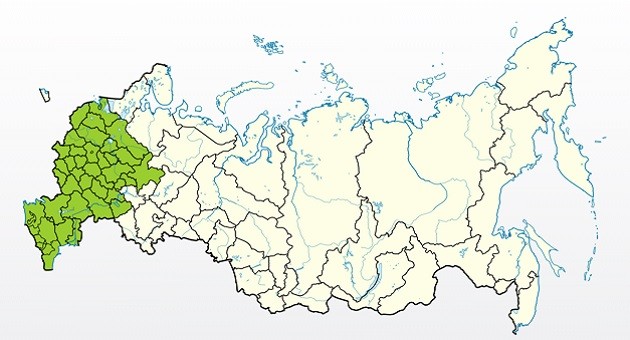
Growing regions
- Bryansk and Ryazan regions.
- Moscow region and Moscow.
- Leningrad region.
- Middle zone.
- Crimea.
- North Caucasus.
Origin
The origins of this ancient apple tree are impossible to fully understand. It is known that the first mentions of it appear in the chronicles of the Polish King Jan III Sobieski. These dates back to the mid-seventeenth century. This means the variety is over three hundred years old.
Different sources have slightly different names for this variety, but the most accurate is considered to be the Kasztelskaya apple. Some call it the Polish Sugar Apple, which is also correct.
In our country, this variety was widely cultivated in the late nineteenth and early twentieth centuries. Until 1948, it was recommended for commercial cultivation. Currently, it is not officially zoned, and there is no information about it in the State Register.
Description of the Kashtel variety
 This late-autumn variety is quite popular in our country and is common in Ukraine and Belarus, as well as throughout almost all of Europe. The trees are medium-sized, beautiful, densely foliated, and have spreading, voluminous crowns. They grow well in any conditions, are winter-hardy, require little watering or feeding, and require little special care.
The Kashtel apple variety produces large fruits of high commercial quality, rich in pectin and ascorbic acid. The only drawback is the pronounced irregularity of fruiting and the late onset of fruiting. It is primarily grown in small private orchards for personal consumption.
Apples: What do they look like?
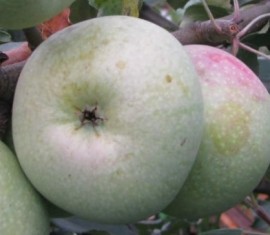
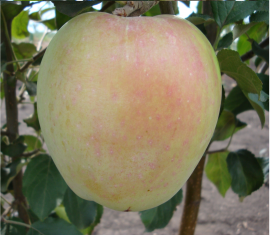
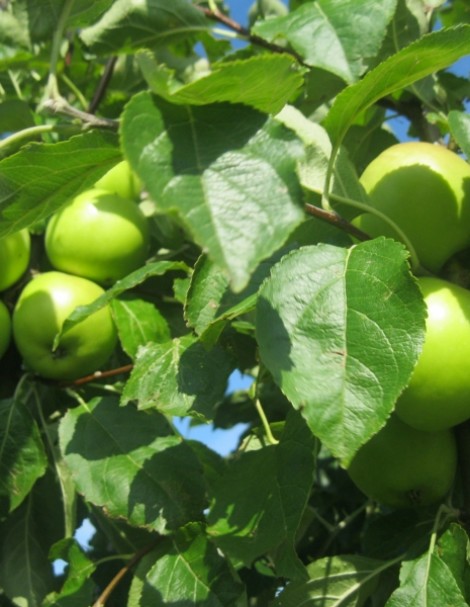
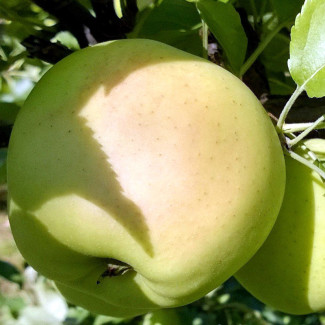
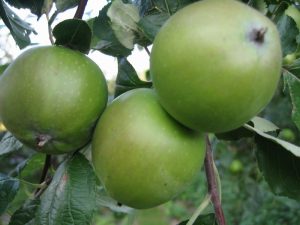 The fruits are round, almost spherical, but can be slightly conical. They are quite large, weighing up to 140-180 grams, uniform and symmetrical. The ribbing is almost imperceptible, strongly smoothed, and slightly visible near the calyx.
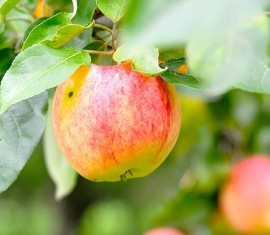
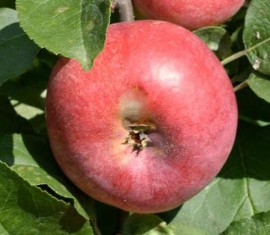
The skin is firm and elastic, but not thick or brittle, and may split when overripe. It is green or even bright green, but turns golden-yellow or lemon-gold as it ripens. The skin blush is completely absent, but sometimes, on the sunny side, large, transparent, orange-tinted spots can be seen. There are numerous, clearly visible, whitish subcutaneous spots, which can be large and rusty. The chemical composition can be judged by several factors:
- P-active substances (catechins) – 165 milligrams.
- Ascorbic acid (vitamin C) – 11.2 milligrams.
- Fructose (total sugars) – 13.6%.
- Pectins – 14.3%.
- Titratable acids – 0.65%.
The apples have a pleasant, dense, fine-grained flesh, white, creamy, or slightly lemon-straw-colored. It's crisp, not prickly, tender, and juicy. The flavor can rightfully be called dessert-like: it's sweet but with a distinctive tartness, and the aroma is strong, pleasant, and easily recognizable. According to unofficial tasters, the fruit scores at least 4.5 out of 5.
Apple tree Kashtel: characteristics
Crown and root system
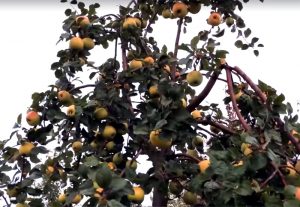 Trees of medium vigor, reaching 4-4.5 meters in height, sometimes slightly more if not pruned. The crown is very voluminous and dense, initially broadly oval, becoming more spreading with age. It is attractive, but requires regular thinning. Branches extend from the trunk at almost a right angle and branch extensively. The shoots are medium in length, rounded in cross-section, and covered with greenish-brown or tan-brown bark. Fruiting is mixed.
The leaves are large, fairly dense, and leathery. They are glossy, dark or rich green, and may have slight pubescence on the underside. The leaf blade is ovoid and elongated, with long-pointed tips and wavy, serrated, and doubly serrated margins. A well-developed root system indicates the trees' resilience, capable of surviving even the longest dry periods. It is branched, with numerous offshoots; on some rootstocks, it may have a taproot, but most are fibrous.
Productivity and pollination
The apple tree's main drawback is its intermittent fruiting, yielding a harvest only once every two years. However, in private farms, this is offset by its high fertility and longevity.
One Kastel tree can produce over 100-120 kilograms of aromatic fruits per year at a mature age..
Apple trees don't need external pollinators; they are completely self-pollinating. Moreover, their pollen is so potent that they can easily serve as such. However, having trees that bloom at the same time significantly increases the variety's yield. Therefore, it's important to interplant them.
Winter hardiness and disease resistance
The trees have average to slightly above-average tolerance to low temperatures. They can survive temperatures as low as -25-27°C without freezing if properly covered. Lower temperatures can damage buds and even young shoots. They easily tolerate temperature fluctuations, making them suitable for growing in the Moscow region and even the Leningrad region, with their challenging climate.
Castel is extremely resistant to diseases and is very rarely affected. scab and other fungal infections. But if the tree gets sick, both the leaves and the fruit suffer. Therefore, completely abandoning preventative measures is undesirable, as it can ruin your garden. Trees can also be damaged by parasites, so regularly inspect them for insects.
Rootstocks and subspecies
There are no original subspecies of Polish Sugar, but they can be grafted onto almost any rootstock. The most suitable options are dwarf and semi-dwarf varieties, where trees grow no more than 2.5-3 meters tall. The most popular varieties are MM106 and 54-118. This doesn't significantly affect fruit quality, but the trees begin to bear fruit as early as 3-4 years.
Features of growing Castel
 Landing
 Landing
Basic conditions
- Loams and sandy loams are preferred for this variety, but it will grow in any soil. Rich, heavy black soil can be slightly thinned with river sand, and depleted soils can be fertilized regularly. Overly acidic sites are undesirable, but this problem can be solved with dolomite flour or lime.
- Trees grow much better in the sun than in the shade. In the shade, they can be weak, delay flowering, and develop a lopsided, elongated crown with thin branches.
- It's best to keep the groundwater level below 2-2.2 meters, otherwise the apple trees will root there and rot. Replanting mature trees is problematic, so it's best to plan for this in advance.
- Blowing winds don't usually cause much damage to trunks, but drafts aren't ideal for trees. They weaken their immune system and make them more susceptible to disease.
- Experienced gardeners dig holes in advance, a season or two before purchasing new seedlings. But for Koshtel, this isn't necessary; the main thing is to let the holes sit for at least three to four weeks.
- Dig holes 85-90 centimeters in diameter and 60-80 centimeters deep, filling the bottom with fertile topsoil mixed with fertilizer. Cover with broken brick or vermiculite and add 3-4 buckets of water. Leave the holes uncovered.
- Before planting, apple trees should be inspected, dry or broken roots should be cut off, and they should be immersed in water for 5-9 hours, for example, in the evening before planting.
- The drainage material is raked into a pile in the center of the hole, and the seedling is placed on top of it, ensuring that the root collar is at least 10 centimeters above the ground level. The soil should not settle below this level after watering. It's best to fill the soil in layers, compacting it with your feet, but not too much.
- Water the seedlings with 25-40 liters of water, depending on the size of the planting material. To retain moisture longer, the surface can be mulched.
Landing dates
Castel apple trees are planted in spring or fall, but only during the period when the sap has not yet started to flow in the trunks, or when it has already stopped. If the region is extremely cold, with sudden, sudden frosts, it's best to choose the former option, choosing a warm, dry day when the soil has already warmed up completely. In warm regions with a mild climate and predictable weather, it's acceptable to plant trees in September or October, after the leaves have completely fallen. It's also common to bury apple trees at a 45° angle until spring.
Tree care
 Tree care
Protection from frost and pests
In Crimea or the North Caucasus, it's not necessary to cover trees for the winter; they can easily withstand any weather conditions. However, in more northern latitudes, it's a good idea to wrap the trunks with burlap or roofing felt. Small young saplings can be wrapped from top to bottom, like a tent. In the harshest climates, you can cover the area around the spruce tree's root system with spruce branches, straw, or hay, and pile up the soil. All of this should be removed in early spring.
Preventative spraying against insects and diseases won't hurt, but they're not absolutely necessary. Trunks a little over a meter high can be whitewashed with lime in the spring and fall; this will rid the tree of pests and make the garden look more tidy. Hungry mice and hares, which readily nibble on bark and young branches, can be deterred by coating the trunks with grease, lard, or fuel oil.
Loosening the soil, watering: proper agricultural technology
The trunk is dug twice a year, but once a year is sufficient, along with removing weeds, debris, rotting leaves, and fruit. As trees mature, they are self-sufficient, so the root zone is seeded with herbs or grasses, and covered with gravel, similar to a Japanese garden, or turf.
Young apple trees need watering. Two to three buckets per trunk every 10 to 12 days is sufficient, especially if the summer is hot and dry. Older trees will only need water four to six times a season, during the driest periods and before fruit set. Fertilizers and other fertilizers are easily added along with the water. It's not recommended to water the Kashtel apples while they are ripening, as they may burst.
Pruning: simple crown shaping
There's no need for extensive pruning, but avoid allowing the plants to become overly dense. They're usually purchased from nurseries already formed, with a central conductor and 2-4 skeletal shoots. Subsequently, selective thinning and sanitation cleaning are sufficient. In the fall, all suckers, dead or broken branches are cut off, and wounds are sealed with tar.
Pollinator varieties
- Florina.
- Zhigulevskoe.
- Melba.
- Idared.
- Borovinka.
- Lobo.
- Delicious golden.
- Ola.
Diseases and pests
- Scab.
- Cytosporosis.
- Moniliosis.
- Powdery mildew.
- Rust.
- Green aphid.
- Leaf roller.
- Hawthorn.
Ripening and fruiting of Kashtel
The beginning of fruiting
 The beginning of fruiting
A distinctive feature of these apple trees, as well as their main drawback, aside from the regularity of fruiting, is the late onset of fruit production. The first flowers may appear in the 6th or 7th year, but they often fail to develop into ovaries. The harvest can be reaped around the 8th or 9th year. It won't be abundant, but several kilograms of fruit can be harvested. Dwarf and semi-dwarf varieties begin bearing fruit in the 3rd or 4th year.
Flowering time
The Polish Sugarcane buds open no earlier than mid-May, which is on average. Therefore, pollinators are unlikely to be a problem, although they are not particularly needed anyway. The tree's flowers are single, large, and very fleshy. They are snow-white and extremely fragrant.
Fruiting and growth
These trees can grow 35-55 centimeters per year, so they reach their final height very quickly. Kashtel prefers to increase fruit production gradually, producing more fruit with each harvest. A full crop can be expected in 10-15 years, depending on various external factors (weather, suitable location, climate, conditions, and care).
Apples begin to ripen in September and October. You can tell when the fruit is ready by the golden hue of the skin. They ripen uniformly, all at once, so the entire harvest can be harvested in a single day. Consumer maturity does not occur immediately, but approximately 2-3 weeks after storage. If picked green, the apples will keep longer, almost until spring. If you wait until they are ripe, it's best to process or eat them before early February. The fruit transports well.
Top dressing
- Eggshell.
- Humus.
- Manure.
- Compost.
- Superphosphate.
- Mineral and nitrogenous complexes.
- Ammonium nitrate.
What to do if it doesn't bloom or bear fruit
- Wrap up for the winter.
- Limit watering.
- Eliminate insect infestation.
- Cure diseases.
Why do apples fall?
- Wind.
- Frosts.
- Pests or diseases.
- Overripening.
Share your own experience with the Kashtel apple tree variety, so even novice gardeners have no questions about cultivating these trees.