Kuibyshevskoye apple tree: characteristics of the variety and care
| Color | Yellow |
|---|---|
| Ripening season | Autumn |
| Size of apples | Average , Large |
| Taste | Sweet and sour |
| Crown type | Tall tree |
| Shelf life | Average shelf life |
| Application | For recycling , Fresh |
| Winter hardiness | Average winter hardiness |
| Fruiting age | From 5 years old |
 History of origin and regions of growth
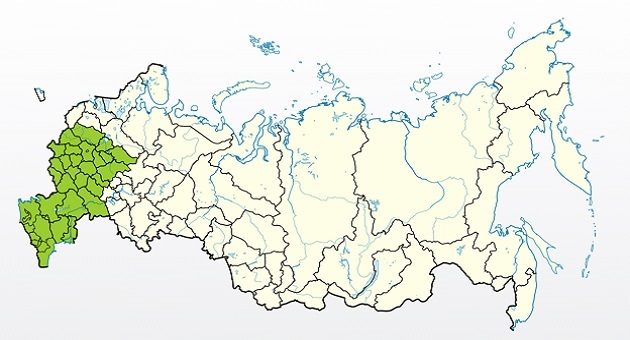
Growing regions
- Crimea.
- Samara region.
- Tatarstan.
- Volga-Vyatka region.
- Middle zone.
- Tver region.
- Leningrad region.
- Mordovia.
- North Caucasus.
- Ulyanovsk region.
- Moscow region.
Origin
The variety was developed in the early 1950s at the Kuibyshev (now Samara) Zonal Horticultural Experimental Station. The author was renowned Russian pomologist and breeder Sergei Pavlovich Kedrin. The new variety, named Kuibyshevsky, was created by crossing London Pepin and Saffron Antonovka.
The first application for testing approval was submitted in 1954, after which the apple trees were classified as elite and sent to nearby farms for field testing. By 1979, the variety was included in the State Register of Breeding Achievements and zoned for the Middle Volga region. In fact, it is successfully cultivated throughout the central part of the Volga region, as well as much further north, south, and east.
Content
Description of the Kuibyshevskoye variety
 Winter apple trees have been popular in our country for many years due to their numerous advantages. The trees are vigorous, with a beautiful, sparsely dense crown. They are easy to care for and require different growing conditions, and are environmentally friendly. Their main drawback is their low resistance to scab, but timely preventative measures effectively address this issue. Kuibyshevskoye bears fruit regularly and abundantly.
The fruit ripens beautifully on the tree, and its marketability is excellent. They are delicious, aromatic, and very juicy, transport well, and store well even in a standard cellar. They are suitable for processing and fresh eating. Kuibyshevskoye is recommended for intensive commercial gardening, but they are also a real find for small home gardens.
Apples: What do they look like?
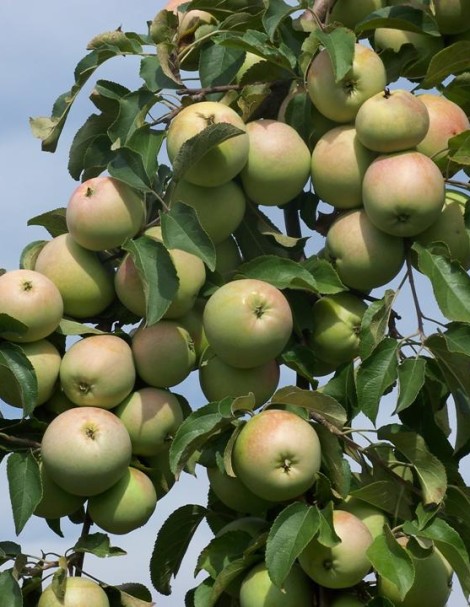
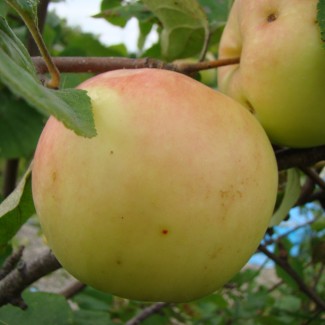
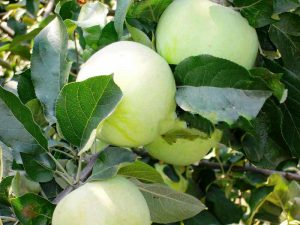 The fruits are medium, medium-large, or large, and can reach 250-300 grams on young trees. They become somewhat smaller with age, and on mature trees, they barely reach 130-150 grams. The fruit shape is generally round, flattened, compressed along the central axis, and regular. They are symmetrical and uniform, with ribbing that can be clearly visible near the calyx and smoothed out near the petiole; the lateral suture is not visible.
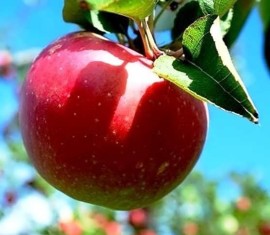
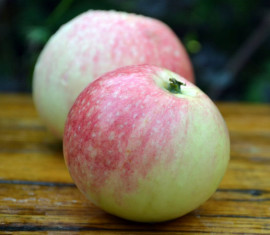
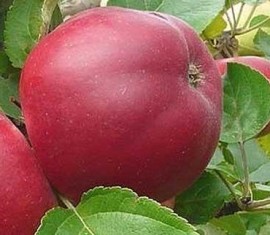
Kuibyshevsky fruits have a smooth, highly shiny, glossy skin. It is medium-thick, not hard, even, and easily bitten off. The base color at full ripening is yellow or greenish-yellow, with a reddish-brown or reddish-brown blush appearing on the sunny side, blurred and spotted, covering no more than 30-45% of the surface. Subcutaneous punctures are large, greenish, numerous, but barely noticeable. Chemical composition is assessed based on the following characteristics:
- P-active substances (catechins) – 242 milligrams.
- Ascorbic acid (vitamin C) – 12.5 milligrams.
- Total sugars (fructose) – 13.8%.
- Pectins (fiber) – 9.1%.
- Titratable acids – 0.54%.
The fruits have a pleasant, creamy-yellowish flesh. It is fine-grained, juicy, crisp, and somewhat refreshing. The flavor is considered harmonious, dessert-like, and balanced; it is sweet and sour, very pleasant, and has a strong aroma. According to professional tasters, the apples score 4.3 out of 5 for taste and appearance.
Kuibyshevskoye apple tree: characteristics
Crown and root system
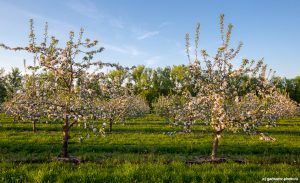 Trees are usually considered vigorous because They can grow up to 6.5-7.5 meters without pruning., and sometimes even taller. They are fast-growing, with a crown generally broadly conical or rounded, and moderately dense. The shoots are thick or medium-thick, set at right angles to the conductor, straight, long, rounded in cross-section, and covered with grayish-brown bark. Fruiting is concentrated on the rings.
The leaves are generally medium-sized, flattened, smooth, leathery, oval-elongated, and have a short, pointed tip. The edges of the blade are crenate-serrate, doubly serrated, and can be slightly wavy or keel-shaped. The base color is dark green, but sometimes they can be rich green or emerald. The root system is highly branched, fibrous on most rootstocks, with numerous small branches. The rootstock is well-drained, the rhizome is robust, and occupies an area approximately equal to the diameter of the crown.
Productivity and pollination
The fertility rate of the variety is high, given that the trees bear fruit quite early.
With proper care and favorable weather and climate conditions, one mature Kuibyshevsky tree can yield approximately 240-280 kilograms of aromatic and delicious fruit per year. Over the years, irregular fruiting may occur, with yields declining by 45-50%.
Kuibyshevskoye is considered a self-sterile variety, meaning it won't produce any fruit without pollinators. Therefore, apple trees with suitable flowering times should be planted within 100-150 meters of each other. It's best to intersperse them, spray the trunks with honey or sugar syrup during flowering, and use mobile apiaries during this period.
Winter hardiness and disease resistance
With proper care and preparation for winter, trees are quite frost-resistant. They can withstand temperatures down to -22-25°C with virtually no damage, even during prolonged cold spells. However, Kuibyshevskoe does not tolerate sudden changes in temperature; damage can occur to buds, bark, and even wood.
Apple trees have low resistance to scab, which is considered one of their most frustrating problems for gardeners. They are frequently affected if preventative measures are not taken promptly, damaging leaves and fruit, and taking a long time to recover. Resistance to other fungi is moderate, and parasites are also dangerous to the variety. Regular and timely spraying with commercial products is necessary.
Rootstocks and subspecies
The variety is grown on a variety of rootstocks, slightly altering the tree's properties, which doesn't significantly affect the fruit. Dwarf varieties are less frost-resistant but begin bearing fruit earlier. Tall varieties, on the other hand, tolerate wintering well, but bear their first fruit somewhat later.
Features of growing Kuibyshevsky
 Landing
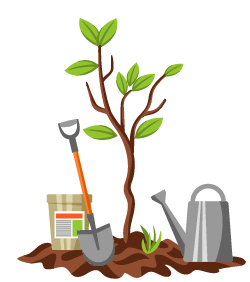 Landing
Basic conditions
- This variety doesn't tolerate even minimal shade, so it should be planted in sunny locations only. Trees will neither flower nor bear fruit in the shade.
- Groundwater levels should be managed; if trees are planted where the water level is too close to the surface, the rhizomes will rot. It's not recommended to plant apple trees in marshy areas or areas prone to spring flooding, near rivers, lakes, shallow wells, or streams. If necessary, drainage can be carried out before planting, and a layer of roofing felt or slate can be dug in at a depth of 2-2.2 meters to direct the roots.
- Almost any soil is suitable, but fertile sandy loam or clay loam is best. Overly acidic or salty soils are unsuitable, but these can be addressed by adding additional components such as ash, lime, or dolomite powder mixed into the soil.
- Ventilation doesn't play a key role, but it's worth considering that if air stagnates in the crowns, fungi will develop much more frequently and quickly.
- The holes are dug in advance, approximately 4-6 months before planting, but sometimes this period can be shortened to 3-4 weeks. They should be spaced at least 4.5-5 meters apart, 70-80 centimeters deep, and up to 1 meter in diameter. Fertilizer mixed with the topsoil is placed at the bottom, followed by drainage, and then the entire thing is watered generously.
- Trellis or stakes are immediately dug into the holes to support the trees. In winter, they will also serve as frost protection if placed on the north side.
- The root collar should be left 5-8 centimeters above the soil surface, otherwise the rootstock's properties will be lost. It's also important to allow for some soil settlement after planting and the first watering to prevent the grafting site from sinking into the soil after top-dressing.
- The drainage material is raked into a pile in the center of the hole. The tree is placed on it, the rhizome is straightened, covered with soil, and compacted with feet, but not too vigorously. The surface is watered with 2-40 liters of water, and then mulched, ensuring that the mulch and the apple tree bark do not touch.
Landing dates
Kuibyshevskoe tolerates planting easily both in April-May, before the buds open, and in September-October, after the leaves have fallen. The key is to ensure that frost doesn't damage the young, fragile trees and that the soil is sufficiently warm.
Tree care
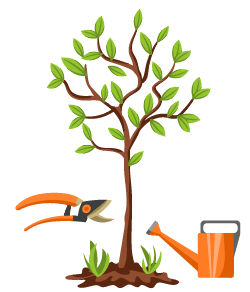 Tree care
Protection from frost and pests
Young saplings aged one or two years should be covered with a tent to prevent damage from severe frosts. For older trees, wrapping the trunks with burlap, tarpaulin, roofing felt, or old tights will suffice. In the harshest regions, soil, straw, spruce branches, and hay are scattered over the root zone. All this should be removed before the trees begin to grow in the spring.
To combat insects, tree trunks should be whitewashed twice a year, taking every precaution to avoid damaging the trees. Commercially available products, as well as insect and fungal protection systems, are also recommended. Specialized products can repel rodents, or you can simply coat the bark with melted animal fat, grease, or fuel oil.
Loosening the soil, watering: proper agricultural technology
Trees of this variety require little special care. It's sufficient to dig around the trunk twice a year, in the fall and spring. At the same time, remove root suckers, shoots from other plants, and weeds. You can lightly loosen the soil on the second day after each watering to prevent it from compacting into a solid lump. Debris from under the tree should be removed regularly, as rotting leaves and fruit encourage the development of diseases and fungi.
Water the Kuibyshevskoye tree as needed, ensuring the soil around the trunk never dries out completely. During the hottest and driest periods, apply 25-30 liters per tree every 7-10 days when young. Older trees can be watered 4-5 times a year, provided the heat is not too intense. Ideally, setting up drip irrigation will eliminate this issue. Fertilizers and fertilizers are diluted with water, and the solution is applied along the perimeter of the crown.
Pruning: simple crown shaping
Initial shaping is carried out in the first year, removing a third of the central conductor and leaving only 2-3 skeletal branches. Subsequently, all that remains is to maintain the shape, removing inward-growing or vertical shoots, and maintaining natural branching.
Sanitary pruning is carried out more often in the fall. Then, all broken, diseased, and dry branches that are no longer useful need to be removed. The cut areas are sealed. garden pitch, water-based or oil paint.
Pollinator varieties
- Spartan.
- Sinap northern.
- Zhigulevskoe.
- Idared.
- Korobovka.
- Spartacus.
- Kutuzovets.
- Delicious golden.
Diseases and pests
- Scab.
- Cytosporosis.
- Fruit rot.
- Powdery mildew.
- Scale insect.
- Leafhopper.
- Fruit hyacinth.
- Hawthorn.
- Green aphid.
- Leaf roller.
Ripening and fruiting of Kuibyshevsky
The beginning of fruiting
 The beginning of fruiting
Although this variety is considered early-bearing, the first harvest will take 5-6 years. Flowers begin to bloom as early as the 4th or 5th year, but these are often barren flowers that fail to produce ovaries. The first harvests will be abundant, yielding several kilograms of delicious and aromatic fruit.
Flowering time
The Kuibyshevskoye variety typically blooms mid-season, so finding pollinators for it won't be a problem. The trees produce rich, dense pink buds as early as April, and by mid-April, they open into large, pale pink or white flowers with a slight pink tint. There are numerous flowers, densely covering the branches, but not all develop into ovaries. The flowering process lasts approximately 12-16 days, depending on climate and weather.
Fruiting and growth
Apple trees grow quickly, reaching at least 45-60 centimeters in height per year before fruiting begins. Once mature, trees slow down slightly, but not dramatically. Fruiting increases quite rapidly, and by the 8th to 11th year, harvests reach full capacity, yielding over 150 kilograms of fruit.
Kuibyshevsky apples ripen in mid- to late September and are not prone to shedding. However, if the harvest is not picked on time, their shelf life will be significantly reduced. Therefore, it's best to wait until the apples have developed a brown tan and waxy coating and immediately remove them from the branches for storage. They can be transported without problems even in bulk, as long as the layer isn't too thick. Store the fruit even in a special container. refrigerator They will last until mid- or late February, sometimes until early March. After that, they lose their flavor, juiciness, and aroma. It's better to store them in a cellar. recycle or eat them by the end of January.
Top dressing
- Superphosphate.
- Humus.
- Peat.
- Calcium.
- Manure.
- Compost.
- Nitrogen complexes (not in the first 4 years).
What to do if it doesn't bloom or bear fruit
- Limit watering.
- Eliminate insects.
- Cure diseases.
- Fertilize.
- Move to a sunny place.
Why do apples fall?
- Wind, rain, hail, snow.
- Pests or diseases.
Leave a review of the Kuibyshevskoye apple tree variety so that even a novice gardener can receive useful information firsthand.