Apple tree Prima: characteristics of the variety and care
| Color | Reds |
|---|---|
| Ripening season | Summer |
| Size of apples | Average |
| Taste | Sweet and sour |
| Crown type | Tall tree |
| Shelf life | Low shelf life |
| Application | Fresh , For recycling |
| Winter hardiness | Low winter hardiness |
| Fruiting age | Up to 5 years |
 History of origin and regions of growth
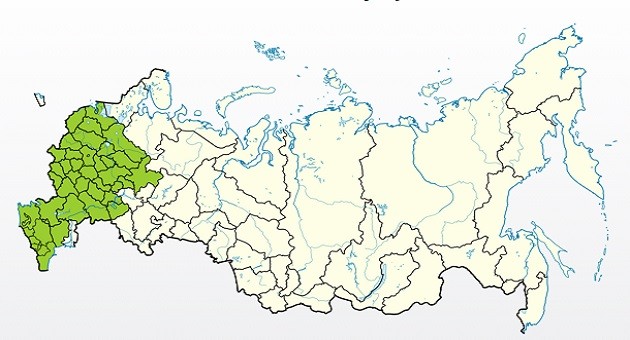
Growing regions
- Moscow region.
- Leningrad region.
- North Caucasus.
- Crimea.
- European part of Russia.
Origin
The variety was developed in the United States around 1950 from a wild M. floribunda 821 seedling, which was resistant to spot and scab. The wild seedling was crossed with a variety of cultivated apple trees: Rum Beauty, Delicious Golden, Melba, and Welsey. The result was the disease-resistant Prima apple, which by the late 1980s had confidently spread throughout the world.
In our country, the variety was studied by renowned breeder Olga Nikolaevna Migina, an employee of the North Caucasus Federal Scientific Center for Viticulture, Winemaking, and Horticulture. In 1976, she submitted an application for registration, but it was only approved in 1996. At that time, the new variety was included in the State Register of Breeding Achievements and officially zoned for cultivation in the North Caucasus.
Description of the Prima variety
 There are many factors and characteristics that have made this variety sought after and beloved by many gardeners around the world, including in our country. The apple tree is extremely resilient and easily adapts to a wide range of growing conditions. It exhibits exceptional environmental sustainability and winter hardiness, is resistant to many dangerous diseases, and produces large harvests annually without a break.
The fruits are quite large and attractive. For an early autumn or late summer apple, they store well and are easily transported over long distances. The Prima variety is recommended for cultivation in commercial intensive orchards and individual home gardens.
Apples: What do they look like?
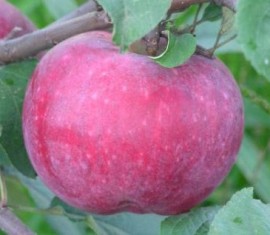
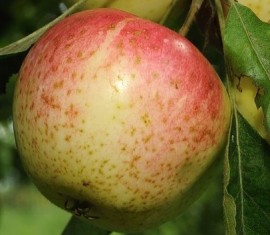
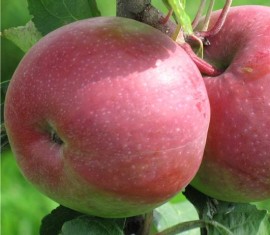
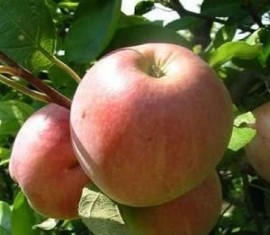
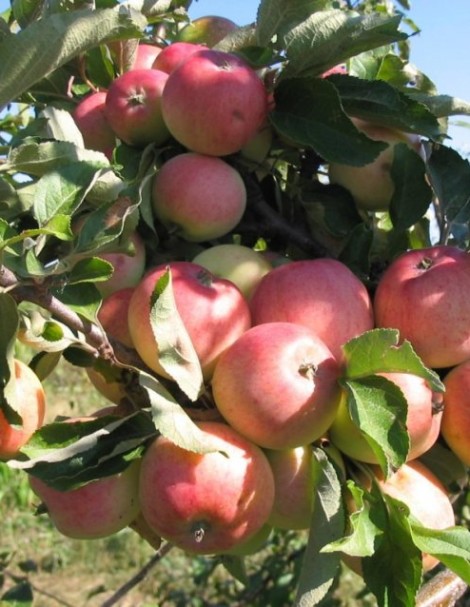
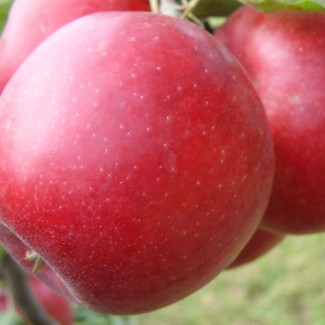
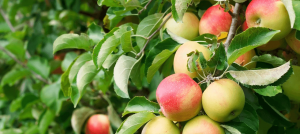 The fruits are medium-sized, sometimes slightly larger than average. They grow to approximately 140-190 grams, and even then, with proper care and timely fertilizing. They are round, symmetrical, but may be slightly slanted to one side. They are smooth, slightly flattened along the central axis, and of medium uniformity. Ribbing is subtle and smooth, and there is no lateral seam.
The skin is dense but thin, elastic, strong, smooth, glossy, and highly shiny. A waxy, bluish-silver coating appears during harvesting and storage. The ground color is green, greenish-yellow, or golden-green when fully ripe. The blush is vaguely spotted and mottled-striped, red, carmine-red, or bright red. Subcutaneous punctures are numerous, small, gray or slightly greenish, and moderately visible. Assessing the chemical composition is easier with the following data:
- P-active substances (catechins) – 148 milligrams.
- Ascorbic acid (vitamin C) – 9.5 milligrams.
- Fructose (total sugars) – 10.2%.
- Pectins – 13.1%.
- Titratable acids – 0.84%.
The flesh is pleasantly coarse-grained, juicy, easy to peel, crisp, slightly prickle-like, and refreshing. It is creamy or slightly lemon-colored, very delicate and aromatic. Its flavor is considered harmonious, sweet and sour, balanced, and satisfying. A professional tasting score for the fruit is 4.4-4.5 out of 5 for flavor and appearance.
Apple tree Prima: characteristics
Crown and root system
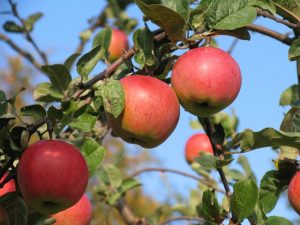 The tree can safely be considered vigorous. On a vegetative standard rootstock, it can grow to a height of 6-7, and sometimes even more, meters.Its crown is inverted pyramidal or oval, moderately dense, and can become spreading, drooping, and even weeping with age. The shoots extend from the trunk at an acute angle when young, but with age they droop to a straight line, covered with brown, brownish-green, and grayish-brown bark. Fruiting occurs on the ring shoots, or one- and two-year-old fruiting shoots.
The leaves are green or light green, medium to slightly smaller than medium in size, smooth, shiny, leathery, slightly corrugated, dense, oval or oval-elongated, and long-pointed. The margins are finely serrated, serrate-crenate, and may curl downwards. The undersides are medium-dense or tomentose. The root system is well-branched, fibrous, deeply rooted, and well adapted to seeking water in the soil.
Winter hardiness and disease resistance
This southern variety can have a difficult time adapting to our climate. It thrives in warmer regions, such as the North Caucasus or Crimea, but in colder areas with variable weather, it requires special care, timely shelter, and proper winter preparation. Prima can survive short-lived frosts down to -20-25°C without any damage, but if these temperatures persist for more than a week, the tree will likely suffer damage and will need time to recover.
The variety is resistant to scab, leaf spot, and a number of other common apple diseases. Trees are not affected even during years of severe epiphytotics. However, some parasites and diseases can still creep up unnoticed, so regular preventative treatments by professionals are still recommended.
Rootstocks and subspecies
The apple tree grows well on a wide variety of rootstocks, readily adopting their best qualities, making it a favorite among gardeners. However, there are several special subspecies that deserve special mention. Remember that there is no such thing as a columnar Prima, and don't be fooled by unscrupulous sellers.
| Subspecies | Peculiarities |
| Dwarf | To grow this type, you can use several different rootstocks with varying potential. For example, on MM-111 or M-104, the tree will grow to 3-4 meters in height. The most suitable rootstocks are M-9, M-26, and M-27, which will keep the apple trees no taller than 1.5-1.8 meters, rarely reaching 2 meters. |
| Rouge | A sub-variety with a more summer ripening period, since already in the middle August The fruits reach consumer maturity. The apples are somewhat larger, up to 200 grams, symmetrical, uniform, and spherical. They have a slightly longer shelf life, up to 2.5 months, are easy to transport, and are resistant to mechanical damage. |
Features of growing Prima
 Landing
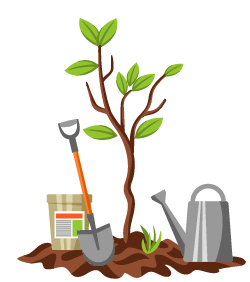 Landing
Basic conditions
- A sunny location is ideal for planting this variety. Apple trees prefer strong ultraviolet light for most of the day. They will grow in the shade, but may refuse to open buds or form fruit.
- It's best to plant Prima in a location with natural ventilation, meaning the space is well-ventilated. At the same time, care must be taken to avoid drafts, which often lead to disease and death of fruit trees.
- Apple trees can thrive in any soil, from rich black soil to rocky, podzolic, sandy loam, or clayey soil. They thrive in these soils as long as the acidity and salinity are moderate, or neutral.
- Groundwater levels are always taken into account when planting. They should flow at least 2.2-2.6 meters deep. Otherwise, plants will grow roots and begin to rot when submerged. If necessary, it's recommended to plant trees on artificial embankments or create special "water dividers" (by digging in a sheet of slate or a couple of layers of roofing felt at a depth of 2 meters).
- Prepare the holes in advance, approximately 5-8 months before planting. Dig them 60-70 centimeters deep, line the bottom with soil and fertilizer, fill with drainage material, water, and leave uncovered.
- The distance between trees can be adjusted depending on the rootstock. Classic tall standard trees require 5-6 meters, while dwarf trees will only need 2-3 meters.
- If it is necessary to preserve the properties of the rootstock, the root collar should be left 6-9 centimeters above the soil surface, keeping in mind the soil subsidence that will inevitably occur.
- Stakelines or stakes are usually driven directly into the holes to support the young seedlings. These supports should not be removed until 3-4 years after fruiting begins. Placing the supports on the north side will also provide additional protection during cold weather.
- Place the apple tree on a mound of drainage material, spreading out the rhizome, then cover it with soil, compact it, and add water. A 5-8 cm high mound of soil is built around the perimeter of the hole, and 35-40 liters of water is poured inside. The surface is then raised to provide additional moisture retention. mulch.
Landing dates
The planting time depends directly on the growing region. In temperate climates, Prima can be planted in the fall, after the leaves have fallen but at least 5-7 weeks before the first frost. In harsher climates, spring planting is preferable, from mid-March to early April. The key is to ensure that the threat of recurrent frost has passed and the soil is well-warmed.
Tree care
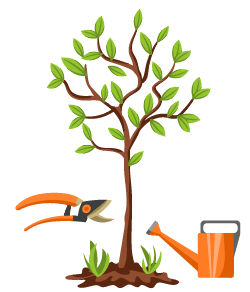 Tree care
Protection from frost and pests
The variety should be prepared for winter from early to mid-August, gradually reducing watering to zero by early September. After the final crown shaping, the trees are lined with straw, hay, or spruce branches to prevent the shallow roots from freezing. Trunks are usually wrapped in burlap, tarpaulin, old tights, or roofing felt. Low-growing varieties can easily be covered with a tent.
Tree trunks should be whitewashed twice a year, in spring and fall, to discourage insects from settling in bark crevices or near the rhizomes. To prevent rodents from eating the bark and young shoots, you can wrap the trees in netting or coat them with pungent-smelling substances such as grease, fuel oil, or lard.
Loosening the soil, watering: proper agricultural technology
I dig around the apple trees twice, once in the fall and once in the spring. At the same time, I remove weeds and other plants, clear the area around the tree trunks of fallen leaves, rotting fruit, and other debris that could cause apple tree diseases. You can hoe the soil in the summer, loosening it and preventing it from clumping into a solid lump.
Watering It's recommended to water trees weekly, especially if the summer has been hot and dry. Approximately 10-15 liters per medium-sized tree is ideal. If possible, it's a good idea to set up drip irrigation or sprinkler systems. Fertilizer and other fertilizers can be added along with the water.
Pruning: simple crown shaping
Trees arrive from the nursery with a well-formed, sparsely layered crown, which only needs to be maintained within normal limits. All upward-protruding branches, inward-growing branches, dead, damaged, and diseased ones are pruned. This is best done before bud break and after the leaves have fallen.
Pollinator varieties
- Welsey.
- Robin.
- Melba.
- Arkad.
- Antonovka.
- Kuban spur.
- Dark-skinned girl.
- Borovinka.
- Alenushkino.
- White filling.
Reproduction
- Layers.
- Grafting cuttings.
- Clones.
- Growing from seeds.
Diseases and pests
- Rust.
- Powdery mildew.
- Spider mite.
- Cytosporosis.
- Weevil.
- Fleas.
- Black crayfish.
- Codling moth.
Ripening and fruiting of Prima
The beginning of fruiting
 The beginning of fruiting
The tree doesn't bloom for the first time until two or three years have passed. However, experts advise against waiting for a harvest and instead pinching off the buds before they develop into apples. Firstly, more than half of these flowers may initially be barren, and secondly, the roots and crown need to be allowed to develop first. Therefore, the first fruiting doesn't occur until four or five years after planting.
Flowering time
The trees begin to bloom around early to mid-May, also depending on the climate and weather. Prima typically opens its buds early and fades quickly, in just 10-16 days. The flowers themselves are medium to large in size. The buds are a rich pink, and when they open, the petals take on a delicate, white-pink hue. They are intensely fragrant and densely cover the branches, giving the tree an attractive, almost decorative appearance.
Fruiting and growth
The apple tree grows quickly, reaching its full size by the sixth to ninth year. Therefore, all pruning should be done in the first few years after planting. Prima also actively increases its fruiting, producing more and more delicious, aromatic fruit each year.
Apples ripen as early as mid-August, all at once. In some cases, they may ripen a little earlier or later, depending on the weather and climate. They must be picked immediately, otherwise they will fall to the ground and need to be processed urgently. The fruit can be stored in a special refrigerator or cellar with the right humidity and temperature for 45-60 days. After this, they wilt, become soft, juicy, soft, and sour, losing their texture and sweetness.
Top dressing
- Peat.
- Superphosphate.
- Compost.
- Wood ash.
- Dolomite flour.
- Humus.
- Manure.
What to do if it doesn't bloom or bear fruit
- Inspect for diseases or pests.
- Limit or increase watering.
- Feed or apply fertilizer.
- Transplant to a sunny place.
Why do apples fall?
- Natural weather conditions (wind, rain, hurricane, hail).
- Overripe.
- Pest damage.
- Diseases.
Share your own experience with the Prima apple variety so that any gardener can learn about it before planting and achieve maximum results.