Persian Apple Tree: Variety and Care Features
| Color | Reds |
|---|---|
| Ripening season | Autumn |
| Size of apples | Average |
| Taste | Sweet and sour |
| Crown type | Average tree height |
| Shelf life | Average shelf life |
| Application | For recycling , Fresh , Storage |
| Winter hardiness | High winter hardiness |
| Fruiting age | From 5 years old |
 History of origin and regions of growth
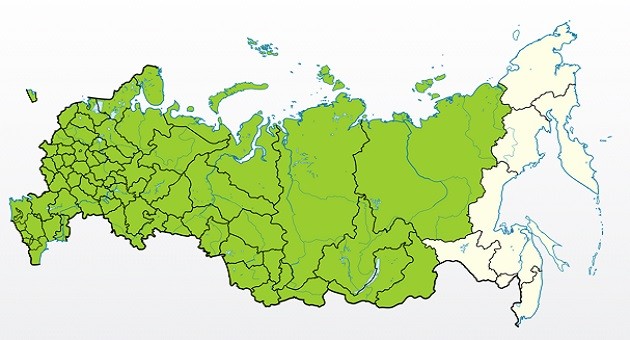
Growing regions
- Ural.
- Crimea.
- Siberia.
- Leningrad region.
- North Caucasus.
- Dagestan.
- Central Black Earth Region.
- Middle zone.
- Moscow region.
Origin
This is one of the northern, exceptionally frost-hardy apple trees, bred at the Sverdlovsk Horticultural Breeding Station, part of the Ural Federal Agrarian Research Center of the Ural Branch of the Russian Academy of Sciences. The cultivar was developed by renowned Russian pomologists and biologists Porfiry Afanasyevich Dibrova and Leonid Andrianovich Kotov, well-known for their numerous achievements in breeding. The Kungurskoye Ananasovoye and Persikovoye varieties were used as parent varieties.
The first application for admission to official testing was submitted in 1990. It took only two years of field trials for the scientific council to determine that the apple tree was worthy of inclusion in the State Register of Breeding Achievements, where it was added in 1992. The new variety, named Persianka, was also officially zoned for the Ural, Volga-Vyatka, and West Siberian regions. In fact, it can be grown virtually anywhere in our country, with the exception of the Far North and the Far East.
Content
Description of the Persian variety
 This rather tall tree, distinguished by enviable winter hardiness and environmental sustainability, immediately attracts the attention of gardeners across the country. Many choose it for their gardens because it requires little maintenance, is tolerant of any soil, doesn't require frequent watering, and, what's more, easily tolerates hot and dry periods. The Persian tree bears fruit regularly and abundantly, without a break.
The variety's fruits have high marketability. They are large compared to other Sverdlovsk varieties, beautiful, aromatic, and, most importantly, very tasty. The apples can be transported not only in crates but also in bulk; they are suitable for processing and keep well, maintaining their quality for six months. This variety is recommended for intensive commercial orchards, as well as individual cultivation.
Apples: What do they look like?
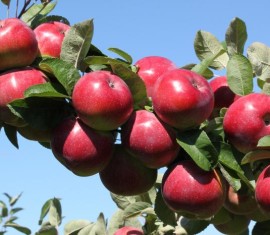
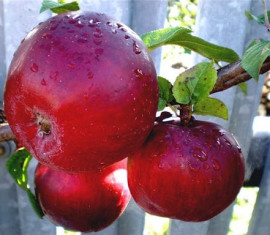
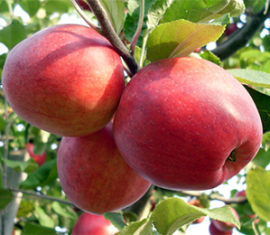
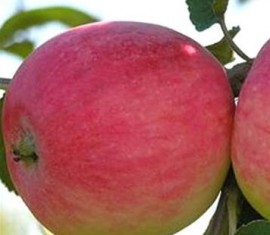
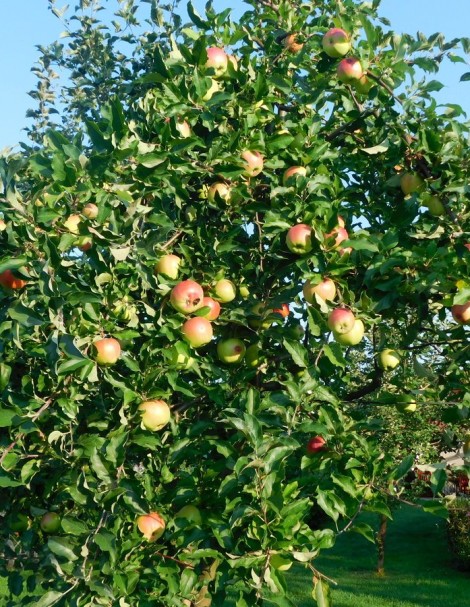
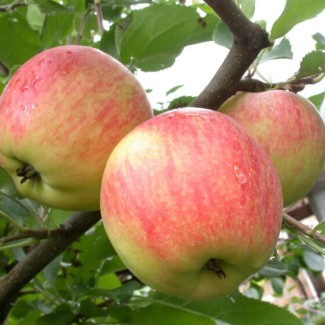
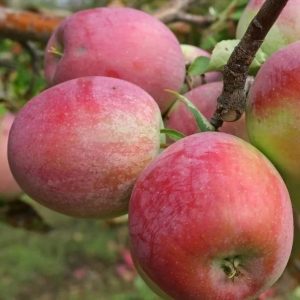 The majority of the fruits are medium-sized, weighing up to 140-150 grams, but there are numerous large specimens weighing 170-200 grams. The fruits are mostly symmetrical, irregularly shaped, round or broadly cylindrical, and may be somewhat flattened at the stem, slightly turnip-shaped. The surface is smooth and even, with no lateral seam, and virtually no ribbing.
Apple skin is firm, glossy, shiny, elastic, and somewhat firm, but not thick. Its base color is green or greenish-yellow, and when fully ripe, it can become golden-honey, covered with a dense, glaucous or glaucous-silver waxy coating. The blush is mottled, blurred, spotted, striped, bright red, or deep red, sometimes with a violet tint, and covers 65-85% of the surface. Subcutaneous spots are gray-green, faint, numerous, but poorly visible. The biochemical composition is best assessed using the following parameters:
- P-active substances (catechins) – 196 milligrams.
- Ascorbic acid (vitamin C) – 20.1 milligrams.
- Total sugars (fructose) – 9.7%.
- Pectins (fiber) – 12.7%.
- Titratable acids – 1.02%.
The Persian apple is distinguished by its dense, even somewhat firm, coarse-grained flesh, creamy or slightly yellowish-lemon in color. It is very juicy, aromatic, crisp, breaks away, and refreshing. The flavor is generally considered good to very good, harmonious and balanced, with a sweet and sour balance. Professionals give the apple a 5 out of 5 for appearance and a 4.7 for taste on a tasting scale.
Persian apple tree: characteristics
Crown and root system
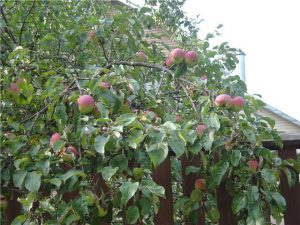 The tree is classified as medium-sized, without formative pruning it can grow up to 5-6 metersMost gardeners limit it to 3.5-4.5 meters to facilitate garden maintenance and harvesting. The crown is initially oval, becoming more spherical over the years, and then broadly oval. It can be spreading or even drooping. The branches are thick, rounded in cross-section, and set at an acute angle from the trunk, requiring additional support during fruiting. They are covered with light brown or brown bark. Fruiting occurs on the ringed branches and, to some extent, on the previous year's growth.
The density and foliage are moderate to low. The leaves are broadly ovate or rounded, short-pointed, flattened, leathery, smooth, glossy, and dense; the margins are serrate-crenate, finely serrated, and the nervation is coarse. They are light green, green, or deep green in color, wrinkled, and may have a light tomentose pubescence on the back. The root system is extensive, mostly fibrous, with numerous small branches, well-developed, and adapted to seeking water in the soil.
Productivity and pollination
The variety is considered high-yielding, although it will never reach the height of some apple trees.
A thrifty gardener can produce 180-190 kilograms of fragrant and delicious fruit per year from a single mature, fully formed Persianka tree during favorable weather conditions. When unfavorable conditions arise, productivity can drop to 140-160 kilograms..
The apple tree is completely self-fertile, meaning it's a good pollinator for itself. However, experienced gardeners still prefer to interplant fruit trees, they say, what pWith cross-pollination, yield increases by 15-35%.
Winter hardiness and disease resistance
This apple tree's frost resistance is truly outstanding. It easily survives winters when temperatures drop to -40-42°C, even for extended periods. In one winter, Persianka even survived temperatures as low as -53°C, suffering half a grade of damage. The tree recovers very quickly, returning to its original values in just one year. Another advantage is its enviable resistance to hot and dry periods. The leaves have a moisture-holding capacity of 56.7%, and their heat resistance is high, allowing them to withstand even temperatures as low as -50°C with virtually no damage. burns.
However, there are also disadvantages, for example, low resistance to fungal diseases often leads to tree loss. Therefore, regular and timely prevention is necessary. powdery mildew, and especially – scabiesOther infections and parasites can also pose a threat, so spraying should never be neglected. Trees themselves can become diseased and trigger an outbreak in their neighbors.
Rootstocks and subspecies
Persianka doesn't yet have its own subspecies, but it can be grown on various rootstocks. This will give the trees some unique characteristics. For example, on dwarf rootstocks, the apple tree grows much more compact, but this reduces winter hardiness. Pruning can be used to create a creeping version of the tree; columnar varieties do not exist.
Features of growing Persianka
 Landing
 Landing
Basic conditions
- Persian jasmine requires slightly more space when planting, as its root system grows quite extensively. Therefore, dig holes 4-5 meters apart.
- The location must be sunny, otherwise the fruits may become smaller, and in some cases, a tree in the shade may not bloom at all.
- The groundwater table and overall humidity of the growing area are more important. Higher levels increase the risk of scab and other fungal diseases, so drainage is essential if there's no other option. Avoid growing Persianka near rivers and lakes, shallow wells, ponds, floodplain meadows, or swamps, as these will cause persistent disease. Artificial embankments can be created and trees planted within them.
- The tree isn't overly dense, so ventilation isn't usually an issue, but it's worth keeping an eye on. Stagnant air is undesirable, as fungi thrive in it, but drafts can also kill a young tree.
- Preparing the holes in advance isn't necessary, but it's possible. Typically, holes up to 1 meter in diameter and 80-90 centimeters deep are dug, fertile soil is placed at the bottom, followed by a drainage layer, and the entire area is filled with water. If the holes are dug at least 3-4 weeks before planting, fertilizer can be added to the soil, so no additional fertilizer will be needed for 3-4 years.
- A wooden, metal, or plastic stake is driven into the center of the hole, preferably on the north side of the seedling. This will provide the young apple tree with reliable support for the first few years. It is not recommended to remove it for the first 3-4 years.
- If you want to preserve the properties of the rootstock, the grafting site should be left above the surface; approximately 6-9 centimeters will be sufficient, even taking into account the initial subsidence after the first watering.
- A pile of drainage material is raked into the center of the hole and the apple tree is placed on it, supported by the trunk, covered with soil, and gently shaken to prevent air pockets and voids that could lead to root rot. The surface is compacted by hand, watered, and mulched.
Landing dates
Like most apple trees, Persianka requires planting before or after sap flow in the trunks has begun. It thrives equally well in both spring and fall plantings. Young saplings are resistant to even fairly severe frosts. Therefore, you can choose any planting time that suits you best.
Tree care
 Tree care
Protection from frost and pests
Persianka doesn't require any special coverings; it can easily withstand even the most severe frosts. However, standard precautions are still a good idea. Place spruce branches, hay, or straw on the root zone, and wrap the trunks in burlap or other available materials.
Whitewashing the trunks twice a year with a lime solution is definitely a good idea. This will prevent insects from nesting in the bark chips and damaging the wood. Rodents that chew young branches and bark can be controlled by coating the lower part of the trunk with fragrant lard, fuel oil, or grease. There are also commercially available products that are a good idea; you can consult with a gardening store.
Loosening the soil, watering: proper agricultural technology
Apple trees are dug twice a year when they're young, removing weeds and debris at the same time. This is done in early spring and late fall, when the sap in the trunks is at rest. Then, even if a root is damaged, the tree won't be severely stressed and will recover more quickly. The soil can be hoeed 4-7 times per season, as needed. For example, it's essential to turn the soil the next day after watering, otherwise it can compact into asphalt.
Watering won't be a big deal either. A young one- or two-year-old seedling can be watered 4-5 times per season, while an adult doesn't even need that. Occasionally, during the most unfavorable periods, when the heat is intense and there's still no rain, you can water an extra 3-4 times. It's a good idea to dilute fertilizer with water and water it along the perimeter of the crown.
Pruning: simple crown shaping
The tree isn't prone to excessive bushiness, so pruning won't be a problem. Apple trees are typically purchased from a nursery. Pruning: simple crown shaping with already pruned crowns, which have a central conductor and 3-4 skeletal branches. Simply maintaining the natural branching and occasionally removing shoots that stick out vertically will be sufficient.
Sanitary cleaning should be performed regularly. All dry, diseased, or broken branches should be removed immediately, otherwise they will promote disease. It is advisable to seal cuts with paint or garden pitch.
Pollinator varieties
- Prima.
- Sunrise.
- Pyros.
- Kate.
- White filling.
- Everest.
- Julia.
- Folder.
Diseases and pests
- Scab.
- Cytosporosis.
- Powdery mildew.
- Black crayfish.
- Leaf roller.
- Leafhopper.
- Scale insect.
- Hawthorn.
- Green aphid.
Ripening and fruiting of Persianka
The beginning of fruiting
 The beginning of fruiting
This variety is by no means an early-bearing variety. You'll have to wait quite a while for the first harvest. The first flowers may appear on the branches only in the 5th or 6th year, but it's best to remove them completely before they begin to set. Most likely, most of them will be empty flowers. The first harvests can be collected in the 6th or 8th year, when the tree is fully established. The harvest won't be particularly abundant at first, but you'll definitely get several kilograms of apples.
Flowering time
This variety blooms mid- to early-season, so finding pollinators won't be a problem. The flowers themselves are large, mostly pure white, though sometimes pale pink. They have beautiful, fleshy petals and anthers below the stigmas. The blooming period is quite long, approximately 14-18 days, so even in poor weather, wind and insects have time to pollinate.
Fruiting and growth
The tree's annual vegetation period is approximately 176-179 days, and it grows quite rapidly. Persian trees can reach a height of at least 43-57 centimeters, so it doesn't take long for them to reach their full height. Fruiting increases rapidly, and by the 8th or 9th year, they are fully mature and marketable.
The fruits ripen in September, but the exact timing depends directly on the climate of the growing region, but in most cases, it's early in the month. It's important to harvest the fruits promptly, as they can easily fall to the ground and become unsuitable for storage. Apples are easy to transport, and they keep well in a good cellar or special storage facility. refrigerator can reach 5-7 months.
Top dressing
- Potassium.
- Superphosphate.
- Humus.
- Peat.
- Calcium.
- Manure.
- Compost.
What to do if it doesn't bloom or bear fruit
- Increase watering.
- Remove insects.
- Cure diseases.
- Fertilize.
- Move to a sunny place.
Why do apples fall?
- Overripe.
- Wind, rain, hail, snow.
- Pests or diseases.
Leave a review of the Persian apple tree variety so that even a novice gardener can receive useful information firsthand.