Primorskoye apple tree: characteristics of the variety and care
| Color | Reds , Striped |
|---|---|
| Ripening season | Autumn |
| Size of apples | Small ones , Average |
| Taste | Sweet and sour |
| Crown type | Tall tree |
| Shelf life | Average shelf life |
| Application | For recycling , Fresh |
| Winter hardiness | High winter hardiness |
| Fruiting age | Up to 5 years |
 History of origin and regions of growth
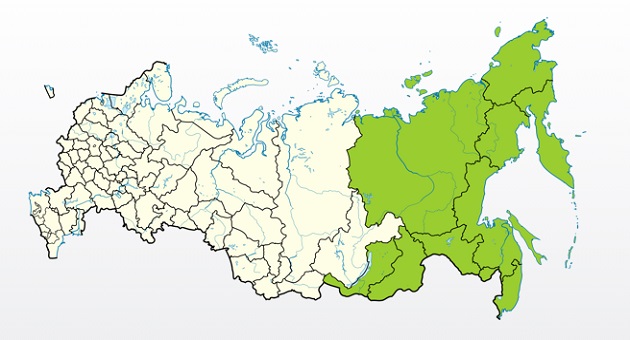
Growing regions
- Far East.
- Primorsky Krai.
- Khabarovsk Krai.
Origin
This variety is considered the very first large-fruited apple tree native to the Far East. Primorsky's development began in early 1935 at the Khabarovsk Federal Research Center of the Far Eastern Branch of the Russian Academy of Sciences. In 1938, A.V. Bolonyaev finally singled out the new variety as elite and submitted it for inclusion in the register.
The source material was the brown Ranetka and Aport varieties. It can be grown throughout virtually the entire Far East and is successfully cultivated in the Primorsky and Khabarovsk Krais, Siberia, and even the Urals. Currently, there is no record of the Primorsky variety in the State Register; it has been supplanted by younger and more promising varieties. It is often used as a crossbreeding agent in intervarietal crosses. This can significantly increase the fertility of other apple trees and the size of their fruit.
Content
Description of the Primorskoye variety
 This frost-resistant tree can be grown in the warmest areas of Primorsky Krai. Considering that standard fruit trees rarely thrive there, Primorskoye will be a real find for many. It also grows well throughout the region as a trailing tree.
The main characteristic of this variety is its large fruits, typical of any Siberian apple tree. The apples are beautiful and round, delicious and aromatic, and have a longer shelf life than most other apples. A drawback is their lack of winter hardiness when grown vegetatively, as well as a short lifespan. It is recommended for breeding and individual cultivation in home gardens.
Apples: What do they look like?
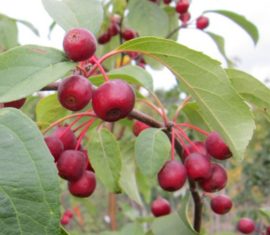
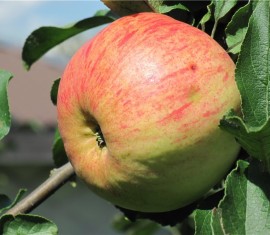
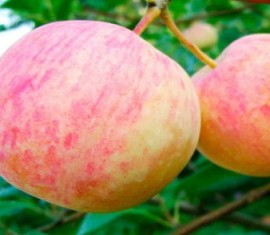
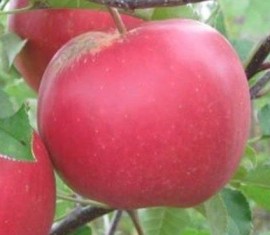
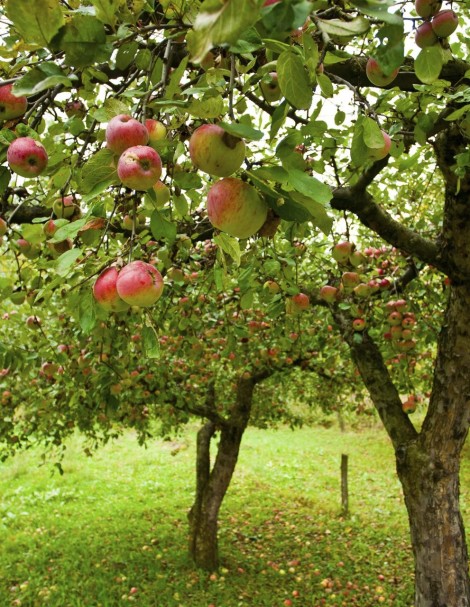
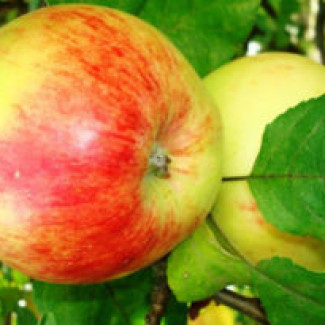
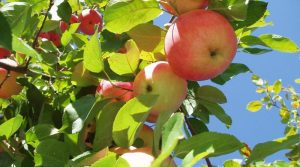 The fruits are usually medium or even smaller in size, weighing 65-120 grams. They are predominantly uniform, symmetrical, flattened-round, flattened, or turnip-shaped, and smooth. They are broadly ribbed, the ribs are very smooth, and the lateral seam may be slightly visible.
The skin is firm, pleasant to the touch, dry, shiny, glossy, greenish-yellow or yellowish-golden in color, and may develop a slight waxy-blue bloom during ripening. The blush is striped and mottled, clearly visible, burgundy or beetroot red, rich in color, and covers approximately 45-70% of the surface. Subcutaneous spots are light, greenish or gray, and moderately visible on the surface. Professionals examine the chemical composition based on the following parameters:
- P-active substances (catechins) – 213 milligrams.
- Ascorbic acid (vitamin C) – 17.3 milligrams.
- Fructose (total sugars) – 11.2%.
- Pectins – 9.1%.
- Titratable acids – 0.41%.
The flesh has a pleasant texture and consistency: crisp, prickly, breakable, and refreshing. It is fine-grained, very juicy, and has a yellowish-cream hue. The skin has reddish-brown veins, giving it a pinkish or even reddish color. The flavor is considered table-worthy, harmonious, and pleasantly sweet and sour. Professional tasters rate it 4.4 out of 5.
Primorskoye apple tree: characteristics
Crown and root system
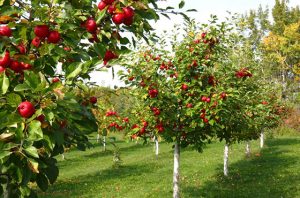 Basically, the crown is round or round-oval, its height is 6-8 metersThe shoots are mostly at right angles to the trunk, are sparse, and not prone to excessive crowding, making it easy to form creeping forms. The branches are thin and long, and can be curved or straight, depending on growing conditions.
The leaves are large or medium-sized, oval-elongated, leathery, dense, and elastic. They are shiny and glossy, often with a felty pubescence on the underside. The margins are serrated, heavily serrated, and the tip is long-pointed. The blade is dark green or simply green, with coarse ribbing. The root system is robust, deeply rooted, and branched, adapted for the search for water and nutrients.
Productivity and pollination
For Siberian and Far Eastern apple trees, Primorskoye is distinguished by its truly enviable fertility.
From one fully grown tree per season in good years and with thrifty owners, you can harvest at least 45-60 kilograms of small, but very attractive and tasty fruits.
This variety inherited the best qualities of its parents, including self-fertility. It can produce a truly good harvest without the need for pollinators, although the yield is always better with pollinators. Therefore, it is recommended to plant Primorskoye within 45-60 meters of other varieties.
Winter hardiness and disease resistance
This apple tree's frost resistance leaves much to be desired; there are more resilient and hardy varieties, but there are some nuances. Primorskoye can withstand temperatures down to -32-35°C without damage, but only for short periods. During the winter, the trees require adequate and timely shelter, otherwise they will die.
The tree is genetically resistant to scab, the most dangerous and widespread apple disease, and is immune. It is also quite resistant to fire blight, as well as other diseases. With timely prevention, the risk of infection is greatly reduced.
Rootstocks and subspecies
There are no subvarieties of the Primorskoye variety; none have been developed yet, and whether they will be is unknown. However, it can be grown on various rootstocks, shaping the unique characteristics and qualities of the standard. This vegetative material will ensure tall growth and good fruiting, with acceptable winter hardiness and vigor. Dwarf and semi-dwarf varieties produce small, compact trees, often producing even larger apples, but with a correspondingly reduced winter hardiness. Primorskoye can be grown as a creeping tree and hidden under soil or snow for the winter. There are no columnar varieties.
Peculiarities of growing Primorsky
 Landing
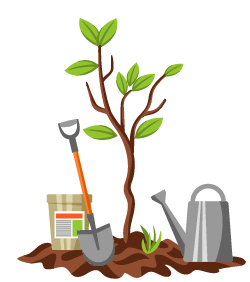 Landing
Basic conditions
- The tree prefers plenty of sunlight, but not excessively. Constant exposure to the sun in the summer heat can cause sunburn on its leaves, shoots, and bark. Therefore, it's advisable to plant young trees so they're exposed to UV light most of the time, but not all of the day.
- Primorsky requires open spaces, but it can also grow in cramped conditions. As a result, its crown will become tall, elongated, sparsely branched, and upward-reaching, resulting in fewer fruits. It's a good idea to ensure adequate ventilation to prevent stagnant air in the crown, as this can lead to disease.
- Primorskoye is planted where the groundwater level is no higher than 2.3-2.5 meters. Its powerful root system can reach the moisture and begin to rot. After this, the tree's death is almost inevitable, as it doesn't respond well to transplanting at an advanced age. If a more suitable site is unavailable, several layers of roofing felt, tar paper, or slate can be dug in at a depth of 2 meters. This will direct the roots laterally.
- It's not necessary to prepare the holes a season before planting, but they still need to sit for 2-3 weeks. Therefore, dig holes 60-70 centimeters deep, add fertilizer mixed with soil to the bottom, then a drainage layer, and fill with water. Leave the holes uncovered until ready to garden.
- You can immediately dig a stake or pole into the hole for staking, preferably positioning the tree on its south side. This will provide additional protection from frost.
- Before planting, the seedlings are carefully inspected: the rhizome can be washed, dry or damaged shoots can be cut off, and they can be immersed in water for 5-7 hours.
- Place the seedling on drainage, ensuring the root collar is at least 8-12 centimeters above the surface. This will prevent it from rooting higher, thereby losing its rootstock properties. Cover the tree with soil, compact it, and water with 20-35 liters of water. Mulch can be applied to retain moisture.
Landing dates
It's best to plant all Far Eastern apple trees only in the spring, when the threat of frost has passed and the soil has warmed thoroughly. In temperate climates, Primorskoye can also be planted in the fall, but in areas where winters arrive abruptly, harshly, and frostily, it's best to play it safe.
Tree care
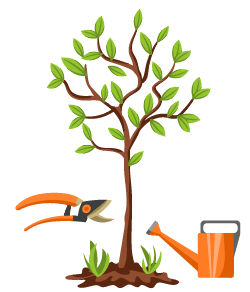 Tree care
Protection from frost and pests
The apple tree needs to be covered properly and prepared for winter in a timely manner. Already at the beginning August Water application should be reduced and stopped completely by mid-month. After the leaves have fallen and the trees have been sanitation-cleaned, add spruce branches, straw bales, or hay mats to the root zone, and rake 15-20 centimeters of soil. Trunks are wrapped with spunbond, tarpaulin, agrofibre, burlap, and even old tights. Small trunks can be covered with a tent-like covering.
Whitewashing the trunk to a height of more than a meter with lime is effective against insects. It's a good idea to brush the bark with a stiff brush beforehand to remove excess. Rodents love to chew young bark and shoots in winter; smearing the trees with grease, lard, or fuel oil will help.
Loosening the soil, watering: proper agricultural technology
The trunk is dug twice a year, which is more than enough. Some only dig in the spring, removing root suckers, weeds, and other plant shoots. Hoeing can be done several times a season; for example, the day after applying water is a good time. If the soil isn't stirred, it can compact into a solid, dense lump. By the 9th to 11th year, the trunk circle can be covered with sod and sown with grass, herbs, and flowers.
Water will need to be applied as needed, so you'll need to monitor the tree carefully. If the top layers of soil dry out, it's time to water. Ideally, sprinkler or drip irrigation would be helpful, but applying water with buckets around the perimeter of a circle will also work. For a mature tree, 15-25 liters of water 6-8 times during the growing season is sufficient.
Pruning: simple crown shaping
Pruning is usually straightforward, as the tree is not prone to excessive crowding. The sparse, tiered form, developed at the nursery, is ideal for simplifying the gardener's work. Branches are spaced widely apart at varying heights, and care must be taken to ensure new shoots do not protrude inward or upward, and to maintain the natural branching pattern.
In spring and fall, inspect the tree crowns and trim off all dead branches. Remove any broken, damaged, rotten, diseased, or fungus-infected branches. Seal any cuts (wounds). garden pitch, water-based paint or even just a swamp.
Pollinator varieties
- Uralsk resident.
- Alenushkino.
- Manchurian.
- Ural bulk.
- Lada.
- Northern Sinap.
- Flashlight.
- Sakhalin pendula.
- Bellefleur the Chinese.
Reproduction
- Layers.
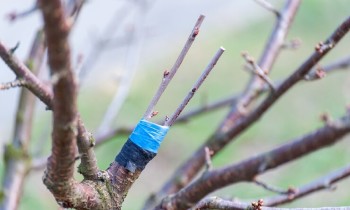
- Grafting cuttings.
- Clones.
Diseases and pests
- Rust.
- Powdery mildew.
- Spider mite.
- Green aphid.
- Weevil.
- Flower beetle.
- Fleas.
- Codling moth.
Ripening and fruiting Primorskoye
The beginning of fruiting
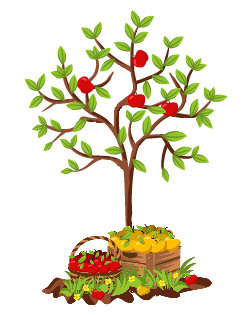 The beginning of fruiting
Apple trees typically begin bearing fruit in the third or fourth year after planting in open ground. At this point, a fairly large number of flowers bloom, and you can get up to 3-5 kilograms of delicious fruit. However, larger fruits will have to wait a little longer. In some cases, gardeners report that trees began blooming as early as the second or third year, but the resulting flowers were mostly barren and fruit buds failed to form. Therefore, it's best to pluck the flowers yourself at this time to prevent them from draining the tree's juices, allowing the roots and shoots to grow first.
Flowering time
Primorskoye begins blooming in May, but no one can say for sure. This process, which lasts approximately 12-16 days, is influenced by many external factors, from lighting to daytime and nighttime temperatures. In most cases, this occurs between the middle and end of the month, but it can happen earlier if the winter and spring are warm. The flowers themselves are large to medium-sized, fragrant, with soft pink or slightly pinkish petals.
Fruiting and growth
This apple tree is considered a medium-vigorous tree. It can grow approximately 25-30 centimeters per year before bearing fruit. After this, the growth rate slows slightly, but the tree still grows fairly quickly and begins producing full crops. They reach a size of over 45-55 kilograms by the 9th to 11th year after planting.
This autumn variety typically reaches harvest maturity around September 10th to 15th. Consumer maturity will take another 2-2.5 weeks. This is when the sugars in the fruit fully caramelize, giving them their most pleasant flavor and aroma. Primorskoye apples keep for 2-3 months in a cellar, and 4-5 months in a dedicated refrigerator. They are also quite good for transportation.
Top dressing
- Compost.
- Manure.
- Humus.
- Chicken manure.
- Wood ash.
- Peat.
- Ammonium nitrate.
- Superphosphate.
What to do if it doesn't bloom or bear fruit
- Inspect for diseases or pests.
- Limit or increase watering.
- Feed or apply fertilizer.
- Transplant to a sunny place.
Why do apples fall?
- Natural weather conditions (wind, rain, hurricane, hail).
- Pest damage.
- Diseases.
Share your own experience with the Primorskoye apple variety so that any gardener can learn about it before planting and achieve maximum results.