Priokskoye apple tree: characteristics of the variety and care
| Color | Greens |
|---|---|
| Ripening season | Autumn |
| Size of apples | Large , Average |
| Taste | Sweet and sour |
| Crown type | Columnar tree |
| Shelf life | Average shelf life |
| Application | Fresh , For recycling |
| Winter hardiness | Average winter hardiness |
| Fruiting age | Up to 5 years |


 History of origin and regions of growth
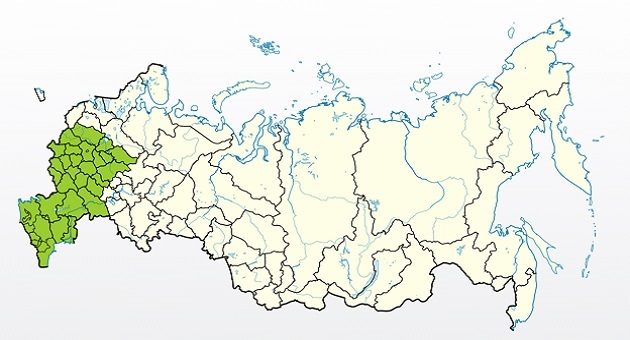
Growing regions
- North Caucasus.
- Crimea.
- Northern regions (partially).
- Moscow region.
- Middle zone.
- Leningrad region.
Origin
Many gardeners in our country are wary of columnar apple trees, preferring the old, tried-and-true varieties that have stood the test of time and experience. However, their development continues, and their popularity is steadily growing year after year. In the early twenty-first century, the All-Russian Research Institute of Fruit Crop Breeding (VNIISPK) developed a completely new columnar variety, named Priokskoye. In 2007, it was sent for field trials to an experimental farm in the village of Zhilina in the Oryol Region, where it proved to be an excellent candidate.
In 2011, the apple tree was classified as an elite variety and became available for sale. However, it was not added to the State Register until 2014. At that time, it was decided to zone it for the Central Black Earth Region. In fact, it can be grown throughout virtually the entire central part of the country, including Crimea and the Caucasus, and with proper care and adequate winter preparation, even in the Urals.
Content
Description of the Priokskoye apple tree variety
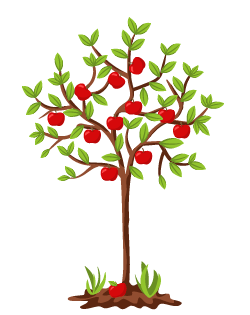 Columnar apple trees are becoming increasingly popular in our country. This variety is ideal for those seeking consistently high yields from minimal land. The trees are compact, grow low, tolerate low temperatures and sudden temperature fluctuations, and are quite resistant to fungal apple infections.
The fruit produces large, high-quality fruits, beautiful, aromatic, and, most importantly, long-lasting. Despite the tree's underdeveloped root system, short lifespan, and high cost, it is recommended not only for private gardens but also for commercial, intensive industrial orchards.
Apples: What do they look like?
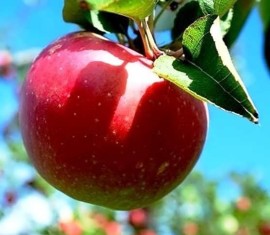
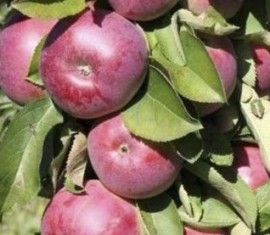
 With proper care, fruit on a tree can grow to be medium, above average, or large, and uneven in size. A single tree can produce apples weighing 145-160 grams, or even 190-220 grams. They are round, often asymmetrical, and can be flattened or slanted. The surface has a distinct, but slightly smoothed ribbing, and a lateral seam.
The skin is smooth, dense, elastic, strong, shiny, and mostly pubescent, protecting the flesh well from mechanical damage. It is green or slightly yellowish in color, and can be lemon- or golden-red when ripe, slightly translucent. The blush is predominantly spotted, but can also be slightly mottled, red, orange, or carmine, or even raspberry or pink. Subcutaneous dots are light, small, and numerous, densely distributed on the surface, and clearly visible. The chemical composition is most easily assessed by examining the following parameters:
- P-active substances – 189 milligrams.
- Ascorbic acid (vitamin C) – 11.5 grams.
- Sugar (fructose) – 10.9%.
- Titratable acids – 0.47%.
- Pectins (fiber) – 12.1%.
The flesh has a fine-grained texture, is dense, crisp, very juicy, prickly, and refreshing. It is green, white-green, light green, or slightly creamy, and can have a lemony hue. The flavor is considered dessert-like, classic, harmonious, and balanced. On a five-point scale, it receives a 4.4 rating.
Priokskoye apple tree: characteristics
Crown and root system
 This is a classic columnar tree, growing with a single trunk and not producing any lateral skeletal branches. It grows to 2.2-2.5 meters without additional pruning. The crown diameter barely reaches 0.25-0.35 meters.This exceptional compactness allows for planting densities of 15,000 or more trees per hectare. The shoots are thick and vigorous, with frequent internodes, covered with steel-gray, grayish-brown, or gray-brown bark. Fruiting occurs on runners, spears, and one- and two-year-old fruiting branches growing directly from the central conductor.
The leaves are smooth, glossy, dark green or rich green, leathery, and dense. The leaf blades are generally straight and short-pointed, with serrated margins that can be slightly serrated or slightly wavy. The Prioksky tree's root system is very poorly developed; it is fibrous and branched, but shallow and superficial. It is poorly adapted to the search for moisture or nutrients, so the trees require regular fertilizing and watering.
Productivity and pollination
Prioksky's fertility rates are considered above average, although compared to ordinary tall apple trees they look so-so.
From one hectare of mature tree trunks of this variety with maximum planting density, it is possible to harvest 190-220 tons of apples per season. After the budding In the 5th-6th year, these figures can be increased to 340-360 tons. One tree can yield approximately 8-13 kilograms of aromatic and delicious fruit..
The variety is considered self-fertile, but only conditionally. This means that even if there are no other apple trees in the area that bloom at the same time as the Prioksky, you'll still see about 25-30% of the fruit. However, maximizing the yield will be impossible. Therefore, experienced gardeners recommend planting this variety no more than 45-90 meters away from other varieties. You can spray the trees with sugar syrup in the spring to attract bees, and use mobile apiaries in the orchards.
Winter hardiness and disease resistance
The tree's resistance to low temperatures is average, or even very close to high. It can withstand short-term temperatures down to -25-30°C, even without special protection. However, proper winter preparation is essential. Apple trees dislike sudden temperature fluctuations, drafts, icing, and prolonged periods of extreme cold.
From the most common apple disease - scabies The Priokskoye variety is protected by the Vf gene embedded in its code. However, it has no effect on other diseases, so completely abandoning fungicide treatments is hardly advisable. Insects can damage the trees, so regular insecticide treatments are also necessary.
Rootstocks and subspecies
There are no subvarieties of this apple variety, so always keep this in mind when purchasing. If you're offered something similar, it's best to politely decline. This variety can be grown on vegetative, dwarf, and semi-dwarf rootstocks. The first type will be more frost-resistant, while the second and third types will be much more compact. The fruit's marketability remains virtually unchanged, though its size may fluctuate slightly.
Features of cultivation Priokskoe
 Landing
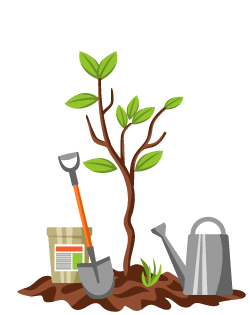 Landing
Basic conditions
- Soils for this variety are selected to be slightly acidic, or treated with lime to neutralize them. It's best to have loose, moist soil that allows water and oxygen to pass through. Washed river sand is usually added to black soil, while sandy loam or loam will require regular fertilization.
- Open spaces are the main requirement for planting Prioksky. Its crown must be well-lit by sunlight for most of the day. In the shade, trees grow weak, spindly, and may never produce buds.
- A lack of drafts and good ventilation is another prerequisite for producing truly substantial harvests over many years. Drafts can kill trees in the first few years, and stagnant air usually leads to rot.
- High groundwater levels are usually not a problem for this variety, as its roots don't penetrate deeply. You can even plant an apple tree near a pond or river; it likely won't affect its growth and development.
- Experienced gardeners dig holes the season before planting, but this is not necessary; the holes only need to stand for 2-3 weeks.
- Dig a round hole measuring 80x90 cm, add fertilizer to the bottom, cover with soil or a drainage layer, fill with 30-45 liters of water, and leave to stand in the open air.
- Leave approximately 0.9-1 meter between the holes, the same amount will be enough between the rows, but you can leave more if space allows, this will provide additional convenience in harvesting.
- It wouldn't hurt to immediately drive rods or stakes into the holes for support. If they're on the north side, they'll provide additional frost protection for the seedlings.
- Root collar It is preferable to leave it above the surface if the properties of the rootstock are to be preserved.
- Place the apple tree on a mound of drainage material or soil, spread the shoots out so they lie freely, and add a layer of earthen soil on top, compacting it lightly. Create a low earthen bank around the perimeter, add 25-30 liters of water, and mulch the surface.
Landing dates
Gardeners advise planting all trees of this variety in any location only in early spring, provided they are bare-root. If the seedlings are purchased with a closed root system, there are no restrictions at all. Such trees, whether in bags, pots, or special containers that require no additional disposal, will take root after planting even in midsummer.
Tree care
 Tree care
Protection from frost and pests
A variety's resistance to low temperatures isn't a reason to do nothing, as otherwise you risk losing your garden. First, you need to properly prepare them by slowly reducing watering from early August until September. Wrap the trunks in burlap or even old women's nylon tights, and cover the root zone with straw, hay, dry leaves, spruce branches, or even foam. In harsh regions with challenging weather conditions, it's advisable to cover the trees with a tent.
To protect tree trunks from insects, whitewash them to a height of 1-1.3 meters with lime diluted with water. This is best done in spring and late fall. To repel hungry rodents in winter, apply regular animal lard, fuel oil, grease, or rancid sunflower oil to the trunks before winter.
Loosening the soil, watering: proper agricultural technology
Moist, oxygen-rich soil is the key to good growth and abundant fruiting, so you'll have to work hard. Dig around the trunk very carefully, as the roots are very close to the surface and easily damaged. Hoeing around the trunk should also be done gently and carefully, without trying to penetrate too deeply. At the same time, you can remove all weeds, plant shoots, and root suckers.
When young, it's best to water trees 1-2 times a week, as the soil dries out, and remember to coordinate your watering with rainfall. As they mature, watering can be reduced to 2-3 times a month. It's also a good idea to add fertilizer with the water; this will ensure better absorption and assimilation.
Pruning: simple crown shaping
The Priokskoye tree grows with a single trunk and, in most cases, does not produce lateral branches. However, if any appear, they should be pruned immediately, before they become woody. In some cases, it is advisable to shorten the central (single) stem and then grow a new top. For example, this is what is done after the terminal bud freezes. Sanitary pruning involves removing old, dry, or damaged fruiting branches. Rejuvenation is not required for these trees, as their lifespan does not exceed 20-25 years.
Pollinator varieties
- Vazhak.
- Currency.
- Conference.
- Geyser.
- Cheburashka.
- Malyukha.
- Beam.
- Ostankino.
Reproduction
- Rooting.
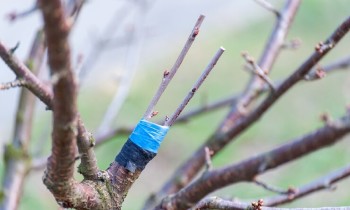
- Kidney grafting.
- Growing from seeds.
- Cuttings.
Diseases and pests
- Black crayfish.
- Bacterial burn.
- Powdery mildew.
- Green aphid.
- Codling moth.
- Leaf roller.
- Hawthorn.
Ripening and fruiting of Prioksky
The beginning of fruiting
 The beginning of fruiting
These trees are called early-fruiting for a reason, as they can arrive with flowers even from the nursery. However, the first buds are usually picked off, not allowing them to develop into ovaries. In the second or third year, you can harvest the first 10-15 fruits, and then 4-5 kilograms of fragrant and delicious apples.
Flowering time
Priokskoye is an early bloomer and can open buds as early as mid- or late April, but only in relatively warm and sunny conditions. By late March, nearly ready buds appear, which soon unfurl into beautiful, slightly pink, cup-shaped flowers with a powerful, pleasant fragrance.
If the spring is cold and there is constant rain, flowering may be delayed until mid- or late April, and the fruit will ripen later. This process takes approximately 12-15 days, during which time insects, wind, and neighboring trees must participate in cross-pollination.
Fruiting and growth
In one season, the tree can grow more than a meter in the first year, and subsequently grows approximately 35-50 centimeters until it reaches its maximum height. It also increases its yield very quickly, and by the fifth to seventh year, it begins bearing fruit fully. If the fruit is becoming smaller, it's a good idea to control flowering in the spring by removing approximately 30-45% of the buds.
Apples ripen quite early, somewhere around August, and are ready for picking. A more precise time can only be determined through experimentation, as it is directly influenced by many factors, from the weather to the general climate of the region. Their shelf life is considered average; in a good cellar or refrigerator, they can last until the end of February or mid-March at the latest. After that, the fruits become limp, cottony, crumbly, bitter, and tasteless.
Top dressing
- Peat.
- Compost.
- Ammonium nitrate.
- Humus.
- Chicken manure.
- Superphosphate.
- Manure.
- Mineral complexes.
What to do if it doesn't bloom or bear fruit
- Check for pests or diseases.
- Transplant into the sun.
- Water.
- Fertilize.
Why do apples fall?
- Wind, hail, hurricane, rain.
- Pest damage.
- Diseases.
Please leave your feedback on the Priokskoe variety, as many gardeners would like to grow similar ones in their gardens.