
Apple tree President: characteristics of the variety and care
| Color | Greens , Striped |
|---|---|
| Ripening season | Autumn |
| Size of apples | Average |
| Taste | Sweet and sour |
| Crown type | Columnar tree |
| Shelf life | Average shelf life |
| Application | Universal variety |
| Winter hardiness | Average winter hardiness |
| Fruiting age | Up to 5 years |
 History of origin and regions of growth
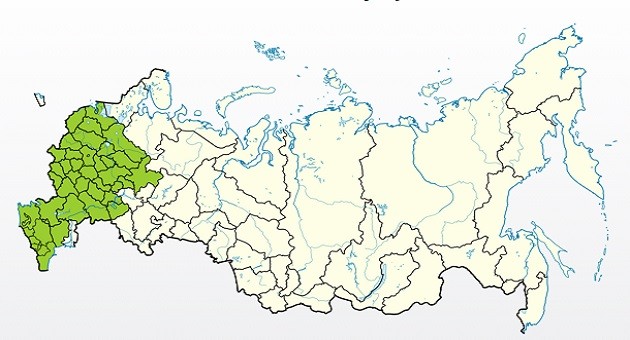
Growing regions
- Middle zone.
- North Caucasus.
- Some northern regions.
Origin
Work on breeding a new type of columnar apple tree began in the late 1960s at the Zonal Research Institute of Horticulture of the Non-Black Earth Region by pomologist and distinguished breeder Viktor Valeryanovich Kichina. By crossing the Obilnoye apple tree and the columnar variety Vozhak, a new hybrid was created in 1974. It was decided to name it "President."
Several years later, the variety was sent for testing to various farms in the Black Earth and Non-Black Earth regions. As a result, the apple trees were added to the State Register and zoned for Moscow, Perm, Samara, and several other regions. In fact, the President variety is successfully grown throughout virtually the entire central part of the country.
Content
Description of the apple tree variety President
 Many gardeners prefer columnar apple trees, although their active lifespan is relatively short compared to other varieties, lasting only 15-20 years. However, they are easy to care for, undemanding in terms of growing conditions, fairly winter-hardy, early fruiting, and produce substantial harvests. Combined with the apple tree's extremely compact stature and the characteristic dessert flavor of its fruit, the President apple tree becomes a welcome addition to virtually any garden, whether in a home garden or in a commercial, intensively cultivated one.
Apples: What they look like
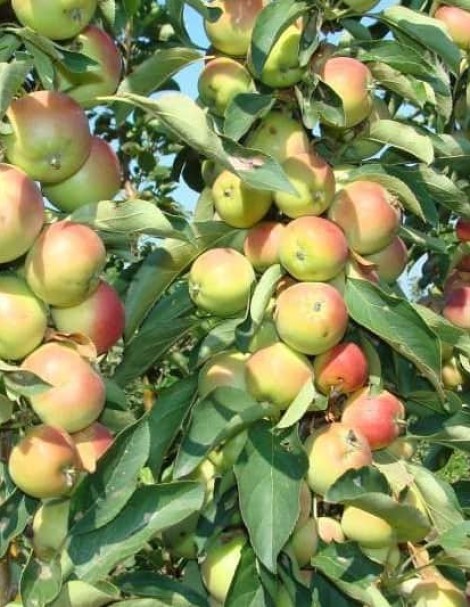
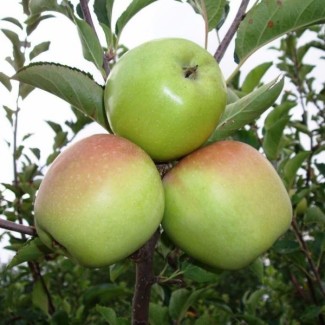
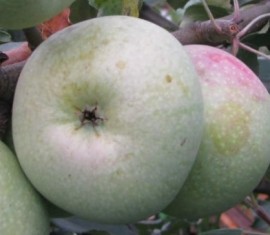
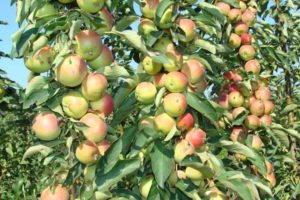 The fruits of this variety can be considered large, as they typically weigh 130-250 grams. They are irregular, round, with barely noticeable ribbing, and smooth. They are generally symmetrical and can be slightly flattened. They begin to grow at 25-30 centimeters from the ground, densely covering almost the entire trunk, right up to the top.
The fruit's skin is dense, delicate, and fragile, yet thin and glossy. When unripe, it is green, but turns yellow with age. The underlying blush, a blurred, streaky, carmine-red or coral color, covers approximately 50-60% of the fruit, leaving the underlying color clearly visible. The surface has a light waxy coating, giving the apples a slightly bluish tint. The chemical composition is well characterized by the following indicators per 100 grams of product:
- P-active substances – 235 milligrams.
- Ascorbic acid (vitamin C) – 11.2 milligrams.
- Total sugars (fructose) – 10.5%.
- Titratable acids – 0.39%.
The apple flesh is fine-grained, very juicy, and crisp, prone to cracking. It has a white or slightly light green-yellow hue and can be slightly creamy. The apples have a dessert-like flavor, considered harmonious and balanced, with a sweet and sour balance and a distinctive, very powerful aroma. The appearance is rated 4.8, and the taste 4.9 out of 5 possible points.
Apple tree President: characteristics
Crown and root system
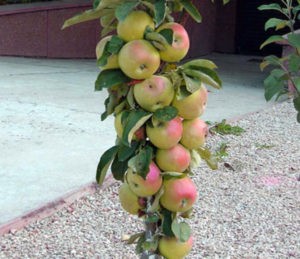 The variety is considered to be a semi-dwarf, but it is more likely to be called a natural dwarf, as the trees barely reach 2 meters in height. Crown The tree is extremely compact, reaching barely 20-25 centimeters in diameter. A characteristic feature of the President tree is the complete absence of lateral branches and fruiting directly on the central trunk (on densely distributed spurs and rings). The bark of the shoots is smooth, greenish-brown, and may turn brown over time.
The leaves are densely distributed on the trunk; they are large, oval-elongated, rounded, green or dark green, and covered with a network of veins. The surface is dense and leathery, but not glossy, more matte, with faint serrations along the edges. The leaf tips are slightly pointed. The tree's root system is very branched and dense, not well adapted to water-seeking, but also superficial, not deep, which reduces the tree's winter hardiness. It lacks a central stem and is very fragile and delicate.
Productivity and pollination
You can't expect to get a large harvest from a single small tree, especially when it's a standard tree with a single shoot. However, considering that its compact size allows for multiple specimens to be planted in a plot, the yield doesn't seem so insignificant.
A mature tree produces approximately 8-11 kilograms of apples per season. With proper care, regular fertilizing, watering, and other measures, the yield can be nearly doubled.
The President bears fruit annually, but may experience a slight decline in fertility with annual cycles. The variety is considered self-fertile, so it doesn't need apple trees of another variety to produce fruit. However, it's important to understand that the pollen production will only produce 60-75% of the fruit. Therefore, experienced gardeners still recommend rotating the trees in the garden. During flowering, it's a good idea to set up mobile apiaries nearby or even locate gardens near beekeeping areas. This will also significantly increase the plot's yield.
Winter hardiness and disease resistance
The apple tree is considered winter-hardy, but only moderately so. Its performance is comparable to that of the more common Melba and the well-known Antonovka apple tree. Young one- and two-year-old saplings must be protected from frost if temperatures drop below -20-22°C for more than a week. If frosts in your region are more severe and persist longer, it's best to thoroughly cover apple trees of any age. If necessary, this can be done using the ball method, wrapping them with agrofibre or regular burlap. Tarpaulin is also an option, but it is excessively heavy and can damage the branches.
The President variety lacks genetic immunity to fungal infections, but it has a moderate resistance to scab and powdery mildew. This means that if you regularly perform all necessary preventative maintenance, removing fallen leaves and especially fruit from the root zone, the risk of damage is reduced to zero. Don't forget to spray the plants with insecticides to prevent damage from insect pests.
Rootstocks and subspecies
These apple trees are typically grafted onto standard vegetative rootstock. However, they can also be grafted onto semi-dwarf or dwarf rootstocks. In the latter case, the trees are even smaller, no more than 1.5 meters tall, and their yield is correspondingly reduced. Furthermore, the fruit is much smaller, weighing only 100-120 grams.
Features of growing the President
 Landing
 Landing
Basic conditions
- The planting site for seedlings must be sunny. In the shade, trees grow more slowly and bear fruit poorly or may not bloom at all.
- Locations with strong winds or drafts are unsuitable for growing this variety; they don't tolerate such conditions and become diseased. If you have no choice, it's best to plant the 'President' variety under the protection of building walls, hedges, fences, or larger trees.
- You need to pay attention to the quality of the soil and the proximity of groundwater. Slightly acidic soil is suitable for apple trees. soil With deep water table, this can be loam or sandy loam. Chernozem soils support trees well, but it's best to dilute them with imported river sand and provide drainage. If the water table is high, it's best to create a special barrier. To do this, bury a sheet of slate or roofing felt at a depth of 2 meters, and then plant the apple trees on top.
- Planting holes for apple trees should be prepared in advance. Ideally, this should be done in the fall, but 3-4 weeks in advance is also possible. Dig holes 50-60 centimeters deep and up to 70 centimeters in diameter. Mix the topsoil with fertilizer and add it to the bottom. Water is added and the entire planting is left uncovered. The distance between apple trees should be no more than 0.5 meters, and between rows, up to 1 meter.
- Before planting, a 10-15 cm layer of drainage is placed at the bottom of the hole, the seedling is placed vertically on top, covered with soil, compacted, watered with 20-30 liters of water, and the surface is mulched with compost or humus.
Please note that the root collar (the grafting site) should always remain at least 5-8 centimeters above the soil surface. If the seedling roots above this height, it will lose all of its rootstock properties, and will develop much more slowly and begin bearing fruit later.
Landing dates
The optimal time to plant the President tree is autumn, when the sap flow in the trunks has ceased and the leaves have completely fallen. However, you can also try in the spring, if you prepare the holes before the cold weather sets in. Seedlings purchased from a nursery with a closed root system (in pots or bags) can be planted outdoors at any time during the growing season.
Protection from frost and rodents
For planting, it's best to buy sturdy, two- or three-year-old seedlings that are approximately a meter tall. They root best, but they will still require frost protection, even if your region has a mild climate. To do this, surround the root zone with straw bales, hay, or spruce branches. Wrap the trunks in burlap, nylon tights, or roofing felt. In harsh conditions, it's best to completely wrap the tree in agrofibre or burlap.
All of the above-mentioned clutter will inevitably attract rodents, who, moreover, are not averse to feasting on the tender bark of young trees. Therefore, it's necessary to coat the trunks with a special solution, such as lard or grease, beforehand. Whitewashing the trunks with lime in the fall is also effective in repelling insects.
Tree care
 Tree care
Loosening the soil, watering: proper agricultural technology
When growing this variety, special attention should be paid to fertilizing and regular watering. Immediately afterward, the soil should be loosened and mulched with humus or chopped grass to retain moisture.
When calculating the amount of fertilizer needed for the President variety to thrive, remember that all the usual doses required for other apple trees should be divided by 10. One tenth will be sufficient for columnar apple trees.
The frequency and amount of watering may vary depending on the tree's age and weather conditions. Young seedlings should be watered twice a week in dry weather; 10-15 liters of water will be sufficient. However, for a mature tree, this amount will no longer be sufficient. If there is no rain, 20-30 liters will need to be applied at the same rate. Fertilizers should be applied immediately with the water or immediately beforehand, so they are better absorbed into the soil and take effect more quickly.
Pruning: simple crown shaping
This tree doesn't require any special pruning, as it naturally grows quite compact, with one or two central branches at most. In the first year, the tree doesn't need any pruning, but in the second year, it needs to be pruned, meaning removing dried, thin, damaged, or diseased shoots. If the central bud freezes in the winter, it can be removed in early spring, where it will produce two shoots, one of which is also removed, but only after a year.
Pollinator varieties
- Scarlet Sails.
- Leader.
- Antonovka.
- Moscow Necklace.
- Currency.
- Melba.
Reproduction
- Clones (layering).
- Grafting by cuttings or buds.
- Growing from seeds.
Diseases and pests
- Scab.
- Powdery mildew.
- Cytosporosis.
- Black crayfish.
- Moniliosis.
- Scale insect.
- Leaf roller.
- Green aphid.
Ripening and fruiting of the President apple tree
The beginning of fruiting
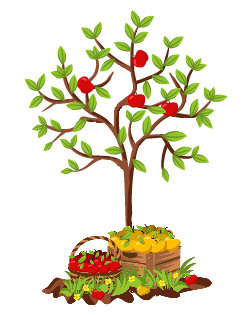 The beginning of fruiting
Apple trees of this variety are extremely early fruiters, blooming within the first year after planting outdoors. However, leaving buds to develop into apples is not recommended, as this will weaken the tree. In the second year, it is also recommended to remove blooms, and starting in the third year, it is acceptable to leave about 50-60% of the blossoms. This allows you to get several fairly large, flavorful apples. By the third year, fruiting can be considered full-fledged, although it will only yield half the usual yield.
Flowering time
Like most apple trees, the columnar President apple tree blooms in May, but the exact timing will depend directly on the region, its climate, and weather conditions. The blooming period can last 7-11 days. The variety produces large flowers, gathered in small clusters, white with a slight pink tint, all opening together.
Fruiting and growth
The first harvests will be small, no more than a couple of kilograms. However, by 6-8 years, they can reach the coveted 10-11 kilograms. However, the lifespan of all columns leaves much to be desired, which significantly dampens the enthusiasm of many gardeners. By 10-15 years, the tree begins to slowly slow down, and by 15-20 years, it stops bearing fruit completely.
Apples usually ripen by the end of August, making it possible to harvest even in areas with relatively short warm periods. However, they can linger until early or even mid-September. Apples have an average shelf life; in suitable conditions, they can last no more than 1.5-2 months. Eventually, they first lose their flavor and aroma, become soft, and then wilt and rot. By this point, they should be completely eaten or processed.
Top dressing
- Bird droppings.
- Manure.
- Compost.
- Humus.
- Ammonium nitrate.
- Urea.
- Superphosphate.
- Mineral complexes.
What to do if it doesn't bloom or bear fruit
- Apply fertilizer.
- Transplant to a sunnier and windless place.
- Check for pests or diseases.
- Provide watering.
Why do apples fall?
- Overripe.
- Lack of moisture.
- Natural phenomena (wind, rain, hail).
- Diseases.
- Pests.
Leave your feedback on the President apple tree in the comments and share your experiences with other gardeners.





Comments
A few years ago, we bought columnar apple trees named "President" and "Ostankino." They took root quickly and produced a harvest the very next year. It's important to remember that we live in Northern Karelia, and the climate there is definitely not conducive to apple trees. After the first harvest, first one, then the other, got sick, and we had to uproot them. It's a shame, because they were actually producing quite well.