Raika apple tree: characteristics of the variety and care
| Color | Reds |
|---|---|
| Ripening season | Autumn |
| Size of apples | Average |
| Taste | Sweet and sour |
| Crown type | Average tree height |
| Shelf life | Average shelf life |
| Application | For recycling , Fresh |
| Winter hardiness | Average winter hardiness |
| Fruiting age | From 5 years old |
 History of origin and regions of growth
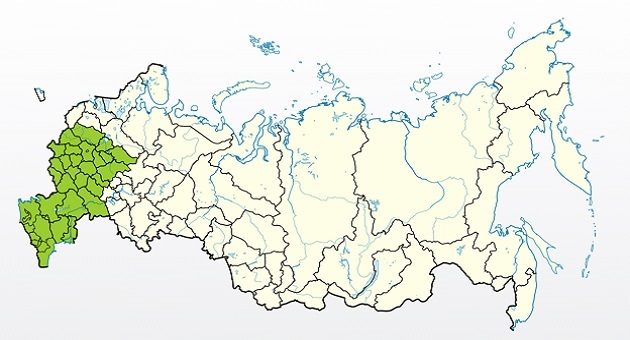
Growing regions
- Crimea.
- Middle zone.
- North Caucasus.
- Moscow region.
- Leningrad region.
Origin
This variety is considered a Czech selection. It was developed in the mid-20th century by crossing the Katka and Champion varieties. As a result, by the end of the 20th century, it had successfully spread to Ukraine, Belarus, and Russia, where it is successfully cultivated without much difficulty.
There is no official data on the Raika variety in the State Register of Breeding Achievements, nor is it zoned in our country. However, the apple tree can be successfully cultivated throughout almost the entire central part of Russia, as well as slightly north, south, and east.
Description of the Raika variety
 This late-ripening apple tree immediately attracts attention. It is beautiful and decorative, yet also resistant to severe frosts and sudden temperature fluctuations, and tolerates prolonged dry periods. The trees are undemanding, requiring no special soils, intensive care, or frequent watering, and are undemanding of the environmental conditions of the growing site. They are naturally resistant to field diseases, although they have no genetic immunity. They fruit regularly, without resting, producing good harvests.
The fruits, although medium-sized, are attractive and have high marketability. They are juicy, incredibly aromatic, beautiful, and delicious. They ripen relatively late, but are easy to transport and can be stored until spring without losing their flavor or nutritional value. This variety is recommended for cultivation in small individual gardens and for industrial production in intensive commercial gardens.
Apples: What do they look like?
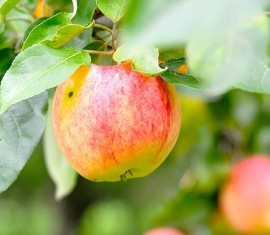
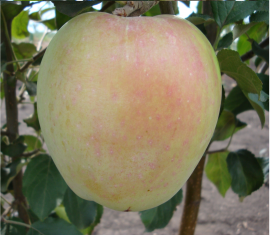
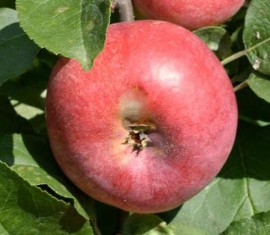
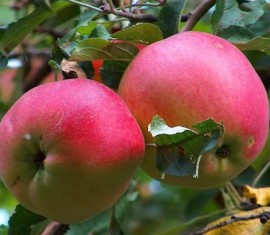
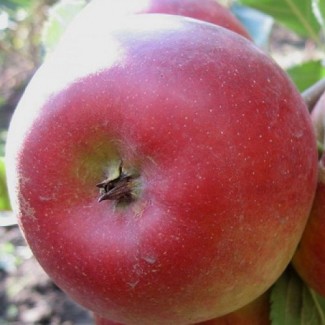
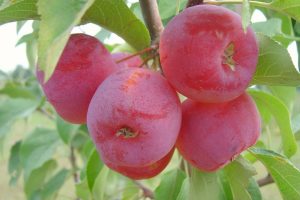 The fruits are medium to larger than average in weight, but rarely reach large sizes. The maximum weight of apples is 170-190 grams, no more. Only occasionally do they exceed this weight, and more often they are somewhat smaller. The shape of the fruits is round, round-conical, or slightly elongated, flattened at the stem. The ribbing is practically invisible, and the side seam is completely invisible.
The skin of Raika apples is dense, elastic, and strong, providing excellent protection against mechanical damage. It is smooth, glossy, and highly shiny, though occasionally, as the apple ripens, it may develop a waxy, silvery-gray coating. The base color is greenish-yellow, becoming golden or lemon-gold when fully ripe. However, this color is difficult to discern, as it is usually hidden beneath a dense, rich blush of bright red, dark red, cherry, or purple-cherry hue, which covers the majority of the apple's surface. Subcutaneous punctures are small, light, and barely noticeable, and the lateral suture is not visible. Experts recommend assessing the chemical composition based on the following parameters:
- P-active substances (catechins) – 347 milligrams.
- Ascorbic acid (vitamin C) – 12.2 milligrams.
- Total sugars (fructose) – 11.5%.
- Pectins (fiber) – 13.9%.
- Titratable acids – 0.67%.
Rayka has firm to medium-firm flesh, fine-grained or medium-grained. It's very juicy and has a powerful, distinctive aroma, easily recognizable from afar. The flavor is considered a dessert fruit; it's sweet and sour, leaning heavily toward sweetness, but with a distinct wine-spicy acidity. It's harmonious and balanced. Professionals give the fruit a tasting score of 4.4-4.5 out of 5 for both taste and appearance.
Apple tree Rayka: characteristics
 Crown and root system
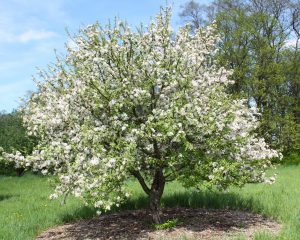 Crown and root system
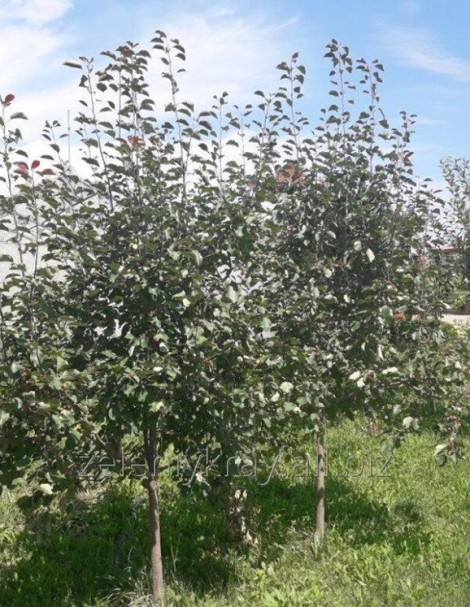
Trees on different rootstocks may have different growth rates, but are generally considered medium-sized. On a standard rootstock, they can reach 4-4.5 meters without pruning, but on a shorter rootstock, they will be much more compact. The crown is round, rounded-oval, or spherical, becoming drooping, spreading, and sometimes weeping over time. The branches are long, straight, covered with greenish-brown bark, smooth, and pubescent. The density of the branches is average, and the fruiting pattern is mixed.
The leaves are medium to small, smooth, flattened, leathery, and dense. They are rich green, dark green, or emerald in color, often with a felty pubescence on the back. They are oval, elongated, and long-pointed, with serrated, crenate, and doubly serrated margins. The nerve roots are delicate, and the leaflets can fold into a boat shape. The root system is well-developed and adapted to water-seeking. On most rootstocks, it is fibrous and branched, occupying an area roughly equal to the crown area.
Productivity and pollination
Professionals consider this variety to be high-yielding, although it still has a long way to go to reach the same levels as Antonovka.
From one fully mature tree of the Raika variety, a good farmer can harvest approximately 65-90 kilograms of apples per year..
The variety is self-fertile and does not require pollinators to produce fruit. However, with the presence of pollinators, productivity increases significantly. It is also common to spray flowering stems with honey or sugar syrup in the spring to further attract insects. Placing the apiary close to the garden will further increase the chances of pollination.
Winter hardiness and disease resistance
This variety has enviable frost resistance, even surviving temperatures down to -29-35°C. With proper winter preparation and adequate shelter before the onset of cold weather, they easily withstand sudden temperature fluctuations and changes, as well as harsher conditions than those described above. Even if damaged, the trees recover very quickly. They are also very drought-tolerant, surviving even prolonged hot and dry periods.
Raika is tolerant of scab, powdery mildew, and other fungi. It is field-hardy and is not affected by more than 1-2 points of damage even during years of severe epiphytotics. Typically, the fruit is unaffected, only the leaves. Therefore, the apples are suitable for fresh consumption and processing without any restrictions. Parasites can damage apple trees, and other diseases are also possible, so it is best to carry out preventative spraying in a timely manner.
Rootstocks and subspecies
Raika doesn't have any specific sub-varieties or sub-types, although it can produce slightly different results in terms of growth, fruiting, winter hardiness, and other characteristics on different rootstocks. A columnar variety exists, but a creeping variety is not yet available. Dwarf varieties are less tolerant of low temperatures, but they begin producing fruit earlier, and the fruit is somewhat larger than on tall varieties.
Features of growing Raika
Landing
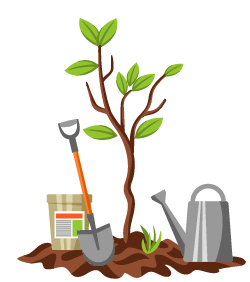 Landing
Basic conditions
- Raika is best grown in an open, sunny spot, away from any shade from taller plants or buildings. In the shade, trees cannot thrive and will likely die or simply become weak, possibly refusing to bear fruit or bloom at all.
- Raika thrives in fertile, unclogged soil with low acidity and salinity. It's best to ensure adequate water and air permeability to ensure the rhizome develops well and nourishes the apple tree.
- Ventilation of the crowns is important for the variety, so you need to carefully select a location that will provide good ventilation, but will not have drafts, which can easily provoke the development of various diseases.
- Planting holes are prepared in advance, preferably the previous season. Experienced gardeners dig holes 80-90 centimeters deep and approximately 1 meter in diameter, adding fertilizer and drainage to the bottom, then filling with water and leaving the hole uncovered. The prepared holes should be left to rest for at least 4-5 weeks.
- Leave at least 4-5 meters between trees to ensure that their crowns and rhizomes don't interfere with each other's growth as they mature. A row spacing of 3-4 meters is sufficient for comfortable maintenance and harvesting.
- The properties of the rootstock will be preserved only if the grafting site (root collar) remains above the surface by at least 7-9 centimeters.
- It's a good idea to immediately drive stakes or planks into the holes to support the seedlings. Tie them in a figure-eight pattern with regular mailing or household twine to prevent damage to the bark even in strong gusts of wind.
- Place the tree on the drainage material collected in a pile in the middle of the hole, straighten out all the roots, sprinkle with soil, compact, water and mulch.
Landing dates
Rayka is resilient to almost any weather conditions, so any planting time is acceptable. However, in harsher climates, it's still best to plant it in the spring, when the soil has warmed up completely and the threat of frost has passed. The optimal time is late March to early September, sometimes a little later, but not significantly; you can't wait until the buds open.
Tree care
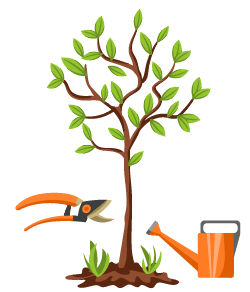 Tree care
Protection from frost and pests
In the fall, starting in early September, stop applying any moisture, including fertilizing or fertilizer. Failure to do so may prevent the tree from preparing for winter and result in frost damage. One- and two-year-old seedlings can be covered with a tent, but this is no longer possible with older trees. Therefore, simply wrap the trunks with agrofibre, spongebond, or burlap, and cover the root zone with sheaves of brushwood, spruce branches, or hay mats.
To protect trees from insect damage, whitewash the lower parts of the trunks with a thick lime solution. This will prevent pests from settling in the bark chips over the winter. Rodents can be repelled by coating the trunks with fuel oil, grease, or melted animal fat.
Loosening the soil, watering: proper agricultural technology
Young apple trees are typically dug twice a year, before bud break and after the leaves have completely fallen. At this time, remove root suckers, shoots from other plants, weeds, and debris. In summer, you can additionally loosen the soil with a hoe or hoe, for example, the day after applying water.
It wouldn't hurt to water the apple tree regularly until it grows. Ideally, this should be done once or twice a month if natural precipitation is on time. Mature apple trees aren't particularly susceptible to drought and can withstand fairly long, hot periods without additional watering. Drip irrigation or irrigation won't hurt the trees; the orchard will only benefit from it.
Pruning: simple crown shaping
The variety's crown is quite dense, so regular pruning is necessary, starting in the first year after planting. Optimally, it should be formed into a tiered or sparsely tiered form, either broom-shaped or cup-shaped. It's best to space the branches out at different heights from the start to facilitate later thinning.
Sanitary pruning is most often done in the fall, but cutting off a diseased or dead branch in midsummer is also possible. All of this hinders the tree's proper development, so it's important to eliminate any threats immediately. Cut areas should be sealed with paint or garden pitch.
Pollinator varieties
Diseases and pests
- Cytosporosis.
- Fruit rot.
- Black crayfish.
- Scale insect.
- Leafhopper.
- Fruit hyacinth.
- Hawthorn.
- Green aphid.
- Leaf roller.
Ripening and fruiting of Raika
The beginning of fruiting
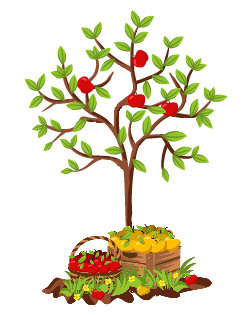 The beginning of fruiting
Although this variety is considered early-bearing, you'll have to wait 3-4 years for fruit to appear. This isn't a long wait, especially since the flowers can bloom much earlier, but it's recommended to pluck them to ensure a more abundant first harvest. In the first few years, you'll only be able to harvest a few kilograms of apples, but that's plenty for a taster.
Flowering time
The rayka blooms mid- to late-season, so pollinators should be selected with this in mind. It produces beautiful, large, fragrant flowers that densely cover all branches, giving the tree an unusually decorative, almost festive appearance. The flowers, with large, fleshy, rounded petals, are a bright crimson or pink hue. The process lasts at least 12-14 days, so insects and wind usually have time to complete the pollination process in any weather.
Fruiting and growth
The tree grows very quickly, adding at least 55-70 centimeters per year, so it reaches its maximum height quickly. Yields also increase rapidly. By the 10th or 11th year, the harvest is already fully mature, so there's no need to wait too long. At this point, the fruit yield can exceed 120-150 kilograms.
Apples ripen by the end of September, sometimes, in the coldest regions, they can be delayed until early October or even mid-September. Consumer ripeness coincides with technical ripeness, meaning apples can be eaten immediately after picking. They tolerate transportation well, even in bulk, but not in a very thick layer. They are best stored in a regular cellar with a temperature of up to 5-6°C and humidity of 55-60%. Then they will last 4.5-6 months, while in a special refrigerator even 7-8.
Top dressing
- Superphosphate.
- Humus.
- Peat.
- Calcium.
- Manure.
- Compost.
- Nitrogen complexes (not in the first 3-4 years).
What to do if it doesn't bloom or bear fruit
- Increase watering.
- Remove insects.
- Cure diseases.
- Fertilize.
- Move to a sunny place.
Why do apples fall?
- They are very overripe.
- Wind, rain, hail, snow.
- Pests or diseases.
Leave a review of the Raika apple tree variety so that even a novice gardener can receive useful information firsthand.