Riga Golubok apple tree: characteristics of the variety and care
| Color | Greens |
|---|---|
| Ripening season | Summer |
| Size of apples | Average |
| Taste | Sweet and sour |
| Crown type | Average tree height |
| Shelf life | Average shelf life |
| Application | Fresh , For recycling |
| Winter hardiness | High winter hardiness |
| Fruiting age | Up to 5 years |
 History of origin and regions of growth
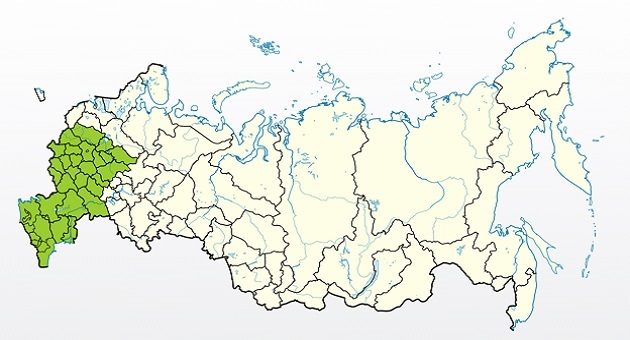
Growing regions
- Crimea.
- Samara region.
- Tatarstan.
- Volga-Vyatka region.
- Middle zone.
- Tver region.
- Leningrad region.
- Mordovia.
- North Caucasus.
- Ulyanovsk region.
- Moscow region.
Origin
The first apple tree of the Riga Golubok variety was created by Estonian amateur breeder and teacher K. Treb. He experimented with open pollination of the Lithuanian Pepin apple, resulting in the selection of a seedling named Treb's Seedling, and later, Riga Golubok.
The apple tree is not included in the State Register of Breeding Achievements of Russia and has no official zoning in our country. It is successfully grown throughout virtually the entire central part of the Russian Federation, as well as much further north, south, and east.
Content
Description of the Riga Dove variety
 These small, compact-crowned trees are remarkably resilient to low temperatures and sudden temperature fluctuations. They recover very quickly even from severe frost damage, exhibit high environmental resilience, and produce abundant fruit annually. Apple trees have a relatively long lifespan and are undemanding in terms of soil quality, care, fertilizing, and watering.
The fruits are medium-sized, very beautiful, attractive, fragrant, juicy, and delicious. They are resistant to shedding, transport well, and are suitable for processing or eating fresh. They can be stored in a cellar for approximately 3-4 months, in a special refrigerator up to 4-5. The variety is recommended for industrial commercial gardening and for individual cultivation in the home garden.
Apples: What do they look like?
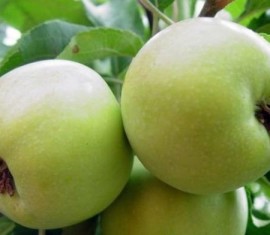
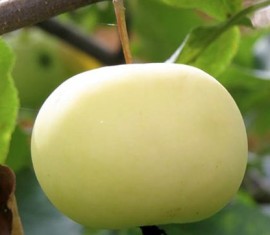
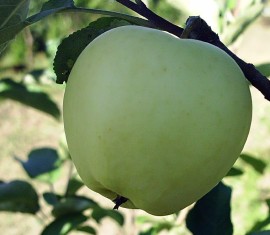
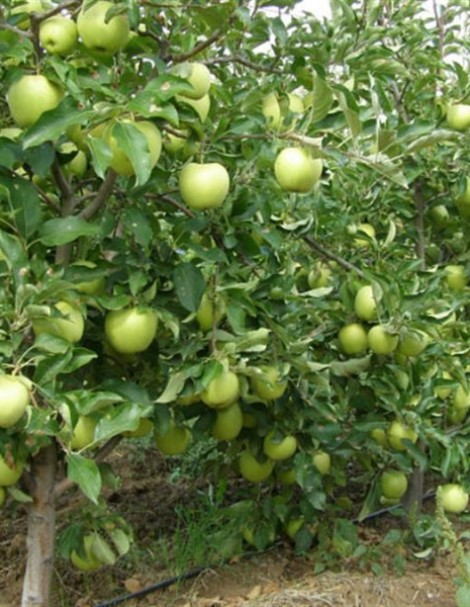
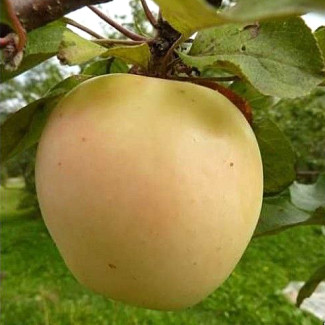
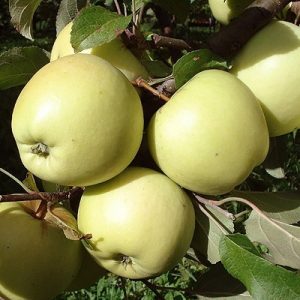 The fruits are generally medium or slightly larger than average in size, weighing up to 100-140 grams. They are round or round-conical, turnip-shaped, and can be flattened or slightly elongated, evenly spaced. The fruits can be symmetrical or slightly lopsided, uniform in size.
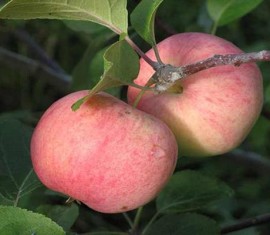
The fruit skin is very dense but not thick, smooth, highly shiny, and glossy. At maturity, it becomes covered with a dense oily-waxy coating. The base color is light green, whitish-yellow, or deep yellow. A blush is generally absent, but may appear slightly on the sunny side as blurred spots of a pinkish or reddish-crimson hue. Subcutaneous punctures are moderate in number; they are dark and clearly visible on the surface. Experts recommend examining the chemical composition using the following parameters:
- P-active substances (catechins) – 134 milligrams.
- Ascorbic acid (vitamin C) – 10.4 milligrams.
- Total sugars (fructose) – 12.8%.
- Pectins (fiber) – 8.7%.
- Titratable acids – 0.53%.
The Riga Golubok has a fairly dense, fine-grained flesh with a pleasant texture. It is very juicy, crisp, fresh, and aromatic, usually white or pale yellow, sometimes with a slight creamy tint. The flavor is considered a dessert variety; it is sweet and sour, balanced, and harmonious, with light spicy notes in the aftertaste. Professional tasters give this variety 4.5 out of 5 possible points.
Riga Golubok apple tree: characteristics
Crown and root system
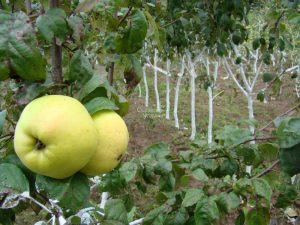 The tree is medium-sized and can reach a maximum height of 5-6 meters without pruning, but no more. Its crown is round, round-oval, or broadly oval, spreading, becoming drooping or even weeping with age. It is quite dense, so regular pruning is essential. Branches are set at a nearly right angle to the trunk, rounded in cross-section, long, of medium thickness, directed upward or sideways, and covered with gray-brown or brownish bark. Fruiting is mixed.
Foxtails are medium or small, rounded-oval, slightly elongated, and short-pointed. They are flat, leathery, and dense, with serrated, crenate, and serrated edges, sometimes slightly wavy. The color is light green, deep green, or even closer to light green, with a felt-like pubescence on the underside. The root system is moderately deep and branched, with many small branches, fibrous on most rootstocks. It is well adapted to seeking water.
Productivity and pollination
This not very tall tree invariably pleases its owners with good harvests.
In one season, from a fully formed eleven-year-old Riga Golubok tree, thrifty owners and under favorable climatic and weather conditions can obtain approximately 150-180 kilograms of aromatic and tasty, very attractive fruits..
Golubok apples are self-pollinating, so the presence of other apple trees is not necessary to achieve a bountiful harvest. However, cross-pollination significantly increases yield, so it's a good idea to plant nearby apple trees that bloom at the appropriate time. You can spray flowering trees with sugar or honey syrup, or use mobile apiaries.
Winter hardiness and disease resistance
This variety is resistant to low temperatures. It can withstand temperatures down to -29-32°C without significant damage. They can easily withstand sudden changes from thaws to severe frosts. However, to avoid various unexpected consequences, it's important to ensure proper shelter and winter preparation.
With proper and timely care, regular treatment with insecticides and fungicides, Riga Dove is virtually immune to diseases and parasitic threats. Even during years of severe epidemics, scab and powdery mildew affects trees only slightly, and the fruits are usually edible, only the leaves are affected. Only the leaves are dangerous for the variety fruit rot, and even then only at an average level.
Rootstocks and subspecies
The Riga Dove variety is unknown. It is grown on a variety of rootstocks, with gardeners favoring dwarf varieties, which allow for even neater, more compact crowns that take up minimal garden space. However, this reduces winter hardiness slightly, which is not always acceptable. Columnar or creeping varieties of Riga Dove do not exist.
Peculiarities of growing Riga dove
 Landing
 Landing
Basic conditions
- Sunny areas are always better for planting apple trees than shady ones. In the shade, trees grow weak and may refuse to bear fruit or even bloom.
- The choice of soil isn't particularly important, as long as it's permeable, breathable, and fertile. All of these factors can be achieved artificially by adding the necessary components when planting apple trees.
- The groundwater table should be medium to deep, otherwise the trees will reach the moisture with their roots and may rot. It is not advisable to plant Golubok directly near a lake, river, stream, marshy area, or floodplain meadow.
- It's not necessary to prepare the holes in advance; you can dig them 2-3 weeks before planting, or you can plant young trees directly in the fresh holes. They should be up to 80 centimeters deep and 1 meter in diameter. If time allows, add soil and fertilizer to the bottom, fill with water, and leave to stand. If the groundwater level is close, it's also worth providing a drainage layer, such as vermiculite, broken brick, or gravel. If there isn't one, simply place the rhizome directly into the mixture, support it with your hands, and cover with soil.
- Stakes or metal rods are driven into the holes to tie the trees to them; it is good to place them on the north side of the trunk.
- There should be at least 3.5-4 meters between apple trees, and 4.5-5 meters between rows, and sometimes even more, to make it easier to tend the garden and harvest.
- The root collar of the tree should always protrude above the soil surface, otherwise it will take root higher and the properties of the rootstock will be lost.
- Before planting, the drainage is raked into a pile, the apple tree rootstock is lowered onto it, all the shoots are straightened, covered with soil and watered with plenty of water, the surface is mulched, ensuring that the mulch does not touch the trunk.
Landing dates
The best time to plant Riga Dove is in the spring, when the soil has fully warmed up after the winter cold, but sap flow in the trunks has not yet begun. The optimal time is around late March or April, depending on the region. In warmer regions, trees can also be planted in the fall, around September or October, after all the leaves have fallen, but there will still be about 3-5 weeks before frost. Saplings not planted in the fall are dug in at a 45° angle until spring, covered with straw, hay, leaves, spruce branches, and sometimes even soil.
Tree care
 Tree care
Protection from frost and pests
Trees need to be properly and promptly covered before the cold weather sets in and prepared for winter with the utmost care, despite their enviable resilience. Watering is usually stopped in mid-season. August, and by early September, eliminate them completely. Spruce branches, hay, or straw are thrown over the roots, and sometimes even soil is raked in. The trunks are wrapped in burlap or other suitable materials, even old tights. Young, short apple trees can be covered with a tent.
Annual whitewashing with lime in the spring and fall helps prevent insect attacks; this prevents pests from settling in cracks and chipped areas. Treating trees with commercial pesticides, readily available at gardening stores, is also helpful. Rodents dislike strong and unpleasant odors, so to prevent them from chewing the bark and young branches during the lean winter, it's common to coat the trunks with lard, fuel oil, or grease.
Loosening the soil, watering: proper agricultural technology
Dig around the tree trunks twice a year, not going deeper than half a spade's depth to avoid damaging the surface roots. In summer, simply hoe the soil around the trunks, loosening it slightly to ensure oxygen reaches the roots. This should also be done the day after applying water, otherwise the soil may compact into a solid lump.
Young Golubka seedlings are watered regularly during the first few years, 1-2 times per month, depending on weather conditions. If it's dry and hot, you can increase the frequency of watering to 3-4 times every 30 days. Water is a convenient way to dilute fertilizers and fertilizers, as they are better absorbed by the rhizomes. This solution is applied along the perimeter of the crown, where small shoots are located.
Pruning: simple crown shaping
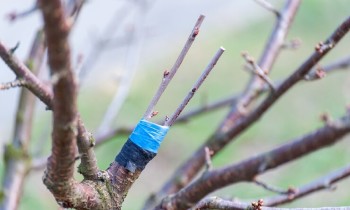
Proper pruning will ensure not only a neat and compact crown but also annual fruiting. The optimal option for this variety is a sparsely tiered form, with branches spaced widely apart and at varying heights. However, if desired, a broom-shaped, cup-shaped, or other shape can be created; the tree is quite flexible and tolerant of stress. Cuts should be carefully sealed. garden pitch.
Autumn pruning is essential to prevent excessive damage to trees, as branches often break under the weight of fruit. It's best to inspect the crowns and remove broken, damaged, diseased, and dry shoots that are no longer useful. It's also common to remove parallel, crisscrossing, inward-protruding, or vertically protruding shoots.
Pollinator varieties
- Borovinka.
- Antonovka ordinary.
- Titovka.
- Seedless Michurinskaya.
- Gloucester.
- Idared.
- Irish.
- Gala.
Diseases and pests
- Scab.
- Cytosporosis.
- Fruit rot.
- Powdery mildew.
- Scale insect.
- Leafhopper.
- Fruit hyacinth.
- Hawthorn.
- Green aphid.
- Leaf roller.
Ripening and fruiting of Riga Dove
The beginning of fruiting
 The beginning of fruiting
The tree bears fruit quite early, and you can enjoy the first fruits around the third or fourth year of life. On a dwarf rootstock, Golubok begins bearing fruit somewhat earlier, as early as the second or third year. The yield initially leaves much to be desired, but this variety is certainly worth trying.
Flowering time
Finding suitable pollinators for this variety is usually straightforward, as many other varieties bloom alongside it. The average blooming time of mid-May is typical for most apple trees growing in the temperate zone and far beyond.
Around the 15th or 20th, large, beautiful, very delicate, and fragrant, slightly pinkish flowers bloom on the tree. They cover the branches densely, making the tree decorative and suitable for use in landscape design. This process lasts about two weeks, so pollination will occur in any weather.
Fruiting and growth
The Golubok tree reaches its maximum height fairly quickly due to its remarkable growth rate. In a single season, it can reach 45-60 centimeters, which is quite impressive given its small stature. It increases its fruit production gradually but at a good rate, reaching full yields around 8-10 years later, when it can produce over a hundred kilograms of fruit.
The fruits ripen at the end of summer, and starting from about mid-August they can be picked and sent to processing or storage. They hold very firmly to the branches and practically do not fall off, which is considered a special advantage, especially for summer varieties. Transporting apples is easy in boxes, no more than 2-3 layers deep. They are well suited for fresh eating and processing, and they can retain their unique flavor until March or even April, which is quite rare among summer varieties.
Top dressing
- Superphosphate.
- Humus.
- Peat.
- Calcium.
- Manure.
- Compost.
- Nitrogen complexes (not in the first 4 years).
What to do if it doesn't bloom or bear fruit
- Increase watering.
- Remove insects.
- Cure diseases.
- Fertilize.
- Move to a sunny place.
Why do apples fall?
- Wind, rain, hail, snow.
- Pests or diseases.
- They are very overripe.
Leave a review of the Riga Golubok apple tree variety so that even a novice gardener can receive useful information firsthand.