Apple tree Rozochka: characteristics of the variety and care
| Color | Reds |
|---|---|
| Ripening season | Summer |
| Size of apples | Small ones |
| Taste | Sweet and sour |
| Crown type | Average tree height |
| Shelf life | Low shelf life |
| Application | Fresh , For recycling |
| Winter hardiness | High winter hardiness |
| Fruiting age | Up to 5 years |
 History of origin and regions of growth
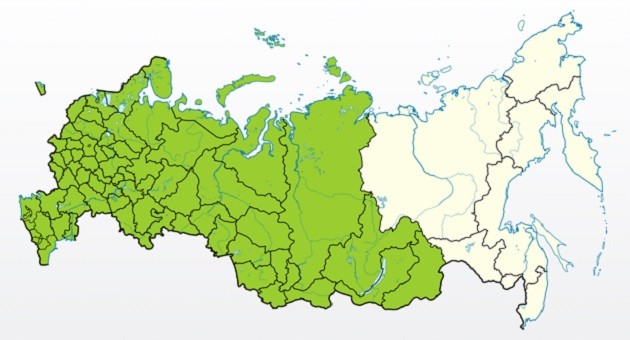
Growing regions
- Crimea.
- Yaroslavl region.
- Ural.
- Volga-Vyatka region.
- Middle zone.
- Tver region.
- Leningrad region.
- North Caucasus.
- Pskov region.
- Moscow region.
Origin
This is one of the apple trees bred relatively recently by the renowned Russian pomologist and plant breeder Leonid Andrianovich Kotov at the Sverdlovsk Horticultural Breeding Station in Yekaterinburg. It was created by crossing the Orlovim and Serebryanoe Kopyttse varieties.
The new tree was classified as an elite variety and sent for field trials, which continue today. However, many gardeners are eager to acquire these apple trees, which has led to their widespread distribution throughout virtually all of our country.
Content
Description of the Rozochka variety
 Summer apple varieties are created specifically to delight owners with fresh fruit when most varieties are still ripening on the branches. The trees are relatively easy to grow, environmentally friendly, and can thrive even in harsh regions, withstanding severe frosts and sudden temperature changes. The variety is immune to the four main races of apples. scabies, and scientists don't yet have precise data on the fifth. The apple tree bears fruit abundantly every year, without resting, while maintaining a compact and neat crown.
The fruits are very attractive in appearance, and most consumers enjoy their taste—juicy, aromatic, and unique. They are small in size, but this is hardly a drawback. Rosette is recommended for cultivation in individual garden plots, as well as in large, intensive commercial orchards.
Apples: What do they look like?
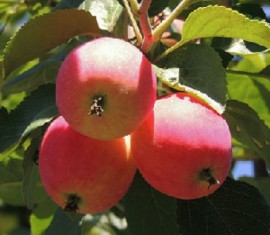
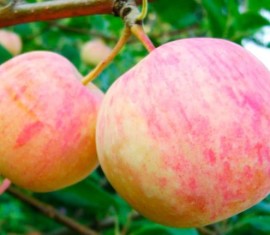
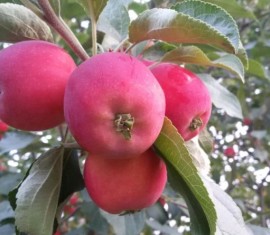
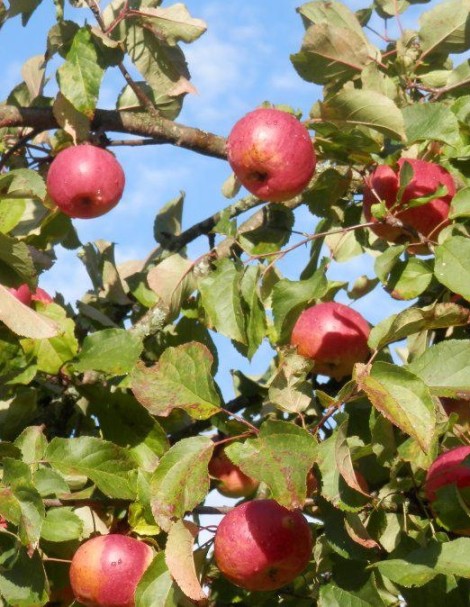
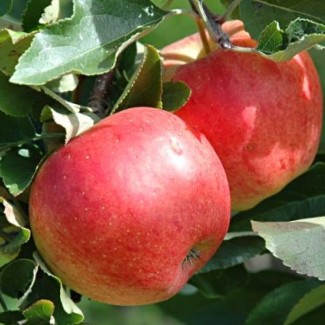
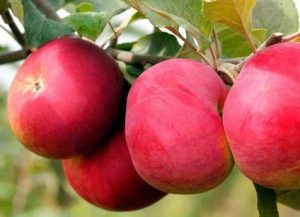 The fruits are typically small or slightly larger than small, but not quite medium-sized. They can reach 70-130 grams, no more. Their shape is round, slightly flattened along the central axis, and can be spherical. The apples are generally symmetrical and uniform, with barely noticeable ribbing and no visible side seam.
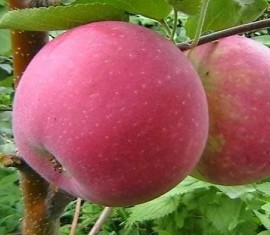
The rosette has a dense, smooth, shiny, and highly glossy skin that effectively protects the fruit from mechanical damage. The skin's base color is greenish-yellow or pale yellow. The blush is mottled, slightly speckled, and dense, bright red or pinkish-red, occupying at least 65-70% of the surface. When fully ripe, it can become covered with a dense, grayish, dry, waxy coating. Subcutaneous punctures are numerous, but small and barely noticeable, and the chemical composition can be judged by the following indicators:
- P-active substances (catechins) – 243 milligrams.
- Ascorbic acid (vitamin C) – 17.6 milligrams.
- Total sugars (fructose) – 10.9%.
- Pectins (fiber) – 9.7%.
- Titratable acids – 0.49%.
The apples have dense, fine-grained, and easily peeled flesh. It is very aromatic and juicy, which appeals to most apple lovers. When ripe, it acquires a light creamy hue and a slightly spicy flavor. The flavor is considered harmonious, balanced, and dessert-like, with a sweet and sour tart flavor and a distinctive, slightly wine-like aftertaste. According to professional tasters, the rose apple scores 4.5-4.7 out of 5.
Apple tree Rozochka: characteristics
Crown and root system
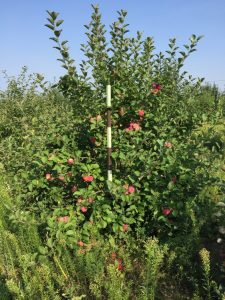 The trees of this variety are considered medium-sized. They can only grow to a maximum of 4-5 meters without formative pruning.The rose bush is characterized by a compact, moderately dense crown, neat and oval when young, rounded and sometimes spherical when older; in old age, the trees can become broadly oval and spreading. The shoots are medium thick, set at an obtuse angle from the trunk, and have medium foliage, covered with smooth, pubescent brown or greenish-brown bark.
The leaves are medium-sized, mostly flat, oval-ovate or elongated, and can sometimes fold into a boat shape. They are dense, leathery, and matte. They sometimes have a slight felty pubescence on the underside. The ground color is green, light green, or deep green. The tip is short-pointed, and the margins are serrated, serrated, and crenate. The root system is well-deepened, branched, fibrous, and adapted to seeking water in the soil.
Productivity and pollination
The yield of Rozochka is characterized as average or slightly above average.
A skilled grower can produce at least 85-120 kilograms of fragrant and beautiful fruit per year from a single mature tree of this variety. With proper care and regular fertilizing, the trees bear fruit regularly, without resting, and produce more substantial harvests..
This variety is not self-fertile and requires external pollinators to produce fruit. Therefore, standard trees should be planted so that there is at least one tree of a different variety with a suitable flowering time per 50-90 square meters. It's also a good idea to spray flowering apple trees with honey or sugar syrup.
Winter hardiness and disease resistance
Rozochka has enviable winter hardiness. It can even withstand temperatures as low as -27-32°C without significant damage. However, if these temperatures last longer than 2-3 weeks at a time, the trunks can become frostbitten without protection, damaging not only the buds but even the wood. Therefore, all scheduled preparation and covering of apple trees for winter must be carried out promptly.
Rozochka is not very susceptible to diseases, and has genetic immunity (Vf gene) to four main types of scab. Other diseases also rarely affect the variety, and they are usually easy to treat. However, regular preventative treatments with insecticides and fungicides should not be omitted from care.
Rootstocks and subspecies
The variety doesn't yet have any subspecies, but it is grown on a wide variety of rootstocks. Dwarf and semi-dwarf varieties, which allow for even more compact standard trees, have become the most popular, with the most sought-after being the "Malysh Budagovsky."
Features of growing Rosochka
 Landing
 Landing
Basic conditions
- The main rule when choosing a site for the Rozochka apple tree is that it should be well-lit by sunlight throughout the day. In the shade, trees grow poorly, develop slowly, and may refuse to bloom or even die.
- Ventilation of the crown plays a secondary role, but stagnant air should be avoided. Drafts aren't particularly harmful to the tree, but constant wind can lead to problems with common diseases.
- The distance to groundwater must be considered before planting. It shouldn't be higher than two meters, otherwise the roots of mature trees will inevitably rot. For this reason, Rozochka should not be planted in swamps, floodplain meadows, or directly near rivers and lakes.
- Trees thrive in virtually any soil, except acidic or salty soil. Excessively heavy and rich black soil will need to be diluted with washed river sand and clay. They grow well in loam, sandy loam, podzolic, and rocky soils.
- Prepare the holes in advance, at least a few weeks before planting. They are dug 70x80x90 centimeters deep, with a mixture of minerals and organic matter mixed with soil placed at the bottom, followed by drainage and water.
- Leave 3-4 meters of space between holes in rows, as well as between trees within a row. Taller plants should be spaced 4-5 meters away from the apple tree to prevent them from shading it later, and shrubs or low-growing trees should be planted 1-2 meters away.
- The root collar must protrude 4-7 centimeters above the surface to prevent the roots from growing higher. Otherwise, all the qualities of the rootstock will be completely lost.
- It would be a good idea to immediately dig supports into the holes, and if they are placed on the north side, they will also protect from the cold wind in winter.
- In the hole, rake the drainage material into a pile in the center, and place the apple tree on it, straightening out all the shoots. Cover the Rozochka with soil, compacting it gently with your hands. Water the surface and mulch it with any available materials (chopped grass, manure, compost, sawdust).
When mulching an apple tree, it is very important to understand that the mulch should never come into contact with the bark of the seedling..
Landing dates
The best time to plant the Rozochka variety is in the open ground in spring. You need to wait until the soil has warmed up completely, around April or May, especially in harsh northern regions. Returning frosts can seriously damage the trees, so this must be carefully monitored. In warmer regions, apple trees can be planted in the fall, after the last leaf has fallen, signaling the end of the sap flow.
Tree care
 Tree care
Protection from frost and pests
One- and two-year-old seedlings are best carefully covered for the winter using the tent method, wrapping them in burlap or agrofibre from the ground up. Straw, hay, or even spruce branches are scattered over the root zone. Older trees cannot be covered this way, so simply wrapping the trunks in old tights, roofing felt, roofing felt, or something else is sufficient.
To prevent rodents from damaging the bark and young shoots during the lean winter months, coat the trunks with grease, old or rendered lard, fuel oil, or special industrial products with a strong and unpleasant odor. Whitewashing the trunks with a thick lime solution in the spring and fall is also effective against insects.
Loosening the soil, watering: proper agricultural technology
Digging around the trunks is only common with young apple trees; older trees no longer require loosening twice a year. You can also hoe the soil after watering to prevent the surface from compacting to the consistency of asphalt. Over the years, you can seed the trunk circle with herbs or lawn grasses, which will ensure aeration and water permeability.
Rozochka appreciates watering during dry periods, and it's helpful to ensure a proper watering schedule. For young seedlings, it's best to follow the ten-day rule, meaning water every ten days until it rains, and then count the required amount from there. Mature trees will benefit from one to two waterings per month during dry and hot weather. Gardeners typically switch to a regimen of four to five waterings per season, timing them to coincide with flowering, fruit set, and fruit ripening.
Pruning: simple crown shaping
In good nurseries, apple trees are trained in the first year, creating a sparse, tiered form. After that, all that remains is to maintain it, preventing it from becoming overly dense. Any shoots that protrude inward, grow vertically, run parallel, or cross should be removed.
Sanitary pruning involves cutting off dead, diseased, or broken branches that are infested with parasites and otherwise unsightly. This is usually done in the fall, but can be done as needed to prevent a broken branch from hanging for six months, sucking up the tree's sap and providing no benefit. Wounds should be sealed. garden pitch, water-based or oil paint.
Pollinator varieties
- Borovinka.
- Ranetki.
- Sverdlovsk beauty.
- Bugler.
- Carpet.
- Silver hoof.
- Solntsedar.
- The aroma of Uktus.
- Progress.
- On-screen.
Diseases and pests
- Cytosporosis.
- Fruit rot.
- Powdery mildew.
- Scale insect.
- Leafhopper.
- Fruit hyacinth.
- Hawthorn.
- Green aphid.
- Leaf roller.
Ripening and fruiting of the Rose
The beginning of fruiting
 The beginning of fruiting
One of the advantages of apple trees is their early fruiting. Buds and flowers appear as early as the second or third year, but they don't always develop into apples, so it's best to pluck them and harvest the first crops only in the fourth or fifth year. Don't expect much from a young Rozochka, but you might still get a couple dozen apples.
Flowering time
The rich, white-pink buds bloom in mid-May or late May. Therefore, finding pollinators for this variety is usually easy. Similar apple trees are abundant throughout the country. The medium-sized flowers, with beautiful, delicate petals, densely cover the branches. Their fragrance has a distinctive note, quite strong and perceptible from afar.
Fruiting and growth
The tree grows quite quickly, adding approximately 35-60 centimeters per year, so it can take 7-10 years to reach its full height. Rozochka also increases its fruit production, producing more and more fruit each year. It will take a while to reach its full production; a large harvest of apples will be possible around the 8th or 9th year.
The fruits ripen in late August, not very early, but much earlier than autumn varieties. In some northern regions and/or under poor weather conditions, they can be delayed until early September, ripening evenly, all at once. The harvest must be collected all at once to prevent the apples from falling to the ground. The fruits are fairly easy to transport, even over long distances, but storing them for long is unlikely. In a special refrigerator at temperatures up to 5°C they last no more than 30-45 days, and in a regular cellar it is better recycle the entire harvest in 1-2 weeks.
Top dressing
- Superphosphate.
- Humus.
- Peat.
- Calcium.
- Manure.
- Compost.
What to do if it doesn't bloom or bear fruit
- Limit or activate watering.
- Eliminate insects.
- Cure diseases.
- Fertilize.
- Move to a sunnier location.
Why do apples fall?
- Overripe.
- Wind, rain, hail, snow.
- Pests or diseases.
Leave a review of the Rozochka apple tree variety so that even a novice gardener can receive useful information firsthand.