Uralskoye Nalivnoye apple tree: characteristics of the variety and care
| Color | Whites , Greens , Yellow |
|---|---|
| Ripening season | Autumn |
| Size of apples | Average |
| Taste | Sweet , Sweet and sour |
| Crown type | Tall tree |
| Shelf life | Low shelf life |
| Application | For recycling , Fresh |
| Winter hardiness | High winter hardiness |
| Fruiting age | Up to 5 years |
 History of origin and regions of growth
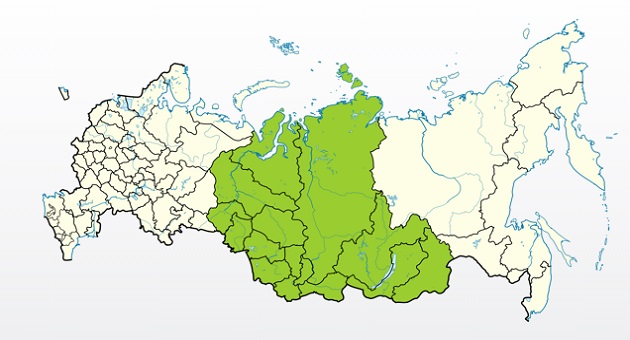
Growing regions
- Ural.
- Western Siberia.
- Eastern Siberia.
- Far East.
Origin
In the late 1930s, work was actively underway throughout the Soviet Union to develop new varieties of fruit trees for agriculture. The renowned professor Pavel Aleksandrovich Zhavoronkov led research into apple varieties at the South Ural Research Institute of Fruit, Vegetable, and Potato Growing. The parent varieties for the Ural Bulk Apple were the well-known Papirovka, crossed with the winter-hardy Raneta.
In 1940, the variety was sent for testing, and just a couple of years later, it was added to the State Register and zoned in the Urals, Eastern, and Western Siberia. Although older varieties are now being actively displaced by newer ones, there are few equals to the Ural Bulk.
Content
Description of the Uralskoye Nalivnoye apple variety
 This apple tree adapts so easily to virtually any growing conditions that it becomes a welcome guest in any garden, especially in the harsh Russian North. The Ural Nalivnoe apple tree is distinguished by its good yield, enviable early fruiting, and ease of care.
However, the variety's versatility is limited, as its tasty fruits cannot be preserved fresh for long, and their size leaves much to be desired. Nevertheless, the variety is recommended for cultivation in both small private farms and commercial orchards, where the fruit is used to make juices, jams, ciders, and compotes.
Apples: What they look like
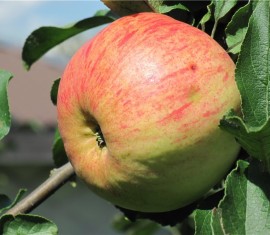
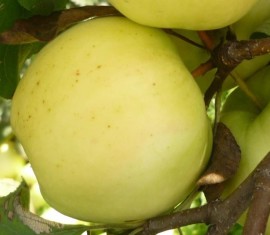
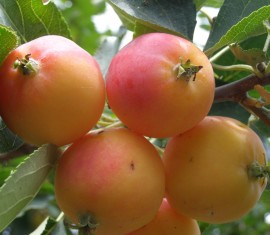
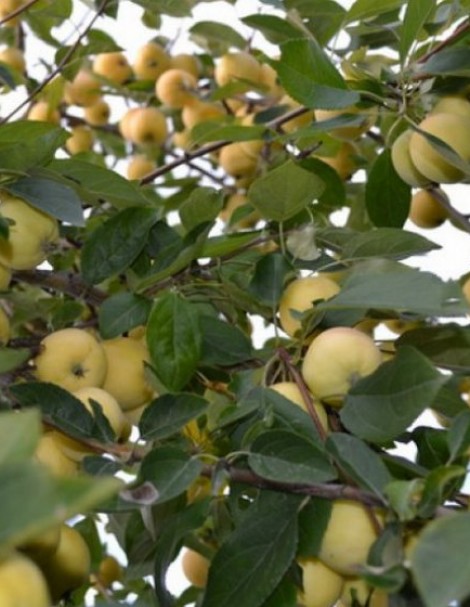
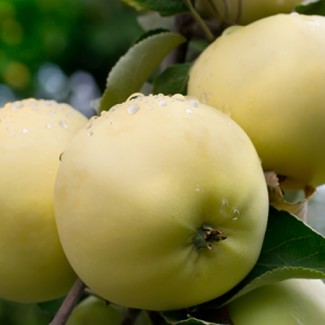
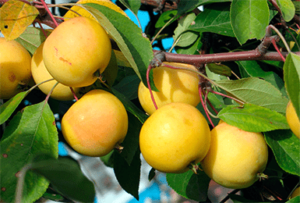 The fruits of this variety are quite small, barely growing to 70-100 grams, although they can look impressive compared to other Siberian apples, such as Ranetki or Alyonushka. They are rounded with subtle ribbing, and can be slightly flattened or turnip-shaped, but are more often uniform.
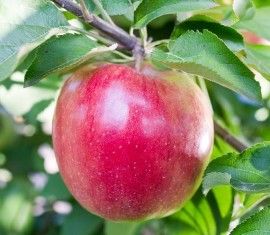
The apple skin is dense, glossy, smooth, and shiny. It has a beautiful greenish-yellow hue. The blush appears as light golden, diffuse spots, covering no more than 45-55% of the surface; sometimes, the apples take on a slight pink tint in the sun. A light oily coating may appear. The chemical composition is characterized by the following indicators per 100 grams:
- P-active substances (catechins) – 104 milligrams.
- Ascorbic acid (vitamin C) – 9.1 milligrams.
- Total sugars (fructose) – 11.3%.
- Pectins (fiber) – 14%.
- Titratable acids – 0.6%.
When unripe, the flesh is light green or even bright green, becoming lighter as it ripens, and at full maturity, it acquires a characteristic golden-yellow hue. When overripe, it sometimes becomes plump and translucent, allowing you to even see the dark seed pods through. It is tender, fine-grained, crisp, and juicy, with a sweet flavor with a very slight apple tartness and a powerful, pleasant aroma. Because of this, these apples are safe even for those with high stomach acidity. Professional tasters rate them 4.5 out of 5.
Ural Bulk Apple Tree: Characteristics
Crown and root system
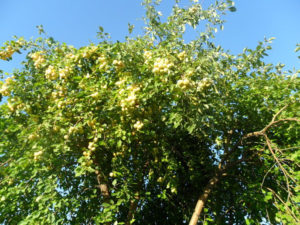 Depending on the subspecies, Ural Nalivnoe can reach varying heights. Trees are considered medium-sized, although some specimens, without pruning, can grow up to 6-8 meters in favorable conditions. However, they generally only reach 3-4 meters, and with proper pruning they can be limited to even 2.5-3 meters.The crown is usually dense, rounded or rounded-drooping, becoming more spreading with age. It covers an area up to 4-4.5 meters in diameter.
The shoots are long, slender, covered with greenish-brown or brown bark, smooth and glossy. Branches often emerge from the trunk at an acute angle, which can cause them to break off during snowfalls or heavy fruiting. The leaves are medium-sized, elongated, light green, and pointed. They are pubescent on both the outer and inner surfaces, leathery, glossy, and finely serrated at the edges. The root system is quite robust and branched, and may have a central taproot, depending on the rootstock.
Productivity and pollination
This variety is considered early-fruiting and high-yielding. Several dozen apples can be harvested in just the second year. While this isn't much, it does produce very quickly.
A full harvest of Uralskoye Nalivnoye apples will average 150-180 kilograms per tree, putting it on par with anise. There have been cases of up to 220-250 kilograms of delicious, plump fruit being harvested from a mature tree..
The variety is considered self-sterile, so don't expect to harvest unless there are other apple trees growing within 50-150 meters. Gardeners have long adapted to this characteristic, so they plant standard trees interspersed with weeds. Uralsk residentIt becomes an ideal pollinator for them, especially on an industrial scale. During flowering, it is also recommended to bring mobile apiaries into the garden.
Winter hardiness and disease resistance
Not many Siberian apple varieties can match the Ural Nalivny variety's resistance to low temperatures. It easily survives even the harshest winters. During the extreme cold of the late 1970s, when temperatures dropped to -57°C, virtually all apple tree varieties suffered serious damage, and Borovinka And the Antonovskys simply perished. Meanwhile, Uralskoye suffered only minor frostbite and recovered in just a year.
Apple trees have average resistance to various fungal infections. Even in a year of severe epiphytotics, scab Trees are severely affected, but only the leaves are affected, leaving the fruit unharmed. Timely preventative maintenance significantly reduces the risk of various diseases. Pests also pose a moderate threat with regular spraying and whitewashing.
Rootstocks and subspecies
Before choosing a subspecies to grow in your garden, keep in mind that Uralskoye Nalivnoye is particularly susceptible to scab. It is attacked quickly and heavily, and the disease is difficult to tolerate. Yields are significantly reduced.
| Subspecies | Description |
| Ural Big | This subspecies is grown on vegetative rootstock and shares all the qualities of the mother plant, but produces larger fruits, weighing 150-280 grams. It grows to a height of 7-8 meters, bears fruit annually, and its fruits, ripening in mid- to late September, can easily last until May, or even until the next harvest. However, they have a more tart flavor than the regular Ural bulk variety. |
| Autumn yellow | The tree is also grown on vegetative rootstock; it grows up to 6-7 meters in height, but its fruits are small (80-100 grams), but very numerous. It has a very dense crown, requiring constant pruning. The fruits ripen in September and can be stored until January or February at the latest. |
| Semi-cultured | This subspecies has inherited more characteristics from its ancestor, the Renet, producing very small apples, weighing only 55-70 grams, which ripen around late August to early September. This subspecies is exceptionally adaptable to any conditions and easily survives even the harshest winters. |
| Kalikovoe | Uralskoye Nalivnoye can be grafted not only onto apple rootstock but also onto rowan or pear. The result is a dwarf subspecies that grows no more than 2 meters in height. Apples ripen on it to a standard size (120-150 grams), and the compact size of the trees allows for automated care and harvesting. |
Features of growing Ural bulk grapes
 Landing
 Landing
Basic conditions
- For planting, choose sites that receive plenty of sun but are not exposed to strong winds. Trees do not tolerate drafts or shade and may become diseased or even die.
- Uralskoe Nalivnoe is best planted in elevated areas and where the groundwater table is fairly deep (more than 2.5-3 meters). Sites near open water bodies, marshy areas, or in hollows and lowlands where spring runoff flows are unsuitable. These conditions will lead to root rot.
- Planting holes can be prepared 2-4 weeks before planting, or even earlier, in spring or fall. To do this, dig a hole 80 centimeters deep and 90 centimeters in diameter, filling it with a small layer of topsoil mixed with various fertilizers. Add gravel, vermiculite, or broken brick for drainage, and fill the entire hole with 20-30 liters of water. Leave the entire area outdoors until planting.
- Between trees in a row you need to leave about 4.5 meters, and between rows you can reduce the distance to 4.
- Stakes (made of wood or metal) are immediately driven or dug into the holes, which will serve as support For a young tree trunk. These supports should not be removed until after the 3rd or 4th harvest.
- The trees are installed so that root collar The roots should be 8-12 centimeters above the soil surface. Otherwise, they may root above the rootstock, which will lead to the loss of all its properties.
- Before planting, inspect the rhizome, cutting off all dry, rotten or diseased shoots.
- The seedlings are placed on a drainage mat and covered with soil, compacting it with your hands but not too hard. Trees prefer airy, oxygen-rich soil, so it should not be overly packed. A small earthen mound is created around the perimeter of the tree trunk circle, and 20-30 liters of water are poured into it. The surface is mulched with humus, compost, and chopped grass.
Landing dates
Trees of this variety can be planted in either spring or fall, but the latter is preferable. Seedlings planted after the leaves have fallen take root better, and by the second year, they produce buds. However, before the buds open, they are also a good time to plant. Trees in special bags, packages, or pots (closed root system) can be transplanted into open ground at any time during the growing season.
Protection from frost and rodents
This variety is very resistant to low temperatures, so no special winter protection is necessary. However, it's a good idea to line the area around the trunk with straw or dry grass to prevent the roots from freezing, especially when using dwarf and similar rootstocks. The trunks can also be wrapped in burlap, roofing felt, or roofing felt, but this is not necessary; Ural Bulk is never covered with a ball.
However, trees need to be properly protected from insect pests and hungry rodents during the winter. To do this, trees are whitewashed with lime in the fall and sprayed with special industrial compounds. The lower part of the trunks is also coated with grease or lard, which will definitely deter animals.
Tree care
 Tree care
Loosening the soil, watering: proper agricultural technology
Young trees are dug around the perimeter twice a year, but as they age, this becomes unnecessary. Initially, you'll need to remove weeds, root suckers, and other plant shoots that rob the apple trees of nutrients, but later, the shade from the dense canopy will do the rest. Around the fifth or sixth year, you can cover the root zone with sod and forget about tilling altogether.
Regular antifungal spraying and fertilizing of the garden will be necessary, along with the addition of moisture. However, over-watering is not recommended, nor is using fungicides. It's sufficient to do this at least four times per season, but no more than seven. Overwatering this variety is not recommended, as this will cause root rot. No more than 10-20 liters of water should be applied at a time.
Pruning: simple crown shaping
Crown shaping for this variety should begin in the first year, as it has a strong tendency to become dense. The central trunk is shortened by approximately one-third, leaving only 2-3 tiered branches. These skeletal branches are positioned 5-7 centimeters below the main trunk. Any type of pruning can be used, but the most common is the sparse tiered pruning. Subsequently, each year, all branches growing inward, suckers, and any seemingly unnecessary branches that prevent the sun from evenly lighting the tree will need to be removed.
Sanitary pruning also requires careful attention, promptly removing dead, diseased, or damaged shoots. Starting in the 10th to 12th year, rejuvenation pruning should begin, removing old branches down to two- or three-year-old wood. This will significantly extend the tree's active life.
Pollinator varieties
- Borovinka.
- Bellefleur the Chinese.
- Uralian
- Yandykovskoye.
Reproduction
- Clones (layering).
- Rooting cuttings.
- Grafting by buds and cuttings.
Diseases and pests
- Scab.
- Moniliosis.
- Powdery mildew.
- Fruit bitterness.
- Fruit gil.
- Hawthorn.
- Leaf roller.
Ripening and fruiting
The beginning of fruiting
 The beginning of fruiting
The first inflorescences on the tree can bloom as early as the second year after planting in open ground. However, don't let them develop into apples; it's best to pluck the buds immediately before they open. This will give the tree time to develop its root system and crown, after which it will be ready to bear fruit. By the third or fourth year, you can harvest approximately 10-25 apples for sampling.
Flowering time
The variety blooms quite late, as for European apple trees, but for the conditions Siberia And Urals – just right. In early or mid-June, when the threat of frost has completely passed, very large, fragrant, snow-white flowers bloom.
Fruiting and growth
Uralskoye grows very quickly, adding 45-60 centimeters of green mass per year, so it can reach its peak within just a couple of years. Its yield also increases rapidly. The first few dozen fruits quickly give way to full yields of 150-200 kilograms, depending on the subspecies.
Apples ripen by mid- to late September, when they can be picked and stored or processed. The first-ripening apples are usually eaten, while those picked later are immediately used for juice, compotes, and jams. It's worth noting that, despite being an autumn variety, they are unlikely to last more than 50-60 days, even under the best conditions.
Top dressing
- Mineral complexes.
- Superphosphate.
- Compost.
- Manure.
What to do if it doesn't bloom or bear fruit
- Check for pests and diseases.
- Provide or stop watering.
- Feed.
- Transplant to a sunnier area.
Why do apples fall?
- Natural factors.
- Pests.
- Diseases.
Please leave your own reviews of Uralskoye Nalivnoye honeycomb so that both novice and experienced gardeners can learn something new.