Steppe Beauty apple tree: characteristics of the variety and care
| Color | Reds |
|---|---|
| Ripening season | Autumn |
| Size of apples | Average |
| Taste | Sweet and sour |
| Crown type | Tall tree |
| Shelf life | Average shelf life |
| Application | For recycling , Fresh |
| Winter hardiness | High winter hardiness |
| Fruiting age | From 5 years old |
 History of origin and regions of growth
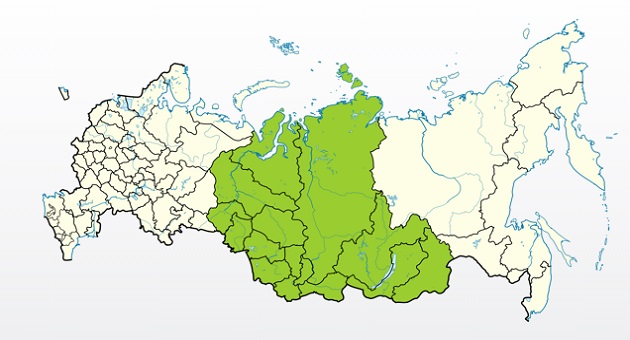
Growing regions
- Kurgan region.
- Yamalo-Nenets Autonomous Okrug.
- Tyumen Oblast.
- Chelyabinsk Oblast
- Yugra.
- Sverdlovsk region.
Origin
The variety is believed to have been developed by Mikhail Mikhailovich Ulyanishchev, a prominent Soviet pomologist and author of the book "The Apple Tree," sometime in the 1950s and 1960s. It was created by crossing the McIntosh and Renet Simirenko varieties.
Currently, there is no information about the Steppe Beauty in the State Register. It has no official zoning. It is grown primarily privately. It can be cultivated throughout the country, including the Urals and Western Siberia.
Content
Description of the Steppe Beauty variety
 This winter-hardy, early-fruiting, autumn-bearing variety is widespread in the Ural region. The trees are compact, medium-height, easy to care for, and tolerate a wide range of growing conditions. They are resistant to various diseases and pests, drought- and heat-resistant, and produce fruit regularly.
The fruits of the Steppe Beauty are quite large, for a Ural variety, attractive, fragrant, and delicious. They are easy to transport, but their shelf life leaves much to be desired. It is recommended for private gardens or for processing in intensive plantings.
Apples: What do they look like?
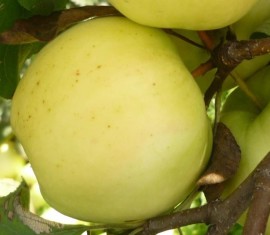
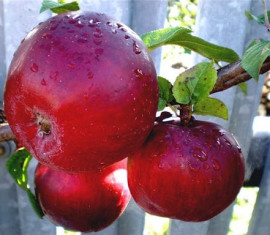
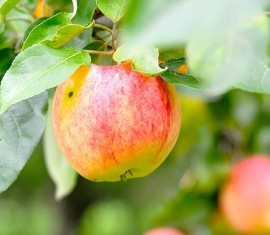
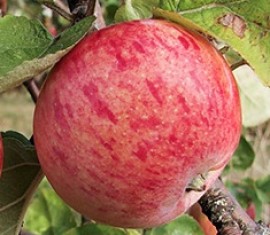
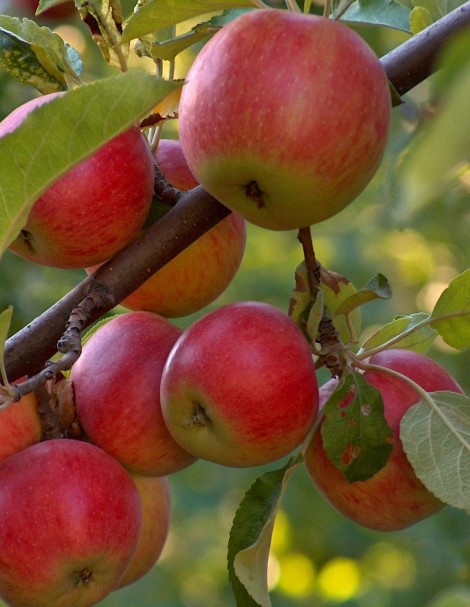
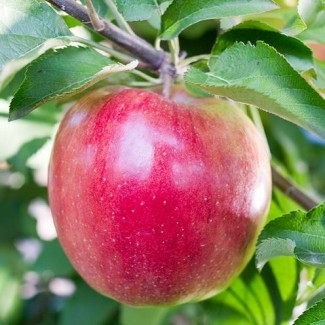
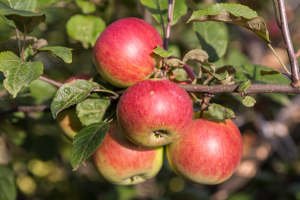 This Beauty produces predominantly medium-sized or slightly larger-than-average fruits, which can weigh 130-180 grams. The shape is generally round or spherical, sometimes slightly tapering toward the calyx or slightly flattened. The apples are smooth, virtually ribbed, symmetrical, and uniform.
The skin is dense, thick, tough, smooth, and glossy. The base color is green or greenish-white, sometimes with a slight yellow tint. At full maturity, it has a bluish-silver bloom. The blush appears as bright, rich streaks, stripes, and spots of red, red-burgundy, or red-brown. It is more noticeable on the sunny side and may be absent on the shady side. Chemical composition:
- P-active substances (catechins) – 234 milligrams.
- Ascorbic acid (vitamin C) – 14.8 milligrams.
- Fructose (total sugars) – 11.4%.
- Pectins – 11.3%.
- Titratable acids – 0.79%.
The Steppe Beauty has medium-density, fine-grained flesh and a snow-white color, rarely with a slight yellowish tint. It has a sweet and sour, slightly wine-like flavor, and is unusually aromatic, with a slight wine undertone. According to unofficial tasters' ratings, it scores 4.5 out of 5.
Steppe Beauty apple tree: characteristics
Crown and root system
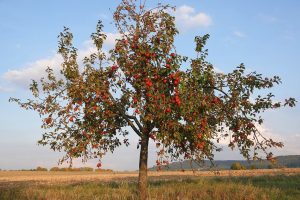 The trees are not particularly tall, barely reaching 4.5-5 meters. The crown is distinctly oval, but over the years it can become broadly oval and even spreading. Branch and foliage density is average to above average. Shoots are rounded, medium in length and thickness, vigorous, extending at right angles to the trunk, directed upward, and covered with gray-brown, sometimes brown, bark.
The leaves are oval, elongated, and short-pointed. They are dense and leathery, with rough nervation and finely serrated, doubly serrated, crenate, and may be wavy or cambered. The leaf blades are green or dark green, turning yellow-brown in autumn, and may have a light pubescence on the underside. The root system is highly branched, and depending on the rootstock, can be fibrous or taproot, penetrating deeply into the soil.
Productivity and pollination
This apple tree is considered a productive one. Its annual production is particularly impressive compared to other Sverdlovsk apple trees.
A single Steppe Beauty tree can yield at least 75-90 kilograms of aromatic fruit per year. In good years and favorable conditions, thrifty growers can harvest over 120 kilograms.
It's believed that this variety doesn't require external pollinators and will bear fruit without them. However, many gardeners note that the presence of nearby apple trees with active pollen can significantly increase yields. Therefore, it's best to interplant these trees.
Winter hardiness and disease resistance
The Beauty can safely be considered frost-hardy. It easily tolerates temperatures down to -29-32°C. Sudden temperature fluctuations can cause some damage, but with proper winter preparation and covering, the buds are virtually immune to freezing. The trees tolerate drought well; their rhizomes are deep, but watering won't hurt.
Steppe Beauty has good immunity to scab, but not at the genetic level. During years of extremely severe epiphytotics, it is affected at approximately 2 points. This means the leaves are damaged, but the fruit remains edible. It doesn't exhibit particular resistance to parasites and other diseases, so it's best to carry out preventative treatments in a timely manner.
Rootstocks and subspecies
There are no official sources describing subspecies of this apple tree. However, it can be grown on a wide variety of rootstocks, imparting some unique characteristics. The fruit retains the same flavor, although dwarf trees may grow slightly larger. These trees barely reach 3-3.5 meters in height, and their winter hardiness suffers. Low-growing rootstocks can significantly reduce their tolerance to low temperatures.
Features of growing Steppe Beauty
 Landing
 Landing
Basic conditions
- There's no specific soil selection required; apple trees will thrive in any soil, as long as they receive regular fertilization and nutrition. However, they prefer airy, podzolic soils. They don't tolerate excessive acidity or salinity.
- The planting site should be well-ventilated, and there should be no stagnant air in the crowns. However, young seedlings will likely not tolerate strong drafts and will die. Therefore, it's crucial to maintain a balance, preventing stagnant air and strong winds.
- Groundwater depth is of primary importance when choosing a planting site for the Steppe Beauty. Its roots penetrate deep into the soil; if they reach water, they will rot and the tree will die. It's important to choose a site where the groundwater level doesn't rise above 2.5-3 meters. For the same reason, apple trees should not be planted near shallow wells or natural or artificial reservoirs.
- The holes can be prepared in advance or 3-4 weeks before planting. They should be 1 meter in diameter and 70-80 centimeters deep. Add mineral and organic matter to the bottom, cover with soil or drainage, add 40-45 liters of water, and leave uncovered. This supply of fertilizer will last the apple tree 2-4 years.
- Planks, stakes, or other supports should be driven into the holes immediately to tie the seedlings to. Trees should be positioned on the south side of the support, which will also provide protection from the cold.
- Trees are typically spaced 4-5 meters apart when planted in a square nest pattern. For dwarf rootstocks, this distance can be reduced to 2.5-3 meters.
- When planting, the root collar should remain 5-9 centimeters above the soil surface.
- The seedlings are inspected, all dry shoots and root suckers are removed, the rhizomes are lowered into water, and left for 5-7 hours.
- The trees are placed on a drainage mound, the shoots are straightened so they lie level, and the holes are widened if necessary. The holes are filled with soil, shaking the trees by the trunk and compacting it in layers. The surface is watered with 20-35 liters of water and mulched with available materials (sawdust, manure, compost).
Landing dates
Beauty can be planted in either spring or fall, but the former is preferable in the harsh Ural climate. Choose a dry, warm day in late April, ensuring there has been no precipitation the day before. Ideally, the soil should be completely warm and there should be no risk of frost. In fall, it's very difficult to find the right time to prevent the tree from developing, but frost should also be avoided for the next 2-3 weeks.
Tree care
 Tree care
Protection from frost and pests
Apple trees tolerate cold well, but watering should be stopped no later than early September. Fertilizing should also be avoided later. Trunks can be wrapped for the winter with roofing felt, burlap, fabric, or even old nylon tights. Straw, hay, or pine or spruce branches can be spread around the roots.
Regular spraying will protect against pests, but you can also whiten the trunks with a thick lime solution. Timely treatment with fungicides helps prevent diseases. Rodents can be repelled by smearing the trunks with melted animal fat, fuel oil, or grease. This will prevent them from gnawing the bark and young shoots.
Loosening the soil, watering: proper agricultural technology
You can loosen the soil the next day after watering. Twice a year is sufficient, and once a year as the years go by, or you can even sow grass around the trunk to provide natural aeration. Fertilizer should be applied around the perimeter of the crown, but not until the third year after planting.
Young trees should be watered frequently, 2-3 times a month, but the water should be applied in two doses of 10-12 liters, morning and evening. Mature trees may only need watering during the driest periods. Drooping, limp foliage may indicate this need.
Pruning: simple crown shaping
Apple trees are resilient and tolerant of pruning. The first, formative pruning, is performed in the first year, if it wasn't done at a nursery. Only two to three main branches are left at different heights, and the central conductor is shortened by no more than a third. Then, all that remains is to maintain the natural branching, trimming off suckers and branches growing inward.
Sanitary pruning is performed every fall. All broken, dry, and diseased shoots must be removed, and the cut areas must be sealed. garden pitchIf branches break off under the weight after winter or fruiting, it's best to remove them immediately at any time.
Diseases and pests
- Cytosporosis.
- Scab.
- Moniliosis.
- Powdery mildew.
- Hawthorn.
- Green aphid.
- Leaf roller.
- Scale insect.
Ripening and fruiting of the Steppe Beauty
The beginning of fruiting
 The beginning of fruiting
The trees are precocious, beginning to bear fruit no later than 4-5 years after planting. If they haven't bloomed by then, they should be inspected for pests or diseases, and perhaps replanted. The first harvests are unlikely to be abundant; the apple tree will yield only 4-5 kilograms.
Flowering time
This apple tree has a medium-season bud break. It blooms around mid-May, sometimes closer to mid-May. After cold winters and a prolonged, rainy spring, it may not bloom until early June. This process lasts 12-14 days. The flowers are medium-sized, pleasantly fragrant, snow-white, and can be solitary or in small clusters. The petals are individual, delicate, airy, and snow-white or slightly lemon-colored.
Fruiting and growth
Trees can grow up to 2-3 meters in just a few years, reaching their maximum height by the 8th to 10th year. They produce at least 45-60 centimeters of growth per year. They increase their productivity quickly, and high yields begin in the 9th to 12th year. At that point, harvests can exceed a hundred kilograms. Fruiting is not regular, but in some years, yields may decline due to external factors (droughts, winter cold, excessive rainfall, etc.).
The fruit is harvested in mid- to late September, and in some cases, early October. By then, they're covered with a light, bluish, non-oily coating. They hold onto the branches fairly firmly for the first week, but may fall off afterward, so harvesting should be done immediately. Even in ideal refrigeration, apples can only store for 3-4 weeks, so it's best to process or eat them immediately.
Top dressing
- Dolomite flour.
- Eggshells (calcium-containing complexes).
- Humus.
- Manure.
- Compost.
- Superphosphate.
- Mineral and nitrogenous complexes.
- Chicken or pigeon droppings.
- Ammonium nitrate.
What to do if it doesn't bloom or bear fruit
- Wrap up.
- Limit or increase watering.
- Remove insects.
- Cure diseases.
Why do apples fall?
- Weather troubles.
- Early frosts.
- Pests or diseases.
- Overripening.
Leave your review of the Stepnaya Krasavitsa apple tree variety so that even novice gardeners can easily overcome any cultivation problem.