Cherry Apple Tree: Variety and Care Features
| Color | Reds |
|---|---|
| Ripening season | Autumn |
| Size of apples | Average |
| Taste | Sweet and sour |
| Crown type | Average tree height |
| Shelf life | Average shelf life |
| Application | Fresh , For recycling |
| Winter hardiness | Average winter hardiness |
| Fruiting age | From 5 years old |
 History of origin and regions of growth
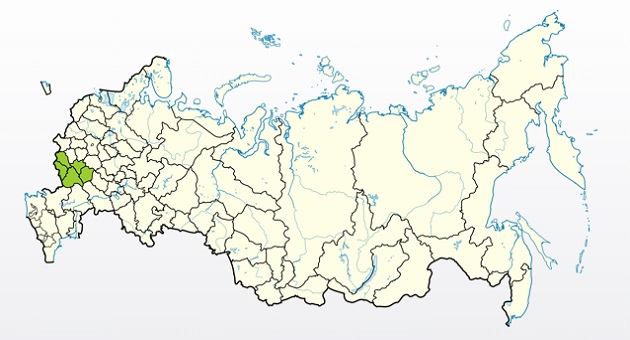
Growing regions
- Tambov region.
- Central Black Earth Region.
- Voronezh region.
Origin
In the early 1930s, renowned Soviet breeder Sergei Ivanovich Isaev became head of the fruit crop selection department at the I.V. Michurin All-Russian Research Institute of Horticulture. He began developing apple varieties suitable for the central Russian region, as well as other regions of the country. One of these developments was a hybrid of the saffron Pepin and the common Antonovka apple, which was named Vishnevoe (or Cherry Apple), due to its distinctive peel color.
Isaev succeeded in obtaining a seedling in collaboration with others (G.A. Lobanov, V.K. Zayats, and Z.I. Ivanova), and by the end of the 1940s, after the end of WWII, it was sent to various farms for testing. The apple tree performed exceptionally well, and was therefore included in the State Register and recommended for cultivation in the Central Black Earth Region.
Content
Description of the Cherry apple variety
 Old apple varieties are gradually losing popularity as newer ones demonstrate superior performance in various aspects. However, there are "eternal classics" that always remain a priority and cannot be replaced by anything. Cherry apples are ideal for growing in both small garden plots and intensive orchards.
This variety produces abundant harvests every year without fail, boasting delicious flavor and color, disease and pest resistance, and excellent transportability. It's important to note that the flavor of these apples leaves much to be desired, and their shelf life is limited.
Apples: What they look like
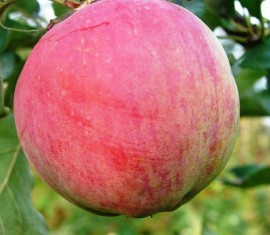
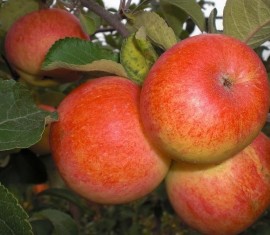
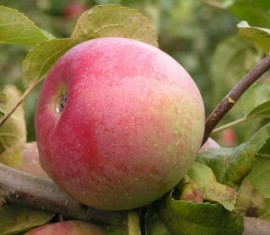
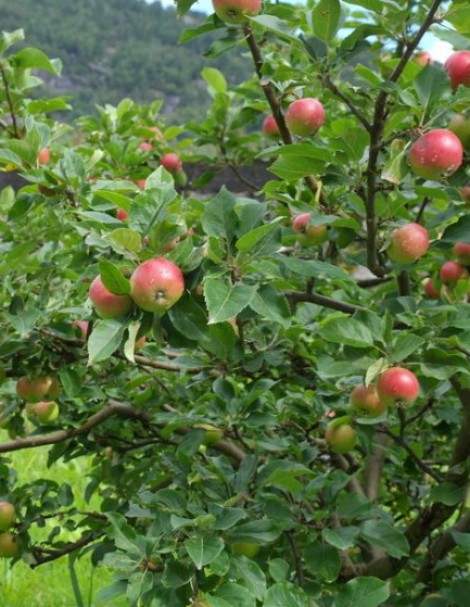
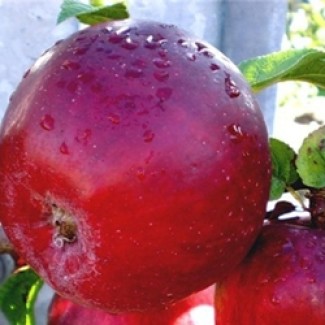
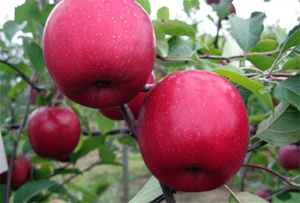 Most apples are medium-sized, round or even round-conical, and generally uniform in size. The average weight of a ripe apple ranges from 110 to 140 grams.
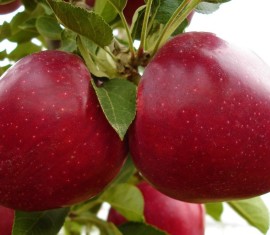
The fruit's skin is very delicate, thin, and glossy, with a light waxy coating that doesn't affect the color. The base color is green, becoming more yellowish or white over time, but this is unnoticeable. When ripe, the entire apple develops a beautiful, cherry-colored, diffuse blush. The subcutaneous spots are light-colored and numerous, making them easily visible. The chemical composition is characterized by the following indicators per 100 grams of product:
- P-active substances (catechins) – 158 milligrams.
- Vitamin C (ascorbic acid) – 11 milligrams.
- Total sugars (fructose) – 10.5%.
- Titratable acids – 0.48%.
- Pectins (fiber) – 16%.
The apples' flesh is firm, very juicy when ripe, and white or slightly creamy. It is tender, prickly, crisp, and fine-grained, with a pleasant sweet-and-sour flavor that is rated as harmonious, balanced, and dessert-like. The tasting score is 4.6-4.7 points for appearance and flavor on a 5-point scale.
Cherry apple tree: characteristics
Crown and root system
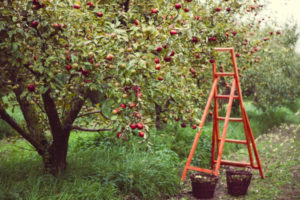 The variety is considered medium-sized; without pruning it can easily reach 4 meters or more.But most gardeners prefer to limit the tree to 3-3.5 meters. Crown The Cherry tree's stem is spherical or oval, sometimes broadly oval, and can become spreading and weeping with age. It bears fruit primarily on spurs and thin fruiting twigs. The branches extend from the trunk mostly at right angles; they are fairly straight, medium-thick, and have reddish-cherry bark that fades to brown on the main trunk and can become brownish with age.
The leaves of this variety are medium-sized, dark green or just green, dense, leathery, and moderately pubescent. They are smooth, leathery, matte, or slightly shiny, with a slightly serrated edge and a pointed tip. The apple tree's root system is branched and superficial, and, depending on the rootstock, may or may not have a central taproot.
Productivity and pollination
Due to its high yield, this variety has become so popular in many regions of our country.
On average, a single mature tree can easily produce 120-150 kilograms of delicious fruit, which can be safely transported even over long distances. Moreover, the apple tree bears fruit year after year, which is another advantage.
Cherry apple is considered self-sterile, meaning that if there are no nearby apple trees with suitable flowering times for cross-pollination, fruit will not be produced. It is recommended to plant this variety alternately with others to achieve good results. Experienced gardeners recommend setting up an apiary near the garden or using portable apiaries during the blooming period.
Winter hardiness and disease resistance
The cherry tree's frost resistance is considered average, so it's hardly worth considering in harsh northern climates. Apple trees' one-year-old shoots, buds, and even wood can freeze if temperatures drop below -22-25°C. Trees require careful protection even in temperate climates, not to mention colder regions.
The variety does not have resistance to fungal infections at the genetic level, but they are very rarely affected. scab, powdery mildew, or other apple tree diseases. This mostly occurs in particularly wet years. Therefore, it's important to carefully monitor humidity levels, prevent water stagnation near the apple tree's rootstock, and ensure good ventilation. Pests are very prone to damage trees, so regular insecticide treatments are essential.
Rootstocks and subspecies
There are no subspecies of this variety yet, but it can be grown on various rootstocks. Dwarf and semi-dwarf varieties will help the variety fruit earlier, yielding its first harvest as early as the second or third year, while vegetative trees will be more durable and frost-resistant. There are no columnar varieties of Cherry, so if someone offers you one, they're likely trying to scam you.
Features of growing Cherry
 Landing
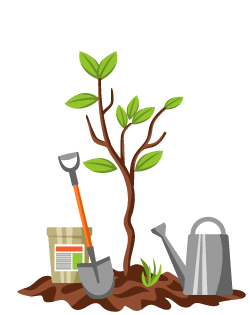 Landing
Basic conditions
- The Cherry apple tree, like most others, prefers sunny, breezy locations without drafts. In the shade, the tree may simply not bloom, let alone produce fruit.
- Avoid planting apple trees in low-lying areas where water stagnates, in marshy areas, or in close proximity to open water bodies. The root system may rot, which will kill the tree. The same applies to high groundwater levels. If you have no choice, you can create a special barrier by digging a sheet of slate or a layer of roofing felt 2-2.5 meters deep.
- Pits should be prepared in advance, as direct contact of fertilizer with the roots of a young seedling is tantamount to death, and without it, the tree may not produce the growth you'd hoped for. Therefore, it's best to dig holes 80-90 centimeters deep and 1 meter in diameter in the fall. Mix the topsoil with fertilizer and fill them back in. Add 30-40 liters of water, and leave the floor to steam, meaning no covering. Ideally, this should be done in the fall for spring planting, or at least 4-5 weeks beforehand.
- Due to its shallow root system, the tree is quite unstable, so it's advisable to tie it to supports during the first few years. For this purpose, special wooden or metal stakes are dug into the holes and removed only after 4-6 years.
- Drainage material, such as broken brick, vermiculite, nut shells, or gravel, is poured into the bottom of the hole. A 15-20 centimeter layer is sufficient.
- The seedlings are planted vertically, leaving at least 5-8 centimeters above the root collar. This will prevent the 4th tree from rooting higher and losing all the properties of the rootstock.
- The trees are covered with soil, compacted, but not excessively, a border is formed along the contour of the tree trunk circle, 30-40 liters of water are poured in, and the surface is mulched with humus, chopped grass or compost.
Landing dates
For the Cherry tree, it makes absolutely no difference whether you plant it in the fall after the leaves have fallen, or in early spring before the buds have opened. For trees with closed root system (in special bags or pots that do not require separate disposal) the planting period is limited only by the growing season, that is, this can be done from the end of April to September.
Protection from frost and rodents
Due to the variety's moderate frost resistance, it's a good idea to carry out a full range of protective measures annually to avoid losing the future harvest or even the trees themselves. The root zone should be lined with straw mats, hay, or spruce branches, and the trunks should be wrapped in burlap, agrofibre, or roofing felt. During severe frosts, apple trees can be covered with tents, especially when young.
Such structures and the succulent young bark of saplings can attract hungry mice and hares, which migrate closer to human dwellings for the winter. A good way to repel them is by applying grease or lard to the lower part of the trunk. To protect against insect pests, whitewash the trunks with regular lime in the fall.
Tree care
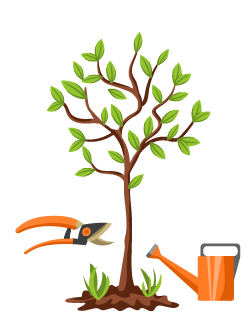 Tree care
Loosening the soil, watering: proper agricultural technology
To soil To ensure the soil remains airy and oxygenated for a long time, it needs to be loosened regularly. Twice a year, it wouldn't hurt to dig around the tree trunks, but do so carefully to avoid damaging the shallow roots. Hoeing the surface can be done partially, while removing all weeds, grass, and shoots from shrubs and other trees.
There's no need to water the Vishnevoe tree frequently, but if the year is dry, it's unavoidable. Watering can be done 2-3 times a month if there's no natural precipitation. Fertilizers can be added to the water, as this will help the tree absorb them better. It's convenient to split the watering into two smaller doses (10-20 liters each)—one in the morning and one in the evening.
Pruning: simple crown shaping
The first formative pruning is performed immediately in the year of planting. The central core and all skeletal branches are pruned by approximately one-third to maintain the shape given to the tree at the nursery. Subsequently, the crown can be shaped as desired, as long as the branches and leaves receive adequate ventilation and light.
It's also important to immediately remove suckers, or shoots growing vertically, as well as old, damaged, and diseased branches. This should be done regularly, every fall after the sap has died down. After 12-15 years, the tree can begin rejuvenating. To do this, remove 2-3 mature shoots at a time, allowing the young ones to develop.
Reproduction
- Clones (layering).
- Rooting cuttings.
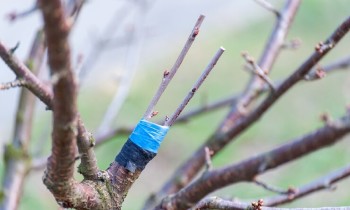
- Grafting by cuttings or buds.
- Growing from seeds.
Diseases and pests
- Cytosporosis.
- Moniliosis.
- Scab.
- Fruit rot.
- Powdery mildew.
- Green aphid.
- Codling moth.
- Flower beetle.
Ripening and fruiting of the Cherry apple tree
The beginning of fruiting
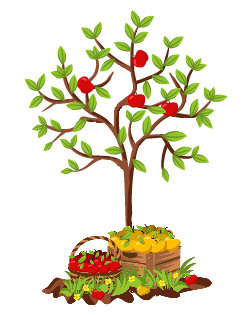 The beginning of fruiting
The tree doesn't bear fruit early on vegetative rootstock. Therefore, you'll have to wait quite a while for the first harvest. The first flowers appear only in the third or fourth year after planting, and they rarely develop into fruit. A normal harvest of 5-10 kilograms can only be harvested in the fifth or seventh year.
Flowering time
The tree begins to produce buds as early as early May, but how quickly they open depends entirely on the weather. If it's warm, the trees will likely bloom as early as May 10, while if it's cold, it may linger until the end of the month. Cherry blossoms are large, fleshy, saucer-shaped, and white or slightly cream-colored. They have a moderate fragrance, so it's a good idea to provide access to pollinating insects or to use artificial pollination.
Fruiting and growth
The variety doesn't produce good harvests immediately, despite the tree's significant growth of 20-40 centimeters per season. Full yields of 120 kilograms or more can only be achieved 10-12 years after planting in open ground. Cherry bears fruit reliably every year, without a rest period.
The fruit ripens on the vine only in September, reaching technical maturity at the very beginning of the month. This is when it's time to begin harvesting, although the apples will still be quite tart. Consumer maturity occurs only 1-2 weeks after storage. The apples transport fairly well, as their thin skin is quite durable. However, their shelf life leaves much to be desired; by early to mid-February, their flavor has noticeably deteriorated, and they become limp, crumbly, and lacking in juiciness. Therefore, by this time, it's best to eat them completely or process them.
Top dressing
- Manure.
- Compost.
- Humus.
- Ammonium nitrate.
- Urea.
- Mineral complexes.
What to do if it doesn't bloom or bear fruit
- Apply fertilizer.
- Transplant to a sunnier location.
- Check for pests or diseases.
- Remove drafts.
- Provide watering.
Why do apples fall?
- Lack of water.
- Natural phenomena (wind, rain, hail).
- Excess fertilizer.
- Diseases.
- Pests.
Leave your feedback on the Vishnevoe apple tree in the comments and share your experiences with other gardeners.