Geromini apple tree: characteristics of the variety and care
| Color | Reds |
|---|---|
| Ripening season | Autumn |
| Size of apples | Average |
| Taste | Sweet |
| Crown type | Average tree height |
| Shelf life | High shelf life |
| Application | Universal variety |
| Winter hardiness | Average winter hardiness |
| Fruiting age | From 5 years old |
 History of origin and regions of growth
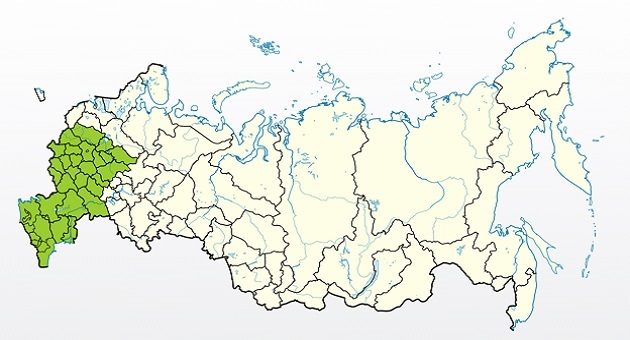
Growing regions
- Middle zone.
- Crimea.
- North Caucasus.
- Some northern regions.
Origin
Breeding efforts to create new, unusual apple trees are ongoing worldwide. Recently, French scientists introduced a very intriguing variety, named Jeromine, to the world. It belongs to the Delicious Red group, members of which share a distinctive characteristic: pink, raspberry, or red flesh.
An unusual variety was developed at the Mondial Fruit Selection SARL experimental station. The mother plant was the hybrid Early Red and its variety, Erowan. This new variety is popular worldwide and is grown commercially in Poland. In our country, the variety is not yet listed in the State Register and is not officially zoned, but it is successfully grown in many regions.
Content
Description of the Geromini apple variety
 The unusual pinkish-raspberry flesh immediately attracts consumers with its novelty, and, what's more, it has a very pleasant taste. These fruits are versatile: they have a long shelf life, are easily transported over long distances, and can be used as a base for jams and juices, as well as eaten fresh.
This variety of apple trees is easy to care for, produces fruit quickly, and is quite winter-hardy. All this makes Geromini a desirable variety for both small private plots and intensive commercial orchards.
Apples: What they look like
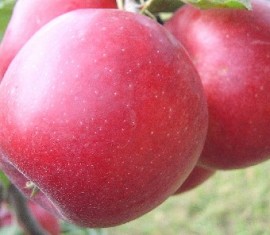
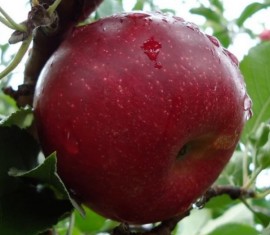
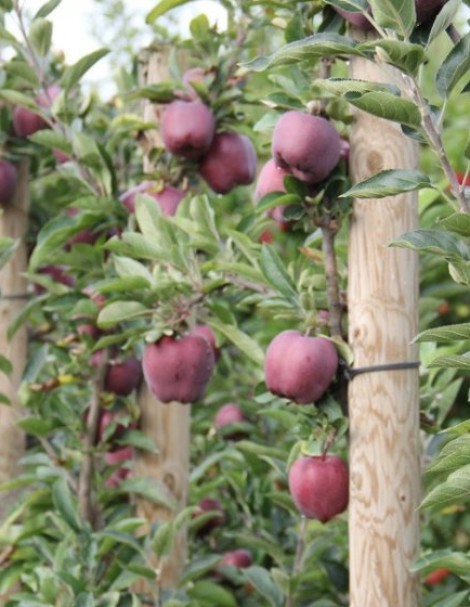
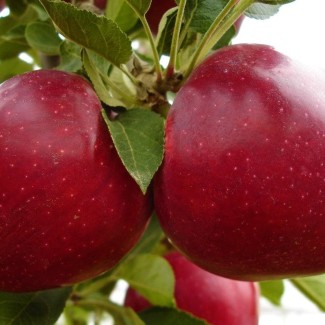
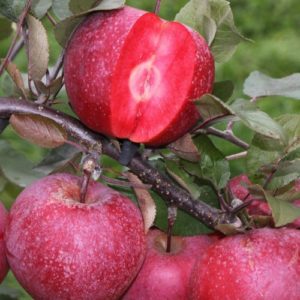 The fruits of this variety are medium-sized or slightly larger than average, easily reaching 160-200 grams in weight. The fruits are round, sometimes slightly elongated, with a truncated apex, symmetrical, and mostly uniform in size, with subtle ribbing.
The skin is firm, fairly thick, glossy, shiny, and smooth, and may be covered with a slight bluish-gray waxy bloom. The base color is greenish-yellow when ripe, but this is almost 96-99% hidden by a dense blush of bright red, crimson, beetroot, or dark crimson. Subcutaneous spots are light, clearly visible against the contrasting surface; they are grayish-green and medium in size. The chemical composition is characterized by the following indicators per 100 grams:
- P-active substances (catechins) – 326 milligrams.
- Ascorbic acid (vitamin C) – 5 milligrams.
- Total sugars (fructose) – 13.8%.
- Pectins (fiber) – 8.7%.
- Titratable acids – 0.82%.
The flesh is dense and crisp, but not prickly; rather, it's tender, fine-grained, and juicy. It has a fibrous texture, unusual for apples, and a distinctive, uniform pinkish-red, raspberry, or purple hue that gradually lightens toward the core, becoming almost white. The flavor is sweet, with a distinctive, slightly tart aftertaste. It's considered a dessert-like, balanced, and harmonious. Experts have awarded it 4.8 and 4.9 points for taste and appearance, respectively.
Geromini apple tree: characteristics
Crown and root system
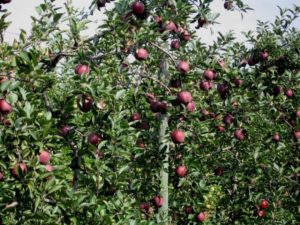 Officially, the tree is classified as medium-sized, although it looks more like a natural semi-dwarf. Jeromini grows to a maximum of 2.5-3 meters, without any shape correction.Most owners prefer to prune the trees additionally, preventing them from growing beyond 2-2.5 meters. The crown shape is spherical or broadly oval. The shoots are fairly thick, medium-length, and covered with smooth, grayish-brown bark with a light pubescence.
The leaves are medium to large, oval, elongated, and long-pointed, with a curled tip and a finely serrated, wavy, and serrated margin. They are smooth, slightly glossy, and pubescent on either the front or back. The leaves are emerald or deep green, with delicate veining, often folded like a boat. The root system is medium-deep, even superficial, and branched, well adapted to seeking water.
Productivity and pollination
With such "masters" as Antonovka, Geromini cannot be compared in any way, but the variety is still considered high-yielding.
From one mature tree in one season, subject to proper care, competent agricultural technology and suitable climatic and weather conditions, it is possible to easily harvest approximately 65-90 kilograms of tasty and unusual fruits.
The variety is self-sterile, which is often cited as its main drawback. For cross-pollination, it requires other apple varieties with a suitable flowering time, as well as trees located no more than 20-100 meters from Geromini. To facilitate pollinating insects, the trees are sprayed with sugar syrup during flowering, and the trees themselves are interspersed.
Winter hardiness and disease resistance
This variety can't compete with the strong and robust Siberian apple trees, but it also boasts excellent winter hardiness. With proper preparation for the cold season and proper shelter, it can even withstand temperatures as low as -27-30°C. However, irregular temperature fluctuations, unpleasant drafts, or even more severe frosts will likely kill the tree, so extreme care and attention are essential.
All Delicious varieties share a common vulnerability to bacterial canker, scab, and other fungal infections. Therefore, preventative measures are essential. Regularly clear the area around the trunk of leaves, fallen fruit, and branches, and spray with fungicides and insecticides to repel insects.
Rootstocks and subspecies
While the subspecies of this new variety are unknown, it can be planted on a wide variety of rootstocks: dwarf, semi-dwarf, vegetative seed, and wilding. MM-106 and M-9 are considered the most suitable. There are no columnar Gerominis, so be careful when purchasing.
Features of growing Geromini
 Landing
 Landing
Basic conditions
- This variety thrives on sunlight and good ventilation, so its planting locations should be chosen accordingly. Open, flat spaces free from drafts are ideal.
- Geromini should not be planted where groundwater is close to the surface, otherwise the tree's root system may rot. Ideally, the roots should be no higher than 2.5-2 meters. For the same reason, apple trees should not be planted directly next to rivers, ponds, springs, lakes, or even shallow wells.
- Soil Almost any soil (loam, sandy loam or black soil) is suitable for apple trees, as long as you feed your trees on time, add moisture and fertilizer.
- It's best to prepare the planting holes the previous season, that is, in the fall or spring. If you didn't have time to do this, preparing them 3-5 weeks before planting will also work.
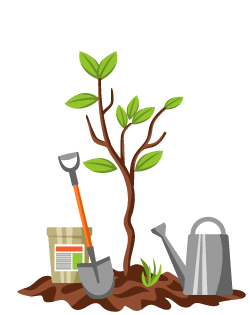
- Dig holes 70-90 centimeters deep and about the same or slightly larger in diameter, making the sides steep. Add half a bucket of soil from the top, fertile layer, fertilized with organic matter, to the bottom. Add a drainage layer of broken bricks or gravel, vermiculite, or even nutshells. Fill with 35-50 liters of water, and leave uncovered.
- Leave approximately 2.5-3 meters between planting holes, and the same distance can be left between rows of trees. This will prevent the apple trees from interfering with each other, clashing with their roots, or touching each other with their crowns.
- Immediately dig in support stakes, which can be made from any available material—metal, plastic, or wood. They should not be removed immediately, but only after 2-3 years of fruiting.
- Before planting, carefully inspect all roots and trim off any damaged, dry, or diseased ones. Soak the trees in warm water for 4-6 hours or in a mixture of water and soil.
- Root collar The seedling should always protrude above the surface, approximately 8-12 centimeters will be quite enough.
- The tree is placed directly on the drainage hole, the roots are spread out so they lie freely, and covered with soil, compacting it with the palms of the hands in layers. A small earthen mound is built around the perimeter of the hole, and approximately 35-55 liters of water are poured into it. It is advisable to mulch the surface to retain moisture in the soil longer.
Landing dates
The variety isn't particularly cold-hardy, so in harsher regions, planting it in the fall, in late September or early October, is not recommended. This option is better suited to mild climates and regions with generally warm weather. In all other cases, it's best to wait until spring to avoid damaging your tender seedlings. In spring, you can choose a warm day in late May or early April, making sure the buds haven't yet begun to open.
Protection from frost and rodents
This variety is quite delicate, so winter preparation requires thorough preparation. First, watering should be stopped no later than late September or early October, otherwise the tree simply won't have time to stop its sap flow. Second, it's best to cover the root zone with straw or grass mats, and wrap the trunks with burlap or whatever else is at hand. Only dwarf or young seedlings should be covered with a tent.
To prevent insects from overwintering in bark crevices, tree trunks are whitewashed with lime in the fall. This should be done to a height of at least 1-1.3 meters. To repel hungry rodents that seek out tender bark and shoots in winter, it's common to coat the trunks with lard or grease. If possible, you can use products from a gardening store; they can be even more effective.
Tree care
 Tree care
Loosening the soil, watering: proper agricultural technology
Dig the soil around the tree's trunk no more than twice a year, and then very carefully, so as not to damage the roots near the surface. Several times a season, you can hoe the soil, removing weeds and other plants that could rob the apple tree of essential nutrients.
Young seedlings require watering 2-3 times a month, but if the weather is hot and dry, they can be watered once a week. As they mature, the frequency of watering can be reduced to 4-6 times per season. It's best to apply 10-15 liters of water in the morning and evening, divided into two doses. If possible, drip irrigation is recommended.
Pruning: simple crown shaping
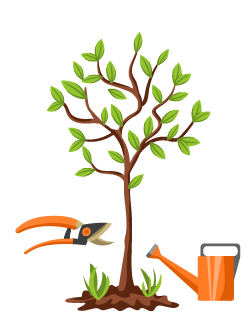
Trees of this variety aren't particularly prone to becoming dense, so pruning won't be a big hassle. In the 2nd or 3rd year, you can remove a third of the central basal branch and leave just 2-3 skeletal branches, shortening them by 5-7 centimeters. Subsequently, maintaining the shape will be fairly easy.
Regularly inspect the crown and perform sanitary pruning in spring and fall, removing any dead, damaged, or diseased shoots. It's also a good idea to remove any shoots that stick up vertically or grow inward.
Pollinator varieties
- Granny Smith.
- Everest.
- Gala.
- Fuji.
- Delicious golden.
- Delicious red.
- Malus Golden Jam.
Reproduction
- Rooting cuttings.
- Grafting by buds and cuttings.
- Growing from seeds.
- Clones (layering).
Diseases and pests
- Powdery mildew.
- Cytosporosis.
- Fruit rot.
- Scab.
- Cytosporosis.
- Tinder fungus.
- Green aphid.
- Codling moth.
Ripening and fruiting of Geromini
The beginning of fruiting
 The beginning of fruiting
This variety is considered early-bearing, and the first flowers can appear as early as 2-3 years after planting. However, it's best to pluck them immediately, preventing them from developing into fruit. Harvesting can begin in the 4-5th year, when you'll be able to harvest 15 to 20 kilograms of fragrant, beautiful apples with distinctive flesh.
Flowering time
Apple trees bloom in May, but the exact timing depends directly on the region's climate and weather conditions. In warmer regions, blooming can begin around the first half of the month, from the 5th to the 15th, while in colder regions, it usually lags until the second half, or even the end, of the month. The tree blooms profusely, producing large, pink, fragrant, saucer-shaped flowers that cover the branches densely, making the tree very beautiful.
Fruiting and growth
Geromini has a medium growth rate, achieving approximately 25-35 centimeters of green mass per year. It grows much faster before fruiting begins, then slows significantly. The tree also gains fruitfulness gradually. By the 7th to 9th year, it will be possible to harvest approximately half of its full harvest, and the coveted 80-100 kilograms can be achieved by the 10th to 14th year.
Apples ripen in mid-September, and then they're ready to be picked. They hold tightly to the branches for about a month, after which they begin to fall. Therefore, it's important to be attentive and not miss the moment. The variety has an enviable shelf life; the fruit can easily be stored in suitable conditions for 6-8 months, and sometimes until the next harvest. They are well suited for fresh consumption and for making juices, jams, and preserves.
Top dressing
- Compost.
- Nitrogen fertilizers.
- Humus.
- Ammonium nitrate.
- Manure.
What to do if it doesn't bloom or bear fruit
- Check for pests and diseases.
- Transplant.
- Limit watering.
Why do apples fall?
- Overripe.
- Natural factors.
- Pests.
- Diseases.
Leave your feedback on the unusual French variety Geromini to share your experience with other gardeners.