Florina apple tree: characteristics of the variety and care
| Color | Reds |
|---|---|
| Ripening season | Autumn |
| Size of apples | Large |
| Taste | Sweet |
| Crown type | Average tree height |
| Shelf life | High shelf life |
| Application | Universal variety |
| Winter hardiness | Low winter hardiness |
| Fruiting age | Up to 5 years |
 History of origin and regions of growth
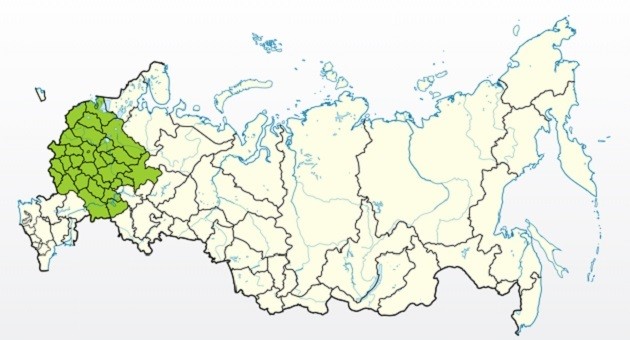
Growing regions
- European part of Russia.
History of origin
The apple tree was developed in the mid-1970s in France. At the time, it was fashionable to create universal hybrids, and the variety we're interested in was no exception. To develop the Florina, local breeders repeatedly crossed several well-known, well-tested, and beloved varieties:
- Delicious golden.
- Floribunda 821.
- Starking.
- Jonathan.
- Rum Beauty.
As a result, the apple tree successfully spread throughout Western Europe and was first cultivated in the Soviet Union in 1988. Since then, it has been grown everywhere, as its fruit has excellent consumer qualities.
Content
Description of the Florina apple variety
 When looking for new trees for your orchard, you can't ignore the prolific winter apple tree Florina. It produces regular, consistent harvests, with virtually no rest breaks, and its fruit has a unique flavor reminiscent of banana or melon. This variety is recommended for both large, intensive commercial orchards and small home gardens.
Apples: What the Fruit Looks Like
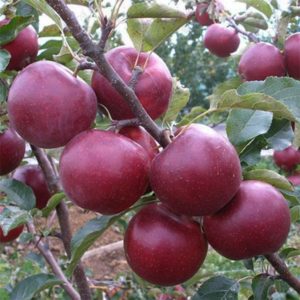 The fruits of this variety are typically medium-sized, weighing up to 120-150 grams. However, this size is more than compensated for by the fact that they are almost all identical, as they say, "one for one."
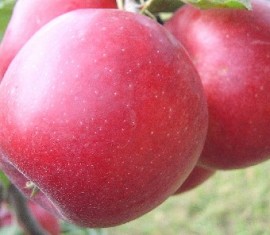
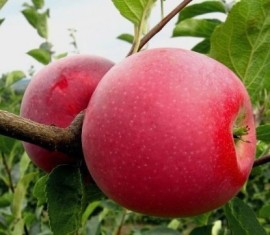
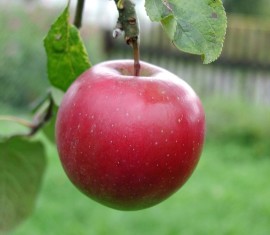
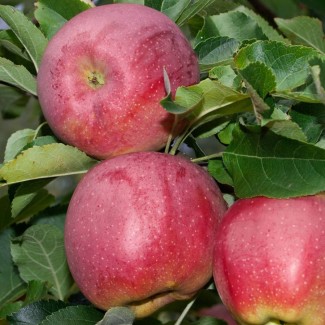
Their skin is thick and green, but as they ripen, it develops a bright red or slightly orange blush, covering up to 75-90% of the fruit. The apples' surface has a waxy coating that gives them a bluish tint. Numerous light green subcutaneous spots are clearly visible on the surface. The chemical composition can be characterized by the following indicators:
- P-active substances (catechins) – 305 milligrams.
- Vitamin C (ascorbic acid) – 7.2 milligrams.
- The amount of sugars (fructose) is 10-10.3%.
- Titratable acids – 0.58%.
- Pectins (fiber) – 14%.
The fruit's flesh is white with a slight creamy-yellow tint; it's very juicy, dense, and fine-grained. The flavor is considered balanced, dessert-like, sweet, with a slight, characteristic apple tartness. The tasting score for appearance is 4.8, and for taste, 4.4 out of 5, although opinions vary.
Florina apple tree: characteristics
Crown and root system
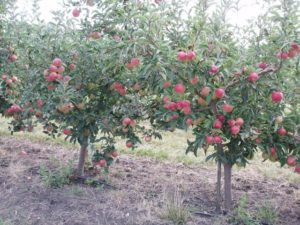 This variety is considered to be of medium height, although if it is grown on a vegetative rootstock and is not pruned in time, it can easily stretch to 5 meters or more. However, in most cases the tree only reaches 3-4 meters. The branches extend from the trunk at an acute angle, which is why most often crown The apple tree has a broom-shaped stem, which becomes spherical and spreading over the years. It is very prone to becoming dense, and regular pruning further stimulates new growth, so it requires some effort. The bark on the branches is gray-brown and smooth, but may turn brown with age.
The foliage is predominantly bright green, rounded, slightly elongated, and tipped with a small, pointed tip. The leaves are matte and leathery, with a slight pubescence on the underside. Florina's root system is extensive, but not too deep. The presence of a central stem depends on the rootstock used.
Productivity and pollination
This apple tree produces its heaviest yields on a vigorous vegetative rootstock. A mature tree can easily yield at least 350 kilograms of fragrant, beautiful fruit per season. However, it is not used commercially because each tree takes up a lot of space, and harvesting is difficult due to the height of the trees.
Dwarf and semi-dwarf rootstocks produce less, only 70-90 kilograms, but overall the yield per hectare is higher.
The variety is considered conditionally self-fertile, meaning Florina's pollen activity is high enough to pollinate at least 28-35% of the buds. However, to bring this figure to 100% or as close as possible, other varieties with suitable flowering times should be planted within 50-150 meters. It's a good idea to set up an apiary nearby or bring in a mobile one regularly during bud opening.
Winter hardiness and disease resistance
This apple tree is said to have average frost tolerance. But in reality, it's a very delicate tree, unable to withstand even -20°C frost for more than a month. No matter how much you cover or bundle the trunk, it will inevitably become stressed and may even die. Growing it outside of the central zone is out of the question, and even those living in the European part of the world will have to work hard to protect the apple trees.
During the variety's development, the primary focus was on creating a standard resistant to various fungal infections. This was entirely successful; Florina is now almost never affected by five different strains of fungal diseases. scabies, powdery mildew, moniliosis. It is not afraid of fruit rot and bacterial burn and even pests are reluctant to damage the tree, with the exception of the flower beetle and leaf rollersThe only serious threat to the variety is black crayfish.
Subspecies and rootstocks
Depending on the rootstock, an apple tree can vary its vigor and height. All the fruit's consumer qualities are almost always preserved. However, there are several subspecies that are worth examining more closely.
| Subspecies | Description |
| Columnar | This option is very compact and therefore ideal for intensive gardens. After all, no more than 0.5-1 meter of space should be left between trees. Furthermore, small "columns" can be easily protected from frost. Florina is reportedly successfully grown in the Leningrad region with its harsh winters, covered with agrofibre from root to tip. |
| Red | This vigorous apple variety is only suitable for southern regions and for very responsible homeowners who have the time to constantly tend to the tree. It produces large yields, but branches regularly break off, freeze, and nothing grows under the tree, resulting in an excessively dense crown. However, if properly cultivated, the apples can reach 250 grams. |
Features of growing Florina
 Landing
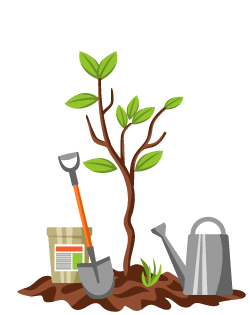 Landing
Key Features
- Apple tree soil can be any type of soil. The main requirement is that it shouldn't be too acidic. Acidity above 7 pH can kill apple trees and prevent them from even developing. This can be corrected with lime.
- It's best to choose a sunny location, but be careful to avoid drafts. Florina doesn't like this and will become ill.
- It's best to prepare the holes in advance, ideally in the fall, but at least 3-4 weeks before planting. To do this, mix some of the soil with fertilizer, then fill it back in, fill with water, and leave it outdoors. Ideally, the holes should be 80 centimeters deep and 1 meter in diameter.
- Stake tines are driven in immediately on the north side to support the young tree. They should not be removed for 3-4 years, but it's best to leave them in place at least until the tree bears its first fruit.
- Depending on the rootstock used, the distance to other plants on the site should be from half a meter (for columnar) to 4-6 meters (for vigorous).
- The root collar should protrude above the soil by at least 5 centimeters, otherwise the tree may root past the rootstock, completely negating all its properties.
- The seedlings are carefully sprinkled with soil, lightly compacted, watered with 20-30 liters of water, and the soil surface is mulched with humus or chopped grass.
Landing dates
Florina is a heat-loving apple tree, so it's best to plant it in the spring, around mid- to late April, when the risk of frost has completely passed. You can try rooting the tree in late September, but in most cases, the tree doesn't have time to adapt to the environment and dies, so most experienced gardeners prefer not to take any chances.
Protection from frost and rodents
Florina must be protected from frost in winter. This must be done thoroughly. It freezes easily even with a slight drop in temperature. The root zone can be covered with spruce branches or straw bales, and the trunks can be wrapped with roofing felt, tar paper, or agrofibre. Even burlap will do if the cold in your region is mild and short-lived.
To prevent insects from settling near the rhizomes during the winter, trunks and skeletal branches are whitewashed with lime in the fall. To repel rodents, which readily move closer to humans during the winter, trees are coated with grease or lard.
Tree care
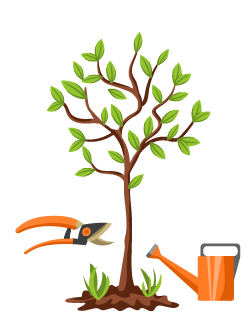 Tree care
Loosening the soil, watering: proper agricultural technology
In spring, you don't need to worry about loosening the soil; it's not necessary, but in summer and fall, it's essential. Care must be taken to avoid damaging the roots located close to the surface. You'll need to remove weeds from under the tree, pull out root suckers, and remove shoots from shrubs and other trees.
It also helps to water the apple tree regularly if needed. Most fertilizers can be added with water. Extra moisture is especially beneficial during the period of fruit formation and ripening. During this period, it's best to apply 40-60 liters in two doses, morning and evening, according to the ten-day rule.
Pruning: simple crown shaping
Florina is very prone to developing a dense crown, so it will require a lot of formative pruning. Moreover, the more you prune, the more new branches will grow. Initially, the trunk is shortened by a third, and the skeletal branches are made a few centimeters shorter. In the fall and spring, all dead, diseased, or damaged branches from fruiting are also removed.
It's also a good idea to regularly remove one of the three branches to rejuvenate the tree. Keep in mind that during fruit ripening, you'll need to support the tree anyway, otherwise the branches will break off.
Pollinator varieties
- Liberty.
- Gloucester.
- Delicious golden.
- Idared.
- Champion.
Reproduction
- Growing from seeds.
- Layers (clones).
- Grafting by buds or cuttings.
- Rooting cuttings.
Diseases and pests
- European cancer.
- Leaf roller.
- Flower beetle.
Ripening and fruiting of the Florina apple tree
The beginning of fruiting
 The beginning of fruiting
The fruiting of an apple tree depends entirely on the rootstock it's grown on. On a regular, vigorous vegetative rootstock, it won't begin bearing fruit until 6-7 years after planting in open ground. Semi-caoliks begin bearing fruit as early as 4-5 years, while dwarf apples can yield 5-15 kilograms of flavorful apples in as little as 2-3 years.
Flowering time
Florina blooms mid-season, around early to mid-May, like most apple trees. Therefore, cross-pollination is almost never an issue. Its bloom period can last up to two weeks. The flowers are densely packed on the branches; they are white, fragrant, and large.
Fruiting and growth
Florina begins actively bearing fruit no earlier than the 8th to 10th year, when yields of 50-60 kilograms per tree begin. However, in adulthood, it begins to alternate two years of fruiting with a year of sterility. Artificial flowering control is then used to increase the yield and eliminate the dormant period. To achieve this, 40-60% of the buds are removed during flowering. The tree grows very rapidly, up to 40-50 centimeters per year. However, it only grows vertically for the first 10-15 years, after which it begins to branch out in various directions.
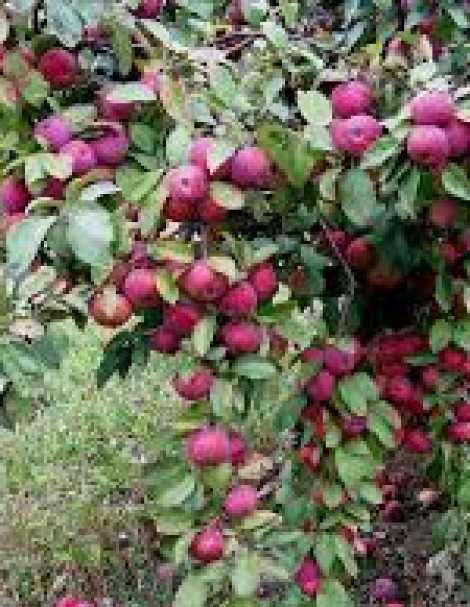
The fruits ripen in late September or early October. There's no need to rush to pick the apples from the branches once they reach technical ripeness. They cling tightly to their stems, so they rarely fall to the ground. You can let them hang until mid-October to develop that unique melon flavor that makes them so beloved by both adults and children. In suitable conditions, they can last for 5-6 months.
Top dressing
- Humus.
- Manure.
- Bird droppings.
- Mineral complexes.
- Potassium and phosphorus fertilizers.
- Urea.
What to do if it doesn't bloom or bear fruit
- Check for pests or diseases.
- Start watering.
- Fertilize.
- Transplant to other places.
Why do apples fall?
- Natural weather phenomena.
- Pests.
- Diseases.
- Over- or under-watering.
Please share your feedback on the Florina apple tree in the comments so everyone can learn from your experience and gain some useful insights.