Red Chief Apple Tree: Variety and Care Features
| Color | Reds |
|---|---|
| Ripening season | Winter |
| Size of apples | Large |
| Taste | Sweet |
| Crown type | Average tree height |
| Shelf life | High shelf life |
| Application | Universal variety |
 History of origin and regions of growth
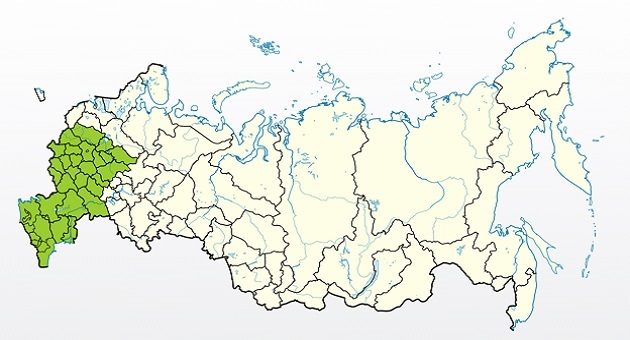
Growing regions
- North Caucasus.
- Crimea.
- European part of Russia.
- Moscow region.
- Leningrad region.
Origin
The United States, specifically West Virginia, near Charleston, is considered the homeland of this variety. There are several theories about its exact origin. According to one theory, at the very beginning of the twentieth century, amateur breeders unexpectedly discovered a hybrid resulting from the accidental (spontaneous) pollination of the Grims Golden and Reinet Golden varieties.
Another theory is that the variety is simply a clone of the Delicious Red apple tree, as the shape, size, and skin color are very similar. Some biologists cite Wagner, Idared, Jonathan, and many others as the variety's "parents." Reliable information regarding the apple tree's origins has never been found.
The variety's name is no coincidence. Literally translated from English, the name Red Chief means "red chief" or "chief of the Redskins." This is a common expression in North America, directly related to the American Indians. Many believe the apple tree was named for the deep red color of its fruits.
The apple tree was registered in the United States in 1914, after which it began its triumphant march around the world. It was first introduced to Europe, Australia, Asia, South America, and even Africa. The variety was first brought to Russia no earlier than the late 1970s, but it did not become widespread due to the abundance and diversity of domestic apple varieties. It was only in 2016 that it was added to the State Register and zoned in the aforementioned regions.
Content
Description of the Red Chief apple variety
 Despite a delay in its popularization in our country of more than a century, it is confidently joining the ranks of already well-known and beloved apple trees. The Red Chief's unique properties and qualities have finally been duly appreciated, as it is truly easy to grow, undemanding of soil and fertility, and highly productive.
Apples emerge on the branches soon after planting. They are delicious and beautiful, and they can be stored in the cellar for long periods without changing their taste or appearance. These large fruits are easy to transport even over long distances. They are recommended for growing in large, intensive industrial orchards, as well as in small garden plots.
Apples: What they look like
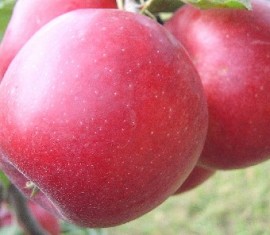
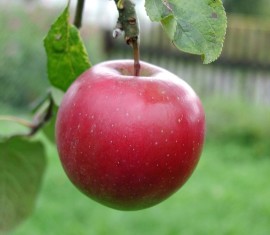
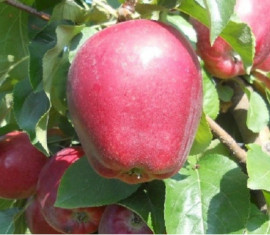
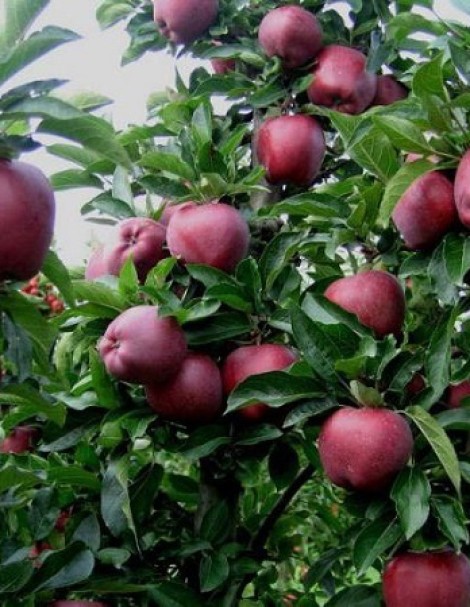
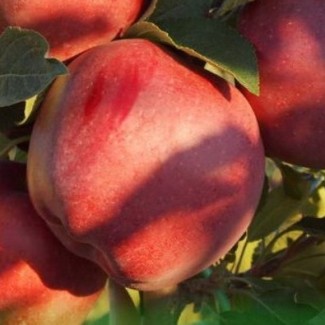
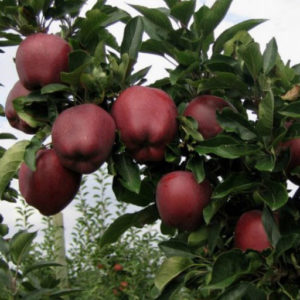 The fruits are large to very large, typically reaching approximately 180-250 grams, but with good care and favorable weather and climate conditions, they can reach 245-300, or even 450 grams. They are smooth, rounded-conical, slightly elongated, and very attractive. The ribbing is clearly visible, wide and smooth, most noticeable at the tip. There is a distinct lateral suture and a grayish-blue, very dense waxy coating at full maturity.
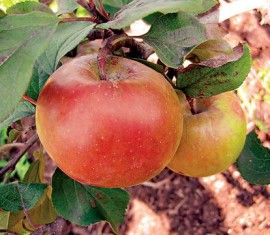
The skin is glossy, shiny, elastic, strong, and dense, but not thick or tough; it cracks easily when strained. It has a uniform green or greenish-yellow color, but this can only be seen on unripe fruits, as it is almost 90-98% covered by a blush of beetroot, burgundy, or dark red. If you look closely, you can discern slightly distinct stripes and specks, varying in shade. Subcutaneous punctures are numerous, light, and very visible on the surface, evenly distributed and large. The chemical composition can be assessed by the following indicators:
- Titratable acids – 0.38%.
- Sugars (fructose) – 10.5%.
- Pectins (fiber) – 14.1%.
- Ascorbic acid (vitamin C) – 5.7 milligrams.
- P-active substances (catechins) – 218 milligrams.
The flesh is white, slightly greenish or creamy, but usually without any off-colors. It is fine-grained, medium juicy, not prickly, with a pleasant consistency, more delicate, and aromatic, but not overly sour. The flavor is considered dessert-like, more sweet, but with a slight tartness in the aftertaste. It is not considered balanced or harmonious because it is a bit bland, but tasting experts rate it 4.7-4.8 out of 5 for both flavor and appearance.
Red Chief apple tree: characteristics
Crown and root system
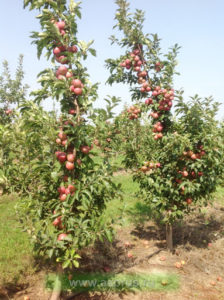 The variety is considered tall, since without formative pruning it usually reaches at least 6-8 meters, and sometimes even stretches up to 9-10However, most experienced gardeners limit the tree to 5-6 meters to facilitate harvesting and maintenance of the trunks. The trees naturally develop a round or oval crown and are not prone to becoming dense. The shoots are long, curved, and covered with smooth, shiny, gray-green or brown-green bark, pubescent in some areas. Fruiting is concentrated on the rings.
The leaves are medium to large, elongated, oval, leathery, smooth, medium matte, and short-pointed. They are bright green or rich green. The leaf edges can be slightly wavy, serrate, and serrated, with delicate nervation. The root system is extensive and fibrous, occupying a considerable amount of soil space and adapted to seeking water at medium levels.
Productivity and pollination
Red Chief is considered an early-fruiting, high-yielding variety, which is why it's loved by most gardeners. Just one apple tree can provide all the fruit needed for a family of three during the cold season.
From one fully mature and formed tree trunk, you can easily harvest 160-220 kilograms of apples per season, depending on care, climate and weather..
While the tree's yield is encouraging, many cite its self-sterility as one of its main drawbacks. This means that Red Chief apple trees require nearby (55-80 meters) apple trees of other varieties with suitable flowering times for cross-pollination. To attract insects to the garden, gardeners use mobile apiaries and spray the trees with sugar syrup.
Winter hardiness and disease resistance
The variety's resistance to low temperatures is rated as average. Suitable for regions with cool and variable weather conditions, such as Moscow region or the Leningrad Region, it is recommended to take all necessary preparatory measures and cover trees to ensure they survive the winter without problems. Temperatures below -27-32°C can pose a serious threat to tree trunks.
Disease resistance is average, but inconsistent. For example, it is rarely affected by powdery mildew, but scab Spotting can become a real nuisance during years of severe epiphytotics. Insects pose a moderate threat to apple trees. All this demonstrates the importance of prevention: promptly treat trunks with fungicides and insecticides, and remove rotting leaves and fruit from the root zone.
Rootstocks and subspecies
For over a hundred years, the Red Chief apple tree hasn't developed any subspecies, although it can be grown on various rootstocks. The most popular is growing on semi-crowns. This results in more compact trees, reaching barely 2.5-3 meters, significantly reducing space requirements for commercial plantings. The fruit grows somewhat larger, but there are some drawbacks. The root system of these plants is located shallow below the soil surface, making them susceptible to wind damage and requiring support.
Features of growing Red Chief
 Landing
 Landing
Basic conditions
- To plant a seedling, choose a location that is as sheltered as possible from strong northerly winds and receives full sun throughout the day. In the shade, the variety does not thrive, grows weakly, produces small and tasteless fruit, and in drafts, it becomes susceptible to disease and often even dies.
- The soil for planting should be slightly acidic and fertile, but you won't have to worry too much about it. Red grows well in loam or sandy loam, and even in rocky soil, as long as it's fertilized regularly and timely.
- The groundwater level should not rise more than 2.5-3 meters to prevent the tree's roots from reaching it. Otherwise, it may rot and die.
- There's no need to prepare planting holes for this variety in advance, as is done with other varieties. Simply dig them 5-15 days in advance, making them 60-90 centimeters deep, filling them with fertile soil, drainage, and a small amount of water (20-25 liters).
- Root collar It is always recommended to leave the surface above the horizon, especially if you do not want to lose the properties of the rootstock.
- The trees are suitable for compact planting, meaning no more than 3-3.5 meters can be left between trees in a row, and 4-4.5 meters between rows. Even this distance is enough for them to grow comfortably and produce abundant fruit.
- The sapling is placed vertically, a stake or plank is driven into the north side for tying, and the roots are carefully spread out, even trimmed if necessary. The tree is covered with soil, compacted in layers, but not too tightly. The surface is watered with 25-35 liters of water and mulched with sawdust, manure, and compost to prevent weed growth and retain moisture.
Landing dates
Red Chief can be planted in spring or fall; it doesn't make much of a difference. The main thing is to ensure the young tree doesn't freeze during the return frosts or the first frosts. Therefore, the timing must be appropriate. In spring, it's best to transplant the variety into the soil in April, and in fall, about a month before the onset of cold weather. The further north the growing region, the better.
Tree care
Protection from frost and rodents
 Protection from frost and rodents
Standard winter protection measures are sufficient for this variety to thrive during cold weather. The root zone is covered with soil, dry leaves, straw bundles, spruce branches, and hay mats. Dwarf and semi-dwarf varieties can be easily covered with a tent-like covering.
To drive insects out of cracks and chips in the bark, you need to whiten Tree trunks should be fertilized twice a year. This can be done in early spring and late fall. Rodents are usually repelled by coating the trees with melted animal fat, drying oil, or grease.
Pruning: simple crown shaping
The variety isn't prone to excessive density, so pruning won't require much effort. In the first few years, the central trunk is shortened and 2-4 skeletal branches are formed, which should be gradually reduced in length. Subsequently, simply trim the overgrown shoots proportionally by a third of their growth, and remove suckers (upward shoots) and those growing inward, thus creating a denser crown.
The crown should be regularly inspected for diseased, damaged, or dead branches. If any are found, they are immediately cut back, generously, and the cuts are sealed with garden pitch. Rejuvenation is usually not performed, as an apple tree's active lifespan is approximately 20-30 years. However, if desired, 2-3 old branches can be removed between the 15th and 18th years, which will slightly extend the fruiting period.
Pollinator varieties
- Elstar.
- Delicious golden.
- Idared.
- Wagner.
- Gloucester.
- Honey Crips.
Reproduction
- Growing from seeds.
- Rooting.
- Kidney grafting.
- Cuttings.
Diseases and pests
- Powdery mildew.
- Black crayfish.
- Scab.
- Green aphid.
- Codling moth.
- Scale insect.
- Hawthorn.
Ripening and fruiting of Red Chief
The beginning of fruiting
 The beginning of fruiting
The crop is extremely precocious; it can begin producing blossoms even in the nursery. However, it's customary to pluck them immediately. The first harvest can be obtained 2-3 years after planting in open ground. At this point, you'll only be able to harvest 7-12 kilograms of apples, but that's plenty for a sample.
Flowering time
The tree begins to bloom buds rather late, around the second half of May. However, climate and weather conditions play a significant role. If the spring is early and warm, flowering may begin much earlier, while if the spring is warm, it may begin later. Red Chief's buds are a distinct, beetroot-red hue, but once they open, the petals turn a delicate white-pink. They are fleshy and beautiful, and the flower itself is saucer-shaped and fragrant. The flowering process lasts approximately 10-14 days, after which the ovaries form.
Fruiting and growth
The tree's natural growth is considered average, although it may barely reach 8-12 centimeters in height in a season. However, it begins to stretch after fruiting begins, and in the first couple of years, it can reach two or even three meters. Yields increase gradually, but quite quickly. By the seventh or eighth year, you can harvest around a hundred kilograms of beautiful fruit.
Apples reach technical maturity in late September or even early October, when they develop a thick waxy coating. This is the key to determining the right time for harvesting. Consumer ripeness, when the sugars are fully caramelized, occurs after 15-25 days. Only then do apples acquire their unique, pleasant flavor and optimal juiciness. They can be stored in an ideal cellar for seven months until the next harvest.
Top dressing
- Mineral complexes.
- Peat.
- Humus.
- Superphosphate.
- Chicken manure.
- Ammonium nitrate.
- Compost.
- Manure.
What to do if it doesn't bloom or bear fruit
- Provide feeding and fertilizers.
- Check for pests and diseases.
- Transplant.
Why do apples fall?
- Wind, hail, hurricane, rain.
- Pest damage.
- They are very overripe.
- Diseases.
Please leave your feedback on the Red Chief variety, giving other gardeners the opportunity to gain ideas on how to improve the cultivation of these apple trees and obtain maximum yields.