
Slavyanka apple tree: characteristics of the variety and care
| Color | Greens |
|---|---|
| Ripening season | Autumn |
| Size of apples | Average |
| Taste | Sweet |
| Crown type | Average tree height |
| Shelf life | High shelf life |
| Application | Universal variety |
| Winter hardiness | High winter hardiness |
| Fruiting age | Up to 5 years |
 History of origin and regions of growth
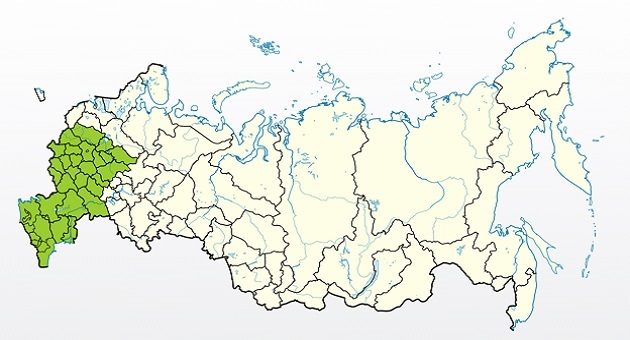
Growing regions
- Middle zone.
- Crimea.
- North Caucasus.
- Some northern regions.
Origin
Few varieties over a hundred years old can boast such recognition and popularity as Slavyanka. As early as the late nineteenth century, the renowned Russian scientist and breeder Ivan Vladimirovich Michurin, known throughout the world, conducted experiments on the Antonovka variety, attempting to maximize its performance. After pollinating it with the pollen of the pineapple scaly, a seed was obtained, which was planted in open ground in 1890.
The seedling began to grow vigorously, and its first harvest arrived exactly seven years later. Michurin continued his observations, which he carried out for three decades. He eventually noted the high consumer and commercial quality of the fruit and the tree's care and weather requirements, which were well suited to the temperate climate. The variety was never entered into the State Register and never received official zoning, but it is grown almost everywhere in the aforementioned regions.
Content
Description of the Slavyanka apple variety
 Old apple varieties are increasingly being replaced by new, more promising ones, each with unique qualities, but not this one. Slavyanka possesses truly enviable winter hardiness, easily enduring even the harshest winters, quickly begins bearing fruit, and requires no additional pollinators.
The fruits are tasty, aromatic, and store very well, practically until the next harvest. Therefore, even with the risk of crop shattering and fruit shrinkage due to insufficient fertilization, Slavyanka is recommended for growing not only in small private plots but also in intensive commercial orchards.
Apples: What they look like
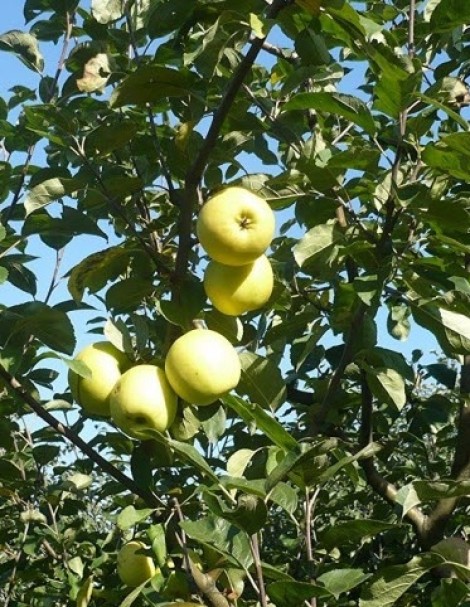
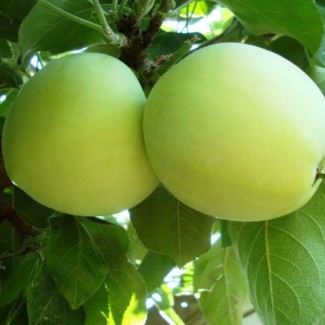
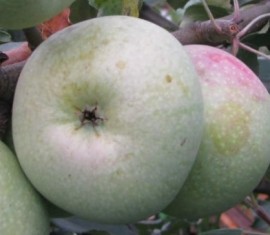
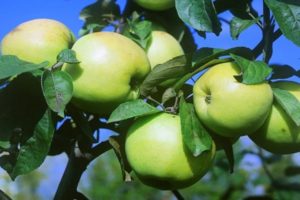 Most fruits are medium or slightly smaller than average in size. Fruit weight ranges from 75-130 grams, but can be slightly smaller or larger in different years. They are typically round-elongated, slightly flattened, or onion-shaped, smooth, with mild to moderate ribbing that is clearly visible. Sometimes a visible lateral suture is present. These characteristics directly depend on the rootstock and care.
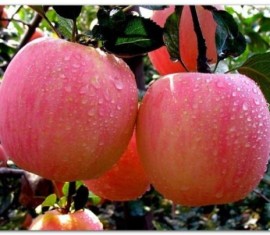
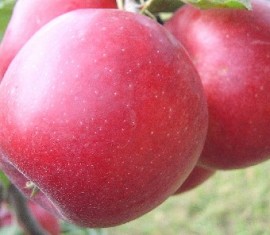
The skin is dense, glossy, and has a clearly visible oily coating, turning green or greenish-yellow when ripe. The blush appears as pale, blurred, streaky spots, barely noticeable, scarlet, pinkish, or carmine-red, which appear on the sunny side. Subcutaneous spots are light, numerous, grayish-green, and clearly visible. The chemical composition is characterized by the following indicators per 100 grams:
- P-active substances (catechins) – 289 milligrams.
- Ascorbic acid (vitamin C) – 7 milligrams.
- Total sugars (fructose) – 10.8%.
- Pectins (fiber) – 13.8%.
- Titratable acids – 0.46%.
The flesh is dense, crisp, white or slightly greenish-cream, fine-grained, and juicy. The texture becomes more fluffy with storage. The flavor is considered dessert-like, harmonious, and balanced; it's sweeter, but with a characteristic light and pleasant tartness in the aftertaste. According to professional tasting reviews, Slavyanka apples score 4.4 and 4.5 points for taste and appearance, respectively.
Slavyanka apple tree: characteristics
Crown and root system
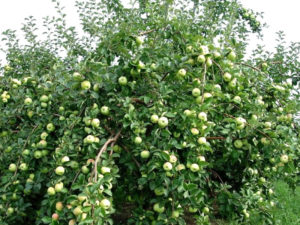 The variety is classified as a medium-sized tree. They stretch to a maximum of approximately 3.5-4.5 meters without additional formative pruning.However, most owners don't allow the tree to grow beyond 3-3.5 meters, as this makes it much easier to care for and harvest the fruit. The crown is compact, naturally broom-shaped, becoming spreading and sometimes even weeping over the years. The shoots are strong, thick, and straight, covered in reddish-brown or reddish-brown bark, which can acquire a steely sheen over time.
Slavyanka's leaves are small, leathery, dense, rounded underneath, and elongated with a long, pointed tip. They are green or dark green, matte, and sometimes have a slight bluish tint due to the pubescence on both the front and back. The root system is highly branched, robust, moderately deep, and may or may not have a central taproot, depending on the rootstock used. It is well adapted to water-seeking.
Productivity and pollination
The tree can't compare to the parent variety, but it's still considered a high-yielding tree. The fruit from these apple trees can truly provide for a family for an entire year.
One mature tree trunk can yield approximately 185-210 kilograms of delicious, aromatic apples with outstanding shelf life per season..
The variety is considered completely self-fertile. This means it doesn't need other apple trees nearby to produce fruit. If the weather is windy and the bees are actively swarming around the flowering trees, the harvest will certainly be more abundant. Therefore, it's common to plant the trees near an apiary, use portable varieties, and spray the trunks with sugar syrup diluted with water.
Winter hardiness and disease resistance
Slavyanka is very tolerant of low temperatures, and most importantly, to sudden fluctuations even over short periods of time. Trees tolerate frosts down to -38-42°C well, rarely sustain damage, and recover fairly quickly. If you properly cover them for the winter, you won't have to worry about them at all.
Apple trees also have an enviable resistance to various types of fungal apple infections. They are extremely rarely affected. scab, rot, powdery mildew, and other unpleasant diseases. But even if the trees become diseased, the damage primarily affects the foliage, and the fruit remains edible. Nevertheless, regular preventative treatments certainly won't hurt. Pests can seriously damage apple trees, so it's recommended to treat them with insecticides promptly.
Rootstocks and subspecies
There are no subspecies of this weed, and most likely, there won't be any. However, it is commonly grown on a wide variety of rootstocks. Moreover, many of the tree's properties change depending on these. For example, apple trees grafted onto wildings are much more frost-resistant and can even be grown in the Far East. Dwarf and semi-dwarf varieties produce somewhat larger fruits, and the crown is more compact.
Features of growing Slavyanka
 Landing
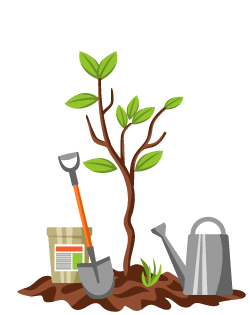 Landing
Basic conditions
- To ensure a good and abundant harvest, it's important to choose the right location for planting Slavyanka. It prefers open, sunny spaces, but not drafty ones.
- Avoid planting this variety in low-lying areas where cold air stagnates or meltwater accumulates. Ideally, the groundwater level should be at least 3-3.5 meters above the horizon. Similarly, avoid planting trees near rivers, springs, lakes, ponds, and shallow wells.
- Soil It can be grown in any soil, from rocky to black soil; the variety grows well in sandy loam or clay loam. The main thing is that the soil isn't overly acidic, which is easily corrected with lime.
- Planting holes are prepared in the fall or spring, but if the time has passed, they can be prepared 3-5 weeks before planting. For this, dig holes 60-70 centimeters deep and 70-90 centimeters in diameter. Add soil and fertilizer to the bottom, cover with drainage, and then fill with water (25-40 liters). Leave the holes uncovered.
- Stakes are immediately dug into the holes, to which the seedlings are then tied. They are made of plastic, metal, or wood.
- During planting, the root collar should remain above the surface by at least 8-10 cm; this will prevent rooting above the rootstock.
- Place the seedling on a drainage surface, cover with soil, and compact it lightly with your hands, but not too much. Avoid creating air pockets around the rhizomes, as this can cause root rot. After this, water the trees with 10-25 liters of water, and mulch the surface with a suitable material.
Landing dates
Trees are planted in spring and fall, and the climate of the region will play a major role. For example, in southern regions, it doesn't matter whether you plant Slavyanka in March-April or September-October. The key is to allow at least 2-4 weeks after the last frost or before the first frost. In harsher climates, spring planting is preferable, so the tree has time to fully adapt to the environment by fall.
Protection from frost and rodents
In the temperate climates of central Russia, southern Russia, Crimea, or the North Caucasus, virtually no frost protection is needed. Although standard burlap wrapping around the trunk certainly won't hurt. However, further north, it's best to cover the root zone with grass or straw mats, or simply pile up a 10-25 centimeter layer of soil.
Hungry mice, hamsters and hares They readily nibble young bark and even small, tender branches, so it's best to coat the trunks with grease or lard in the fall. To repel insects that nest in bark crevices, whitewash the trunks regularly in the fall and spring.
Tree care
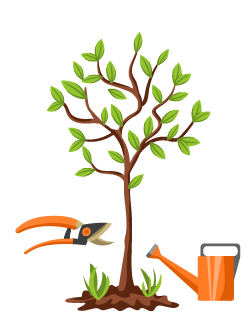 Tree care
Loosening the soil, watering: proper agricultural technology
Like any fruit crop, Slavyanka loves oxygen-rich soil. Therefore, hoeing around the trunk can be done quite frequently, removing weeds and other plants along the way. Dig the area around the trunk no more than twice a year, and then carefully, so as not to damage the roots that run shallowly beneath the surface.
It's best to water young trees fairly frequently, using the 10-day rule as a guide. This means that if there's been no rain for ten days, water should be added. If natural precipitation does occur, count back ten days before watering.
Pruning: simple crown shaping
Even novice gardeners usually encounter no difficulties with pruning. The tree naturally forms a perfectly rounded or broom-shaped crown; maintaining it is sufficient. To do this, shorten the central conductor by a third in the first year, and trim the skeletal shoots further by 5-8 centimeters.
Necessary sanitary pruning can be carried out in spring and fall. At this time, all damaged, diseased, and dead branches are removed, along with those growing inward and vertically upward. Rejuvenation pruning, which involves pruning two or three mature branches to promote new growth, can begin around 15 to 18 years of age, not earlier.
Pollinator varieties
- Antonovka ordinary.
- Granny Smith.
- Cinnamon Striped.
- Rennet.
- Pepinka.
- Saffron pepin.
- Chinese Bluffler.
Reproduction
- Rooting cuttings.
- Grafting by buds and cuttings.
- Growing from seeds.
- Clones (layering).
Diseases and pests
- Powdery mildew.
- Cytosporosis.
- Fruit rot.
- Scab.
- Cytosporosis.
- Tinder fungus.
- Green aphid.
- Codling moth.
Ripening and fruiting of Slavyanka
The beginning of fruiting
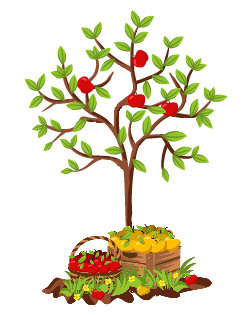 The beginning of fruiting
The variety is considered early-bearing, as the first flowers can be seen on the branches as early as 2-3 years after planting. However, they will be few in number, and they rarely produce single fruits. The first harvest is usually around 4-6 years after planting, yielding approximately 5-15 kilograms of beautiful and delicious fruit.
Flowering time
Slavyanka blooms beginning in the second ten days of May, but the further north the growing region, the closer to the end of the month it may bloom. In some cases, it can open buds as early as early June, but this is rare. The blooming process lasts 10-16 days, depending on the weather; the sunnier the weather, the sooner the blooming will end. The flowers themselves are large, fragrant, saucer-shaped, white or slightly light green, and are borne in small clusters on the branches.
Fruiting and growth
The trees are considered medium-vigorous, although they can easily reach 40 to 75 centimeters in height per year. Therefore, they reach their maximum size quite quickly. Fruit production also increases. By 8 to 12 years, a full harvest of two hundred kilograms can be harvested. Fruiting is regular, with no rest periods. If such periods occur, it means your tree is under attack by pests or diseases.
In mid-September, apples can already be picked in southern regions, keeping in mind that this is only technical maturity. In harsher conditions, the ripening process can drag on until around mid-October. Fruit drop is average; they need to be very overripe to fall to the ground. Consumer maturity occurs around late December or even early January. Apples store well, maintaining their quality, but around late May or early July, they may lose their firm texture and pleasant flavor, becoming bitter, mealy, crumbly, sour, and lacking in juice.
Top dressing
- Compost.
- Mineral complexes.
- Humus.
- Superphosphate.
- Ammonium nitrate.
- Manure.
What to do if it doesn't bloom or bear fruit
- Check for pests and diseases.
- Transplant.
- Limit watering.
Why do apples fall?
- Very overripe.
- Natural factors.
- Pests.
- Diseases.
Leave your feedback on the old Slavyanka variety to share your experiences with professional and amateur gardeners.





Comments
It's not a particularly popular variety, but many people in our village near Tula grow it, and it's easy to grow. The most remarkable thing about it is that the apples ripen bright green and taste very sweet—a deceptive appearance... Incidentally, they're very cold-hardy, even frost-resistant, so we harvest them as late as the fall.