Apple tree "Memory of the Warrior": characteristics of the variety and care
| Color | Reds |
|---|---|
| Ripening season | Autumn |
| Size of apples | Large |
| Taste | Sweet and sour |
| Crown type | Average tree height |
| Shelf life | High shelf life |
| Application | Universal variety |
| Winter hardiness | High winter hardiness |
| Fruiting age | From 5 years old |
 History of origin and regions of growth
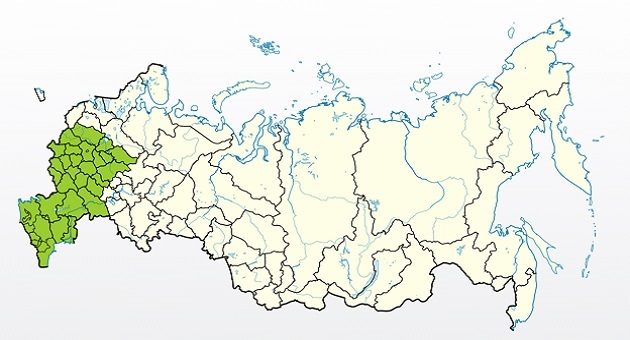
Growing regions
- Middle zone.
- Some northern regions.
- South of Russia.
- Crimea.
Origin
To create this variety, a method called distant hybridization, developed by the great Russian breeder Ivan Vladimirovich Michurin, was used. The principle is simple: parental pairs are created from apple subspecies growing in geographically distant regions. In 1959, scientist Yevgeny Nikolayevich Sedov created a new hybrid between the Antonovka Obyknovennaya variety, well-known and beloved by all Russian gardeners, and the American Welsh variety.
By 1979, the variety had become an elite one, thanks to its high yield, late ripening, and excellent shelf life. In 1997, the decision was made to include it in the state register. At the same time, it was zoned for the Central Black Earth District, which encompassed just six regions: Lipetsk, Voronezh, Kursk, Tambov, Belgorod, and Oryol. In reality, the apple tree has spread much more widely than the aforementioned regions.
Content
Description of the apple tree variety "Memory of the Warrior"
 Apples: What they look like
 Apples: What they look like
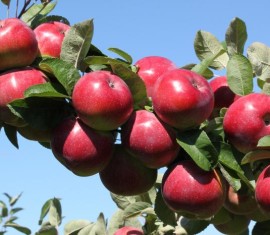
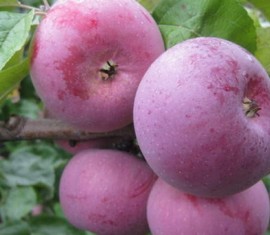
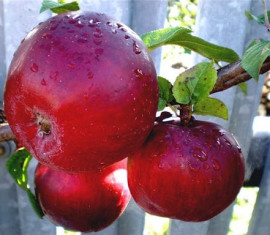
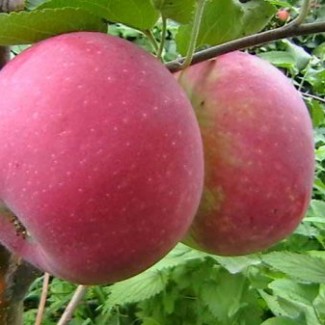
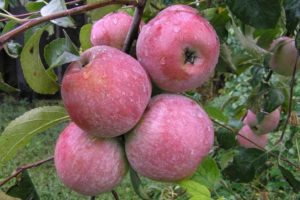 The fruits are generally perfectly round, slightly flattened, but can also be very flattened. They are generally uniform in size with subtle ribbing. They are medium to medium-large, with an average apple weighing 150-170 grams, but sometimes reaching 200-220 grams in favorable years.
The skin is dense, dry, and free of any oily or waxy coating. It may be slightly rough to the touch, dull, and green when unripe, later turning greenish-yellow. The blush is striped and streaked, spotted and diffuse, bright red, beetroot-burgundy, or pinkish-raspberry in color, and covers approximately 70-90% of the surface. Subcutaneous dots are numerous, small, grayish-green, and poorly visible against the striped and spotted skin. The chemical composition is best characterized by the following indicators per 100 grams:
- P-active substances (catechins) – 153 milligrams.
- Ascorbic acid (vitamin C) – 8.6 milligrams.
- Total sugars (fructose) – 10.9%.
- Pectins (fiber) – 9.9%.
- Titratable acids – 0.47%.
The apple flesh is dense, medium-firm, prickly, fine-grained, very juicy, and aromatic. It is most often white or has a slight greenish tint, and can become lemon-colored when fully ripe. The flavor is sweet and sour, considered a dessert-like, harmonious, and balanced table apple. A professional tasting score of 4.6 out of 5 is given for appearance and taste.
Apple tree "Memory of the Warrior": characteristics
Crown and root system
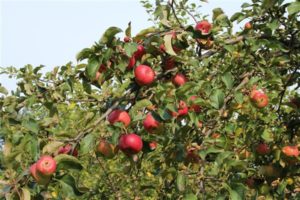 The tree is considered tall, as it can easily reach 6-7 meters in height. However, to simplify care and harvesting, most gardeners limit apple trees to a maximum of 4-5 meters. When young, the crown can be broom-shaped or inverted pyramidal. Over the years, it becomes broadly oval or spherical, with moderate density. Most shoots extend from the trunk at an acute angle, which often leads to splitting, so the branches need to be supported during the fruiting season. The shoots are thick, straight, and covered with cherry-brown bark, which can crack and crumble over time.
The leaves grow quite densely on the branches. They are leathery, dense, wrinkled, glossy, long-pointed, elongated, and shiny, with a slight drooping on the back. They have a rich green or bright green hue, as well as a serrated, jagged edge, and sometimes folded into a boat-like shape. The root system is highly branched, medium-deep, adapted to seeking water, and may or may not have a central taproot.
Productivity and pollination
The variety is considered high-yielding, although it is not comparable to such famous apple trees as Antonovka An ordinary one can't compare to it anyway.
One tree can easily produce 115-130 kilograms of aromatic, tasty fruits per season, which are stored well in suitable conditions..
Pamyat Voinu is considered a relatively self-fertile variety with a low yield when self-pollinated. If there are no other apple trees within a 50-100 meter radius that are blooming at the appropriate time, you'll likely get no more than 5-15% of the maximum possible yield. Therefore, it's common to interplant them with other varieties, and to also bring mobile apiaries to the plantings.
Winter hardiness and disease resistance
Experts describe the tree's resistance to low temperatures as average. It can even withstand temperatures as low as -27-30°C. However, this only applies if the apple tree is properly prepared and covered for the winter. In mild climates, such as Crimea or the North Caucasus, simply protecting it from drafts is sufficient. In harsher northern regions, it's better to cover the trees thoroughly.
Pamyat Voinu is quite resistant to scab and is rarely infected. The disease is inactive, primarily affecting the leaves, while the fruit remains edible. However, other diseases, just like insects, can seriously damage the variety. Therefore, it's advisable to regularly and promptly treat the trunks with insecticides and fungicides, while also taking other sanitary measures.
Rootstocks and subspecies
The subspecies of this variety are still unknown, as it only received official breeding achievement status only recently, just over two decades ago. However, it can be grown on various rootstocks. Clonal and standard rootstocks are most commonly used, as they provide the tree with the greatest winter hardiness. However, dwarf and semi-dwarf varieties can also be used, as these trees begin bearing fruit earlier and grow much more compact, significantly simplifying the gardener's life.
Features of growing Memory of a Warrior
Landing
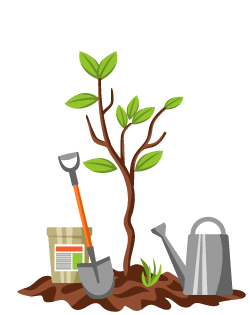 Landing
Basic conditions
- Choosing the right planting location guarantees rapid growth and high yields. Lighting is crucial. Choose only a spot where the sun will warm the crown. In the shade, trees will be weak, with thin branches, and the fruit will be few and small.
- Apple trees should not be planted where the groundwater level is higher than 2-2.5 meters. The Pamyat tree's roots will inevitably reach the water and begin to rot. Therefore, the banks of lakes, rivers, or ponds are not suitable for this plant; even the proximity of a shallow well can lead to its death.
- Seedlings, especially young 2-3-year-olds, don't tolerate drafts. They begin to get sick, and the onset of fruiting is significantly delayed.
- It's best to prepare planting holes in advance, in spring or fall, but 3-4 weeks in advance is also possible. To do this, dig holes 80 centimeters deep and about one meter in diameter with steep walls. Place some of the topsoil mixed with a small amount of fertilizer at the bottom, then add drainage (rocks, gravel, broken bricks), and pour 25-40 liters of water over the entire hole. Leave the holes outdoors.
- Before planting, the rhizomes of the seedlings are inspected, cutting off all damaged, broken or dry shoots with garden pruning shears, and immersed in warm water for 4-5 hours.
- The holes should be located at least 4-4.5 meters apart from each other so that mature trees do not conflict with roots or crowns.
- Immediately before planting, drive metal or wooden stakes into the holes for support. These stakes should not be removed until the tree is four or five years old. The stake should be positioned on the north side of the trunk.
- The root collar of the tree should be approximately 7-13 centimeters above the surface to prevent it from rooting higher. This will negate all the properties of the rootstock.
- The seedling is placed in the hole, the rhizome is carefully straightened, sprinkled with soil and tamped down by hand in layers, so that soil The soil should be compacted sufficiently, but not too tightly. You shouldn't pack the soil to the point of asphalt, but even poor compaction will lead to erosion and expose the upper roots.
Landing dates
You can plant Pamyat Voinu (Memory of the Warrior) in either spring or fall. In the former case, choose a time when frosts are past, but sap flow and bud break have not yet begun (late March or early April). In the latter case, it's best to wait until the leaves have fallen, but make sure there are still about 3-4 weeks before frost (late September or early October). Closed-root trees can be transplanted to open ground at any point during the growing season.
Protection from frost and rodents
Apple trees should be prepared for winter in late summer or early fall. The harsher the climate, the sooner watering should be stopped. Otherwise, the trees won't have time to stop the flow of sap in their trunks before frost sets in. In colder regions, soil is piled onto the root zone or straw mats are thrown. The trunks are wrapped with agrofibre, burlap, or any other suitable material at hand, even old nylon tights. In some cases, covering the trunks with a tent is acceptable.
To prevent insect damage to trees, the trunks are whitewashed in the fall or spring with ordinary lime, to a height of approximately 1-1.2 meters. To repel rodent pests, they can be coated with grease, professional industrial products, or rendered lard.
Tree care
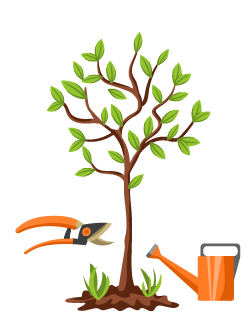 Tree care
Loosening the soil, watering: proper agricultural technology
Maintaining the trunk area is essential for the Pamyat Voinu variety. Regularly, at least twice a year, dig it carefully to avoid damaging the roots, and hoe the surface the rest of the time. Weeds, root suckers, and shoots from other plants can be removed as needed. It's optimal and advisable to regularly mulch the surface with straw, chopped grass, compost, or any other suitable material to retain moisture and prevent weed growth.
Watering is usually done several times during the growing season, starting around the time budding begins. It's best to stop when frost is 6-8 weeks away. A mature tree should be watered approximately every 2-3 weeks during dry, hot weather. Fertilizers can be added along with the water to ensure better absorption.
Pruning: simple crown shaping
To ensure a uniform crown and ultimately maximum fruiting, regular pruning is necessary. In the first year, prune the central conductor by one-third, then leave only 2-4 scaffold branches, which should be even shorter by 5-7 centimeters and spaced widely apart in tiers. Subsequently, you will need to remove shoots growing inward or suckers (those protruding vertically).
Regular sanitary pruning will also be necessary in the fall and spring. This involves removing all dead, diseased, or damaged shoots. Rejuvenation pruning can be performed starting in the 8th to 10th year, removing 2-3 mature branches.
Reproduction
- Rooting cuttings.
- Grafting by buds and cuttings.
- Clones (layering).
- Growing from seeds.
Diseases and pests
- Moniliosis.
- Scab.
- Powdery mildew.
- Green aphid.
- Codling moth.
Ripening and fruiting in memory of the warrior
The beginning of fruiting
 The beginning of fruiting
The apple tree is considered an early-bearing tree, although it only begins to bear fruit around the fourth, but usually the fifth, year after planting in open ground. However, the yield at this time leaves much to be desired, as you can harvest no more than 5-15 kilograms of delicious, shelf-stable fruit. However, this is enough to understand the variety.
Flowering time
Like most apple trees, Pamyat begins to bloom around mid-May in warm regions and towards the end of the month in cold climates. More precise data will have to be determined experimentally, as prevailing weather conditions will play a significant role. The variety's flowers are almost flat, saucer-shaped, large, and intensely fragrant, gathered in small inflorescences. They have a beautiful pink hue, giving the tree a decorative appearance when in bloom.
Fruiting and growth
The tree grows at a moderate rate, gaining approximately 25-50 centimeters per year. The growth rate accelerates before fruiting begins, then slows slightly. Fruit production also increases gradually, and full harvests can be achieved by the age of 9-10. The average active lifespan of a tree is at least fifty years, perhaps longer. During this time, the apple tree bears fruit regularly, without resting.
The harvest is usually around late September or early October. Almost all the fruits ripen simultaneously, so the harvesting process doesn't take long. On average, under good storage conditions, the fruit can be stored without losing its flavor or marketability for approximately 6-7 months, and sometimes until the next harvest, which is why the "Memory of the Warrior" is so prized.
Top dressing
- Superphosphate.
- Compost.
- Potash fertilizers.
- Humus.
- Ammonium nitrate.
- Manure.
What to do if it doesn't bloom or bear fruit
- Check for pests and diseases.
- Transplant.
- Limit watering.
Why do apples fall?
- Overripe.
- Natural factors.
- Pests.
- Diseases.
Leave your feedback on the winter-hardy Pamyat Voinu variety to share your experience with others.