Apple tree Bashkir beauty: features of the variety and care
| Color | Reds , Striped |
|---|---|
| Ripening season | Autumn |
| Size of apples | Average |
| Taste | Sweet and sour |
| Crown type | Average tree height |
| Shelf life | High shelf life |
| Application | Universal variety |
| Winter hardiness | High winter hardiness |
| Fruiting age | Up to 5 years |


 History of origin and regions of growth
Growing regions
- Bashkortostan.
- Tatarstan.
- Mari El.
- Vologda Oblast.
- Orenburg region.
- Moscow and Moscow region.
- Kirov region.
- Samara region.
- Volga region.
*In Bashkortostan, in 2018, the Bashkir Beauty orchards occupied about a quarter of the total area of apple orchards.
Origin
There's a fascinating story behind the origins of this variety, which purports to be true. In the first half of the nineteenth century, a retired officer named Sergei Evgenievich Topornin commissioned a visiting French architect to build him an estate on the banks of the Belaya River, approximately 70 kilometers from Ufa (Bashkortostan). A large orchard containing several hundred apple trees was also planted there.
In ancient documents, the variety is universally referred to as the Bashkir Beauty. However, after the Revolution, it was decided to give it the feminine gender, by analogy with the word "apple tree."
By the end of the century, the estate, along with its orchards, belonged to Innokenty Mikhailovich Gribushin, who further expanded the garden. Within a few decades, the Bashkir Beauty was already bearing fruit successfully in all the surrounding farms. Whether Gribushin developed the variety himself or simply found it in the orchard he had already purchased remains unknown.
With the advent of Soviet power, a pomological center of the Bashnarkomzem was established on the estate. In 1928, apple trees of this variety were studied, described, and added to the State Register by breeder Vasily Strelyaev.
Content
Description of the apple tree variety Bashkir Beauty
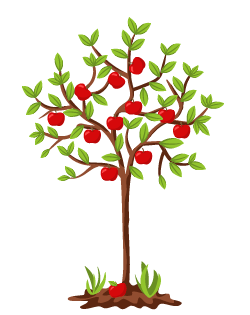 Every gardener dreams of growing a consistently fruitful apple tree that produces a substantial harvest even in the most unfavorable years. The Bashkir Beauty is one such example. It adapts well to even the harshest weather conditions and is particularly easy to care for. Apple trees are grown both in small gardens and in large orchards on an industrial scale, and the apples often appear on the covers of gardening magazines.
Apples: color, size, weight
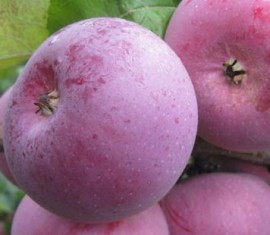
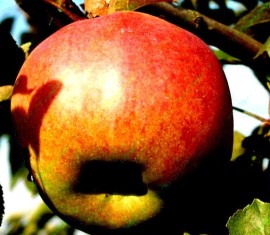
 The fruits of this apple tree are medium-sized, typically weighing no more than 110-140 grams. The apples are nearly uniform in size, round or broadly conical, slightly flattened, with barely noticeable ribs.
The skin is predominantly greenish. During ripening, it becomes covered with a light (approximately 40-55%) red blush. The skin is quite rough, dense, and easily damaged, making the fruit excellent transporters. The surface has a waxy coating, giving the apples a bluish tint. The fruit can be characterized by the following chemical parameters per 100 grams:
- P-active substances – 127 milligrams.
- Ascorbic acid (vitamin C) – 11.5 milligrams.
- Total sugars (fructose) – 12.2%.
- Titratable acids – 0.52%.
The flesh is very dense, sometimes difficult to bite into. It is white, crisp, and grainy, with a mild, slightly sweet flavor with a distinct fruity tartness and a pleasant apple aroma. The tasting score is 4.5-4.6 out of 5.
Apple tree Bashkir beauty: characteristics
Crown and root system
 The tree is considered medium-sized, and it barely reaches 5-6 meters in height if formative pruning is not performed. Although experienced gardeners prefer to limit the growth of the Bashkir Beauty to 3-4 meters for ease of harvesting and tree care. In young seedlings and in the first years after rooting crown It has a spherical shape. Over the years, it becomes spreading and medium-dense. It can cover an area 4-5 meters in diameter.
Branches typically grow at a right angle to the trunk, preventing them from breaking off even with fairly heavy fruit yields. Young shoots are greenish-brown or simply brown, smooth, and shiny. Over time, they become cracked and turn brown. Apple tree leaves are large, oval, slightly pointed at the edges, and have serrated sides. They are smooth and leathery on top, and can be slightly fuzzy underneath.
Productivity and pollination
The yield of the variety is considered average, although these figures are significantly behind the undisputed leaders, for example, Antonovka (250-300 kilograms).
When young, apple trees produce 50-60 kilograms of fruit. Over time, the yield increases, and a mature tree can yield up to 70-120 kilograms.
To significantly increase the variety's yield, trees should be planted in close proximity to the apiary. Bashkir Beauty is considered self-sterile. This means that without other apple trees within reach of the insects for cross-pollination, no harvest will be possible.
Winter hardiness and disease resistance
The Bashkir Beauty variety was specifically bred to be adaptable to virtually any weather conditions. Its main advantage is its exceptional frost resistance. The apple tree can withstand temperatures as low as -35-38°C without losing its fruit. Moreover, even a cold summer will not hinder apple growth or affect fruiting.
Resistance to pests and common apple diseases is average. To protect apple trees from infestation, it's best to perform timely sanitary pruning and hygiene procedures, treat trunks and branches with suitable chemicals, whitewash them, and promptly remove fallen leaves and fruit from the tree's surrounding area.
Subspecies and rootstocks
By using different rootstocks and breeding techniques, scientists have managed to achieve early and late fruiting of apple trees.
| Subspecies | Description |
| Summer | This subvariety was developed using clonal semi-dwarf rootstocks. It is characterized by a spreading, expansive crown and a small height of up to 2-3 meters. This apple tree begins bearing fruit quite early, already in its third year. The fruits ripen by the first ten days of August. They have all the necessary commercial and shipping qualities, store well, and possess a distinctive flavor and aroma. |
| Late | The subspecies was obtained by crossing the Bashkir Beauty with the variety WelseyThese apple trees are grown on semi-dwarf, creeping, or dwarf rootstocks. The tree also has a rounded crown, but does not become spreading even at 20 years of age. Its apples grow larger than usual, up to 140-160 grams, while still possessing all the characteristics of the original variety. |
The fruits ripen much later, depending on the region, in September or early October. They keep well and are not damaged during transportation. Their only drawback is their rather weak aroma.
Peculiarities of growing Bashkir beauty
A tree's survival, subsequent yield, and fruit quality all directly depend on proper planting and subsequent care. Therefore, it's important to put in the effort to achieve truly excellent results.
 Landing
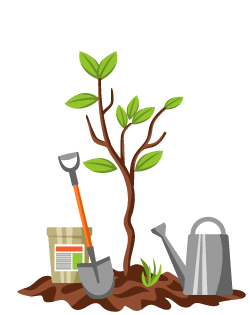 Landing
Key Features
- There's no specific soil requirement for the Bashkir Beauty. It grows well in loam, black soil, sandy loam, and any other soil. However, in poor soils, the tree will need to be fertilized more frequently to prevent the fruit from becoming smaller over time.
- This variety doesn't like drafts. Therefore, the planting site should be protected from wind. Building walls, large trees, hedges, and other structures are suitable as screens.
- This apple tree doesn't like proximity to groundwater or marshy areas; planting it near bodies of water is also not recommended. If there's no other option, ensure good drainage for the rhizome.
- If the roots dry out before planting, the seedlings can be immersed in water for 7-9 hours.
- The holes for the seedlings should be 60 centimeters deep and at least 70-80 centimeters in diameter. Preparing them in advance isn't necessary, but it certainly won't hurt. You can line the bottom with soil with a small amount of superphosphate and potassium sulfate.
- They need to be placed so that there is at least 4 meters between the trees.
- To provide the apple tree with support, stakes are immediately driven in on the north side, to which the seedlings will be tied. These stakes can be removed no sooner than after 3-4 years.
- The root collar is left at a height of 5-7 centimeters above the soil surface.
- Carefully cover the root system with soil, taking care not to compact it or press it down, as this variety prefers airy, soft soil. Later, if necessary, you can add a little soil if it settles. You can mulch the top with chopped leaves or horse manure.
To ensure that young seedlings take root well and bear fruit consistently every year, you need to choose those that have been rooted in greenhouse conditions for at least three years.
Landing dates
It's generally believed that planting Bashkir Beauty in spring or fall doesn't matter. However, experienced gardeners say there is a significant difference. Weak seedlings planted in early October may simply not have time to establish themselves before the first frost and may die. Therefore, it's best to choose three-year-old plants and plant them in April to ensure they have a good chance of establishing roots over the summer.
Protection from frost and rodents
The apple tree does not need any special protection from the cold, unless we are talking about the Far East or SiberiaEven after fairly severe frost damage, the tree quickly recovers and produces a normal harvest within a year. If necessary, you can cover the root zone with spruce branches or cover the trunks with straw, tar paper, or roofing felt.
To protect young trees from insect and rodent damage, it's best to whitewash the trunks and skeletal branches with lime in the fall and coat them with lard or grease in the winter. This will deter pests that might otherwise feast on the young bark.
Tree care
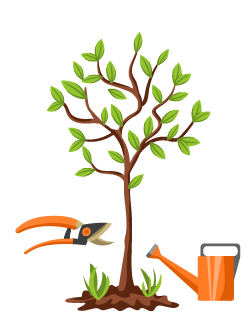 Tree care
Loosening the soil, watering: proper agricultural technology
If you haven't compacted the soil beneath the tree to the consistency of a piece of granite right away, you don't need to worry about loosening it during the first year. Dig around the trees once every one to two years is sufficient. However, it's a good idea to regularly remove weeds, root suckers, and other vegetation.
Bashkir Beauty can be watered once every ten days if there's no rain. Fertilizer is usually added along with the water. However, it's important not to overdo it, as the variety requires fertilizing every two to three years.
Pruning: simple crown shaping
The sooner you begin shaping the apple tree's crown, the more correct it will be in the future. Therefore, formative pruning is carried out as early as the first year after planting. Layers of scaffold branches are usually formed with branches spaced 30 centimeters apart. Two of the three young shoots are removed, for a total of five branches per layer.
Sanitary and maintenance (thinning) pruning is performed annually. This is best done in the fall, around October, when the sap flow in the apple tree has ceased. All diseased, damaged, or dead branches should be removed, along with any unnecessary ones. Rejuvenation pruning is performed in the 20th to 30th year of the apple tree's life, removing 2-3 mature shoots.
Reproduction
- Growing from seeds.
- Layers (clones).
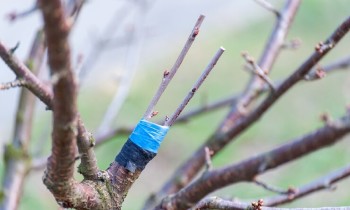
- Grafting by buds or cuttings.
Diseases and pests
- Scab.
- Blackleg.
- Powdery mildew.
- Codling moth.
- Leaf roller.
Ripening and fruiting of the Bashkir Beauty apple tree
The beginning of fruiting
 The beginning of fruiting
Under favorable conditions, one or two apples may be seen on a tree in the second year, but more abundant fruiting doesn't begin until the third or fourth year. However, at that point, you won't be able to harvest more than 5-15 kilograms.
Flowering time
Bashkir Beauty begins blooming in the second half of May, but may linger until the end of the month. The flowers are usually white, sometimes pinkish, fragrant, and gathered in small clusters.
Fruiting and growth
The maximum yield can be achieved 7-9 years after planting in open ground. The variety bears fruit reliably every year. In good years, gardeners have been able to harvest up to 100 kilograms from a single apple tree, but this requires some effort. Growth is modest—no more than 8-10 centimeters per year. The apples store very well. Even if they aren't provided with suitable conditions, the fruit can be stored for at least four to five months.
Top dressing
- Humus.
- Humus.
- Urea.
- Superphosphate.
- Ammonium nitrate.
What to do if it doesn't bloom or bear fruit
- Check for diseases or pests.
- Perform pruning.
- Transplant to a drier area with airy soil (at a young age).
- Stop or start watering.
Why do apples fall?
- Excess moisture.
- Lack of water.
- Natural phenomena.
- Pests.
- Diseases.
Please share your thoughts on Bashkir Beauty in the comments; everyone will be interested to hear about your experience.