Altai Crimson Apple Tree: Variety Features and Care
| Color | Reds |
|---|---|
| Ripening season | Summer |
| Size of apples | Small ones |
| Taste | Sweet and sour |
| Crown type | Average tree height |
| Shelf life | Average shelf life |
| Application | For recycling , Fresh |
| Winter hardiness | High winter hardiness |
| Fruiting age | Up to 5 years |
 History of origin and regions of growth
Growing regions
- Siberian Federal District.
Origin
The development of this variety began in the 1950s at the Siberian Horticulture Research Institute in Barnaul. The renowned Russian-Soviet researcher Mikhail Afanasyevich Lisavenko, whose name the institute bears today, was involved in the selection process. I. P. Kalinina, Z. A. Grankina, and T. F. Kornienko also participated in the work. The basis for the new variety was the Ermolaev Ranetka, which was pollinated with several types of pollen:
- Pepin Chernenko and saffron.
- Lithuanian Pepinka.
- Welsey.
In 1963, the Altayskoye Bagryanoye variety was classified as an elite variety and entered into the State Register. It was only zoned in 1988, in Eastern and Western Siberia, but is actually grown throughout virtually the entire Siberian Federal District.
Content
Description of the Altai Crimson apple variety
 Autumn apple varieties are generally prized by gardeners more than summer varieties, as their fruit keeps better. Altai Bagryanoe is distinguished by its enviable early maturity, high yield, and frost resistance, and, most importantly, the pleasant sweet flavor of its aromatic apples. Furthermore, these apple trees are highly resistant to scab, which is also important. It is recommended for cultivation in both small homesteads and industrial-scale intensive orchards.
Apples: What they look like
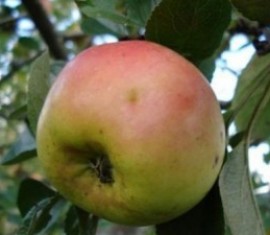
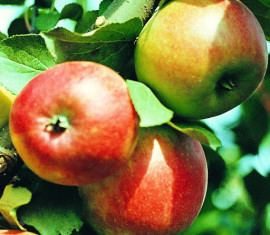
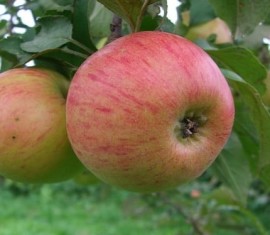
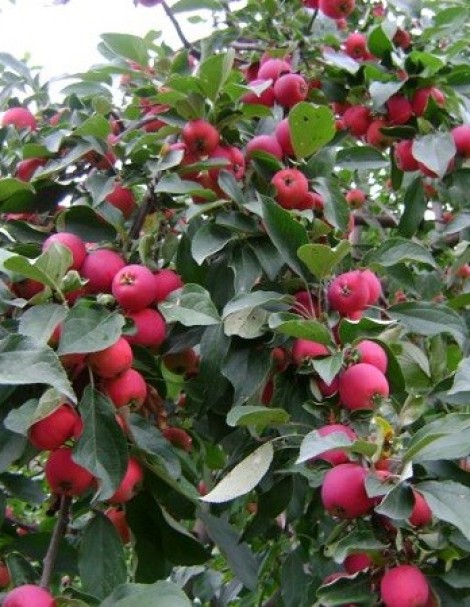
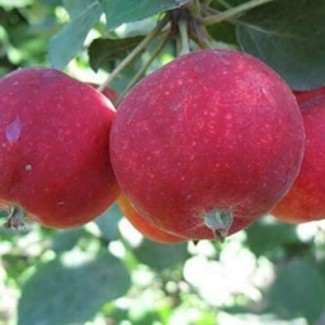
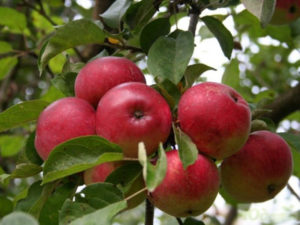 The fruits of this variety are very small, barely reaching 25-30 grams. They are regularly shaped, round or round-conical, with a smooth, glossy surface, usually covered with a dense, bluish-gray waxy coating. The apples have a very appetizing, attractive appearance, and when overripe, they can become translucent and plump.
The skin is dense and thick, its base color green when unripe, turning golden-yellow as it ripens. This color is hidden beneath a deep red, truly crimson, washed-out blush that covers up to 90-05% of the surface. The chemical composition is as follows per 100 grams:
- P-active substances (catechins) – 237 milligrams.
- Ascorbic acid (vitamin C) – 16.5 milligrams.
- Total sugars (fructose) – 13.9%.
- Pectins (fiber) – 6.9%.
- Titratable acids – 1.5%.
The fruit's flesh is quite dense, crisp, fine-grained, prickly, and quite juicy. It has an intense light green hue until the apples are ripe. Once ripe, it acquires a light yellowish or creamy color, and may have red veins on the stem end. Altai Bagryanoe is distinguished by its pleasantly sweet flavor, yet with a characteristic apple tartness, a dessert-like, balanced, and harmonious taste. A professional tasting score for its appearance is 4.8 points, and for its taste, 4.17 points out of a possible 5.
Altai Crimson Apple Tree: Characteristics
Crown and root system
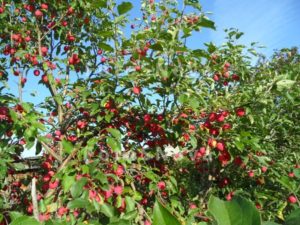 The trees are considered to be of medium height, but are more suitable for the definition of natural dwarfs, since do not grow more than 2.5-3 meters in height. Crown When young, the tree is oval, becoming broadly oval with age. The branch density is medium, so pruning is not a major issue. The branches extend from the main trunk at almost a right angle, grow upward, and are covered with greenish-brown bark, which can turn brown, crack, and crumble with age. Fruiting occurs at the ends of year-old shoots and on ring shoots.
The leaves are a dark emerald green, matte, and barely noticeably pubescent. They are oval, elongated, with a serrated, wavy margin and a long, pointed tip that curves outward. The root system is superficial and may or may not have a central taproot, depending on the rootstock.
Productivity and pollination
Despite the apple tree's compact size and small fruit, its yield can safely be called high. This variety bears fruit annually, without rest, throughout its active growth period, which lasts at least 50 years with proper, consistent care. However, in intensive orchards, it is common to uproot trees every 15-20 years.
By the third or fourth year, the Altai Crimson will produce about a hundred fruits. The recorded yield is 45 kilograms per mature tree. However, in most cases, it's possible to harvest around 30-35 kilograms..
The tree is considered conditionally self-sterile, meaning some fruit can be produced even in the absence of nearby pollinators, but the number will be extremely small. To ensure maximum yields, a variety with a suitable flowering time should be planted within 50-150 meters.
Winter hardiness and disease resistance
The variety is highly resistant not only to low temperatures but also to temperature fluctuations and fluctuations. Therefore, the apple tree is not afraid of frequent thaws alternating with severe frosts. It easily tolerates periods of -40°C (-40°F) for more than 14-20 days. Because of this, the variety is often used as a scion.
Apple trees aren't genetically immune to scab or any other fungal infections, but they're rare. They're not afraid of excessive rainfall. They become infected only in rare cases, and with preventative measures (proper care), the risk can be reduced to virtually zero.
Rootstocks and subspecies
Altai Bagryanoe is grown on vegetative, dwarf, and semi-dwarf rootstocks. A columnar variety is not available. It is also used as a rootstock for other, more frost-resistant apple varieties.
Features of growing Altai crimson
 Landing
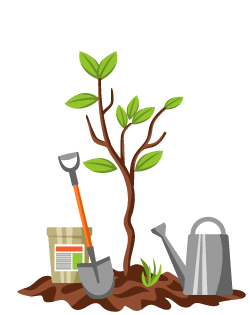 Landing
Basic conditions
- The variety prefers open, sunny locations protected from drafts. Exposure to wind can reduce resistance to fungal infections.
- Trees should not be planted in swampy areas, in close proximity to natural bodies of water or wells, or where groundwater is located at a depth greater than 2.5 meters.
- In harsh Siberian conditions, it's best to prepare planting holes on artificial mounds. These should be prepared in advance in the fall. The optimal height of the mound is 30-50 centimeters. This will prevent the rhizomes from being submerged when the snow melts.
- The hole should be 80-90 centimeters deep and up to 1 meter in diameter. The sides should be steep, and the bottom should be filled with topsoil mixed with fertilizer, followed by 15-20 centimeters of drainage. The holes should be left uncovered for at least 2-3 weeks before planting.
- The optimal distance between trees in a row is at least 3 meters, and between rows up to 2.5 meters.
- The seedling's root system is carefully inspected before planting, and any damaged or dry shoots are immediately trimmed with pruning shears. It's a good idea to soak the roots in warm water for 4-6 hours to allow them to absorb moisture.
- On the north side, stakes are immediately dug into the holes for tying so that the tree grows correctly and straight.
- Place the seedlings on a drainage platform, spreading out the rhizomes, and cover them with soil in layers, compacting them by hand. Avoid overpacking the soil, as the roots need plenty of oxygen for normal growth and fruiting. Create a border of soil around the perimeter, add 20-40 liters of water, and mulch the surface with compost, manure, or chopped grass.
Landing dates
Some gardeners believe that it is possible to plant trees of this variety in the fall, but it is much preferable to do this in the spring, as soon as soil The soil will thaw to a depth of two spade-widths. This will give the trees time to establish themselves and develop a strong root system, which will provide particular advantages during the following harsh winter. Apple trees with a closed root system (in pots or special bags that do not require disposal) can be planted outdoors throughout the growing season.
Protection from frost and rodents
This variety is frost-resistant, but it's still a good idea to cover it during winter frosts. You can pile 10-15 centimeters of soil onto the root zone and lay mats of straw or dry grass. Wrap the trunks with burlap, agrofibre, roofing felt, or roofing felt. First-year seedlings can be covered with a tent, but this won't be necessary later.
To prevent insects from settling near the roots during the winter, trees are sprayed with special compounds and whitewashed with lime in the fall. To protect against hungry rodents, the trunks can be coated with lard, grease, or special commercial solutions. Copper sulfate is also sprayed on trees to prevent diseases.
Tree care
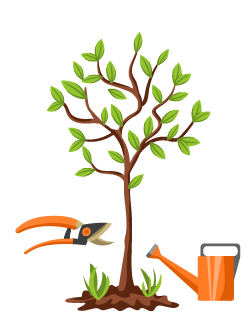 Tree care
Loosening the soil, watering: proper agricultural technology
Immediately after planting, trees must be watered every ten days. Apply 10-20 liters of water morning and evening. Subsequently, watering is also necessary, but the key is to know when to stop. Watering mature trees approximately once or twice a month, using 20-40 liters of water per day, is sufficient. During particularly dry periods, you can return to watering once every ten days, but as soon as it rains, stop watering.
It's a good idea to loosen the soil twice a year by digging up the area around the tree trunk. At the same time, you can remove weeds, shoots from other plants, and root suckers. Fertilizing fertile soil shouldn't be done more than once a year, but if it's less fertile, you can apply nutrients up to 3-4 times.
Pruning: simple crown shaping
Apple tree pruning should begin in the first year after planting and continue annually. The central trunk is shortened by a third, leaving only a few scaffold branches, which should be shorter than the central trunk, approximately 5-7 centimeters. Subsequent pruning should be limited to no more than one-third of the tree's green mass; otherwise, the tree may become diseased or even die.
Every fall and spring, perform sanitary pruning of the crown. All dead, damaged, or diseased branches are removed. Ensure that all fruiting branches receive adequate sunlight; otherwise, fruiting will be significantly reduced.
Pollinator varieties
- Altai ruddy.
- Bellefleur the Chinese.
- A gift for gardeners.
- Firebird.
- Cherished.
- Alyonushka.
Reproduction
- Clones (layering).
- Grafting by buds and shoots.
- Rooting cuttings.
Diseases and pests
- Moniliosis.
- Fruit bitterness.
- Scale insect.
- Leaf roller.
- Codling moth.
Ripening and fruiting of the Altai crimson
The beginning of fruiting
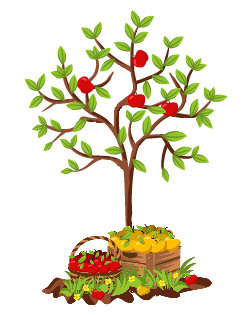 The beginning of fruiting
Altai crimson apples begin to bloom in the second or third year after planting, and some even in the first year. All blooms must be ruthlessly removed to allow the plants to develop a root system and build up foliage. Only then can they begin to bear fruit. The first harvest of several hundred rosy, fragrant apples can be harvested as early as the third or fourth year.
Flowering time
This variety blooms in the first half of May, but sometimes, due to unfavorable weather conditions, it shifts to the middle or even the end of the month. Furthermore, some specimens spontaneously bloom in late May or even early June for no apparent reason. The tree continues to bloom for 6-10 days.
Fruiting and growth
The variety has a medium growth rate, with faster growth in the initial stages before fruiting begins. At this stage, the Altayskoye can grow up to 25-30 centimeters per year, but later, growth slows slightly. It reaches its peak fruiting no earlier than the sixth or seventh year, when it can harvest approximately 60-80 kilograms, a significant amount for a Siberian apple tree.
The apple tree is considered an autumn apple because its fruits ripen in early September. However, some can be picked even as late as late summer. However, they don't yet have the unique flavor and aroma of apples that have matured. They don't fall from the branches on their own, so there's no need to rush harvesting. The Altai Crimson apple has a moderate shelf life.
In a cellar at a temperature not exceeding 5-15°C with good ventilation and moderate humidity, they can be stored with almost no loss of flavor for approximately 75-90 days. However, in some cases, they may become loose and bitter, so it's best to eat them completely after 2 months. recycleThe fruits are easy to transport due to their hard, dense skin.
Top dressing
- Mineral complexes.
- Superphosphate.
- Compost.
- Manure.
- Ammonium nitrate.
- Humus.
What to do if it doesn't bloom or bear fruit
- Check for pests and diseases.
- Provide or stop watering.
- Transplant to a sunnier area.
Why do apples fall?
- Natural phenomena.
- Pests.
- Diseases.
Leave your feedback on the winter-hardy Altai Bagryanoe variety to share your experience and knowledge with other gardeners.