Minusinskoye Red Apple Tree: Variety Features and Care
| Color | Reds |
|---|---|
| Ripening season | Summer |
| Size of apples | Small ones |
| Taste | Sweet and sour |
| Crown type | Average tree height |
| Shelf life | Low shelf life |
| Application | For recycling , Fresh |
| Winter hardiness | High winter hardiness |
 History of origin and regions of growth
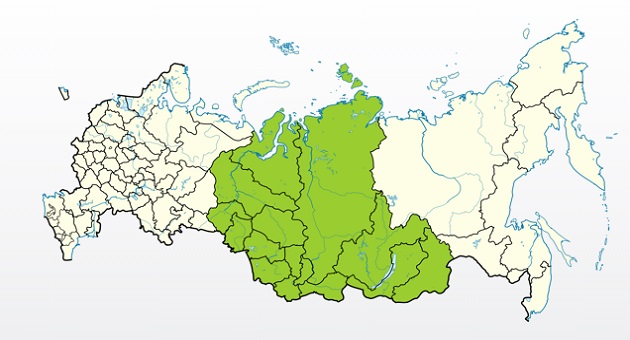
Growing regions
- Tuva.
- East Siberian and West Siberian region.
- Krasnoyarsk Krai.
- Khakassia.
Origin
The variety is no longer considered new, as research into its development was conducted at a breeding station in the city of Minusinsk before the start of World War II. The parent species used were a small-fruited Siberian apple tree, as well as a large-fruited variety whose name has been lost. The final result, a seedling, was obtained in 1943 by breeders V.I. and V.A. Shevchenko, and I.M. Leonov.
The apple tree has several simplified names among the people: Minusinka, Golden Minusinka, Zolotinka.
The variety was immediately distributed to farms for testing. By 1979, it was classified as an elite variety, entered into the State Register, and recommended for cultivation in the aforementioned regions. It was most widely distributed (35-40%) in the republics of Tyva and Khakassia.
Content
Description of the Minusinskoye Red apple variety
 Almost all Minusinsk apples are quite resilient to harsh weather and climate conditions. This slow-growing variety is no exception. It begins bearing small, yet tasty and aromatic apples very early, is resistant to fungal diseases, and transports well. However, it doesn't store well, requiring prompt processing. In Tyva, Krasnoyarsk Krai, and Khakassia, it's found in almost every farm, from homesteads to intensive orchards.
Apples: What they look like
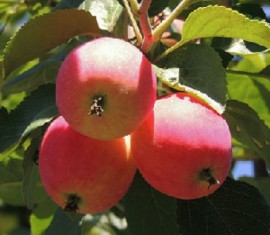
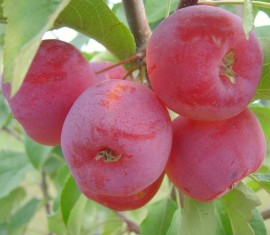
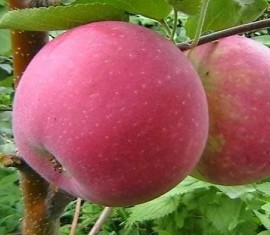
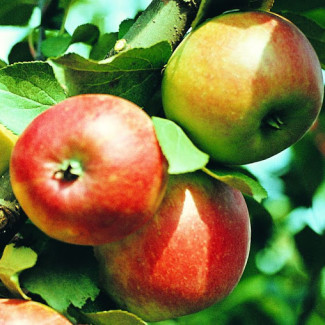
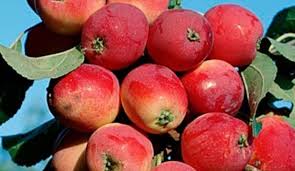 The fruits of the Minusinsky variety are small, like those of its Siberian apple ancestor. They barely reach a maximum weight of 22-35 grams. They are round, with slight ribbing, uniform, and smooth. The skin is glossy with a light waxy coating; green when unripe, it takes on a golden-yellow hue when ripe. The blush can cover 40-65% of the surface; it is diffuse and bright brick-red. Numerous light yellow subcutaneous dots are present. The chemical composition is characterized by several indicators per 100 grams:
- P-active substances (catechins) – 240 milligrams.
- Ascorbic acid (vitamin C) – 15 milligrams.
- Total sugars (fructose) – 14.9%.
- Pectins (fiber) – 15.4%.
- Titratable acids – 0.33%.
The apple's flesh is initially greenish, becoming slightly yellow or creamy as it ripens. It's not very firm, but crisp, fine-grained, tender, and juicy, exuding a distinct, distinctive aroma. The flavor is harmonious, dessert-like, but sweeter, with a slight apple tartness. According to professional tasters, it scores 4.4 points for appearance and 4.3 for taste.
Minusinskoye Red apple tree: characteristics
Crown and root system
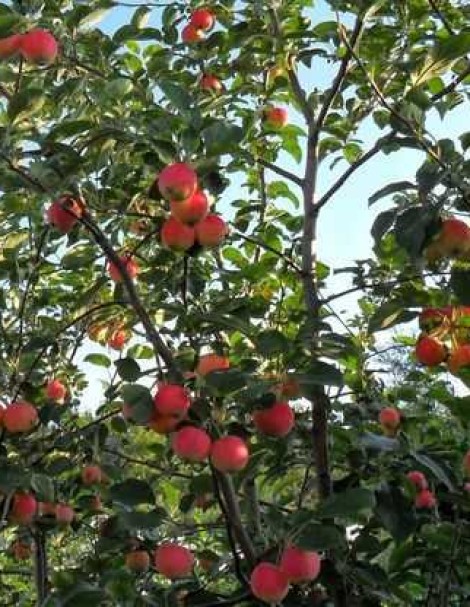
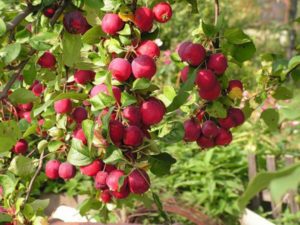 Trees of this variety are characterized by very slow growth and small height. They grow to a maximum height of 2.5-3 meters., which automatically classifies them as natural semi-dwarfs, although officially they are considered medium-sized. Crown When young, the tree is pyramidal, becoming rounded and then spreading with age, reaching approximately 2-3 meters in diameter. The shoots are generally long and straight, growing almost at a right angle to the trunk.
The bark of young branches is green or greenish-brown, while on the main trunk it can be reddish, with a brownish tint, smooth and shiny. The apple tree bears fruit on fruiting canes, both compound and simple. The leaves are large, light green or green, delicate, smooth, and shiny, with slight pubescence on the back. The root system is shallow, branched, and may or may not have a central taproot, depending on the rootstock used.
Productivity and pollination
Minusinskoye is considered an early-maturing variety, as some seedlings can bloom while still in the nursery. It quickly increases its yield, but grows slowly.
A single 8-10-year-old tree can yield approximately 20-25 kilograms of fruit. Maximum yields of 45-50 kilograms have been recorded, but only under optimal conditions and careful care.
The variety is completely self-sterile. This means that unless other apple varieties are planted within 50-150 meters, no harvest will be possible. Experienced gardeners plant their apples close to apiaries to ensure unimpeded access for honey plants to cross-pollinate.
Winter hardiness and disease resistance
The trees show a truly high tolerance to low temperatures. Therefore, the variety is readily grown in Siberia And even in the Far East. At the Minusinsk breeding station in 1980, when temperatures dropped to almost -43°C, frost damage of only 0.4 on a 5-point scale was recorded. Within a year, all the seedlings had fully recovered and were bearing fruit normally. These apple trees are also resistant to drought and heat, even with minimal watering.
Minusinskoye is moderately resistant to scab. Typically, it attacks the foliage without affecting the fruit. It doesn't exhibit any particular resistance to other apple diseases and pests, but with proper care, it can be avoided.
Rootstocks and subspecies
Minusinskoye Krasnoye is grown on various rootstocks. The most popular are vegetative and dwarf. There are no subspecies of this variety, nor are there any columnar varieties. However, each tree may have its own distinctive characteristics, as well as slightly different fruit shapes and colors, which can have different flavors. All of this is influenced by many factors, ranging from soil quality to rainfall and the genetic makeup of the parent plants.
Features of growing Minusinsk red
 Landing
 Landing
Key Features
- Choose a sunny location for planting seedlings. Trees aren't particularly sensitive to drafts, but they can become diseased, so it's best to plant them on the leeward side of buildings or under the protection of taller trees.
- Minusinsk prefers loam and sandy loam. They don't tolerate excessive acidity, so if you have such soil, you'll need to leach it, for example, with lime.
- Apple trees don't like excess moisture, so it's best to choose sites where the groundwater table is at least 2-3 meters deep. The garden should be located away from open water bodies, damp lowlands, and swamps.
- Prepare the holes for Minusinskoye in advance, at least 2-4 weeks before planting. However, it's best to dig holes 80-90 centimeters deep and 1 meter in diameter in the fall, so soil The soil has had time to settle in them. A top layer of fertile soil mixed with fertilizer is added to the bottom, followed by a 10-15 cm thick drainage layer of gravel, vermiculite, or regular nut shells. This is then filled with 40-50 liters of water and left uncovered.
- The recommended distance between trees in a row is 4.5-5 meters, and between rows up to 3-3.5 meters.
- The seedlings are planted so that the root collar is 7-10 centimeters above the surface. Otherwise, the root will root above the rootstock, which will negate all its properties.
- Stake staking is installed immediately after the trees are planted, preferably on the south side. They should not be removed for the first two or three years; it's best to wait until the third or even fourth fruiting season.
- Before planting, it would be a good idea to soak the trees in water for 4-6 hours, after checking the root system and trimming off any damaged or dry shoots.
- Place the trees on the drainage trench, spreading out the roots, and cover with soil, compacting it firmly but not excessively. Create a small mound of soil around the perimeter of the hole, add 30-40 liters of water, and mulch the top with manure, compost, or chopped grass.
Landing dates
Apple trees of this variety can be planted in either fall or spring. In the former case, the best time is around late September, when the leaves have completely fallen and the sap flow has ceased. In the latter case, the best time is mid- to late April, depending on weather conditions (before bud development begins).
Protection from frost and rodents
Although the tree boasts enviable winter hardiness, it's still a good idea to protect it during winter frosts, especially when young. The root zone and lower part of the trunk can be lined with straw bales, mats of dry grass, or burlap. Wrapping them with roofing felt or tar paper is equally effective. Dry leaves or 15-20 centimeters of soil can be piled onto the root zone, but this is optional.
To protect the tender bark of young seedlings from rodents and eliminate insects that hibernate in the root zone, regularly whitewash the trunks with lime in the spring and fall, covering a height of 1-1.2 meters. Coating the lower part of the trunks with lard, special solutions available from agricultural stores, or grease also works well against mice and hamsters.
Tree care
 Tree care
Loosening the soil, watering: proper agricultural technology
Trees don't require any special care. It's enough to dig around the root zone once a year, but not too deeply to avoid damaging the roots. It's a good idea to remove weeds and root suckers, which will rob the apple tree of nutrients. The easiest way to get rid of weeds is to cover the area around the tree trunk with sod 5-7 years after planting.
The trees are very hardy, easily surviving both severe frosts and dry, hot periods. They don't require much watering, but if there's been no rain for more than 14-16 days, it's best to add some moisture as needed. 20 liters morning and evening is enough to keep Minusinskoye healthy.
Pruning: simple crown shaping
In most cases, this apple tree thrives best with a standard, free-growing crown, as it's not prone to becoming overly dense. In the first year after planting, prune the central trunk by one-third, leaving just a few scaffold branches and shortening them proportionally so they grow in tiers. Formative pruning at the nursery is often sufficient.
Trees don't require any maintenance crown trimming. However, regular sanitation is essential. Every early spring or fall, dead, damaged, or fungal branches should be pruned to prevent further disease progression. It's also a good idea to ensure that branches aren't growing inward or vertically upward (suckers); these should also be pruned immediately.
Pollinator varieties
Reproduction
- Budding.
- Growing from seeds.
- Cuttings.
- Layers (clones).
Diseases and pests
- Scab.
- Powdery mildew.
- Fruit rot.
- Black crayfish.
- Leaf roller.
- Flower beetle.
- Hawthorn.
Ripening and fruiting of Minusinsk red
The beginning of fruiting
 The beginning of fruiting
As mentioned, this variety begins bearing fruit very early. Some specimens bloom even before being planted outdoors. However, they should not be allowed to form ovaries or produce fruit. The flowers are picked immediately to allow the seedling to properly develop its root system and crown. The first harvests of 5-10 kilograms of fruit can be harvested as early as the third or fifth year.
Flowering time
Minusinsky Krasny apple trees bloom from mid- to late May and last only 3-6 days. Therefore, careful timing is crucial to selecting suitable pollinators. The blooming period may shift slightly toward the beginning or end of the month due to weather conditions. The tree's flowers are smaller than average, with a beautiful, delicate pink petal color, abundant, and very fragrant. A distinctive feature is the stigma, which extends well beyond the stamens.
Fruiting and growth
The variety grows very slowly, barely gaining 10-12 centimeters per year. Therefore, pruning is not a problem for owners; it can always be postponed. Apple trees may not reach their peak until they are 10-12 years old. On average, you can get about 250 centners of apples per hectare of orchard. If you calculate the yield per tree, you'll get approximately 40-50 kilograms.
This variety is considered a summer variety, and by the second half of August, or less commonly by the beginning of September, you can confidently harvest its fragrant, beautiful, and delicious apples. They don't fall from the branches, so there's no need to worry too much about being late with the harvest. However, by mid- to late-September, they should be fully harvested.
The fruit's commercial and shipping qualities aren't particularly high, but they can be transported; they can withstand short journeys without significant damage to their flavor or appearance. However, apples can't be stored for more than 2-3 weeks, even under specially created conditions, with the right temperature and good ventilation. They lose their aroma, pleasant texture, and flavor. Therefore, they are most often eaten fresh and then processed. These apples are especially suitable for juice production, due to their pleasant sweet taste.
Top dressing
- Mineral complexes.
- Peat.
- Superphosphate.
- Compost.
- Manure.
- Humus.
What to do if it doesn't bloom or bear fruit
- Check for diseases or pests.
- Transplant to a drier place.
- Limit or increase watering.
Why do apples fall?
- Natural factors (hail, wind, rain).
- Pests.
- Diseases.
Please leave your feedback on Minusinsky Krasny so that any gardener can be prepared for any unexpected developments in cultivating this variety.