April apple tree: characteristics of the variety and care
| Color | Reds |
|---|---|
| Ripening season | Winter |
| Size of apples | Large |
| Taste | Sweet and sour |
| Crown type | Average tree height |
| Shelf life | High shelf life |
| Winter hardiness | High winter hardiness |
| Fruiting age | From 5 years old |
 History of origin and regions of growth
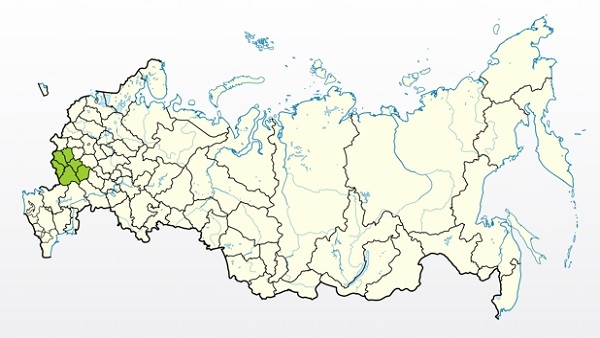
Growing regions
- Voronezh region.
- Tambov region.
- Oryol region.
- Kursk region.
- Lipetsk region.
- Belgorod region.
Origin
Research into developing apple trees whose fruit can easily be stored until spring without losing flavor or marketability has been ongoing since the mid-twentieth century. Over the years, many different varieties have been developed, with the Aprelskoye (Aprel'skoye) considered one of the most recent. Its creator, the renowned scientist and breeder I. I. Ulyanishchev, created a hybrid back in 1938, the parents of which were the Rossoshanskoye Polosatoye (Polosatoye) and the renowned Mackintosh (MacIntosh). However, at the time, no one showed much enthusiasm for the variety. It passed trials, was considered elite, and remained growing in small private gardens of its few devotees.
It wasn't until 2008 that Agronom-Sad LLC, the successor to the Rossoshanskaya Fruit and Berry Experimental Station for Horticulture and Fruit Growing, decided to "resurrect" the undeservedly forgotten variety. Aprelskoye was sent back for field trials, and in 2019, it was added to the State Register and zoned for the Central Black Earth District.
Content
Description of the April apple tree variety
 Even experienced gardeners in our country are not all familiar with this variety, which has a rather complex and long history. The Aprelskoye apple tree is by no means popular, but it is still somewhat widespread. Despite all this, experienced specialists familiar with it believe it can safely be considered the hallmark of all Rossoshansky apple trees. The tree is undemanding, undemanding in terms of growing conditions, moderately tolerant of low temperatures, highly productive, and bears fruit annually without resting. It is recommended not only for small home gardens but also for large commercial intensive farms.
Apples: What they look like
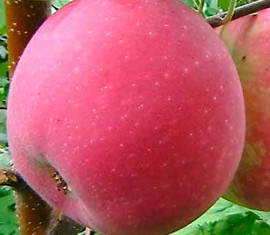
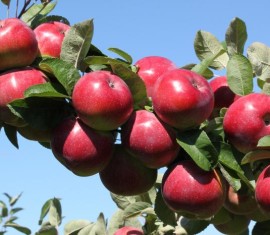
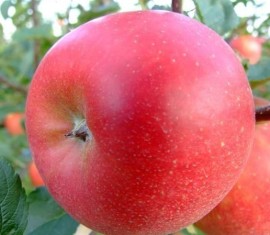
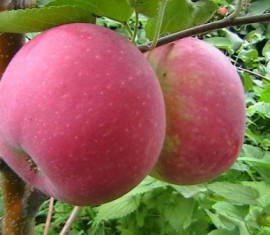
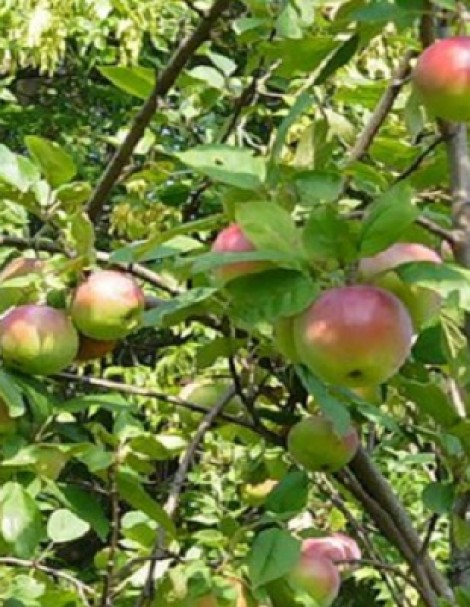
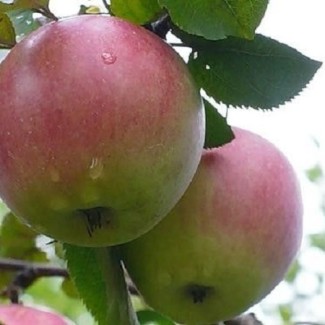
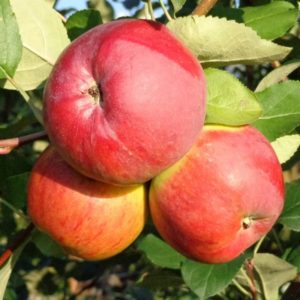 The fruits of this variety are quite attractive: round or slightly conical, uniform in size, generally medium to large, and can weigh up to 180-230 grams. The fruits have subtle ribbing, a smooth surface, and a shallow, narrow crater.
The skin is smooth, glossy, green when young and green-yellow or even pure yellow when ripe, sometimes with a slight oily bloom. The blush covers approximately 60-75% of the skin, but may be less on fruits located within the crown. It is burgundy-red or beetroot-red, with a blurred stripe pattern. Subcutaneous spots are few, and light spots are visible on a medium surface. The chemical composition can be characterized by the following indicators (100 grams):
- P-active substances (catechins) – 269 milligrams.
- Ascorbic acid (vitamin C) – 15.2 milligrams.
- Total sugars (fructose) – 10.6%.
- Pectins (fiber) – 8.2%.
- Titratable acids – 0.43%.
The flesh is dense, fine-grained, with a delicate, non-prickly texture, juicy, and sweet and sour, with a hint of acidity. It has a distinct greenish or greenish-lemon hue. The flavor is considered table-worthy, harmonious, and balanced. The tasting score is 4.4 points for appearance and 4.5 points for taste out of a possible 5.
Apple tree Aprelskoye: characteristics
Crown and root system
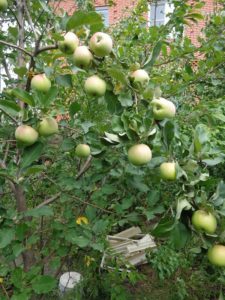 The tree is considered medium-sized, although it can easily grow up to 4-6 meters without formative pruning. Most experienced gardeners limit it to just 3.5-4 meters to make harvesting and care easier. When young, the crown has a distinct, narrow pyramidal shape, but over the years it becomes oval, rounded, and eventually even spreading. Its shoots are thick, geniculate, covered in reddish-brown or cherry-colored, smooth bark with a slight pubescence.
The leaves are medium-sized, slightly elongated, light green or even light green, with a long, pointed tip. The leaf edges are serrate-crenate and serrated. They are leathery, dense, coarsely nerved, glossy, and lightly pubescent on the reverse side. The root system is fairly deep, highly branched, and may or may not have a central taproot.
Productivity and pollination
The variety is considered a high-yielding variety, although it's unlikely to compare with the Antonovka, for example. Officially, the apple tree bears fruit annually without a rest period. In reality, many gardeners note that in some cases, the apple tree allows itself to rest, and sometimes fruiting occurs on approximately 35-50% of the branches, while others remain fruitless, regardless of care or weather conditions.
In a year, one tree can produce approximately 85-120 kilograms of unusual, aromatic and delicious fruits.
The variety is considered completely self-sterile or self-infertile. This means that to produce a harvest, apple trees of other varieties must be nearby, no more than 50-150 meters away, to ensure cross-pollination. Spraying the trees with sugar syrup during flowering and bringing mobile apiaries to the garden are also encouraged.
Winter hardiness and disease resistance
Aprelsky's tolerance to low temperatures is about average. It will inevitably freeze in severe frosts, but can tolerate temperatures as low as -25-27°C without any problems if properly prepared for winter and provided with adequate shelter. The tree dislikes sudden temperature fluctuations and drafts, so pay special attention to this.
The trees do not show any resistance to infectious fungal diseases or other apple diseases. ScabThey can be severely and severely affected by rot, cytosporosis, or fruit rot, especially during years of severe epidemics. Therefore, preventative measures and treatments are essential to the variety, and they must be carried out promptly and regularly.
Rootstocks and subspecies
Although the variety is quite old, it has no subspecies. Aprelskoye is typically grown on vegetative standard or clonal rootstocks, as well as on dwarf and semi-dwarf varieties. This doesn't alter the variety's basic properties, although the crown size may fluctuate slightly.
Features of growing April
 Landing
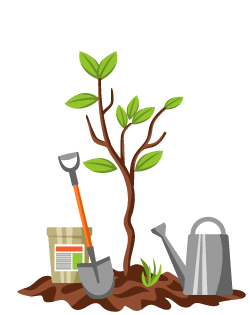 Landing
Basic conditions
- The plants don't have any special requirements for either location or soil. The main thing is that the sun evenly illuminates the crown for most of the day. The trees grow well in loam, black soil, and sandy loam, but they don't tolerate excessive acidity.
- Proximity to groundwater can damage apple trees, causing their rhizomes to rot. Therefore, it's best to choose a site where the groundwater level is no higher than 2 meters, or even better, 2.5 meters. For the same reason, avoid planting trees near rivers, lakes, ponds, and shallow wells, as this will likely result in the death of the seedling.
- The holes can be prepared in advance, in the fall or spring using the standard method, or just 2-3 weeks in advance. For this, the holes are dug 80-90 centimeters deep and approximately the same in diameter. Fertilizer is added to the bottom, followed by broken brick, gravel, or nutshells for drainage, and the entire area is filled with water (25-30 liters).
- Leave approximately 4-5 meters between holes and 4.5-5.5 meters between rows. This will prevent trees from interfering with each other, shading their crowns, or causing root conflicts.
- The rhizome is carefully inspected for dry or damaged shoots, which must be severely pruned. To rehydrate them, they can be immersed in warm water for 3-5 hours or in a "swamp" of soil and water for 6-8 hours.
- You can immediately drive stakes into the holes, to which the young trees can then be tied. Don't remove them immediately; you need to wait 4-5 years after planting.
- The root collar of apple trees should always remain above the soil surface; for the Aprelskoye variety, 2-4 centimeters is sufficient.
- Place the seedling on the drainage hole, supporting it with your hand, then cover it with soil and compact it lightly. Next, create a ridge around the trunk, add 35-50 liters of water, and mulch the surface with manure.
Planting dates
Trees with closed roots can be planted at any time. Otherwise, experts recommend spring, as this is when trees have the best chance of survival. A sunny day in late March or early April, before the buds have opened, is ideal. But first, make sure there's no longer a risk of frost.
Protection from frost and rodents
Standard winter protection methods are sufficient for this variety. It is recommended to wrap all trunks with roofing felt, agrofibre, burlap, or any other available materials. If the climate is particularly harsh, it's a good idea to pile 15-20 centimeters of soil up to the roots, but remember that this will need to be removed in the spring. When young, trunks can be covered with a tent-like covering, which isn't always possible with mature trees.
Tree trunks are whitewashed with lime to prevent insect pests from nesting in the bark crevices. Coating the trunk 1-1.2 meters high with grease or lard also works well against insects. If this is unavailable, special products can be purchased at gardening stores.
Tree care
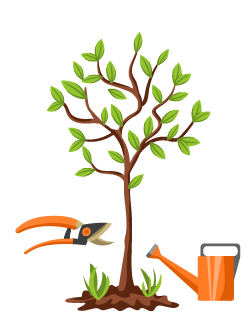 Tree care
Loosening the soil, watering: proper agricultural technology
The area around the tree trunk should be dug at least once a year, but it's best to do it twice: in spring and fall. At this time, you can also clear the area of weeds, root suckers, and other plant shoots. In the summer, you can hoe the soil several times to provide oxygen to the roots.
Trees don't require special watering; they only need 3-4 times per season. Water isn't applied all at once, but rather morning and evening, using 15-20 liters. You can time the application to coincide with bud development, flowering, and fruit ripening. A final watering can be given in mid-September to allow the tree time to prepare for the cold weather.
Pruning: simple crown shaping
Aprelskoe isn't particularly prone to becoming dense, so you won't need to put in much effort. However, you should start in the first year by shaping the main stem and skeletal branches, spaced well apart. In the future, you'll need to maintain the chosen shape by pruning away any unwanted growth. spinning tops (shoots sticking out upwards) and shoots growing inside the crown.
Sanitary pruning, which involves removing dead, damaged, broken, or diseased branches, is a common practice for gardeners who care for their plants. It should be done in spring and fall as needed. Rejuvenation, which involves cutting off two or three mature shoots, is acceptable starting 12 to 15 years after planting.
Reproduction
- Rooting cuttings.
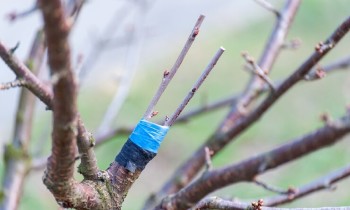
- Grafting by buds and cuttings.
- Growing from seeds.
- Clones (layering).
Diseases and pests
- Moniliosis.
- Scab.
- Powdery mildew.
- Fruit rot.
- Cytosporosis.
- Tinder fungus.
- Green aphid.
- Codling moth.
Ripening and fruiting of April
The beginning of fruiting
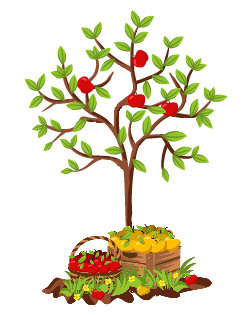 The beginning of fruiting
The variety is considered to begin bearing fruit quite early, but in reality, tasty apples are only produced 6-7 years after planting. The further north the growing region, the later the fruiting period begins. In the first few years, harvesting more than 10-15 kilograms of apples is unlikely, so don't expect a large harvest.
Flowering time
The apple tree is considered a winter weed, so it blooms a little later than early varieties. It opens its buds in the second half of May or even early June. This process lasts approximately 12-16 days, sometimes extending for a good three weeks. The flowers themselves are snow-white, sometimes with a light green or slightly pinkish tint, fragrant, beautiful, and large.
Fruiting and growth
This apple tree grows quite quickly, gaining approximately 50-60 centimeters in a single season. Therefore, it reaches its peak height by the 8th to 10th year, after which it remains stable. Fruit production increases exponentially, and by the 12th to 15th year, a full harvest can be harvested. The tree's lifespan is approximately 50-75 years, and sometimes longer, during which time it bears fruit actively almost annually.
The fruit ripens late, around the end of September or even early October. They cling firmly to the branches, so there's no rush to pick them. Thanks to their relatively dense and firm skin and flesh, the apples transport well. Their shelf life is also excellent. The fruit can retain all its commercial and consumer qualities until April, and sometimes even until the end of May, when storage conditions are suitable.
Top dressing
- Superphosphate.
- Compost.
- Nitrogen fertilizers.
- Humus.
- Potassium complexes.
- Ammonium nitrate.
- Manure.
What to do if it doesn't bloom or bear fruit
- Check for pests and diseases.
- Transplant.
- Limit or increase watering.
Why do apples fall?
- Natural factors.
- Pests.
- Diseases.
Leave your feedback on the winter-hardy Aprelskoye variety to share your experience with others.