Champion Reno apple tree: characteristics of the variety and care
| Color | Reds |
|---|---|
| Ripening season | Autumn |
| Size of apples | Large |
| Taste | Sweet and sour |
| Crown type | Average tree height |
| Shelf life | Low shelf life |
| Application | Fresh , For recycling |
| Winter hardiness | Low winter hardiness |
| Fruiting age | Up to 5 years |
 History of origin and regions of growth
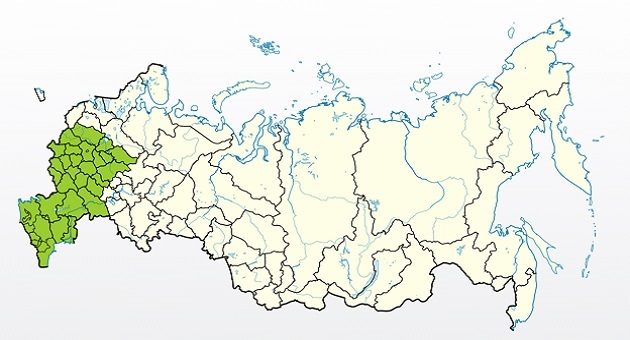
Growing regions
- Crimea.
- Middle zone.
- North Caucasus.
- Moscow region.
Origin
This variety is a Czech selection. It was created by crossing the Reinette Orange Coxa and Delicious Golden apple trees back in 1970. It arrived in our country from Poland in the mid- to late 1990s, where it had become very popular by then.
It is believed that the name of the variety comes from the first letters of the surnames of the pomologists who created it – Reiman and Novakovsky.
The application for inclusion of the Champion Reno variety was first submitted in 2017, after which the apple tree was sent for field trials to various farms in Crimea. In 2019, the trees were officially registered in our country and also received official zoning for the North Caucasus. With proper care and shelter, it can be grown throughout almost all of European Russia.
Content
Description of the Champion Reno variety
 This autumn variety with a compact and neat crown immediately caught the eye of gardeners in temperate and warm climates. It is undemanding, fairly tolerant of soil conditions, and requires no special care, excessive watering, or fertilizing. The tree isn't particularly adaptable to environmental conditions, but it can be grown without problems in most temperate climates. It has good disease resistance, although it isn't immune.
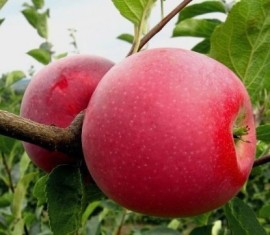
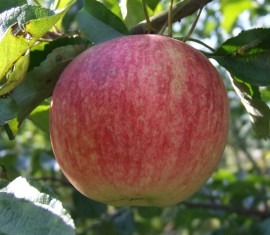
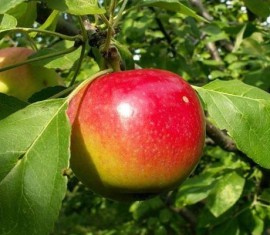
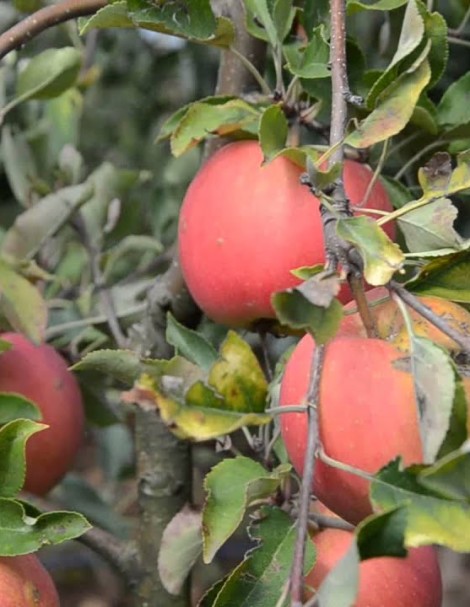
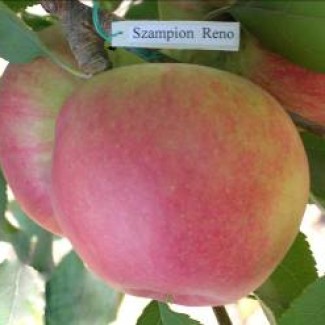
Champion fruits are large, very attractive, rosy-sided, round, and shiny, with a powerful aroma and pleasant flavor. The fruits ripen annually, without resting, and yields are usually abundant. This variety is recommended for commercial intensive plantings and individual home gardens.
Apples: What do they look like?
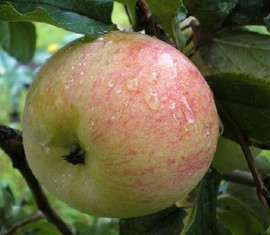
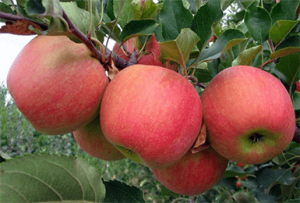 The fruits are quite large. In good years, with proper care, they can easily reach 190-230 grams in weight. They are round or round-oval in shape, uniform in size, and generally symmetrical, although they may be slightly slanted on one side. The ribbing on the fruits is virtually invisible; they are even and smooth, with no visible lateral seam.
This Champion clone has thin skin. It's smooth, highly shiny, glossy, yet elastic and durable. It's dry and may have a light waxy coating. The base color is greenish-yellow, but it's almost completely (85-95%) hidden by a thick, dense blush of bright red, dark red, or burgundy. Subcutaneous spots are numerous, light green or gray-green, with a rusty appearance. For a simple assessment of the chemical composition, the following parameters are easiest to examine:
- P-active substances (catechins) – 154 milligrams.
- Ascorbic acid (vitamin C) – 11.8 milligrams.
- Total sugars (fructose) – 15.3%.
- Pectins (fiber) – 7.3%.
- Titratable acids – 0.63%.
Reno's flesh is medium-dense, fine-grained, light lemon or slightly creamy in color, sometimes tinged with yellow. It's very juicy and has a powerful, unmistakable aroma. The flavor is considered harmonious, dessert-like, sweet and sour, leaning heavily toward sweetness, but not without a distinctive apple-like tartness in the aftertaste. Professional tasters give the fruit 4.5-4.7 out of 5 for both flavor and appearance, which is quite good.
Champion Reno apple tree: characteristics
Crown and root system
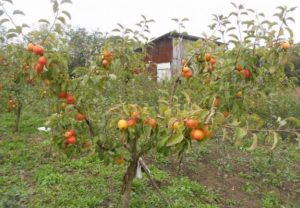 Trees are considered medium- or slow-growing, or medium-sized. They can reach a height of approximately 2.5-3 meters, sometimes slightly higher, but not significantly. The crown shape is predominantly oval-rounded or rounded-pyramidal, with moderate density. The shoots are straight, not pubescent, of medium length, set at a right angle to the conductor, directed upward, and covered with light, yellow-brown bark. Fruiting is mixed.
The leaves are elliptical or oval-ovate, medium-sized, dense, leathery, and smooth. The nerves are coarse, the tip is short and pointed, and the margins are serrated, sometimes slightly wavy or crenate. They are light green or yellowish-green, rich and matte, with a slight tomentose pubescence on the underside. The root system is medium-deep, fibrous on most rootstocks, but can also be taproot, branched, and well-adapted for water-seeking.
Productivity and pollination
This variety not only ripens early but is also considered high-yielding due to its exceptionally compact size. No consistent fruiting was observed during testing, nor is it currently.
From one adult Champion Reno tree, good and thrifty owners can harvest up to 20-35 kilograms of fragrant, large apples per season in years with suitable weather and climate..
The variety is considered self-fertile, but only to a limited extent. Therefore, without suitable trees nearby, you can expect a yield of 15-30% of the potential yield, which is very low. Therefore, it is advisable to plant other apple trees that bloom at the same time as the Reno Champion within 100-150 meters, and no further. Experienced gardeners spray the trees with sugar syrup in the spring to attract more bees.
Winter hardiness and disease resistance
The variety's resistance to winter cold, sudden temperature fluctuations, and other weather extremes leaves much to be desired. Temperatures below -22-25°C can cause irreparable damage to apple trees, especially if they last for more than 4-6 days in a row. Therefore, it's best to avoid growing it in regions with cold, prolonged winters or to carefully cover the trunks.
Reno apple trees have strong resistance to scab, powdery mildew, and other infections, although not at the immune level. Trees rarely become infected, but if they do contract an infection, they can suffer from severe and widespread illnesses. scabiesFor example, not only leaves but also fruits, which must be completely disposed of. Therefore, preventative measures should always be taken.
Rootstocks and subspecies
The Reno subvariety itself is a clone of the Champion variety and has no distinct variations. It can be grown on various rootstocks, which does not alter the quality of the fruit, but may result in the tree acquiring some unique characteristics. Neither a creeping nor a columnar Champion Reno exists.
Features of growing Champion Reno
 Landing
 Landing
Basic conditions
- A sunny location for planting apple trees must be carefully chosen. In the shade, apple trees do not grow, becoming thin, stunted, and die. However, excessive burns they also need to be protected.
- Apple trees require fertile but not heavy soil. They grow well in black soil, if diluted with imported and washed river sand. Sandy loam and loamy soils, permeable to air and water, are ideal.
- Groundwater levels don't play a significant role as long as they don't rise above 2-1.8 meters above the surface. It's best not to plant this variety near ponds, rivers, lakes, marshy areas, or floodplain meadows, as the roots may rot.
- Ventilation of the tree's crown isn't critical, but it is important. If air stagnates, the risk of fungal growth increases significantly. Therefore, it's important to ensure the tree is comfortable, but free of drafts. Blowing winds also often lead to disease and death of trunks.
- Gardeners are accustomed to preparing holes in advance, and this approach is also useful for Reno. They dig holes 60-70 centimeters in diameter and the same depth, add fertilizer to the bottom, then add drainage, and fill with water.
- It is enough to leave no more than 2-2.5 meters between the trees; between the rows you can make it a little more convenient to harvest and care for the apple trees.
- Planks, stakes, or trellises are dug or driven into the holes to which the sapling will later be tied. They should be placed on the north side of the trunk to provide protection from cold winter winds.
- The apple trees are inspected, all unhealthy-looking, dry or broken shoots are cut off, and the rhizomes are immersed in water for 3-6 hours.
- Rake the drainage material into a pile in the hole, place the seedling on it, and spread out the roots. Cover with soil and compact it by hand, being gentle. Water the surface with 35-40 liters of water, applying mulch to retain the water.
Landing dates
Trees can be planted in either spring or fall. However, since trees are quite heat-loving and delicate, it's best to plant from late March to early April, when winter frosts have passed and the soil has warmed up completely. In fall, you'll have to wait until the leaves have fallen; it's best to plant trees in September or October, when frost is at least 5-6 weeks away.
Tree care
 Tree care
Protection from frost and pests
For the winter, young seedlings should be covered like a tent, from the top down to the rootstock. It's common to pile hay, spruce branches, straw, or even rake soil onto the area around the trunk. In early spring, all of this should be quickly removed before the sap begins to flow. In warmer climates, you can simply wrap the trunks in burlap, old tights, or agrofibre.
Tree trunks are whitewashed with lime to a height of 1-1.2 meters to eliminate insects nesting in cracks and crevices in the bark. This also greatly improves the aesthetic appearance of the garden. Coating the trunk with grease, lard, fuel oil, or other unpleasant-smelling substances helps repel rodents.
Loosening the soil, watering: proper agricultural technology
Digging once or twice a year is sufficient. This is done when the trees are bare (no sap flow), in early spring or late fall. This should be done very carefully, as some roots are located shallowly near the surface. You can hoe the root zone more frequently, 5-6 times per season, for example, the following season. glaze day.
The soil around the rhizome should never dry out completely; it needs to be moistened regularly. However, be careful not to overwater, as this can cause fungus. 15-25 liters per tree, divided into two waterings, is ideal. You can follow the 10-day rule, watering the Reno once every ten days if there's no rain. It's also best to dilute fertilizers with water and apply them along the crown.
Pruning: simple crown shaping
The tree is pliable and tolerant of all kinds of shaping manipulation. It can be shaped into anything, as long as the branches are spaced far apart and at different heights. Broom-shaped, sparse, cup-shaped, spindle-shaped, and other forms are guaranteed to emerge.
Every fall, and if necessary, in the spring, the tree should be inspected and given a sanitary cleaning. All dry, broken, or diseased shoots should be trimmed. At the same time, it's worth removing vertical suckers, branches growing inward, and branches that cross or run parallel.
Diseases and pests
- Rust.
- Powdery mildew.
- Black crayfish.
- Scab.
- Rust.
- Scale insect.
- Green aphid.
Pollinator varieties
- Delicious golden.
- Saffron pepin.
- Gloucester.
- Spartan.
- Ligol.
- Idared.
- Elstar.
Ripening and fruiting of Champion Reno
The beginning of fruiting
 The beginning of fruiting
The tree bears fruit very early. As early as the second or third year, it may produce its first fruits, which are quite edible and will even be somewhat larger than in subsequent years. Don't expect much from Reno; you'll only get a few apples, but there's definitely enough for a sample.
Flowering time
Champion Reno opens its buds in mid-May, when most late-summer, fall, and late-autumn varieties bloom. Therefore, there will be no problems with pollinators. The flowers themselves are large, with very fleshy, delicate petals. The buds are bright pink, opening into fragrant flowers of pale pink or even pure white, the branches densely covered with flowers, making the trees very attractive and even decorative.
Fruiting and growth
The trees don't grow quickly, gaining about 25-35 centimeters per year. Therefore, you'll have to wait for them to build up their green mass. Only then, after about 6-8 years, will they begin to bear fruit fully. Don't expect any spectacular harvests, but with proper care, you can get a yield of 50 kilograms.
Reno apples ripen in mid- to late September. They hold well on the branches and are not prone to shedding. However, after 20-30 years (older trees), the fruits may begin to fall off when overripe. They can be transported in three-layered crates without issue, or stored in a cellar for 1-1.5 months. With longer storage, pit bitterness may develop; the flesh loses its pleasant consistency and juiciness, becoming sour, crumbly, and cottony.
Top dressing
- Superphosphate.
- Humus.
- Peat.
- Calcium.
- Manure.
- Compost.
- Ammonium nitrate.
Why do apples fall?
- Wind, frost, rain, hail.
- Overripe.
- Pests or diseases.
What to do if it doesn't bloom or bear fruit
- Limit or increase watering.
- Eliminate insects.
- Cure diseases.
- Feed.
- Transplant to a sunny place.
Leave your feedback on the Champion Reno apple tree variety to ensure that even novice gardeners don't run into any problems.