Darena apple tree: characteristics of the variety and care
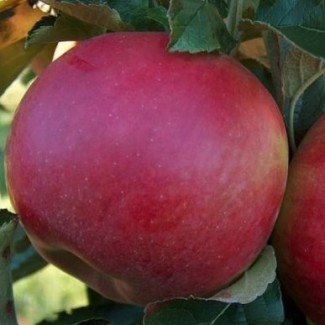
| Color | Reds |
|---|---|
| Ripening season | Summer |
| Size of apples | Average |
| Taste | Sweet and sour |
| Crown type | Tall tree |
| Shelf life | Low shelf life |
| Application | For recycling , Fresh |
| Winter hardiness | Average winter hardiness |
| Fruiting age | From 5 years old |
 History of origin and regions of growth
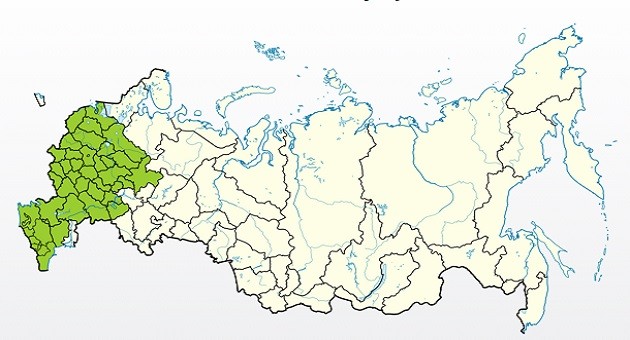
Growing regions
- Middle zone.
- Central Black Earth Region.
- Moscow region.
- Leningrad region.
- Crimea.
- North Caucasus.
Origin
This relatively new variety is one of numerous late-summer or early-autumn apple trees, developed around the mid-1980s by renowned Russian breeders Zoya Mikhailovna Serova, Galina Alekseevna Sedysheva, Evgeny Alekseevich Dolmatov, and Evgeny Nikolaevich Sedov. The development work was carried out at the experimental farm in the village of Zhilina, which belongs to the All-Russian Research Institute of Fruit Crop Breeding in Oryol. The parent varieties were Papirovka tetraploida and the well-known Melba.
In 1999, the Darena variety was first classified as elite and sent for variety testing, and by 2001, an application for inclusion in the official lists was submitted. However, it took many more years for it to finally be added to the State Register of Breeding Achievements in 2011 and zoned for the Central Black Earth Region. In reality, the variety can be grown in much larger areas.
Description of the variety Darena
 This apple variety has gained particular popularity among gardeners due to its enviable resistance to scab (without genetic immunity) and its surprisingly consistent fruiting, despite any external factors. The tree is quite undemanding, grows well in almost any soil, and requires little special care. It tolerates even the harshest winters and variable weather, and requires little fertilizing or watering.
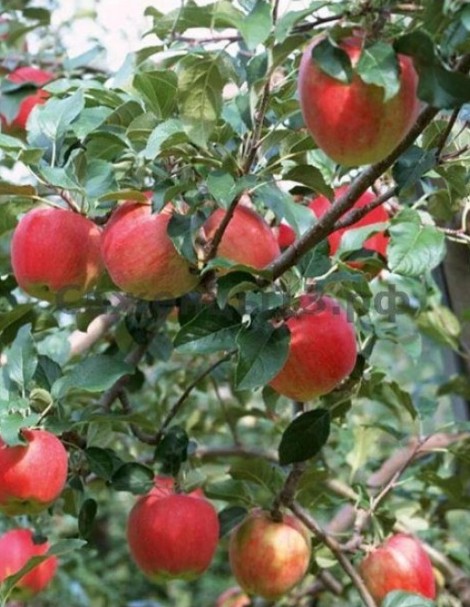
Darena apples are medium to large in size, very attractive, red-sided, aromatic, and delicious. They ripen in late summer and can even be stored for some time in a cellar, making excellent juice, jam, and compotes. This variety is recommended for both home gardening and intensive orchards.
Apples: What do they look like?
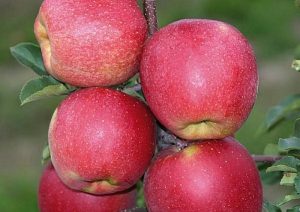 The fruits are usually medium to slightly larger than average in size. They grow to 150-180 grams, rarely reaching 190-200 grams with good care in particularly favorable years. They are round, smooth, slightly elongated, cylindrical, slightly conical, and sometimes turnip-shaped. The fruits are generally symmetrical, but can also be slanted to one side. They are of medium uniformity, have wide ribbed edges, and the side seam is not visible.
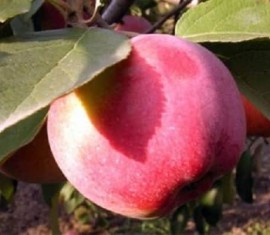
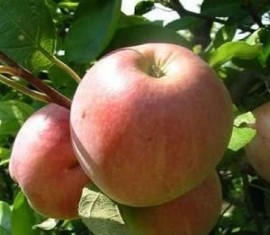
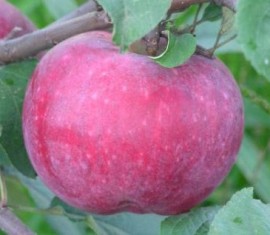
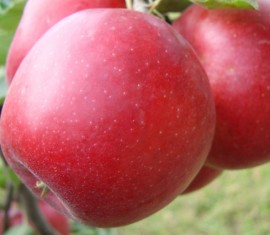
The skin is dense, elastic, yet thin, smooth, glossy, and shiny. It is green, greenish-yellow, or light green during ripening. The blush is vaguely striped and mottled, crimson-red, red, or even slightly orange, occupying approximately 75-90% of the surface. Subcutaneous dots are numerous, large, gray, slightly greenish, and clearly visible. The chemical composition is easier to assess based on the following parameters:
- P-active substances (catechins) – 315 milligrams.
- Ascorbic acid (vitamin C) – 14.3 milligrams.
- Fructose (total sugars) – 10.7%.
- Pectins – 9.1%.
- Titratable acids – 1.1%.
The flesh is dense, fine-grained, aromatic, and very juicy. It has a pleasant consistency, breaks easily, and is creamy-green or light green in color. The flavor is considered table-worthy; it is sweet and sour, with distinct wine-spicy notes, balanced and harmonious. Professional tasters give Darena 4.5 out of 5 stars for taste and appearance.
Darena apple tree: characteristics
Crown and root system
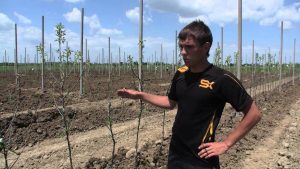 The tree can be safely classified as tall, as it can grow up to 6-7 meters without formative pruning., and sometimes even more. Its crown is compact, sparse, and not prone to excessive thickening. It is predominantly rounded or oval, but can become slightly spreading and drooping as it grows. The branches extend from the central conductor at a nearly right angle and are covered with gray-brown or gray-brown bark. Fruiting occurs on ring shoots, fruiting shoots, and spurs.
Darena's leaves are medium-sized, dense, leathery, long-pointed, oval-elongated, often shiny and glossy, but can sometimes have a medium matte finish. The base color is green or light green, with a felty pubescence on the underside and delicate nervation. The leaf margins are serrate and dentate, and can curl downward or fold into a boat-like shape. The root system is robust, highly branched, and penetrates deep into the soil. It is fibrous and generally lacks a central taproot.
Productivity and pollination
The variety is generally considered high-yielding, although it is far from Antonovka.
With proper and timely care, one Daren tree can produce approximately 80-110 kilograms of fruit per season..
Apple trees are conditionally self-fertile, meaning they will produce fruit even if there are no other apple trees in the area. However, if there are other apple trees within 50-90 meters, cross-pollination increases the yield dramatically. Therefore, it's common to plant similar trees with suitable flowering times in a staggered pattern. You can also spray the apple trees with sugar syrup to attract bees and bring beehives to the orchard.
Winter hardiness and disease resistance
The tree has only average tolerance to low temperatures, although this is quite sufficient for the recommended growing regions. Darena tolerates temperatures down to -22-25°C with virtually no damage, but it is sensitive to sudden changes in temperature, as well as excessive humidity, which can lead to trunks freezing during prolonged winters. Therefore, it is necessary to carefully prepare them for winter, covering and wrapping them well.
The variety has no genetic immunity to disease, but it is very resistant to fungi and other infections. If you try hard enough, the tree will become ill, but preventative measures can completely prevent this.
Rootstocks and subspecies
This new variety doesn't yet have subspecies, and whether there will be any in the future is unknown. Darena is grown on various rootstocks, which allows it to adopt some of their characteristics. For example, on standard rootstocks, it grows tallest, is winter-hardy, and resilient, while on dwarf rootstocks, it is compact, but begins bearing fruit much earlier (in the second or third year).
Features of growing Darena
 Landing
 Landing
Basic conditions
- The planting site for this variety should be open and sunny for most of the day. Darena generally doesn't grow in the shade, and if it does, it's stunted and weak, often refusing to flower or bear fruit.
- It's not advisable to plant in low-lying areas, swampy areas, or places where groundwater is close to the surface. Apple trees can extend their roots meters deep, so they'll inevitably find water and then rot.
- It's best to plant Darena where its crown will be well-ventilated, but avoid drafts. Strong winds can kill the tree in its first few years of life.
- Planting holes are prepared a season or even a season and a half before moving the trees into the garden. They are dug 60-75 centimeters deep and the same or slightly larger in diameter. Fertilizer is added to the bottom, mixed with the topsoil, covered with a drainage layer or soil, and watered thoroughly. These prepared holes are left outdoors to dry thoroughly.
- Planks or stakes are driven directly into the holes to tie the young trees to. If the trunks are placed on the south side, these structures will also provide additional protection during harsh winters.
- It is recommended to leave at least 5-5.5 meters of distance between trees if we are talking about vegetative rootstock, and 2-4 meters will be enough for dwarf trees.
- The root collar always remains above the surface horizon by at least 5-7 centimeters, but it is also worth considering the possibility of soil subsidence, after which it will have to be filled.
- Place the tree on a drainage platform, spread out the roots, cover with soil to eliminate air pockets, and compact firmly with your palms. Create a mound of earth around the perimeter to retain moisture after watering, and mulch the surface.
Landing dates
Darena can be transplanted into the soil in either spring or fall; there's little difference. The key is for the soil to warm up in the spring and for the risk of frost to pass, and for there to be at least 21-30 days left before frost in the fall. With its root system closed, it can be planted at any time during the growing season, as desired.
Tree care
 Tree care
Protection from frost and pests
Watering should be started no earlier than when the soil has completely softened in the spring, warmed up, and the risk of recurrent frosts has disappeared, and finished by the middle August, or at the latest, in early September. The tree should stop sap flow in the trunks and prepare for frost. The trunks are wrapped in various materials; small trunks can be wrapped in a tent-like manner. Soil can be piled onto the root zone, and mats of hay, straw, or spruce branches can be thrown onto the root zone.
To prevent insect infestations, which are eager to nest in bark crevices, tree trunks are whitewashed twice a year: in early spring and in autumn, after the leaves have fallen. It's a good idea to clean the bark with a stiff brush beforehand. Grease, fuel oil, or lard applied to the stems are effective against rodents.
Loosening the soil, watering: proper agricultural technology
Apple trees should be dug no more than twice a year, and then carefully, not going too deep (7-10 centimeters), to avoid damaging the roots. Hoeing can be done more frequently, for example, after each watering or heavy rain, to prevent the soil around the trunk from turning into a hard rock. Weeds, shoots from various plants, and root suckers should be removed.
Watering can be done as needed when the top layer of the tree dries out. In hot weather, this can be as often as once every seven days, and in more humid conditions, every two to three weeks. Young trees are usually watered more frequently, while older trees require less frequent watering, as their root systems are deeply embedded and adapted to seeking moisture. Fertilizers, fertilizers, and other beneficial substances are usually added along with the water, and can be applied along the crown.
Pruning: simple crown shaping
Trees are pruned in early spring and late fall, before the sap begins to flow. The first pruning is done in the first year, creating a sparse, tiered form. The main skeletal shoots should be spaced far apart and at different heights; two to three branches are sufficient.
You cannot cut more than a third of the total green mass, otherwise the tree will become very stressed and may die..
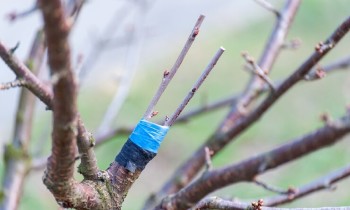
As the plant grows, all that remains is to maintain the chosen shape. All shoots growing inward, as well as those protruding vertically, are pruned. Dry, broken, damaged, and diseased shoots should also be removed right at the trunk. The cut wounds are sealed. garden pitch.
Pollinator varieties
- Alenushkino.
- Melba.
- Folder.
- Northern Sinap.
- Marina.
- Grandma's.
- Avenarius.
- Bellefleur the Chinese.
Reproduction
- Layers.
- Grafting cuttings.
- Growing from seeds.
- Clones.
Ripening and fruiting of Darena
The beginning of fruiting
 The beginning of fruiting
A definite drawback for many is that Darena doesn't bear its first fruit until 5-6 years after planting outdoors. However, the fruit is delicious, and you can harvest up to ten kilograms right away, so the wait is usually worth it.
Flowering time
The tree ripens early in summer, so it blooms quite early. By late April or early May, its large, fragrant buds open. They are snow-white or slightly pinkish, with fleshy, delicate petals and long stamens. Darena's blooming period is short, lasting only 6-8 days, after which the ovaries form. These can be thinned to produce larger apples.
Fruiting and growth
This tree has a medium growth rate, so it doesn't reach its maximum height very quickly. Before fruiting begins, the apple tree can gain 25-40 centimeters per season, but after that, growth slows significantly. Therefore, fruiting doesn't begin very quickly; you have to wait. Fruitfulness increases gradually, and full harvests can be reaped no earlier than 8-12 years.
Apples are harvested in the second half of August, closer to autumn. It's important to determine ripeness correctly, otherwise, even the fruits, which ripen all at once, may fall to the ground all at once. Then, they need to be processed very quickly, within a few days. Fruit picked in a timely manner can be stored in a cellar for 2-3 weeks, and in a special refrigerator for up to 4-6 weeks. By the end of this period, they must be completely processed, otherwise they will spoil.
Top dressing
- Compost.
- Manure.
- Humus.
- Chicken manure.
- Wood ash.
- Peat.
- Ammonium nitrate.
- Superphosphate.
What to do if it doesn't bloom or bear fruit
- Inspect for diseases or pests.
- Limit or increase watering.
- Feed or apply fertilizer.
- Transplant to a sunny place.
Why do apples fall?
- Natural weather conditions (wind, rain, hurricane, hail).
- Pest damage.
- Diseases.
- Overripe.
Please leave a review of the Darena apple variety and your experience growing it to make things easier for other gardeners, both novice and seasoned.