Delicious Red apple tree: characteristics of the variety and care
| Color | Reds |
|---|---|
| Ripening season | Winter |
| Size of apples | Large |
| Taste | Sweet and sour |
| Crown type | Average tree height |
| Shelf life | Average shelf life |
| Application | For recycling , Fresh |
| Winter hardiness | Low winter hardiness |
| Fruiting age | Up to 5 years |
 History of origin and regions of growth
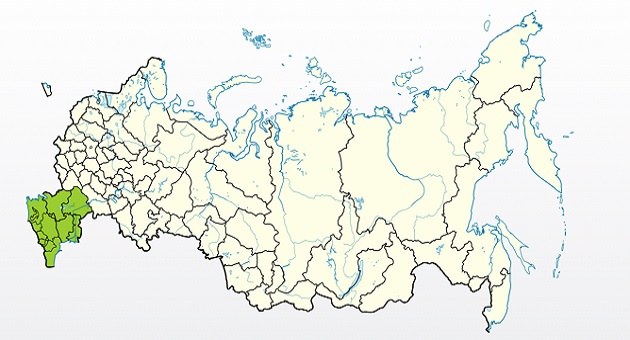
Growing regions
- Crimea.
- North Caucasus.
Origin
Contrary to popular belief, this variety is quite old, dating back over a hundred years. In the late nineteenth and early twentieth centuries, it was extremely popular in the United States, where it was grown commercially. It is believed that the apple tree is a mutant clone of the red-fruited Delicious variety.
It was previously included in the State Register of Breeding Achievements, but after the application expired, it languished in obscurity for a long time. In 2017, Yuzhnye Zemli LLC, based in Crimea, submitted a new application. It was accepted in 2019. The variety is officially zoned only for the North Caucasus, but it also grows very well on the peninsula.
Content
Description of the variety Delicious ed
 This undemanding apple tree, undemanding of soil and care, is sure to attract the attention of gardeners. It's a heat-loving tree, requiring little attention and plenty of ultraviolet light. A distinctive feature of the tree is its self-forming crown, requiring little pruning. However, diseases pose a serious threat to it, and it adapts poorly to unfavorable climates.
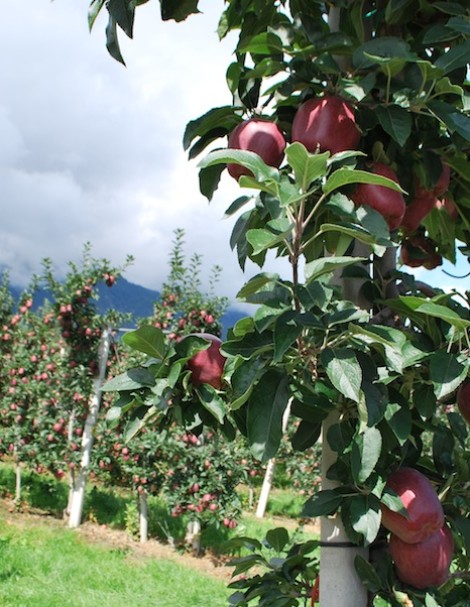
The fruit of this variety is unusual, very attractive in appearance and pleasant in taste. Many say the shiny, dark-red apples look more like plastic replicas than the real thing. They are quite tolerant of transportation and have a moderate shelf life. This variety is recommended for intensive gardens, suitable for processing, and is also a good choice for private gardens.
Apples: What do they look like?
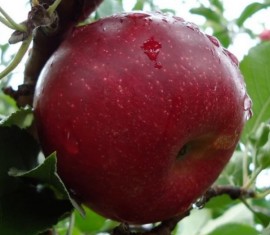
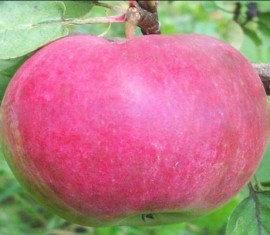
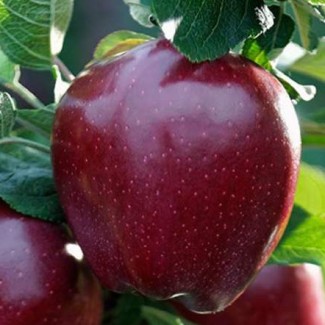
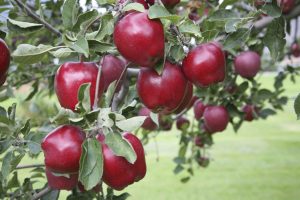 These apples differ from the parent variety by their deep red or blood-red, rich, and dense blush, covering more than 75-80% of the surface. The base color is green, becoming yellow-green, sometimes golden, as they ripen. They are round, conical, smooth, with subtle ribbing. Subcutaneous punctures are inconspicuous, grayish, sparse, and small. The skin is dense but thin, highly shiny, glossy, as if coated with a layer of varnish. The following data best indicate the chemical composition:
- P-active substances (catechins) – 130 milligrams.
- Ascorbic acid (vitamin C) – 9.4 milligrams.
- Fructose (total sugars) – 10.2%.
- Pectins – 15.5%.
- Titratable acids – 0.65%.
The flesh is medium-dense, starchy, crisp, fine-grained, and quite firm. It is creamy or slightly lemon-colored, and the skin may have light reddish veins. As it ripens, it becomes more fluffy while remaining juicy. Experts describe the flavor as exemplary, dessert-like, sweet and sour with a hint of tartness. Some gardeners consider the apples bland, unrefined, and ordinary.
Delicious Red apple tree: characteristics
 Crown and root system
 Crown and root system
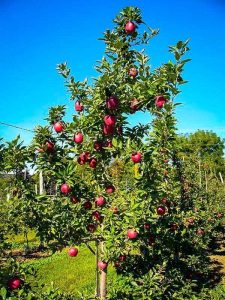
Trees of medium vigor, reaching 4-4.5 meters. They typically do not grow taller, so they can easily fit even in a small space. The crown is inversely pyramidal or high-oval when young. As it matures, it becomes rounded or even broadly oval, but does not become spreading. Branches of medium thickness, rounded in cross-section, straight or slightly curved, are covered with reddish-brown or reddish-brown bark with noticeable pubescence. Fruiting occurs primarily on numerous ring-shaped branches.
The leaves are elongated, elliptical, and quite large. They are leathery and dense, with a serrate-crenate, wavy, and serrated margin. The nerves are rough, the surface glossy, dark green, sometimes emerald. The undersides are covered with a felty pubescence and a red vein running all the way to the petiole. The root system is fibrous on most rootstocks, branching extensively but not very deeply embedded.
Productivity and pollination
The fertility of the Delicious Red variety is directly related to growing conditions and care.
With high-quality and timely care, in favorable climatic regions with mild, warm, but humid weather, trees can produce from 50 to 70 kilograms of beautiful fruits per year..
The variety is relatively self-sterile. If there are no trees suitable for cross-pollination within 100-150 meters, fruit may set, but only a small number (25-30% of the potential maximum). This must be taken into account when cultivating the variety, choosing apple trees according to flowering time and pollen activity.
Winter hardiness and disease resistance
Delicious Red has a low frost tolerance and does not tolerate sudden temperature fluctuations or strong northern winds. Drafts will likely kill the apple tree. Even in Crimea and the North Caucasus, proper and timely shelter is required. The variety tolerates drought better, but requires frequent watering and mulching to retain water.
Red is susceptible to a wide variety of diseases that attack the entire tree quickly and extensively. Prevention should be carried out carefully and promptly. Scab, powdery mildew, glassy pulp, cytosporosis, black crayfish and other conditions often ruin fruit crops. Apples themselves can be affected by bitter spot during storage. Then the entire harvest will have to be ruthlessly disposed of, and far from your garden.
Rootstocks and subspecies
A significant drawback of this variety is that it cannot be grown as an own-rooted tree. This means that, from seed to mature standard, Delicious Red must be grafted onto a suitable rootstock. Any rootstock will do, and it will not affect the quality of the fruit. There is no columnar or natural dwarf variety. Many other varieties have been developed from this apple tree, including Orient, Flame of Elbrus, and Prikubanskoe.
Growing Delicious Red
Landing
 Landing
Basic conditions
- This variety thrives in virtually any soil, provided it's properly prepared and fertilized. Loam, sandy loam, rocky, and podzolic soils will all provide a good growing base.
- A sunny, open space where the tree will receive plenty of ultraviolet light will be the best choice.
- It's important to provide good ventilation for the tree crowns, but avoid drafts. Strong winds often cause trees to become diseased, weaken, or even die.
- The site should have an average groundwater level, which is approximately 1.8-2.2 meters.
- Leave approximately 3-4 meters of space between trees, as well as between rows. This will not only make fruit picking easier but also prevent the plants from clashing with each other due to their crowns and rhizomes.
- Holes are dug 50-60 centimeters deep and 70-80 centimeters in diameter. It's best to prepare them in advance, the season before planting. However, if time is short, they still need to be left to soak for at least 2-3 weeks. Add a mixture of soil, humus, wood ash, and potassium fertilizer to the bottom, fill with drainage material, and fill with water. There's no need to cover the holes.
- The grafting sites of the seedlings should be left 7-8 centimeters above the surface to prevent the roots from growing higher. It's also important to allow for possible soil settling after the first watering.
- It's a good idea to insert stakes or trellises into the holes to support the seedlings. Young trees have weak rhizomes and require reliable support. Furthermore, such structures will provide additional protection from cold winds if placed north of the trunk.
- Before planting, carefully inspect the material, removing any broken, dry, or unhealthy-looking shoots. To be on the safe side, soak them in warm water for 6-9 hours.
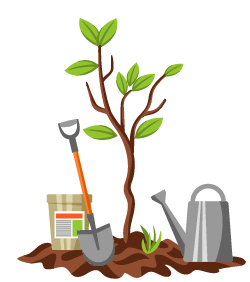
- In the hole, all the drainage material is raked into a pile in the center and the apple tree is placed on top of it, the roots are straightened out, preventing them from getting tangled or bending. Gradually add soil, compacting it with your hands or gently with your feet. Water the top with 25-30 liters of water and mulch with sawdust, grass, humus, or compost.
Landing dates
Delicious Red apple trees are very delicate, so they should be planted with extreme caution. In the warmest regions, this can be done in the fall, in late September or early October, but after the last leaf has fallen. It's important to allow 21-30 days, no more and no less, before the first frost.
The optimal time for planting is spring, from late March to early April. It's best to plant as soon as the soil has warmed completely and the threat of frost has passed. If you purchased seedlings in the fall, you can bury them at a 54° angle and cover them for the winter with tarpaulin, burlap, or agrofibre.
Tree care
 Tree care
Protection from frost and pests
This variety can't be called frost-resistant, so it's best to prepare them for even a mild winter promptly and thoroughly. Avoid adding moisture at the end of August, and clean and cover the trees immediately after leaf fall. Young trees can be covered with a tent-like covering, as they are compact and low-growing. Mature apple trees' trunks are wrapped with suitable materials, from agrofibre to roofing felt and tar paper. Spruce branches, straw bales, or hay mats should be placed over the root zone, and, in a pinch, the soil can be raked.
During the lean winter months, the bark of young trees can be eaten by hares, mice, and hamsters, which are abundant in southern regions. Traditionally, they are repelled by smearing the trunks with animal fat, grease, or other pungent and unpleasant-smelling substances. Insects are removed by whitewashing the trunks in the spring and fall with thick lime. Commercially produced products are usually more effective, so timely prevention is essential.
Loosening the soil, watering: proper agricultural technology
The soil around the tree trunk is dug twice a year, in early spring and late fall. Care must be taken to avoid disturbing the roots, as they are not very deep. Therefore, the shovel should be inserted no more than halfway down. In summer, you can lightly loosen the soil the following day after watering. It's especially important to loosen the root ball during hot, dry weather, otherwise it can become too hard.
Young seedlings need watering up to four times a month until the end of August, when there's no natural precipitation. If it rains, count down the week from that time and water again. Fertilizers can be dissolved in the water, but not until two or three years after planting. Until then, the apple trees thrive on what was added when preparing the holes.
Pruning: simple crown shaping
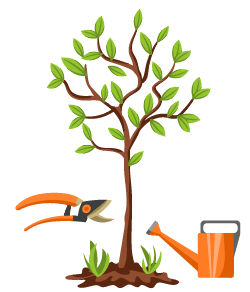
Delicious Red itself develops a well-shaped crown if you leave only the central stem and 2-3 skeletal branches for the first year. Subsequently, you only need to trim inward-growing shoots and vertically growing suckers, and maintain the natural branching.
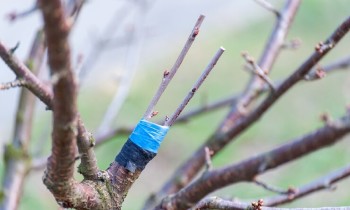
Every fall, and sometimes even spring, apple trees should be inspected for dead or diseased branches. These should be immediately pruned, along with any diseased ones. All cuts (wounds) should be sealed. garden pitch, oil or water-based paint.
Reproduction
- Cuttings.
- Budding.
- Cloning.
- Kidney grafting.
Pollinator varieties
- White rosemary.
- Kandil white.
- Reinette d'Orléans.
- Kandil Orlovsky.
- Chinese Kandil.
- Sar-sinap.
Diseases and pests
- Bacterial burn.
- Black crayfish.
- Cytosporosis.
- Powdery mildew.
- Rust.
- Apple moth.
- Glass-box.
- Leafhopper.
- Scale insect.
- Hawthorn.
Ripening and fruiting of Delicious Red
The beginning of fruiting
 The beginning of fruiting
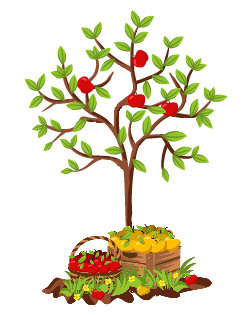
A particular advantage of apple trees is their rapid onset of fruiting. Even on vegetative rootstocks, they produce their first fruits as early as 3-4 years after planting. Dwarf varieties are even quicker to fruit, producing a harvest in 1-2 years. Don't expect abundant fruiting in the first few years, but you'll definitely be able to taste these apples and experience their unique beauty.
Flowering time
Red is a late-blooming variety. It blooms no earlier than the second half of May, but more often towards the end of the month or even early June. Flowers are typically clustered in 2-5-flower clusters. They are large, five-petaled, pure white or with a slight pinkish tint, and fragrant. Flowering lasts 8-12 days, though it can last slightly longer in damp, cold weather.
Fruiting and growth
The trees grow very quickly, delighting their owners with a beautiful crown. They can produce 35-50 centimeters per year, so they reach their final height very quickly. They increase their productivity each year, and by the 7th to 9th year, they produce a full harvest with a large number of beautiful, glossy, and deliciously flavored fruits.
These apples ripen quite late, by early October, and are not prone to falling, but it's best to pick them early. Then they'll keep almost until spring. Thanks to their thick skin, the fruit can be easily transported even over long distances, simply by layering them in boxes with sawdust. In bulk, they'll withstand long journeys, as they'll bump into each other. Waste can reach 35-50%. These fruits are suitable not only for fresh consumption but also for processing. They make delicious compotes, candied fruits, jams, and dried fruit.
Top dressing
- Eggshell.
- Humus.
- Bor.
- Manure.
- Compost.
- Superphosphate.
- Copper.
- Mineral and nitrogenous complexes.
- Ammonium nitrate.
What to do if it doesn't bloom or bear fruit
- Wrap up for the winter.
- Limit watering.
- Eliminate insect infestation.
- Cure diseases.
Why do apples fall?
- Wind.
- Pests or diseases.
- Frosts.
Share your own experience with the Delicious Red apple tree variety so that even novice gardeners have no questions about cultivating these trees.