Gala Royal apple tree: characteristics of the variety and care
| Color | Reds |
|---|---|
| Ripening season | Autumn |
| Size of apples | Average |
| Taste | Sweet |
| Crown type | Average tree height |
| Shelf life | Average shelf life |
| Application | Fresh , For recycling |
| Winter hardiness | High winter hardiness |
| Fruiting age | From 5 years old |
 History of origin and regions of growth
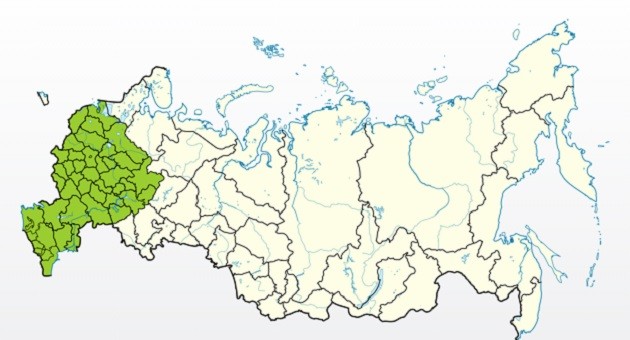
Growing regions
- Crimea.
- Middle zone.
- Leningrad region.
- North Caucasus.
- Moscow region.
Origin
The mother variety Gala originates from New Zealand, developed in the late 1950s or early 1960s. The Gala Royal clone is believed to have appeared on the global market in 1973. It was discovered by chance by gardener Ten Hove, who lived in the town of Matamata.
The name Gala Royal is common in our country and partially in Western Europe. In the international market, this variety is better known as Ten Hove Gala or Tenroy.
There is no information about this apple tree in the State Register of Breeding Achievements, and it has no official zoning. It is grown in commercial and private plantings throughout central Russia, as well as in some northern and southern regions.
Content
Description of the variety Gala Royal
 Autumn apples have been an instant hit with gardeners in our country. The trees are moderately vigorous, beautiful, and well-foliated. They are undemanding, tolerant of a variety of soils and growing conditions, require little special care, and don't require frequent feeding or fertilizer. Gala Royal bears fruit regularly, consistently producing a large number of apples.
The fruits are quite large, very attractive, and appetizing. They are juicy, tasty, and have high marketability. They are easy to transport over long distances and can be stored for quite a long time in a cellar. Gala Royal is recommended for growing in private gardens and in industrial, commercial, and intensive plantings.
Apples: What do they look like?
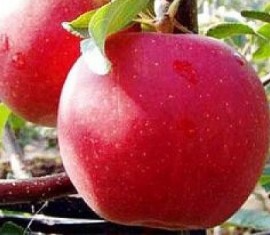
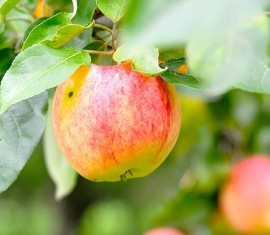
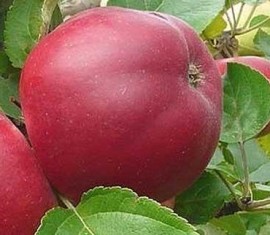
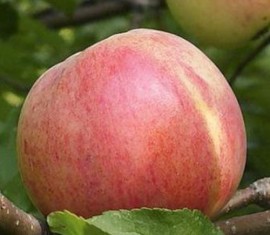
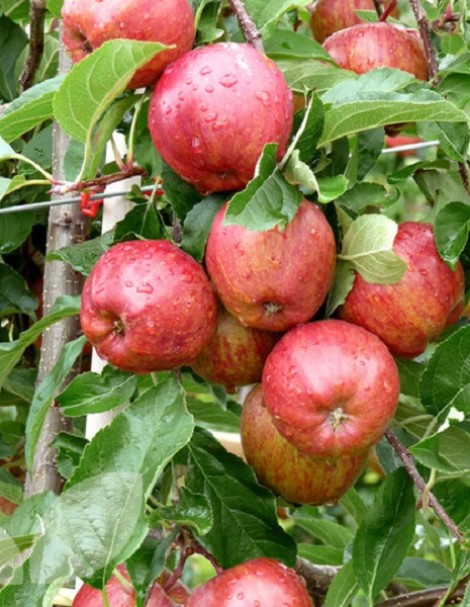
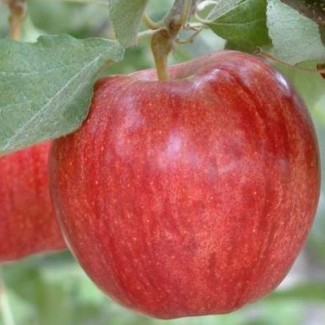
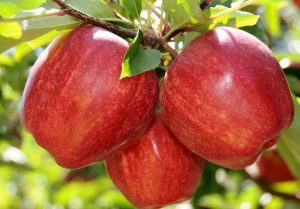 The fruits are predominantly round, cone-shaped, slightly elongated, but not cylindrical. They are generally medium-sized, growing to 140-180 grams. With proper ovary management, they can reach 170-200 grams. Ribbing is clearly visible only at the calyx; on the rest of the fruit, it is smoothed, and the lateral suture is invisible.
Apples have a firm but not thick skin, smooth, very shiny, sometimes cracking, and elastic. Its base color is greenish-yellow, becoming rich yellow and golden as it ripens. The blush covers most of the apple (80-99% of the surface). It is vaguely spotted, striped, bright red, red-orange, and occasionally crimson, intensely saturated, obscuring the apple's underlying color almost completely. The fruits are covered with numerous medium-sized, gray-green subcutaneous dots. The chemical composition is almost identical to the parent variety:
- P-active substances (catechins) – 199 milligrams.
- Ascorbic acid (vitamin C) – 12.2 milligrams.
- Total sugars (fructose) – 12.1%.
- Pectins (fiber) – 8.2%.
- Titratable acids – 0.47%.
The cream-colored fruit has dense, crisp, and slightly prickly flesh, yet very tender. It breaks easily when bitten, is juicy, and finely grained. The flavor is predominantly sweet, with a slight, characteristic apple tartness in the aftertaste. Professionals rate it 4.6 out of 5, and consider it harmonious, dessert-like, and balanced.
Gala Royal apple tree: characteristics
Crown and root system
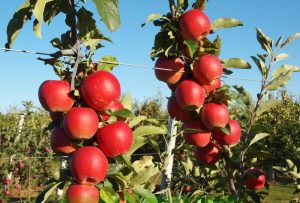 This subspecies of Gala, like the parent tree, is considered to be of medium height. The tree reaches a maximum height of only 3.8-4.5 meters., so it can safely be classified as a natural semi-caricature. The crown is predominantly oval when young, becoming more spreading and broadly oval with age. Shoots can extend from the trunk at either a nearly perpendicular or an acute angle, with their tips pointing upward. Royal bears mixed fruit (spears, rings, and fruiting twigs).
The leaves are large or large, mostly matte, elongated, oval, and pointed. They are dense, leathery, often folded into a boat shape, with serrated, serrate-crenate, and wavy margins. The leaf blade is dark green, sometimes rich green or emerald. The underside has a slight felted droop. The root system is medium-deep, may have a central taproot or be fibrous, branched, and has numerous small branches.
Productivity and pollination
This variety of the cultivar is distinguished by its rather high yield rates, especially considering that the trees are not very tall.
In a good and favorable year, with proper care and timely feeding and fertilization, good growers can harvest up to 65-80 kilograms of fragrant, bright and beautiful fruits from one Gala Royal tree..
The apple tree is self-sterile, but only conditionally. This means that some fruit will be produced, but only 15-25% of the maximum possible.
Winter hardiness and disease resistance
Royal inherited a high degree of resistance to low temperatures from its parent variety. It can be grown throughout the European part of Russia, and slightly further north, east, and south. However, without preparation, the trees will struggle to withstand sudden temperature fluctuations, as well as prolonged cold spells. With proper winter preparation and adequate shelter, they can withstand temperatures as low as -22-27°C.
Apple trees of this variety exhibit no genetic immunity. During years of severe epiphytotics, diseases can strike them rapidly and extensively. Their resistance to infections is considered moderate. Therefore, all sanitary and preventative treatments must be carried out promptly. Insecticide spraying should also be done to prevent parasitic infestations.
Rootstocks and subspecies
Gala Royal is a subspecies itself; it doesn't yet have its own mutants or clones, and it's unlikely any will ever be developed. It can be grown on a wide variety of rootstocks. The best and most popular options are dwarf and semi-dwarf varieties. These produce even more compact trees, take up less space in the garden, and begin bearing fruit earlier without affecting the quality of the fruit.
Features of growing Gala Royal
 Landing
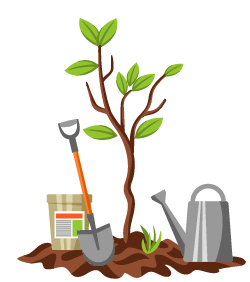 Landing
Basic conditions
- When planting apple trees, always choose locations with full sun. In the shade, trees can die immediately or grow weak, refusing to bloom or bear fruit.
- Gala requires slightly acidic and slightly saline soils; otherwise, there are no special requirements. Ideally, the soil should be permeable, not clogged, and fertile. Suitable soils include black soil and sand, clay and loam, rocky soils, podzolic soils, and others.
- Experienced gardeners prepare the holes the previous season so they have time to mature before planting. They dig holes 80-90 centimeters in diameter and the same or slightly less in depth. They line the bottom with topsoil mixed with fertilizer, then add drainage, and then fill with water (25-40 liters). The holes don't need to be covered.
- It is better to leave a distance of approximately 2.5-4 meters between the holes, depending on the rootstock (more on tall ones), and 4-5 between the rows, to simplify future harvesting and maintenance activities.
- Special stakes or trellises are immediately driven into the holes to support the apple trees. The saplings are tied to them in a figure-eight pattern to prevent damage to the bark. If they are placed on the north side, they will provide additional protection during frost.
- The root collar of the seedling should be at least 4-6 centimeters above the surface. If the tree roots above this height, all the qualities of the rootstock will be lost.
- Before planting, inspect the tree, cut off dry or broken shoots, and place the rhizome in water for 5-8 hours.
- Place the seedling on a drainage surface, spread the roots, cover with soil, and compact it layer by layer by hand or gently with your feet. Water generously (45-60 liters), and mulch the surface with suitable materials.
Clones and varieties typically have subtle characteristics, making them difficult for beginners to navigate. To avoid mistakes, it's best to purchase from reputable sellers or specialized nurseries that can provide documentation for the plants..
Landing dates
Planting Gala Royal is a no-brainer. Like most other frost-hardy varieties, it thrives in both spring and fall. A good rule of thumb is: the cooler and more northerly the planting region, the better time to plant in spring. In spring, the best time is late March or early April, before the sap begins to flow, while in fall, the best time is late September or October, after the sap has flowed and the leaves have finished falling.
Tree care
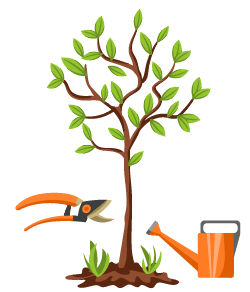 Tree care
Protection from frost and pests
Before autumn sets in, Gala should be completely watered. A final watering can be done around the end of August and any subsequent watering can be postponed until spring. The trunks are usually wrapped in burlap, roofing felt, tarpaulin, and even old tights, and the root zone is covered with spruce branches or bundles of hay and straw. Small trees can be wrapped like a tent from the top to the ground.
Whitewashing the trunk with lime to a height of about one meter is effective against insects. This prevents them from settling in cracks and crevices. It also significantly improves the aesthetic appearance of the garden. Regularly treating the trunks with commercially available chemicals, such as fungicides and insecticides, is also recommended.
Loosening the soil, watering: proper agricultural technology
Royal has numerous small root shoots, so digging around the trunk every year requires great care. You should dig no deeper than half a spade's depth, or even better, a third. You can hoe the soil several times a season, removing debris and weeds from under the trunk. It's best to do this the day after watering to prevent the soil from compacting into a tight ball.
Young trees should be watered frequently, as the soil dries out. If there is no natural precipitation, 10-15 liters can be applied twice daily, every 7-12 days. If there is rain, the next application should be 7-10 days after the rain. Various fertilizers and fertilizers can be added with water.
Pruning: simple crown shaping
In the first year, that is, immediately upon planting, trees should be pruned if this has not already been done at the nursery. A sparse or sparsely tiered form is most often formed. Branches are left at different heights, widely spaced, with no more than three or four branches. Subsequently, natural branching should be carefully maintained, regularly pruning away any excess branches, including shoots that protrude vertically, cross, run parallel, or grow inward.
Every fall, it's customary to perform a sanitation pruning. This involves cutting off all dry or broken branches, and removing any diseased ones. All cut areas must be sealed with sealant after any pruning. garden pitch or paint.
Reproduction
- Cuttings.
- Budding.
- Cloning.
- Kidney grafting.
Pollinator varieties
- Idared.
- Wagner Prize.
- Elstar.
- Jonathan.
- Delicious golden.
- Delicious spur.
- Golden Vladimir.
- Delela.
- Melrose.
Diseases and pests
- Bacterial burn.
- Scab.
- Cytosporosis.
- Powdery mildew.
- Rust.
- Apple moth.
- Scale insect.
- Glass-box.
- Leafhopper.
- Hawthorn.
Ripening and fruiting of Gala Royal
The beginning of fruiting
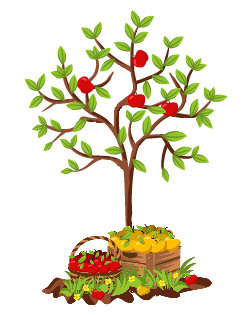 The beginning of fruiting
The early fruiting of this variety on tall standard rootstock leaves much to be desired. The first apples can be harvested only 6-8 years after planting in the orchard. With dwarf rootstocks, the harvest time is shorter, and you can enjoy delicious and beautiful fruits as early as 3-4 years. In the first few years, the yield is small, with only a few fruits, then a couple of dozen.
Flowering time
This variety has a standard, average blooming time. They begin to bloom as early as mid-May, spreading a strong aroma over a fairly large area, attracting numerous bees. In cold years, after a long winter and rainy spring, flowering may shift to June. The flowers themselves are snow-white or delicate white-pink, with individual fleshy petals, large, gathered in clusters and solitary. The process lasts approximately 12-16 days, long enough for insects to pollinate them.
Fruiting and growth
Gala and all its clones are considered medium-vigorous. A year before fruiting, they can stretch quite significantly, reaching 35-60 centimeters. However, this rate slows over the years, and after fruiting, the trees grow only 25-40 centimeters per year. Yields also increase gradually, reaching their peak around the 9th to 12th year, sometimes a little later. Fruiting is regular, with no rest periods; thinning of the ovaries is required to increase the size of the apples.
The fruits begin to ripen at exactly the same time as the parent variety. Full technical and consumer ripeness do not coincide. The fruit is best picked in late September and immediately stored. They are best eaten in mid-November, when the sugars have fully caramelized and they are at their most delicious. Gala Royal can be transported over any distance and stored in a standard cellar for up to 4-6 months, depending on conditions.
Top dressing
- Eggshell.
- Humus.
- Bor.
- Manure.
- Compost.
- Superphosphate.
- Copper.
- Mineral and nitrogenous complexes.
- Ammonium nitrate.
What to do if it doesn't bloom or bear fruit
- Wrap up for the winter.
- Limit or activate watering.
- Eliminate insect infestation.
- Cure diseases.
Why do apples fall?
- Strong wind, hail, rain.
- Pests or diseases.
- Frosts.
Share your own experience with the Gala Royal apple tree variety, so even novice gardeners have no questions about cultivating these trees.